Yes, it’s ornamental cherry time again. Sitting at the breakfast table with a coffee, I watch two male Blackbirds perch on the garden table and chairs under the tree. One flies up, hovers for an instant, lands, and can be seen to have a small black cherry in its propped-open beak. It swallows, looks up, repeats the cycle.
There is a Blackbird nest exactly in the middle of the ornamental cherry, atop the end of a cut branch; it is not very well hidden from anyone walking in the garden, nor very far from night-prowling cats.
Less welcome are the Wood Pigeons that noisily flap into the tree’s slim branches, finding a wobbly perch before greedily guzzling the tiny cherries, the first fruits of the year. If they become numerous they will threaten to devastate the crop of real edible cherries from my ‘Stella’ tree. Stella is a good deep red variety, not as dark and bitter as Morello (but a great deal sweeter), though rather on the late side. The pigeons, of course, find it delicious. I always had to cover the tree with nets, until last year when there was hardly a pigeon or even Blackbird to be seen near the tree: I suspect a bird-killer cat used to lurk on the shed roof at night and stalk its avian prey.
Out the front, another bird-only cherry grows in the pavement. It is risky to park the car beneath it, the birds – mainly starlings – spotting roof and windows with rich purple-red stains made gritty and corrosive with white powdery uric acid.
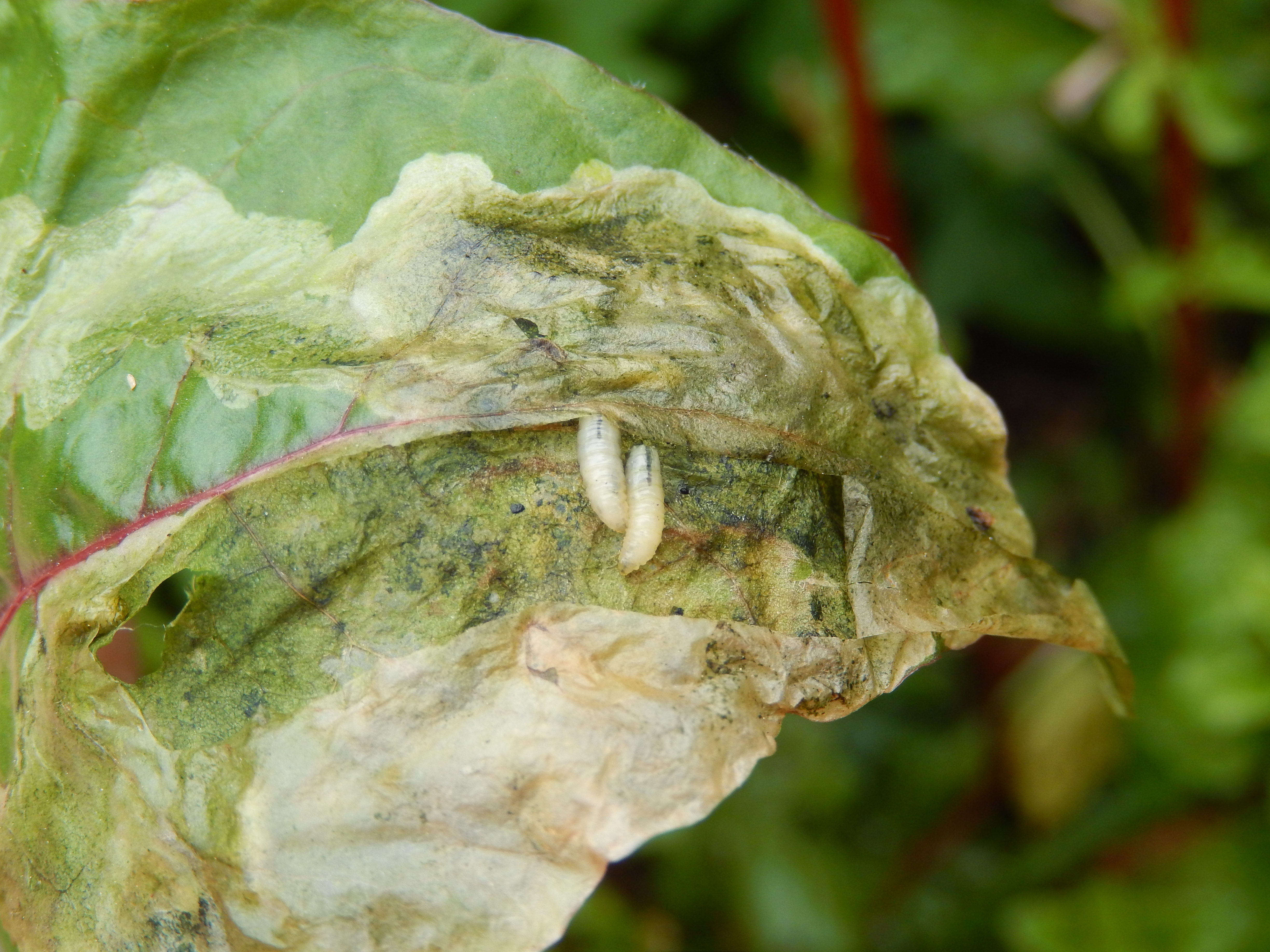
Leaf miners in Spinach Beet leaf. A strip of the leaf’s upper epidermis has been torn back.
Well, I usually try to take a pretty picture to start off a posting, but this one certainly doesn’t qualify. These leaf miners grow entirely inside a leaf, in this case of Spinach Beet. As you can see, as they grow they tunnel around below the leaf’s upper epidermis, which is a translucent layer of cells, leaving it intact to provide themselves with a ready-made cover.
Underneath that sheet, a healthy leaf contains a thick green set of palisade cells in one or several layers. These are the leaf’s (and the plant’s) factory, as they are full of chloroplasts, coloured green to absorb light: they synthesize the sugars on which life depends.
Not many people would want to eat this leaf, once the leaf miner larvae – mostly moths – have been at work. The palisade layers are entirely and efficiently destroyed wherever the insects have been. All that remains is an air-space and some dark frass: all, that is, but for the plump whitish cylindrical bodies of the larvae themselves.
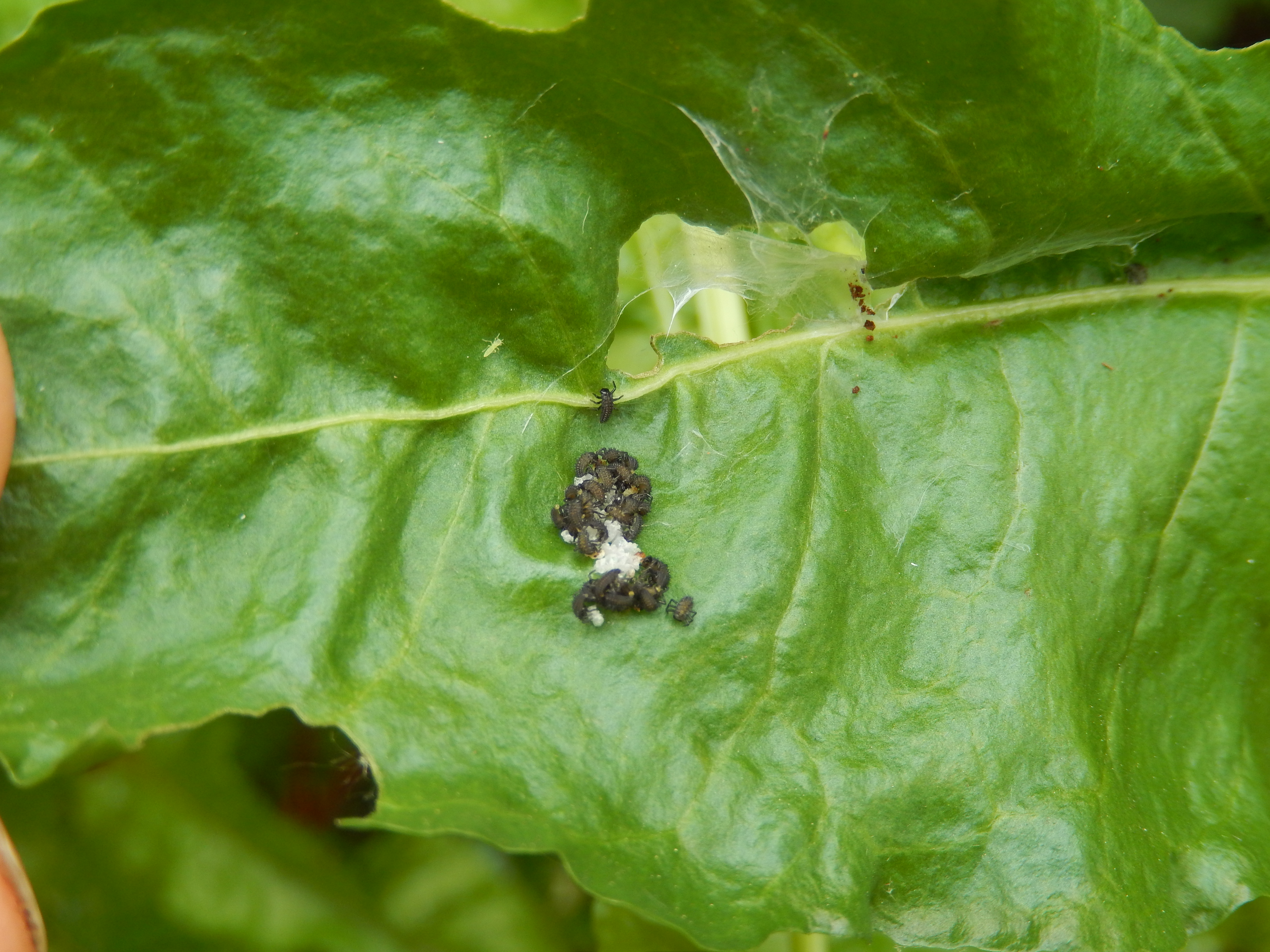
Ladybird larvae and eggs on Spinach leaf
Also nesting on the spinach are some ladybirds. These have incomplete metamorphosis, the young being able to walk as well as eat from their first stage or instar. Each time they moult they change in appearance as well as in size. They mainly eat aphids, troublesome pests of many crops, so they are useful to gardeners and to any farmers who don’t want to use insecticides.
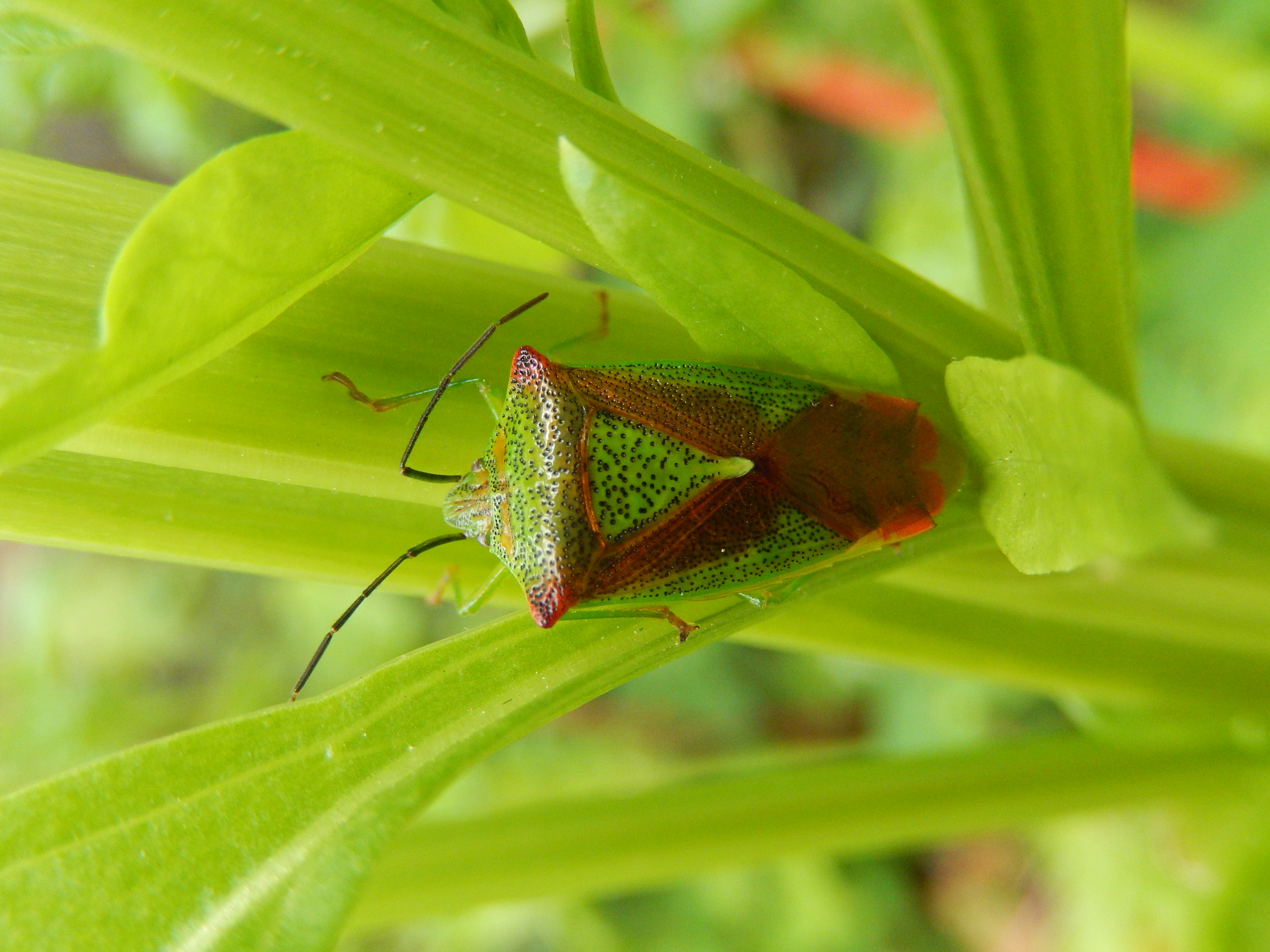
Shield Bug on Spinach
This shield bug, seen here in close-up, may look conspicuous enough, but that is the camera’s view. The insect is actually rather well camouflaged, and it generally hides under a leaf where it is in some shadow. The camouflage consists first of a general colour resemblance to its background, with its overall grass-green coloration; and as seen here, it is also disruptively patterned, with the reddish brown of its wings tending to break up its outline. Perhaps it is also somewhat countershaded, with dots stippling its back. Bugs suck plant juices, and their larvae can be quite destructive, but they never seem to do much harm to the spinach.
There are also some green caterpillars, excellently camouflaged with a pale cream stripe all along their sides. (It might be the Hebrew Character moth.) You might expect this to be conspicuous, but it seems to be a classic piece of disruptive coloration: the stripe appears like a sun-glint specular highlight on the shiny crumpled surface of the spinach leaf, rather than part of a solid, round-bodied animal.
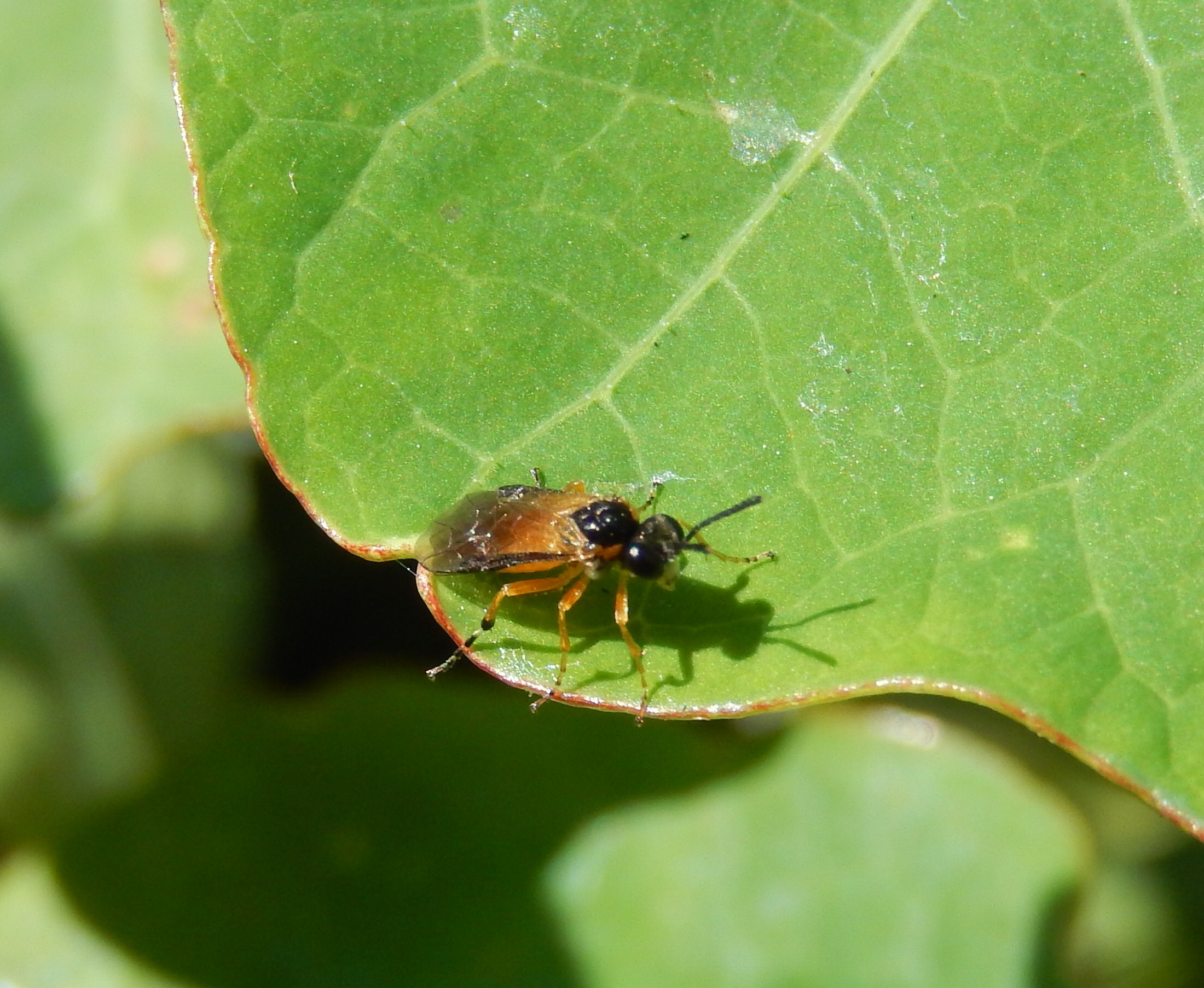
A Sawfly … not on Gooseberry
A pest I know is there is the Gooseberry Sawfly. There are numerous sawflies in the garden right now, but they are all flying around the Nasturtiums, nowhere near the gooseberry bush. However… plenty of the lower leaves of the gooseberry are badly damaged by sawfly larvae, some eaten right down to the petiole, pathetic little stumps with a few short branching veins all that remains of once green foliage. What to do about it? This isn’t a how-to-garden site, but inspect your gooseberry bush(es) regularly, looking especially at the lower leaves to see if they’re being eaten. If some are, check the edges for caterpillars. If you find any, spray the bush after sunset on a dry still evening (to avoid killing the bees that are pollinating your fruit) with a garden insecticide.
Five minutes of careful searching of half-eaten gooseberry leaves failed to reveal a single larva. The cause in this case is not so much camouflage as the incredibly intense predation by Blue Tits (and Great Tits). I estimate these little birds are a hundred times better at finding caterpillars than I am. They have the advantage of getting in close – they must be able to focus down to a few centimetres, their small eyes acting as short-focus wide-angle lenses – and of being able to perch anywhere in a bush. They also get up very early, and know instinctively exactly what food looks like: small well-camouflaged caterpillars on the undersides and edges of leaves.
Zoologists suppose that birds have a ‘search image’ of the prey they are hunting: perhaps this is much the same idea as the training images that computer scientists use to teach their neural nets to recognise patterns such as faces. Once you have such an image in your brain, you almost instantly recognise your target when it appears. To give a small illustration, I remember when I had a small motorbike, I always saw bike shops everywhere; now I never notice them. My eye was attuned, like a Blue Tit’s to a caterpillar.
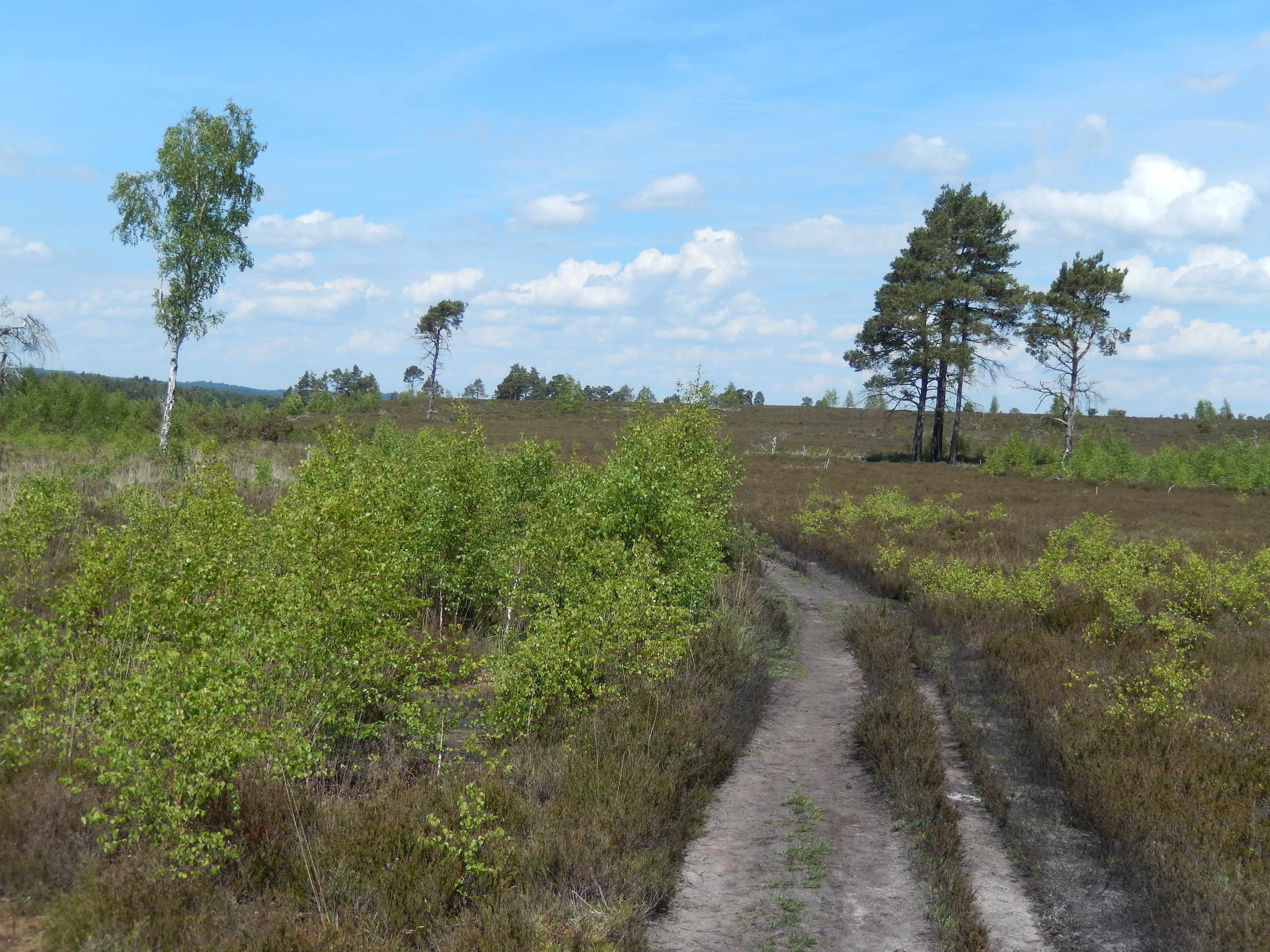
Heath landscape at Thursley with birch scrub, scattered pines
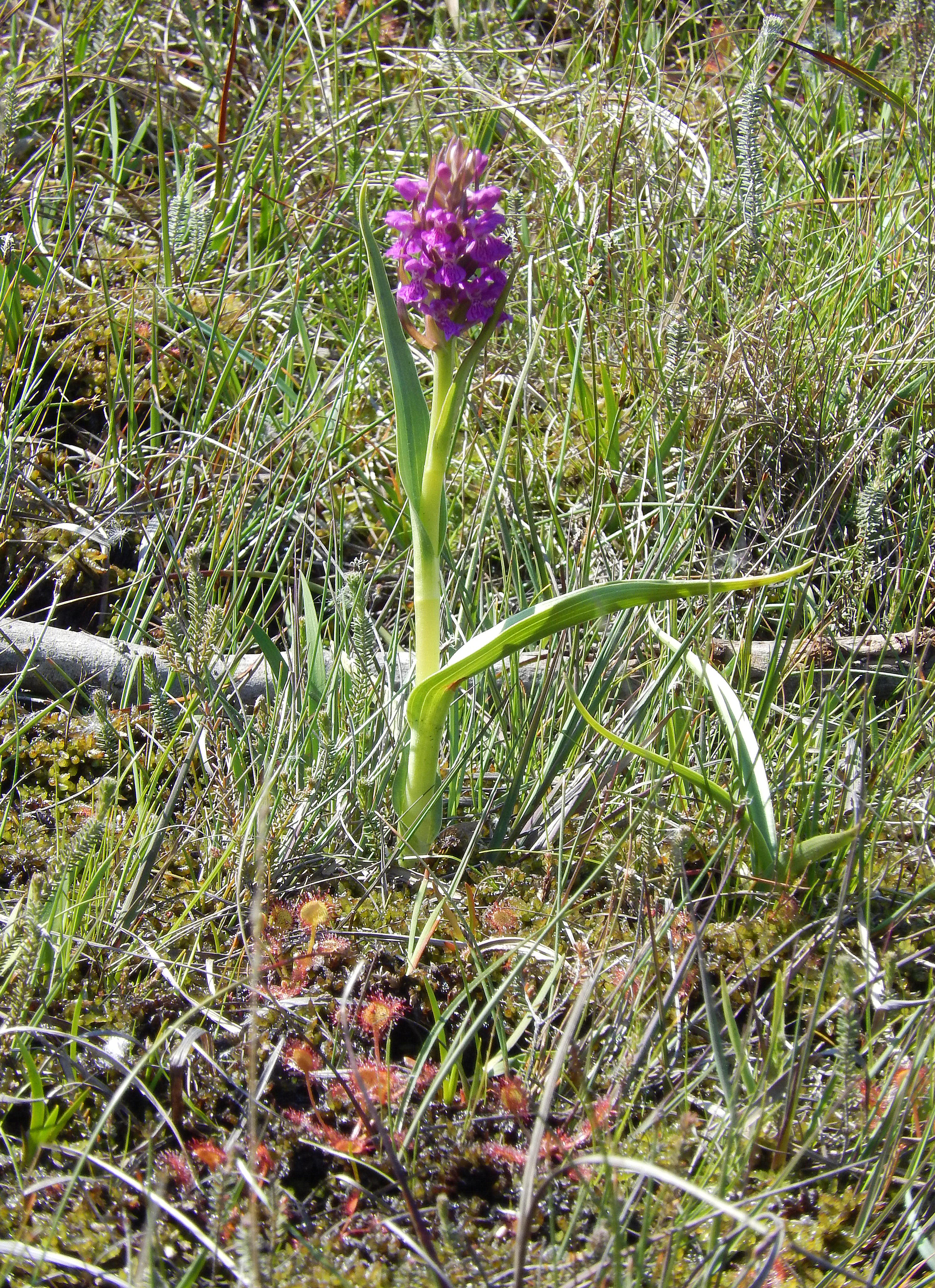
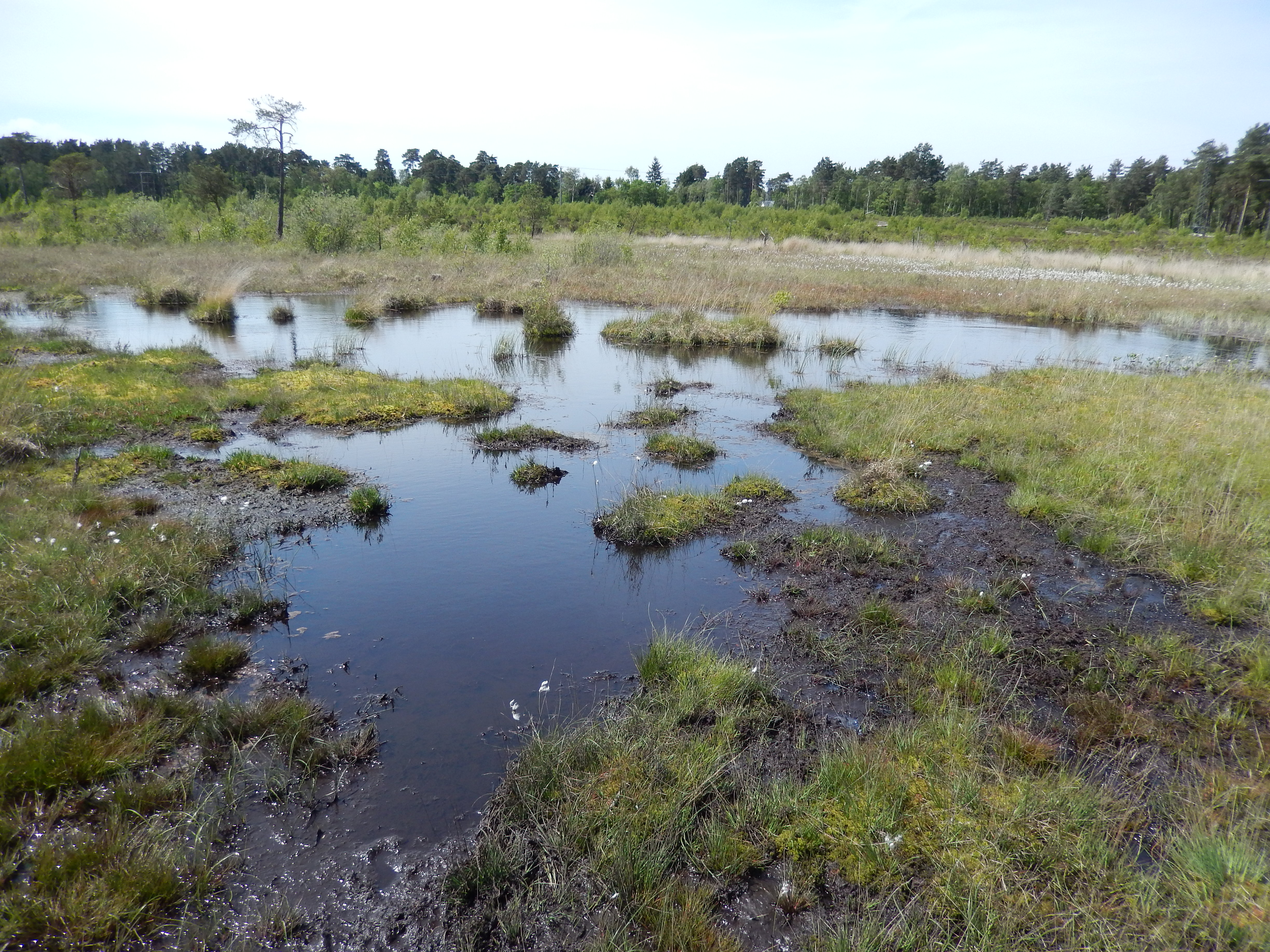
Thursley Common is one of those few, special places where the quiet visitor is almost guaranteed a beautiful experience of nature, at least if busy weekends are avoided. The area of a few hundred hectares offers several habitats, all acid: pine forest; dry sandy heath with heather, gorse and birch scrub, ideal for Whitethroats and Stonechats; acid bog with sphagnum, bog-cotton, marsh orchid, round-leaved sundew; bog pools buzzing with dragonflies; open water with teal and tufted duck.
Marsh Orchid, Round-Leaved Sundew at its foot, Thursley CommonDragonfly habitat: bog pools at Thursley; in the background, white of bog cotton, birch scrub and pine forest
Over the pools were half-a-dozen swallows in a loose flock, mostly flying high, keeping a wary eye out for hobbies. Two hobbies at least flew across the heath on their long grey wings, diving at speed to snatch dragonflies low over the water. A cuckoo called from the pines; another replied cuck-uck-oo from the other side; one flew hawklike across the heath, its wings remaining almost entirely below its body, an odd and very distinctive flight pattern.
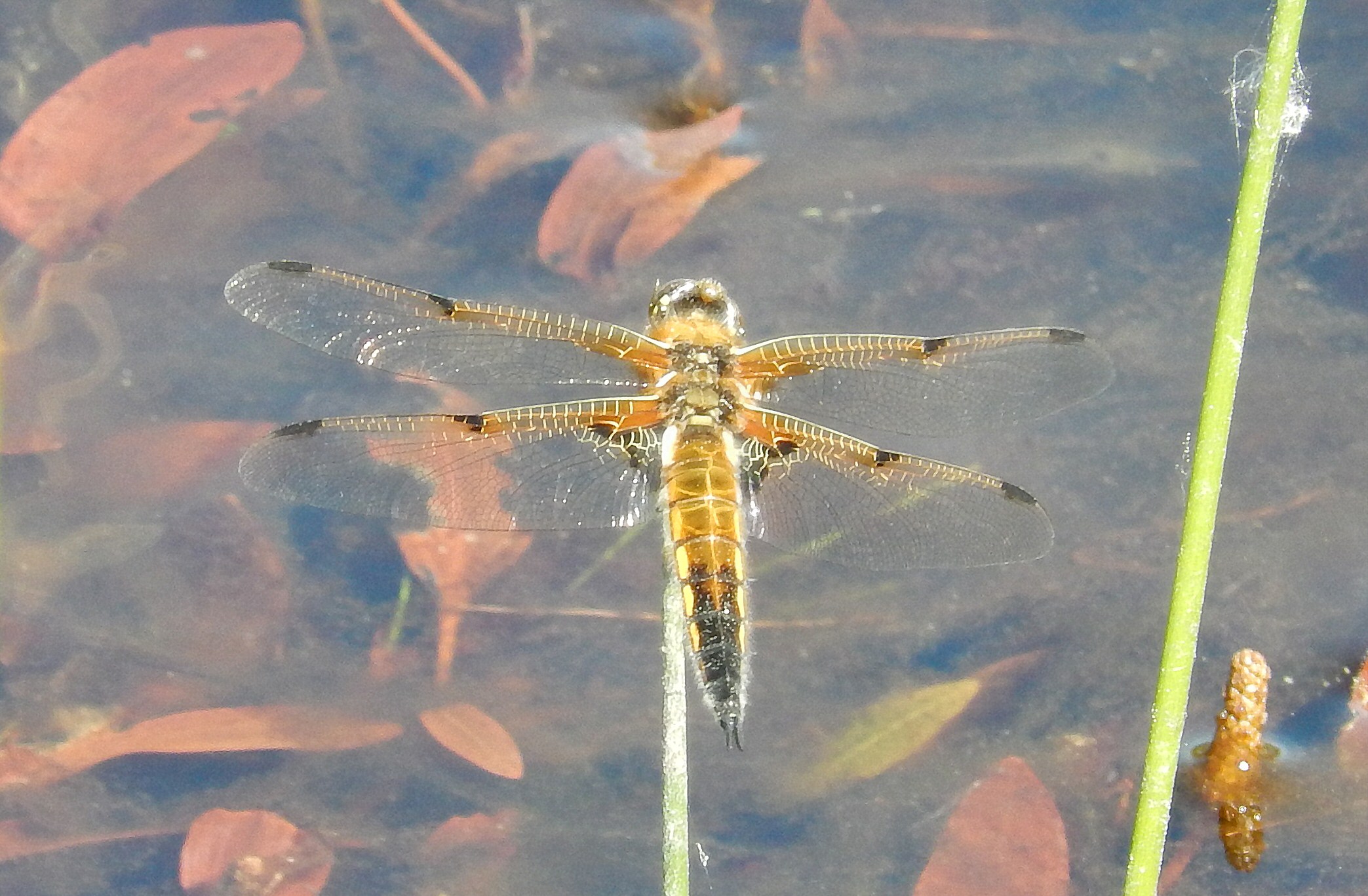
Female Four-Spotted Chaser basking over a bog pool, Thursley
Four-Spotted Chasers have a distinctive jizz, being generally brown, flying fast, and indeed the males aggressively chase off rivals. Today there were several pairs mating in flight; unlike many other dragonflies, they do not settle to form a “wheel”, but soon separate, the female at once starting to lay eggs, darting down to the water to dab her abdomen repeatedly.
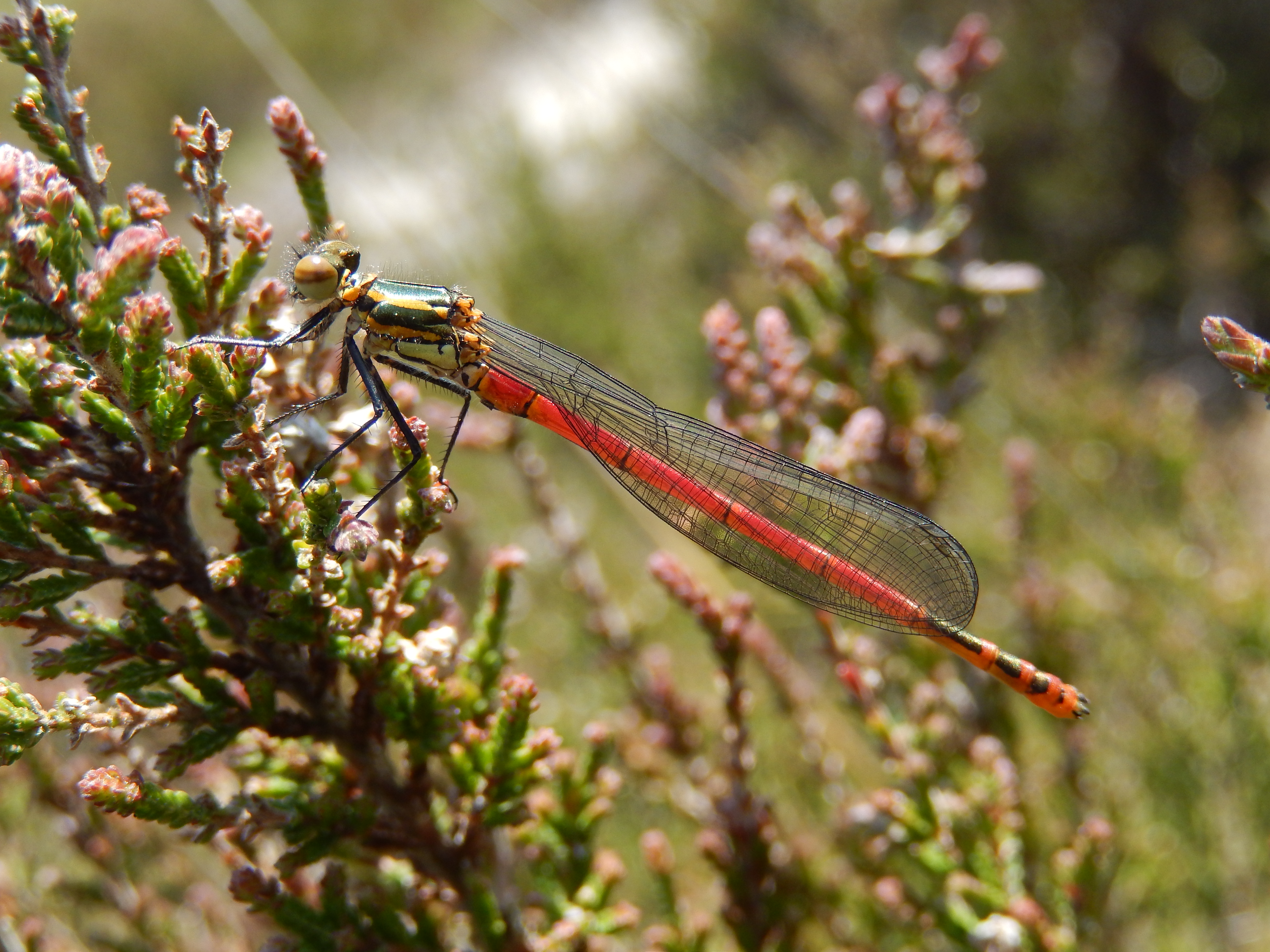
Large Red Damselfly, Pyrrhosoma nymphula male on heather at Thursley
Large Red Damselflies were hardly in evidence near the water, but were around in small numbers on the heather, or basking on the boardwalk. Nearby, a pair of Reed Buntings blundered in and out of the bushes, the male handsome with his black head and white collar, singing his slow brief song. A Goldcrest squeaked its unbelievably high notes from the tops of the pine trees. A Tree Pipit’s repetitive but slightly random riff rang out again and again from somewhere in the same trees; the species, still marked by the book as ‘abundant’ (that’s a 2 not a 1, however), ‘breeds locally’ in places like this.
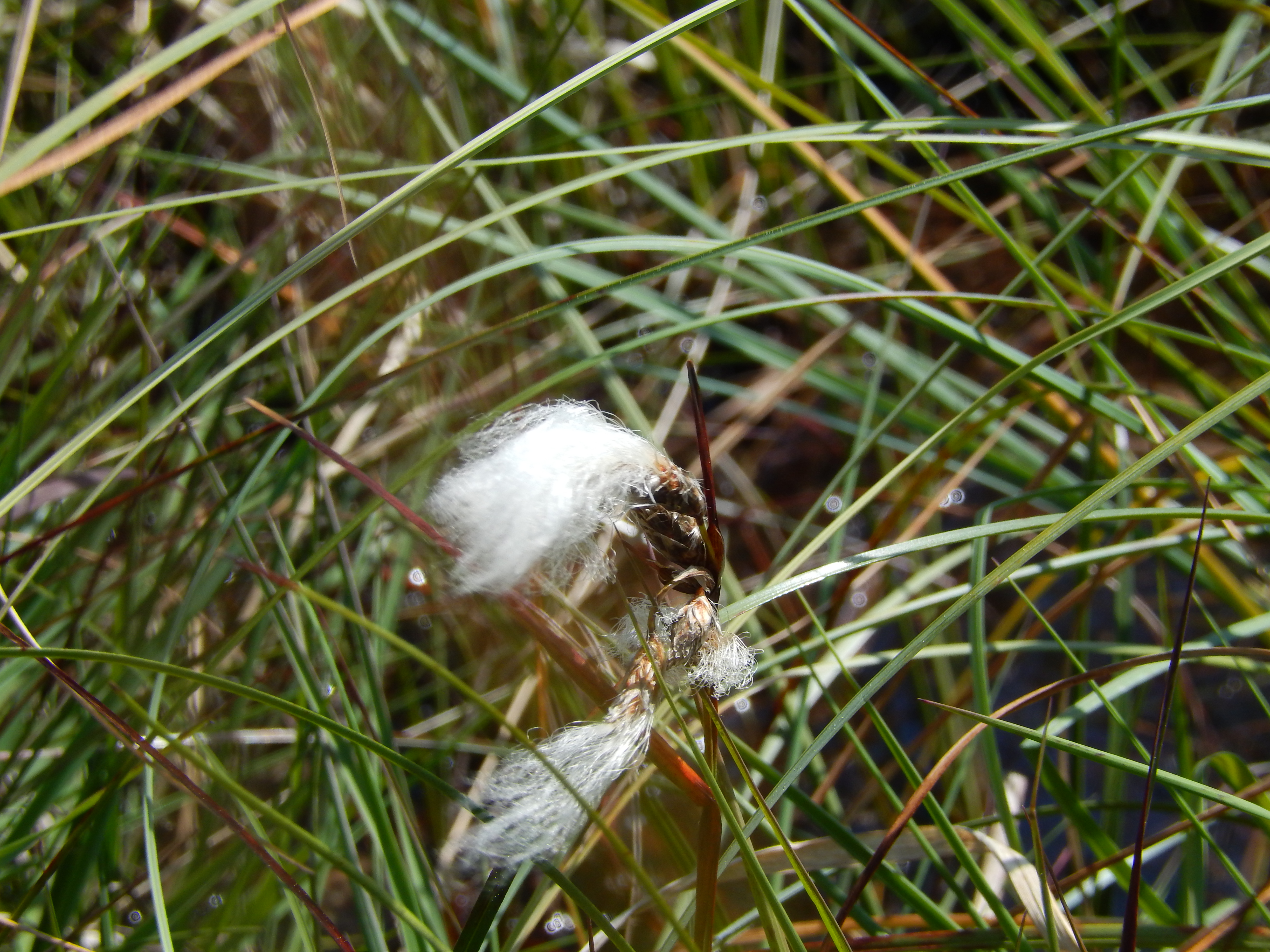
Bog-Cotton, Molinia
It is always a pleasure, too, to see the fluffy white seed-heads of Bog-Cotton. The thin fibres are too brittle to spin, so our native ‘cotton’ remains a symbol of wild and lonely places, from the mountains of Snowdonia to the Pennines. It’s a reminder of just how extensive the heathlands of Southern England once were, Cobbett’s “rascally heaths” famously extending all the way from the Marlborough Downs to the fringes of London. His opinion, loudly voiced in his Rural Rides, was that these unimproved lands were wasted, a sign of lack of proper agriculture. The Dig for Victory! campaign in the Second World War caused many areas of marginal land to be ploughed up, including acid heaths, alkaline chalk grassland, and neutral flowery meadows: all were lost by the thousands of acres in a desperate attempt to increase Britain’s arable production. That led, of course, to the surplus production of the Common Market years, the destruction of farmland wildlife accelerated by grants to grub out hedges, while the use of pesticides of all kinds created marvellously clean crops that even that old badger of a critical farmer, Cobbett himself, would have heartily approved of. The one small problem was that the crops were so clean that there were no wild flowers to support the bees that used to pollinate the fruit trees, the clover, beans and alfalfa, the cabbages and turnips and oilseed rape, the potatoes and vegetables that feed the nation. The cereals themselves need no bees, their grass pollen blowing in the wind: but the rest of the crops are tied to a more balanced ecology. Thus I meditated, even as I enjoyed a nostalgic glimpse of Molinia, the Bog-Cotton; and so it is that delight in nature’s beauty is tinged with sadness at the mess we’re in.
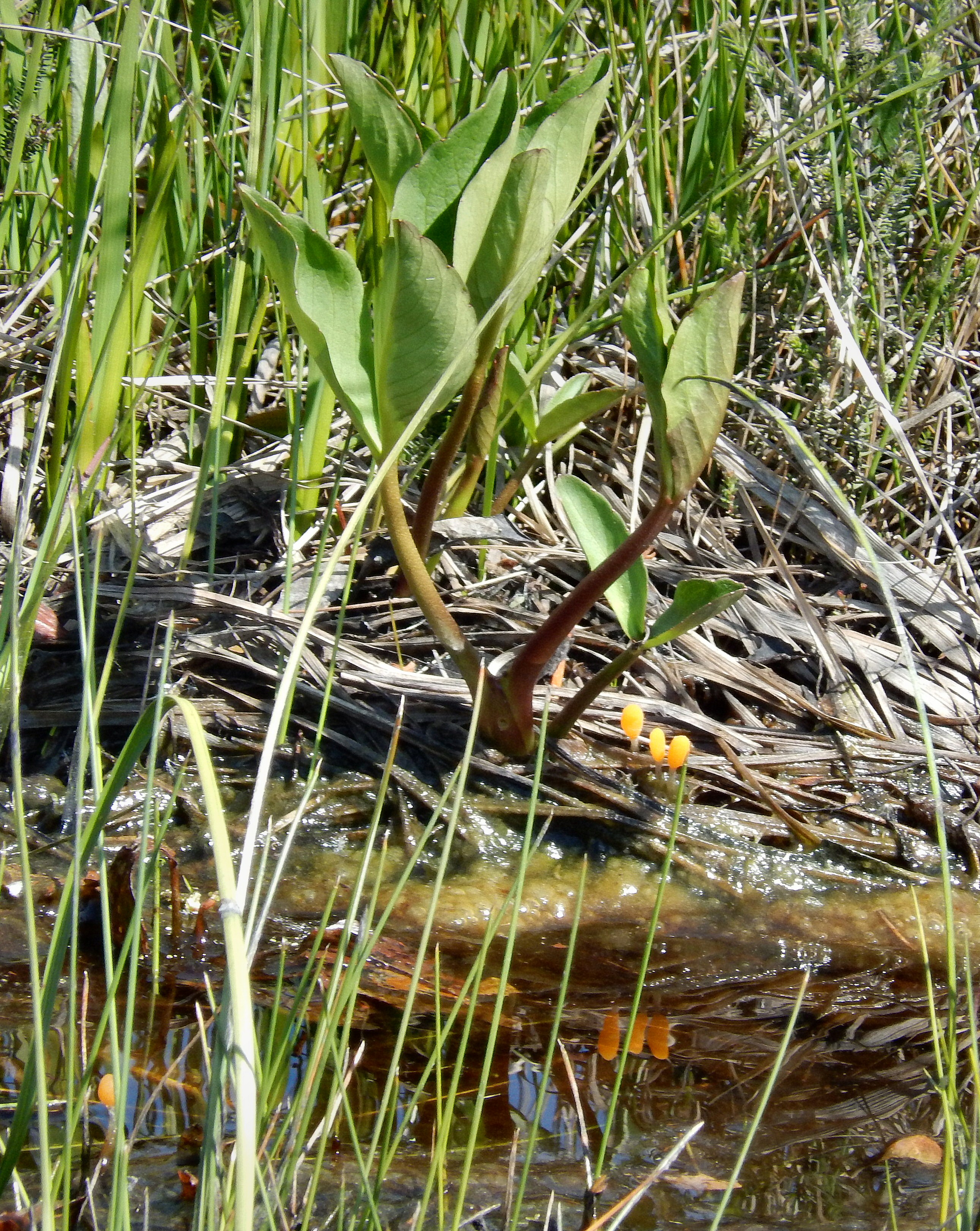
Tiny yellow clubs of Bog Beacon fungus, Mitrula paludosa, by bog pool at Thursley
I was delighted to see the small but bright yellow Bog Beacon fungus. It appears as small clubs with white stalks, and it only grows on dead vegetation in acid bogs. Its specific name ‘paludosa’ means ‘of the marsh’. A single Broad-Bodied Chaser dragonfly scooted swiftly across a small pond.
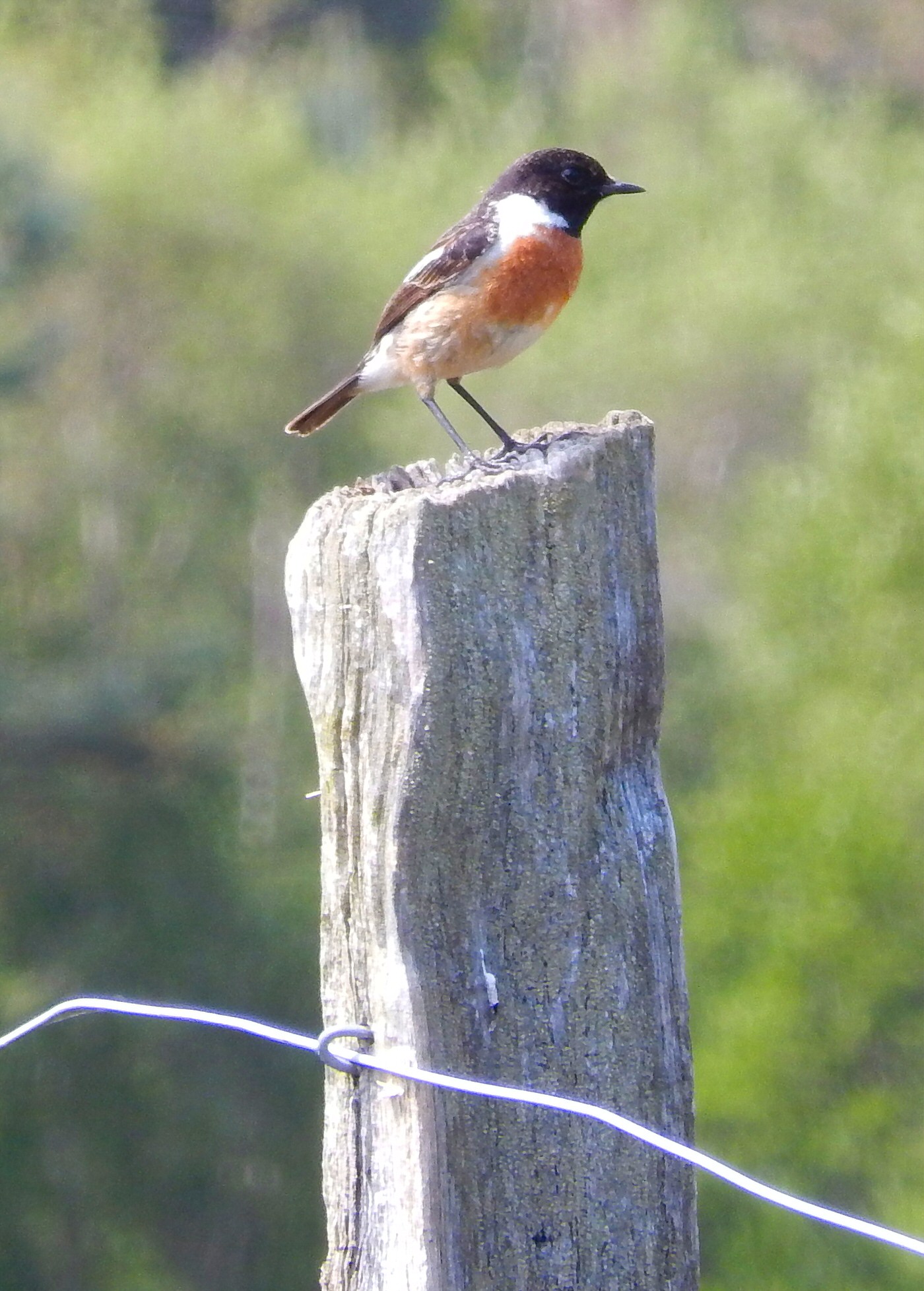
Stonechat on fencepost of Hankley Common training area near Thursley
Stonechat males displayed atop gorse bushes or fence posts, or dived into the bushes for cover, appearing nearly all black from above, with a bold white flash on each wing. Several young ones perched lower down in the gorse, much browner and more streaky than their fathers. They are rather few and far between on the Common itself; more on the training ground just across the road at Hankley Common. Like Thursley Common, the land has remained wild because the army needed it for training; so the Second World War both destroyed much of the wildlife value of our farmland, and saved some places from the general destruction.
Today I watched as a young East Asian family with a small child wandered carefully, heads bowed, through the bracken (Pteridium aquilinum), picking young not-yet-unrolled shoots known as fiddleheads — they do look rather like the curled ends of violins — for use as a vegetable. It is commonly eaten in Japan, China and Korea.
Bracken, including young shoots, is carcinogenic in animals, and herbivores like horses generally avoid it if they can. The main toxin is ptaquiloside. Richard Mabey’s Food for Free mentions bracken only once, to say that it is carcinogenic, and omits it from the main text. Some scientists suspect that the high incidence of stomach cancer in Japan is connected to the consumption of bracken.
It was chilling, on a fine hot day, to consider the danger that family were putting themselves in. On the other hand, if they select only young shoots, the dose is as low as possible — the plants have not had time to accumulate toxins in newly-grown parts. And all of us consume substances — sugar, salt, nitrates in ham and sausages, … — not to mention alcohol, which are certainly not good for us. Can you have a natural history of human beings? I can’t see why not.
Blue Tit Update: after several weeks of frantic activity by the two parent birds until yesterday, today the nestbox is empty and unattended. All the young and their parents have left. They aren’t in sight at the moment: most likely they are not far away, as a family party. There are no signs of predation, and nestboxes mounted high on a wall are in any case very good protection against all our common nest predators.
The villagers queue in a long line, a hundred or more of them, in front of the traditional healer’s hut in the south of Mali. It is the rainy season, and nearly all of them have malaria.
Chief Tiemoko Bengaly learnt traditional medicine from his grandfather. Perhaps soon nobody will learn traditional African medicine any more, as modern medicine arrives, along with manufactured Chinese herbal medicines.
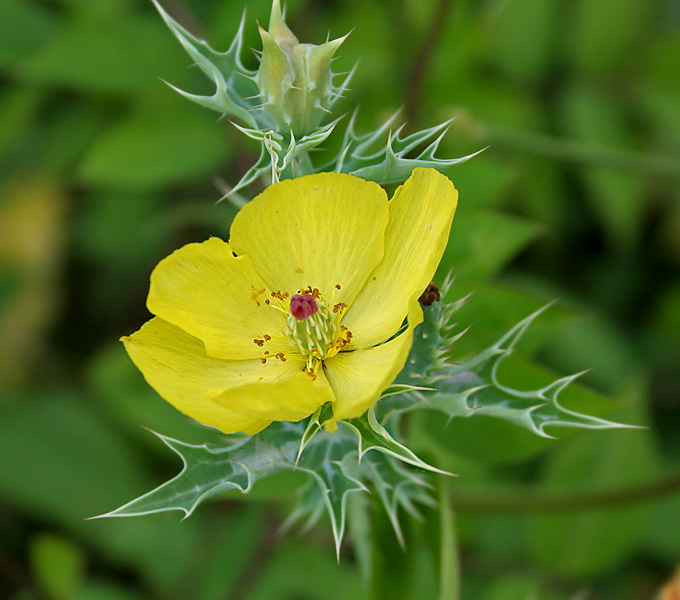
Bengaly hands out dried Mexican prickly poppy, Argemone mexicana, tells his patients to drink as much tea made from the plant as they can for a week. The parts of the plant have different uses, as it contains powerful toxic alkaloids; the seeds are dangerously poisonous.
Mexican prickly poppy, Argemone mexicana.
As Brendan Borrell reports in the June 2014 issue of Scientific American (pages 49-53), the results were dramatic: 89% of the patients recovered from their malaria, compared to 95% for the current best treatment for the difficult disease, Artemisinin-Combination Therapies or ACT. The trial was done in 2010 by Dr Bertrand Graz and Dr Merlin Willcox, and their approach was highly unconventional.
ACT consists of a drug obtained from another plant, sweet wormwood, Artemisia annua, discovered by testing plants used in Chinese herbal medicine, in combination with one or more of the many other drugs used against malaria, but which the malaria parasite has invariably developed resistance to over the years. Thus it has come about that ACT has become the last best hope against a slippery, shape-shifting parasite that has defied half a century of work by the world’s biggest drug companies and medical research foundations. All attempts at an anti-malaria vaccine have foundered on the parasite’s ability to change its biochemical spots, while all the drugs have similarly started to fail as the parasite (actually several related species, causing different malarias) becomes resistant, finding ways to continue growing in the presence of chemicals designed specifically to target vital parts of its metabolism.
One of the most remarkable things about the success in Mali – apart, that is, from its very low cost compared to traditional drug discovery, and its use of ethnobotany and a retrospective treatment outcome (RTO) study rather than a double-blind controlled clinical trial (all remarkable features of the work), was this: if the plant had been tested the conventional (I nearly said ‘traditional’) Western way, it would have failed.
The conventional Western approach would have isolated each compound that had any pharmacological activity – in other words, that did anything useful against malaria – and then tested it, alone, “in vitro” (in a test tube) to see how well it worked. It would then pick the most effective one, and try it against malaria in mice, and if that worked well and safely, then try it against malaria in humans.
The most effective substance in Argemone is berberine, and it fails against the malaria parasite. But the whole plant, as administered by healers like Bengaly in Mali, is life-saving.
Somehow, observational study in the style of ethnobotany succeeded where conventional Western medicine’s protocols for drug discovery – clinical trials and all the other paraphernalia for bioprospecting and pharmaceutical research (a jaw-cracking combination of long words derived from Latin and Greek) – would have (or actually) failed.
There is something both humbling and inspiring about this. We humans come from an incredibly clever but stupid species. Alexander Pope had it right:
Born but to die, and reas’ning but to err;
Whether he thinks to little, or too much;
Chaos of Thought and Passion, all confus’d;
Still by himself, abus’d or disabus’d;
Created half to rise and half to fall;
Great Lord of all things, yet a prey to all,
Sole judge of truth, in endless error hurl’d;
The glory, jest and riddle of the world.
Translated, we might read Pope to say “You do your science by analysis, which is hugely effective, but it leaves you prone to endless error, for you are ignoring all the subtle side effects, interactions and combinations of effects that together make up almost everything that is worth having in the world.” Science is not wrong – it is a marvellously precise application of common sense (try whatever it is with the factor X and without, and see what difference factor X makes) – but the world is such a complex place, and the combinations of X and Y and Z and A and B and C are so many, that it will take forever to analyse everything.
In that case, integrated approaches such as traditional herbal medicine, even if they are often somewhat ignorant and wrong in places, have something important to offer. But like many other things that we are accidentally wiping out, like thousands of species of plant and animal in rainforest, ocean, mountain, grassland and marsh, we’d better be quick to study herbal medicine before it vanishes from the face of the earth for ever.
The Gypsy Moth, Lymantria dispar, is a notifiable pest listed by DEFRA, or at least it was when that document was published back in 1997. The insect was announced to be “a serious pest of trees and shrubs” and nurserymen and landholders were required to notify DEFRA or the PHSI HQ immediately.
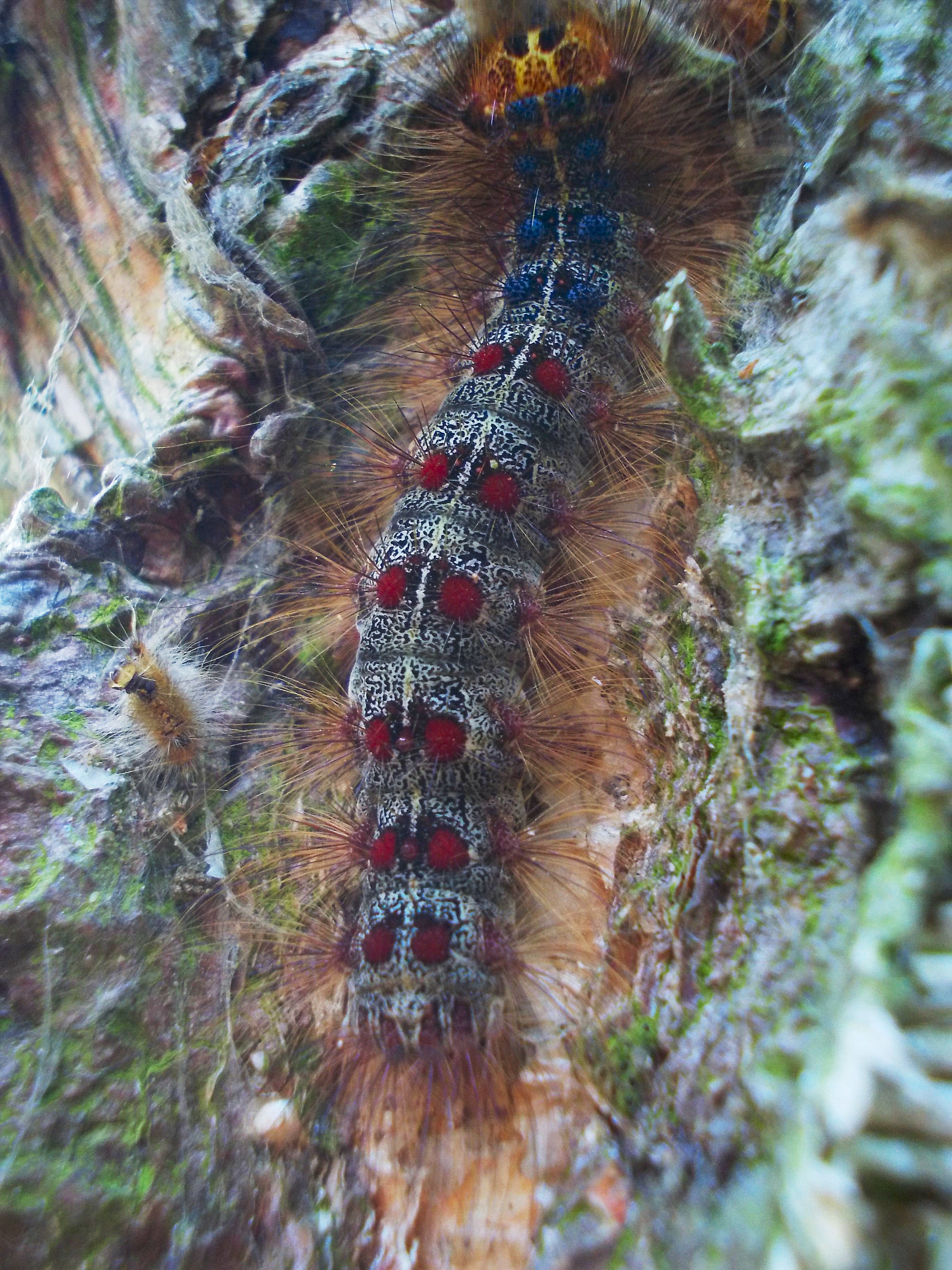
Gypsy Moth caterpillar on birch trunk: blue warts at front, red warts at back. The black-and-white pattern may also be aposematic
It has arrived in the Gunnersbury Triangle with the hairy dark caterpillar larvae with blue and red warts on their backs all over some Birch trees. The infestation is rapidly defoliating them, and causing substantial damage to some Oaks too.
Lymantria means ‘destroyer’, quite a well-named genus. The caterpillars are aposematic, their hairs and bright coloration warning off predators; the hairs are irritant, containing diterpenes, complex organic ring compounds found in wood and plant resins for defence against microbes and fungi, and retained by the caterpillars for defence against predators.
It will be interesting to see how the trees cope. Oaks can generally recover even when thoroughly defoliated; the Birches may suffer more. People can hardly use pesticides in the nature reserve, even given the means to spray whole trees safely, but biological controls are imaginable. The caterpillars are parasitised by Ichneumon flies, which may well be keeping Gypsy Moths under some sort of control in Europe. There were no controls in place to halt the spread of Gypsy Moth in America, however, where the pest was accidentally introduced in 1869 from Europe by the amateur entomologist Étienne Léopold Trouvelot. He was hoping to cross-breed them with silkworms to improve their disease resistance; he is remembered instead for starting a disastrous continent-wide caterpillar plague which still continues. Attempts with other pest species to introduce their predators or parasites have often proved unsuccessful and sometimes disastrous in their turn.
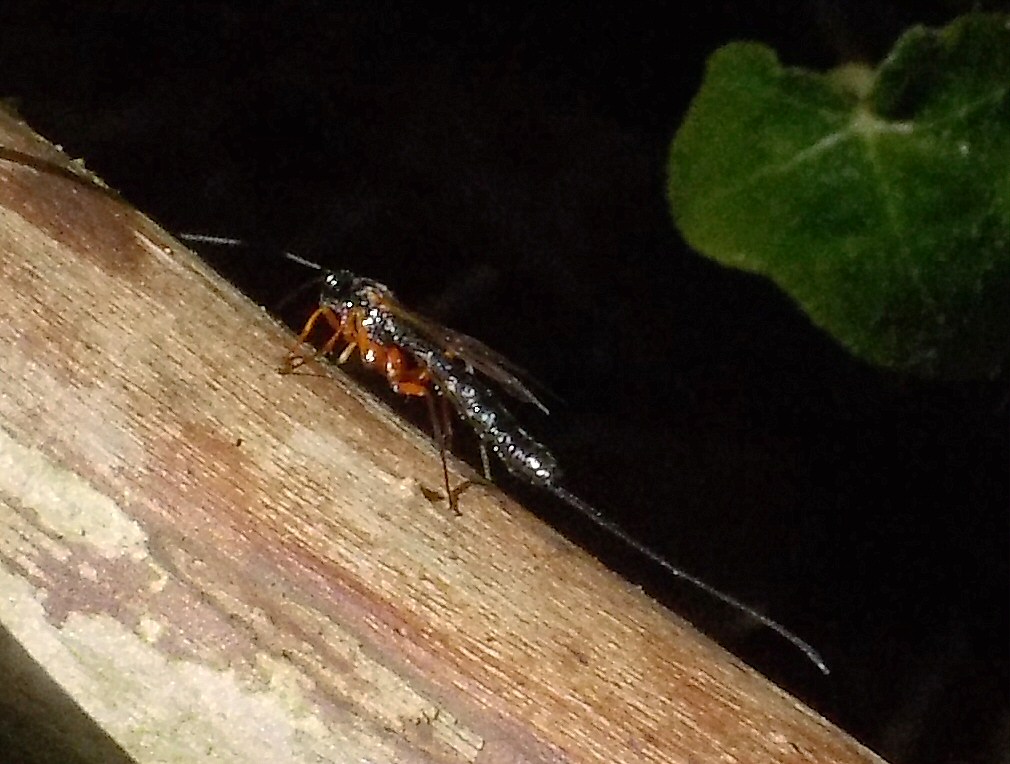
A terrifying monster stalks the suburbs. Silently and with unerring accuracy, it scans the surface, using its advanced sensors to detect and identify targets buried deep below. Once a target has been located, the hunter drills down to find it, deposits the payload, and leaves in search of the next. It could be a cyber-borg or pilotless military vehicle. Actually, it’s Rhyssa persuasoria, the giant Ichneumon. And giant or not, it’s about 30mm long.
Rhyssa persuasoria, side view
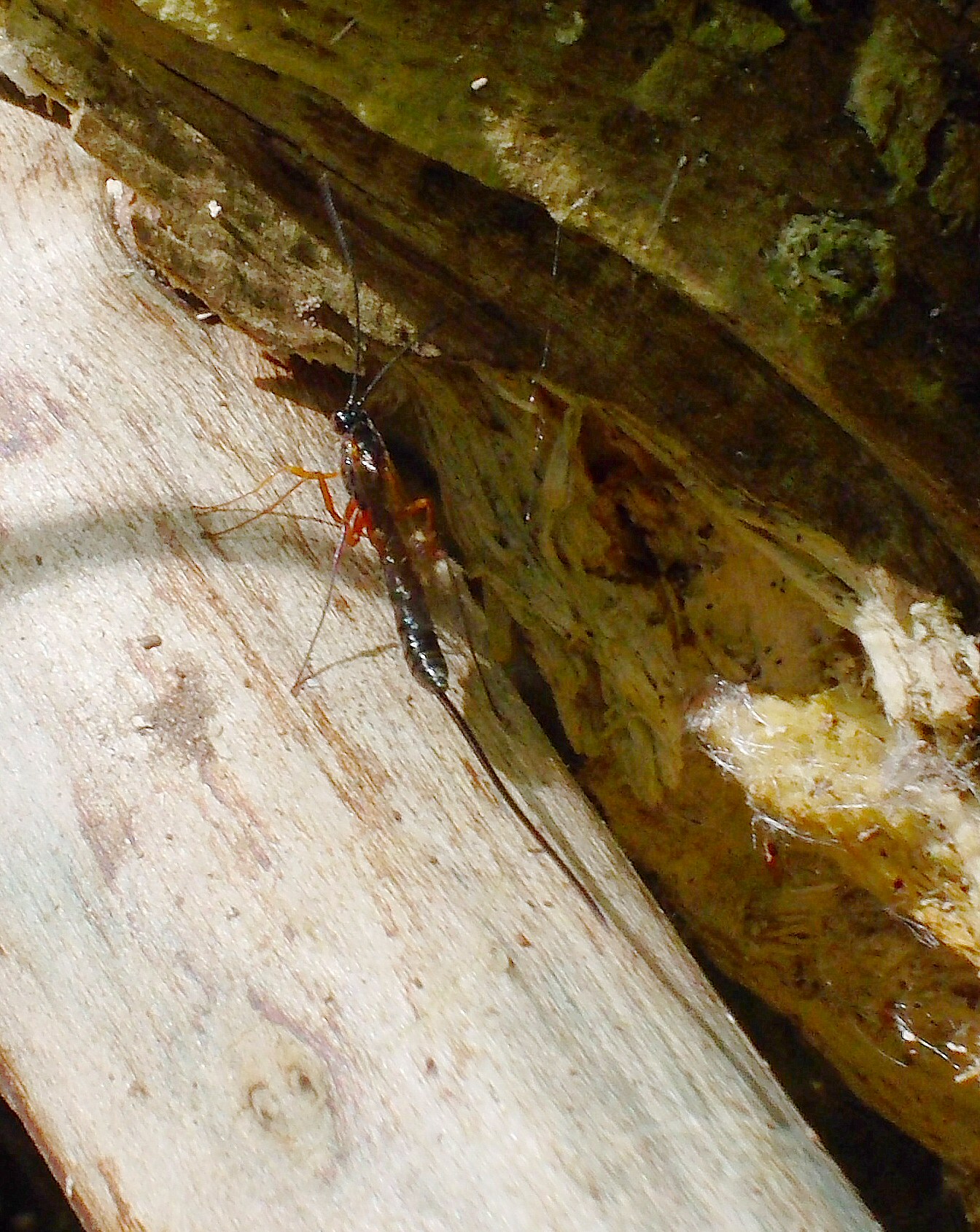
Rhyssa is a parasitic wasp, a solitary hunter distantly related to the social, black-and-yellow striped wasps. Her prey are the larvae of other insects which burrow in dead wood for food and safety. Only when she is above, safety below is hard to find. For Rhyssa‘s weapon is as long as her body: her ovipositor is greatly elongated into a precision instrument that can drill deeply through wood and into the body of the larva. Once there, she lays a single egg down the ovipositor tube. The egg hatches inside the still-living larva, and devours it from the inside. The larva dies (so Rhyssa is a parasitoid, not a true parasite that avoids killing its host) and a young Ichneumon emerges.
Rhyssa persuasoria, dorsal view: in search of a host
Today at Gunnersbury Triangle we erected a new bench, to allow visitors to relax and enjoy a quiet moment in nature. It sounds a trivial task. If only. Two volunteers spent a day putting the “ready to assemble” kits together. All the supplied bolts were the wrong size, so they had to ream out all the pre-drilled holes to the larger size. Meanwhile, that day, I dug out the well-embedded MetPosts remaining from a previous bench. Then we dug 2 holes for the new bench: they promptly filled up with water, and the deeper we dug, the more the local weakly-cemented gravel (our local rock, when it isn’t sticky clay) collapsed into the hole, making it wider at the bottom. It was clearly hopeless.
So today we spent an hour prospecting for a drier place that would also be aesthetically pleasing, not harm the rare ferns nor disturb the nesting Blackcaps, and be close to an existing path. Then we started digging holes all over again. This time they didn’t fill up with water, much: just the bottom 10 cm or so. To keep the sides from crumbling, we avoided digging with spades: we lay on bin-bags, and wearing rubberised gardening gloves, scooped out handfuls of wet gravel. Then we levelled the two holes, cast a base of PostCrete in each, let it cure — at this point everybody disappeared for a cup of tea, leaving me in the wood guarding the site. I sat on a coppiced Willow trunk, and was approached by the giant Ichneumon when I least expected it. Luckily my little camera was not far away — you can readily imagine why I wouldn’t want the big camera with me while working.
The team reassembled, we gingerly lowered the bolted wooden creation into place, wedged it tight with broken bricks, and fixed it in place with plentiful PostCrete before cunningly sloping the top to shed rainwater. Needless to say, during this procedure we accumulated more and more tools all round the excavation site. If only it were as simple as drilling for an unseen caterpillar and laying an egg in it. But then, Rhyssa has the jump on us, with millions of years of evolution in her hunting technique.
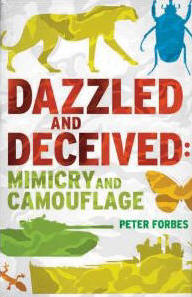
Dazzled and Deceived: Mimicry and Camouflage, by Peter Forbes
The effect of natural selection on how animals look has attracted the
attention of naturalists from the birth of modern natural history, starting even before Darwin’s Origin of Species.
Visual appearance can affect an animal’s survival in numerous ways.
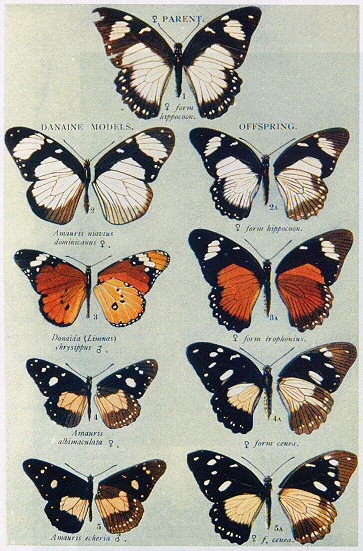
Camouflage makes it hard for predators to find a prey animal; warning coloration advertises that a potential prey is poisonous or distasteful; Batesian mimicry allows an edible species to pretend to be distasteful; and Müllerian mimicry allows a distasteful species to be sampled less often by young inexperienced predators, by resembling a more common distasteful species. And within these areas, there are infinite possibilities.
Butterfly Mimicry: mimics on the right, the imitated ‘models’ on the left
But as the cover art suggests, Forbes does not stop there. Camouflage has military uses; and the history of two World Wars reveals extraordinary interactions between naturalists like Hugh Cott (author of the greatest twentieth-century book on camouflage, Adaptive Coloration in Animals, 1940) and Peter Scott with the military – Scott was a naval captain, so he had a foot in both camps.
Much of the book concerns the natural history and biology of butterflies – they include many of nature’s best mimics, and provide incredibly complex examples of visual evolution at work, as the mimic species adapts to each of the many geographic variants of the host or model species. It’s even possible for multiple forms to appear in a single brood. Forbes describes the research workers, their controversies and their heated opinions, right or wrong. Truth wins in the end, but that doesn’t prevent a messy process along the way, just as in evolution.
Today, new light is being shed on the mechanisms of mimicry and coloration in general by evolutionary developmental biology, which Forbes insists on calling “evo devo”. The result of such inquiry will one day be an explanation of the observed, very complex, natural history at multiple levels – genetics, developmental biology, visual appearance, and natural selection, all of which will have to fit together exactly. Pieces of the puzzle are becoming clear, as in the genetic and developmental mechanisms for producing eye-spots. These can be “impressionistic” – they do not have to mimic a cat’s face, as long as a wing-flash gives a bird predator an illusion of eyes-suddenly-jumping-out-at-me; for we suppose that birds have
an escape reaction triggered in some such way. Thus the explanation must take into account ecology too – the behaviours of both predator and prey are needed to explain why eyespots evolved.
Forbes can’t resist putting an artistic and literary take on the natural
history and science: Sir Ernst Gombrich the art historian was deeply
fascinated by visual illusion, while novelists like Vladimir Nabokov (a keen naturalist) were intrigued by truth and lies. Sometimes the analogies go rather far from natural history (electronic warfare is a case in point: it may be deception but it certainly isn’t visual). But Forbes is always precise, and invariably entertaining.
Deakin died just after finishing Wildwood, so this book is automatically poignant: not just a celebration of life and wildness, but also an epitaph for this wonderful, crazy, brilliant, down-to-earth
craftsman of wood and words.
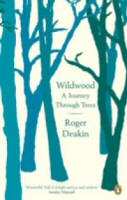
Wildwood, A Journey Through Trees, by Roger Deakin
Deakin was very comfortable with wood, and in woods. Indeed there was a timber merchant named Wood in his family, and one of his father’s Christian names was Greenwood, so he tells us. It is at once personal, uncompromising, and captivatingly narrated. There is no academic or intellectual lamentation about how we have lost touch with nature, no vague generalisation: but the truth emerges, clearly and naturally.
He rebuilt his ancient moated house, from a mossed-over, wooded-up ruin, into a lovely, light, airy place: in the process getting to know every one of the 300 beams (“300 trees: a small wood”) that made up the ancient oak frame of the house. He describes the carpenter’s marks on the beams – cut ready to fit together, then transported and assembled on site.
His wanderings about Britain may seem random, but are highly directed: to the places where the Green Man may be found in a dozen churches; to the home of that most English of plants, the Cricket Bat Willow; to the places where those old badgers, Cobbett and Ruskin, protested the injustices meted out to the common man. There is nothing “quaint”, no “folklore” here: just a constant delight in nature, a steady slow-burning fuse of evidence, of hard-won knowledge lightly worn.
Or he shares his visit to the Pilliga forest in New South Wales,
describing in careful but lightly-told detail how the forest of today is not what it seems; how Charles Darwin saw an open park-like woodland, not the dense and lovely tangles that people imagine is the ancient wooded landscape of Australia. He tells from intimate knowledge of the species of trees that used to dominate; of the skill of the Aborigines in managing the land with fire; of the extinction of the local Kamilaroi language, ironically just as the first and last dictionary of that lost tongue was published.
Deakin is not afraid of seeming tame: he is as much at ease telling us about a Bluebell picnic – on a lawn with a woodland view, accompanied by a posse of Cambridge botanists – as roaming the Outback. His knowledge is deep, even encyclopaedic: he collected facts as he collected interesting pieces of wood, stones, feathers – kaleidoscopically. It’s just a pity that there’s no index in the current paperback edition – let’s hope the publisher rectifies this soon.
Wildwood is, quite simply, a delight. You will want to visit the places described; you will look afresh at the wild places you know; and you will be glad that you met Deakin, in the only way that is now possible, through his graceful and supple writing.