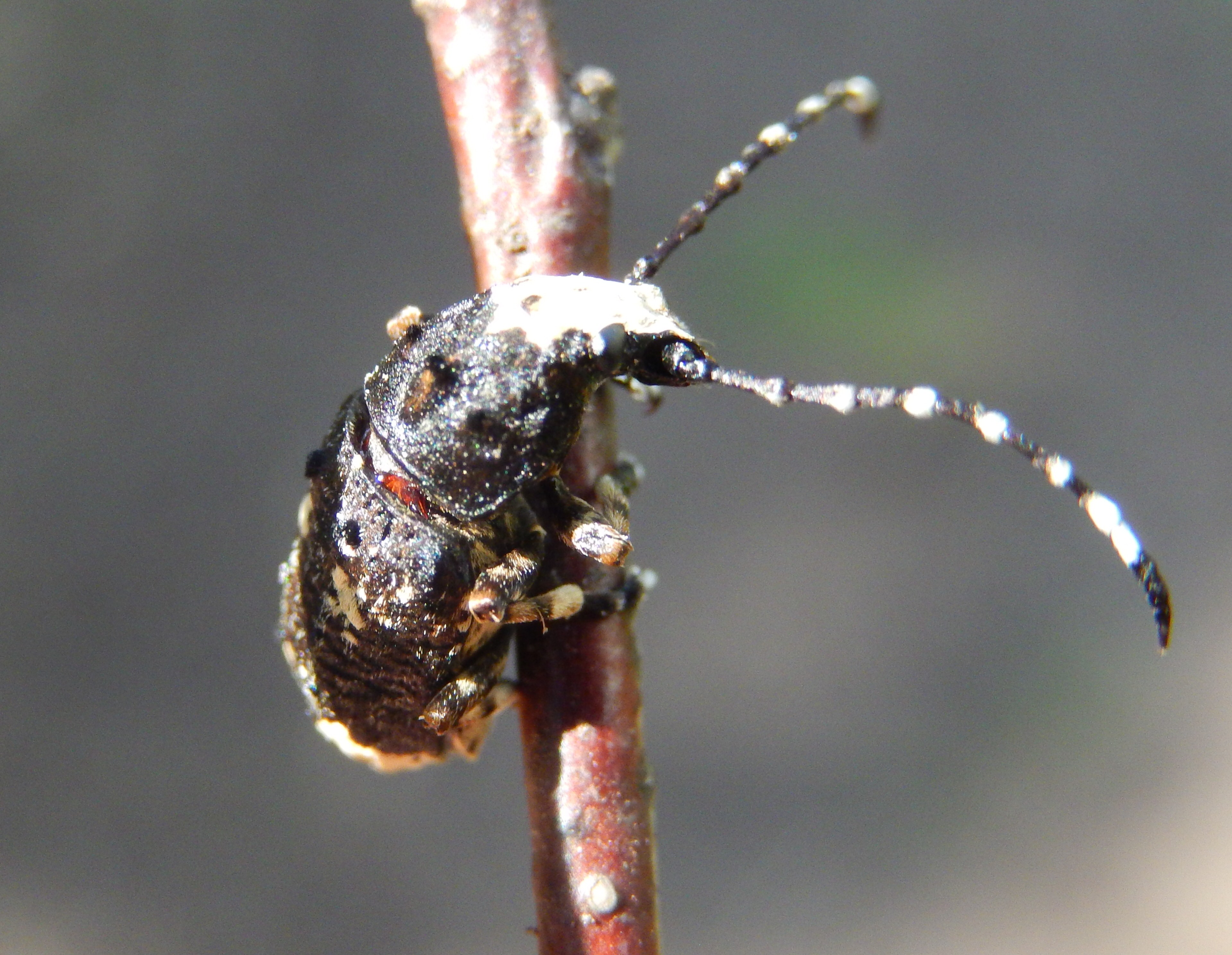
Well, a rarity: this fine beetle, Platystomos albinus, is an Anthribid, a member of a family somewhere between the wood-boring Longhorns and the pointy-nosed Weevils. It has plenty of odd features, not least that it is camouflaged as a bird-dropping. It is “nationally scarce (Nb)” and an “Index of Continuity Species”. This is a male – it’s easy to tell as the species is sexually dimorphic: the males have enormous long antennae nearly the length of the body; the females have antennae about as long as head and thorax together. And this specimen seems (?) to be bleeding from the back of the thorax, possibly an instance of reflex bleeding (autohaemorrhaging) to warn off predators: perhaps the blood is toxic or irritant as it is in several families of beetle. The larvae live in dead standing wood; the adults in fungus-infested Beech or Alder – we have a very few Beech here, and no Alder, and the insect was nowhere near either species.
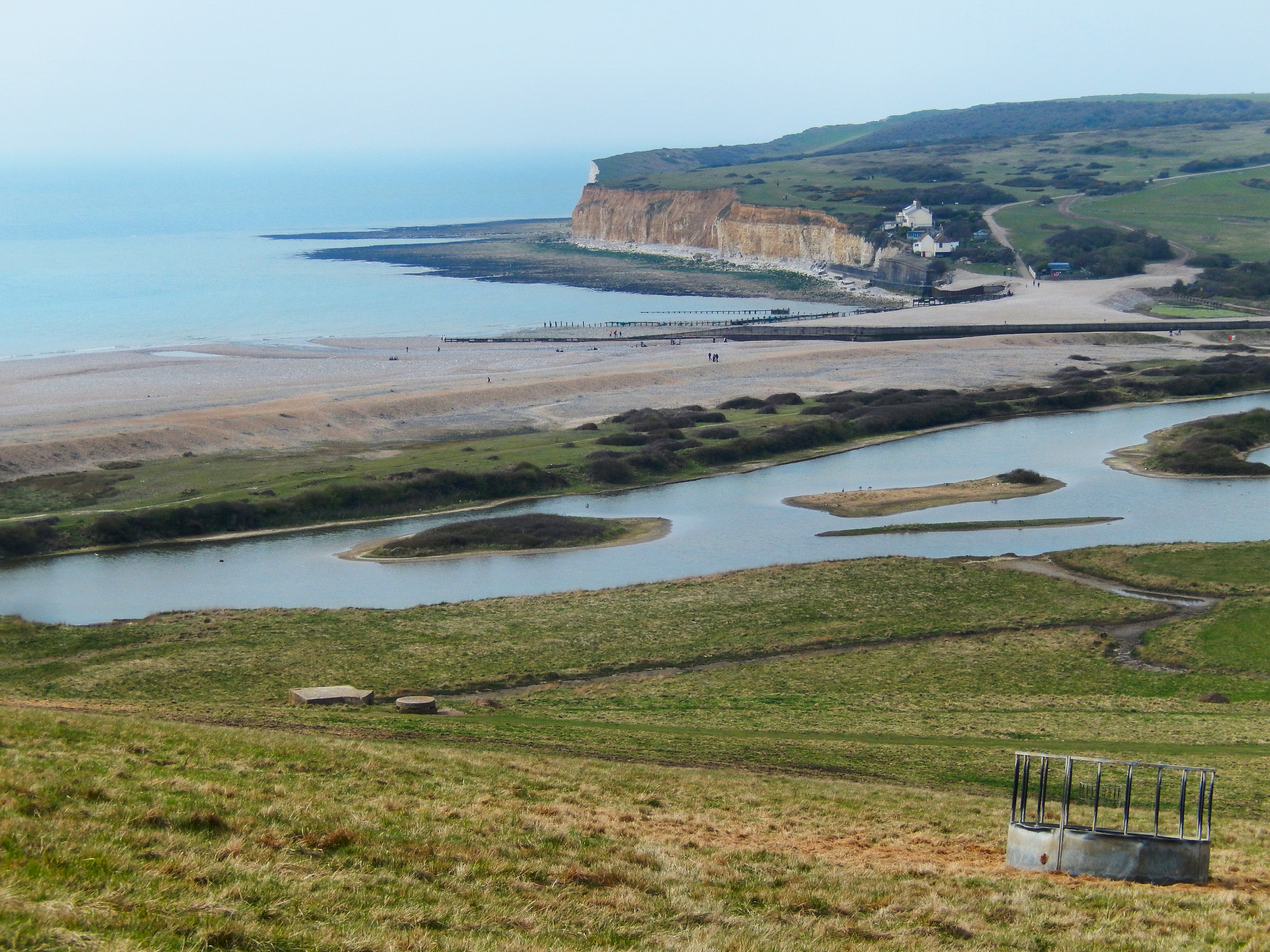
Cuckmere Haven with bar, lagoon, and wave-cut platform
Down in Sussex for a few days, we walked the Seven Sisters from Cuckmere Haven to the Birling Gap.
We had a taste of the scale of human interference with the world’s climate in the shape of a thick haze of pollution trapped by an anticyclone: on the Weald approaching Lewes, we could see the thick haze below the level of the South Downs, and taste the acridity on our tongues. On the coast itself, it was less noticeable in the sea breeze, but the visibility was much reduced with the Newhaven-Dieppe ferry quickly fading into the murk. The BBC warned of high local pollution (worst near Hastings) and an expert advised against strenuous exercise.
The photo of Cuckmere Haven had to be enhanced as it actually looked all washed out in the haze. The geography is interesting: the Cuckmere River emerges (as a dark horizontal line) through what looks from this viewpoint like a continuous shingle bar across the mouth of the valley. The ‘lagoon’ on the landward side of the shingle is part of a former meander of the river, now cut off as if it were an oxbow lake; the current watercourse is canalized with artificial embankments. In the background are vertical sea-cliffs of chalk, with softer (brown) sands above, eroding at a shallower angle. At the base of the cliffs is a white line of fallen chalk rubble, and a dark horizontal surface, a wave-cut platform of chalk (with dark seaweed). In the foreground is the slope of chalk grassland and (left centre) two wartime concrete pillboxes defending the haven.
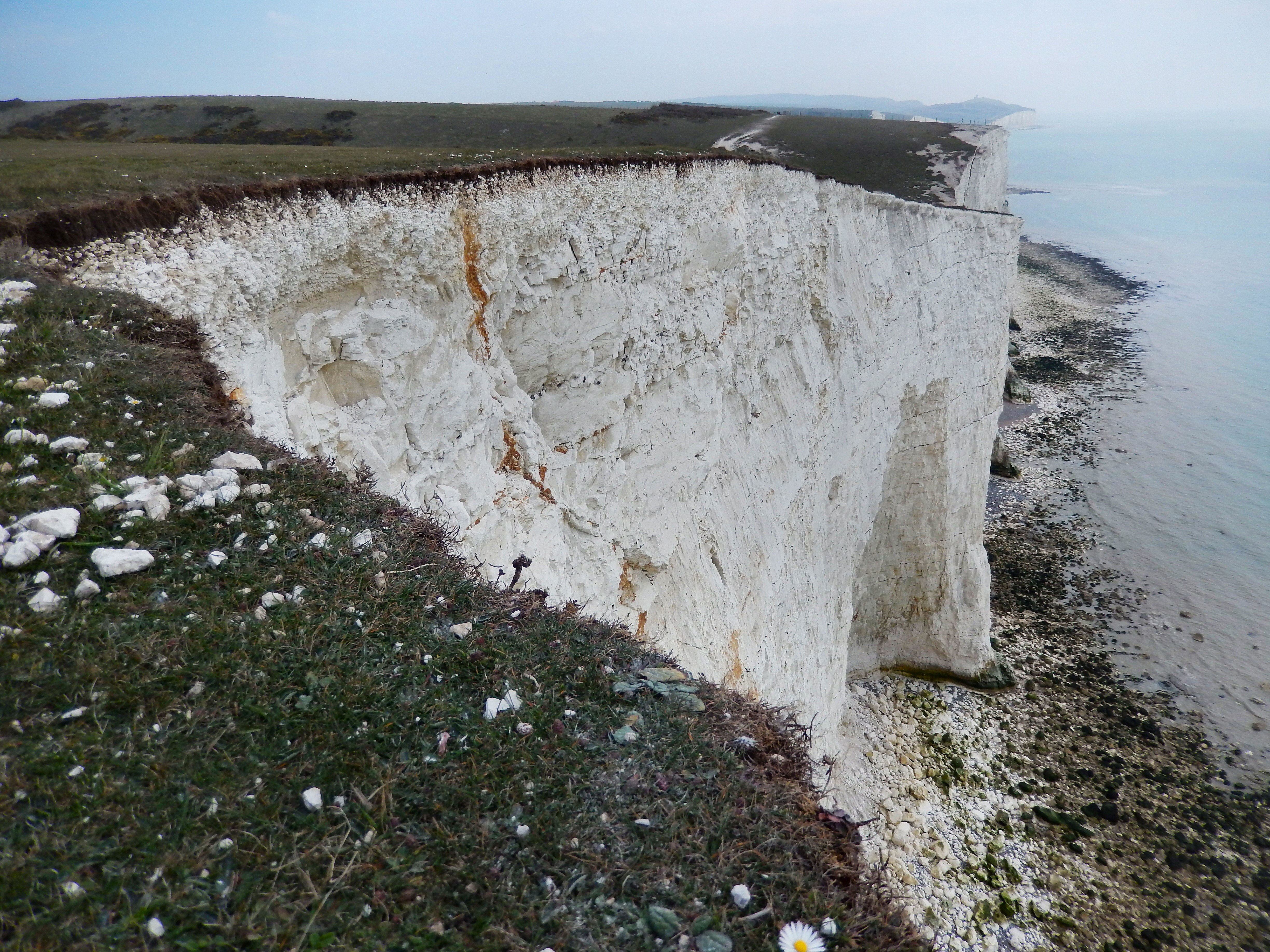
Seven Sisters – coastal cliff erosion
Gingerly approaching the cliff edge at a crawl, I took this photo, showing a large cave in the chalk: the waves fracture and undercut the cliff at high tide, causing progressive and often sudden cliff falls. The coastline recedes by about 70cm per year, but this bland average conceals a very different reality: the cliff edge barely changes from one year to another, until in some specially violent winter storm, perhaps three to five metres of chalk grassland and hundreds of thousands of tons of chalk suddenly collapse all at once into a gigantic white heap on the beach. The cave in the photo has created an overhang of more than 10 metres; it will certainly collapse one day in the next few years.
The walk was constantly accompanied by the song-flights of Skylarks, and their darting duels low over the grass. A few Ravens flew about the cliffs, and many Jackdaws; a pair of Carrion Crows mobbed a Raven; a few Magpies brought the number of members of the Crow tribe up to four. Near Birling, Chiffchaffs crept about an orchard, and Blackcaps dived into gorse bushes. Hundreds of Brent Geese flew Eastwards in V-shaped skeins or long lines half a wingspan above the waves. Four or five Little Egrets darted about the Cuckmere Haven lagoon, spearing small fish: a century ago they were hunted to local extinction for their plumes, used for elegant ladies’ hats. The RSPB was founded partly as the “Fin, Fur and Feather League”, a women’s campaign against the cruel and pointless use of animals in fashion that became a major force in bird conservation. In the last thirty years or so they have quietly returned to the south coast and are increasing in numbers.
It’s spring! Well, a Blackcap sang its cheerful spring song to me yesterday, in my garden, how about that, after flying all the way from Africa. Today, a Chiffchaff sang (and briefly appeared) in the nature reserve while I was working down at the frog pond.
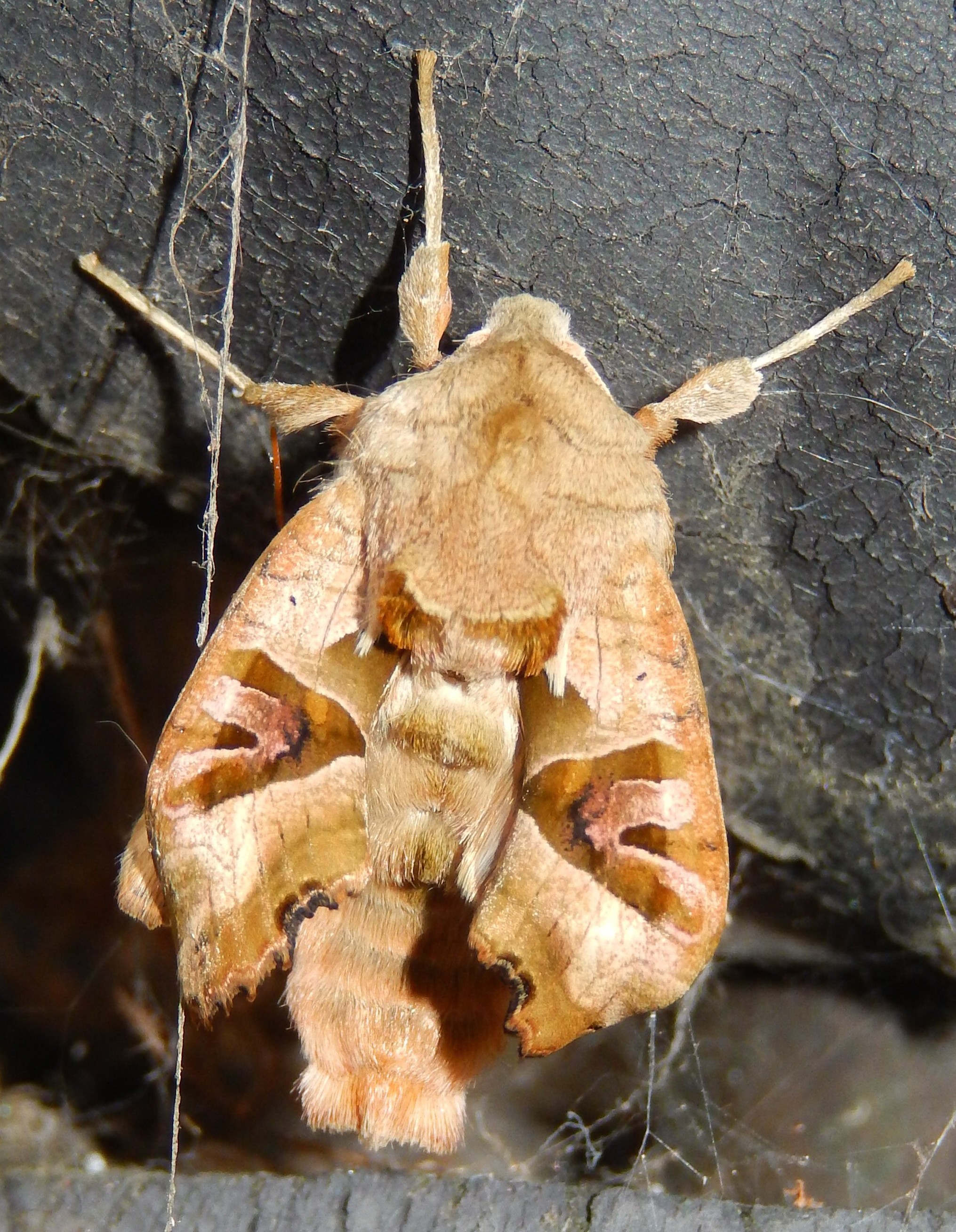
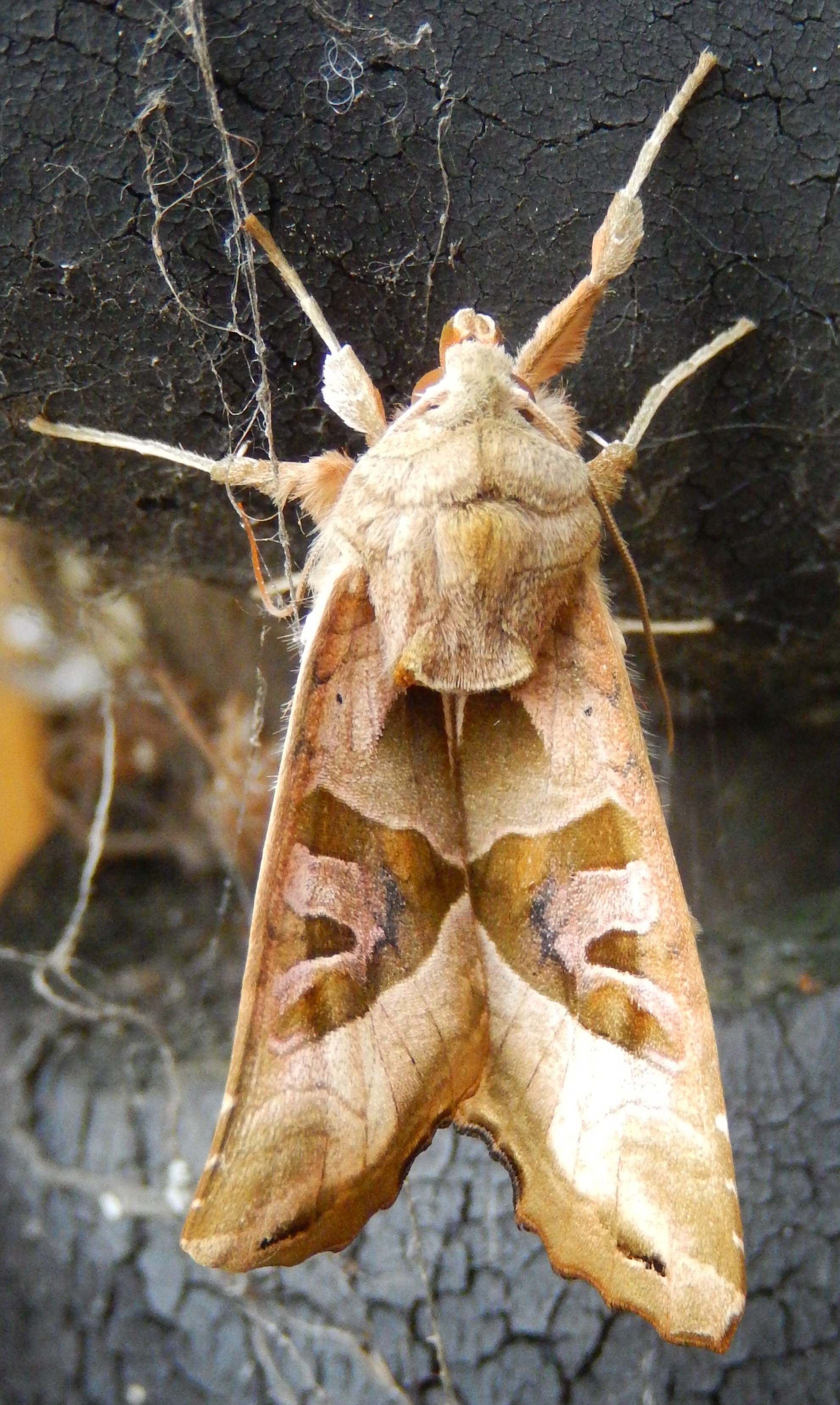
And back at home, as I was watering the garden, I saw this Angle Shades moth (Phlogophora meticulosa, a Noctuid) in its final ecdysis, inflating its wings from their crumpled state inside the overwintering pupa. It was on the pipe insulation of the garden tap.
Angle Shades, wings about to inflateAngle Shades, wings nearly inflated
Presumably the moth’s body clock said “It’s spring”. Amazing to watch.
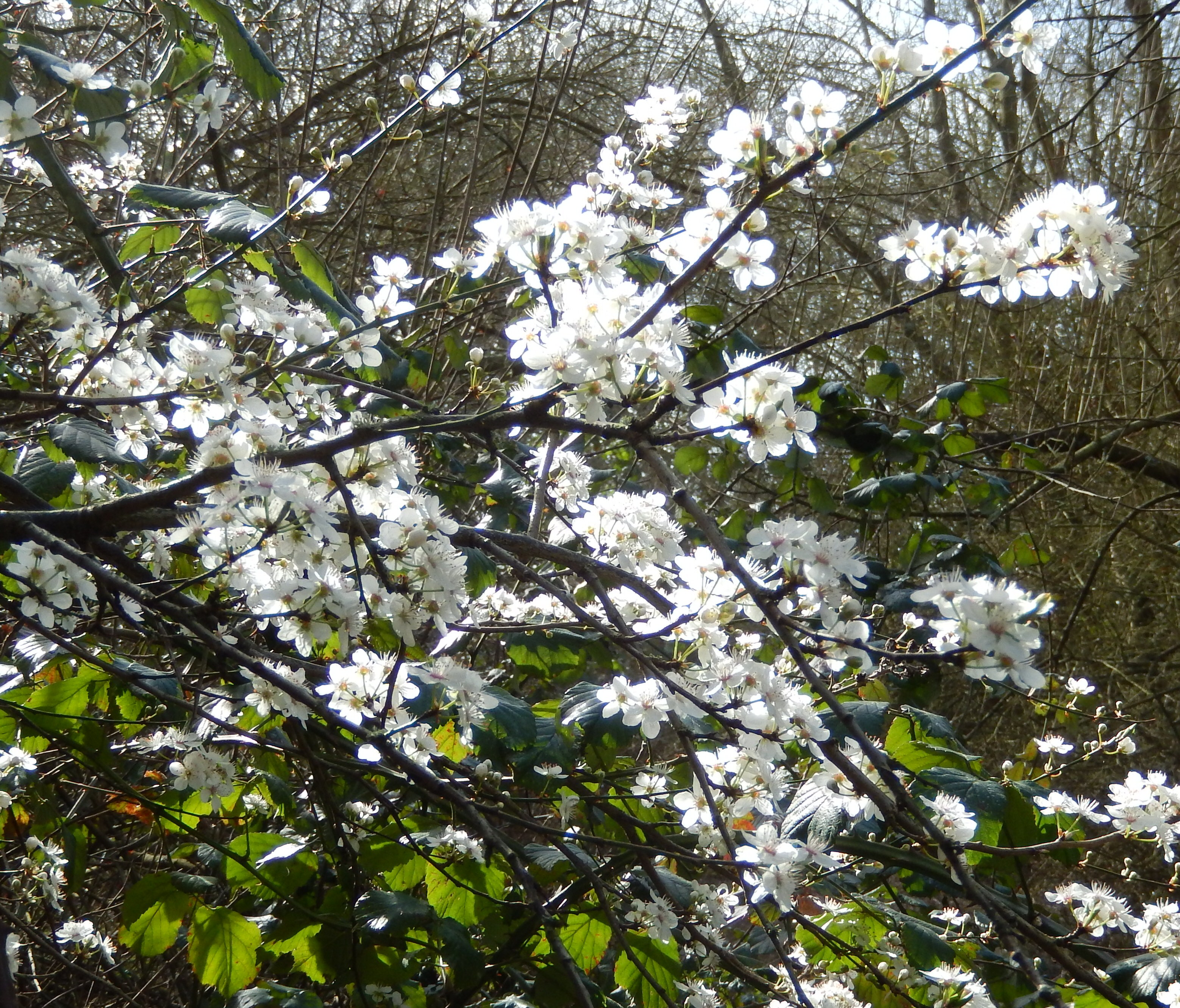
Suddenly it feels like spring. The migrant warblers haven’t arrived, though a resident Cetti’s gave me a fine burst of its loud simple song; and the winter ducks haven’t all gone back up North, a few Goldeneye and Goosander still fishing the lake; but it was almost warm in the bright sunshine, and the wild pear tree in the woods positively sparkled with fresh new blossom.
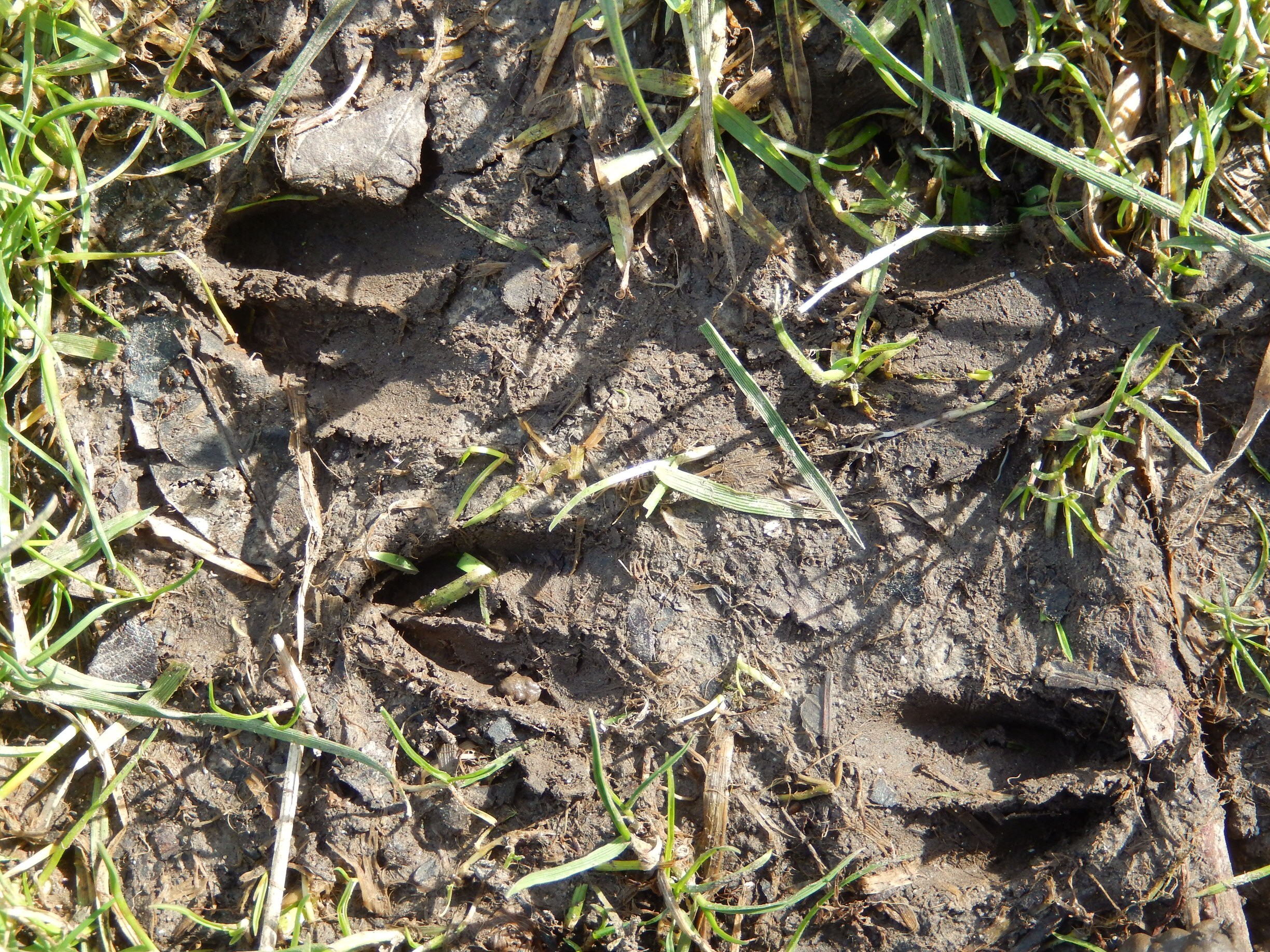
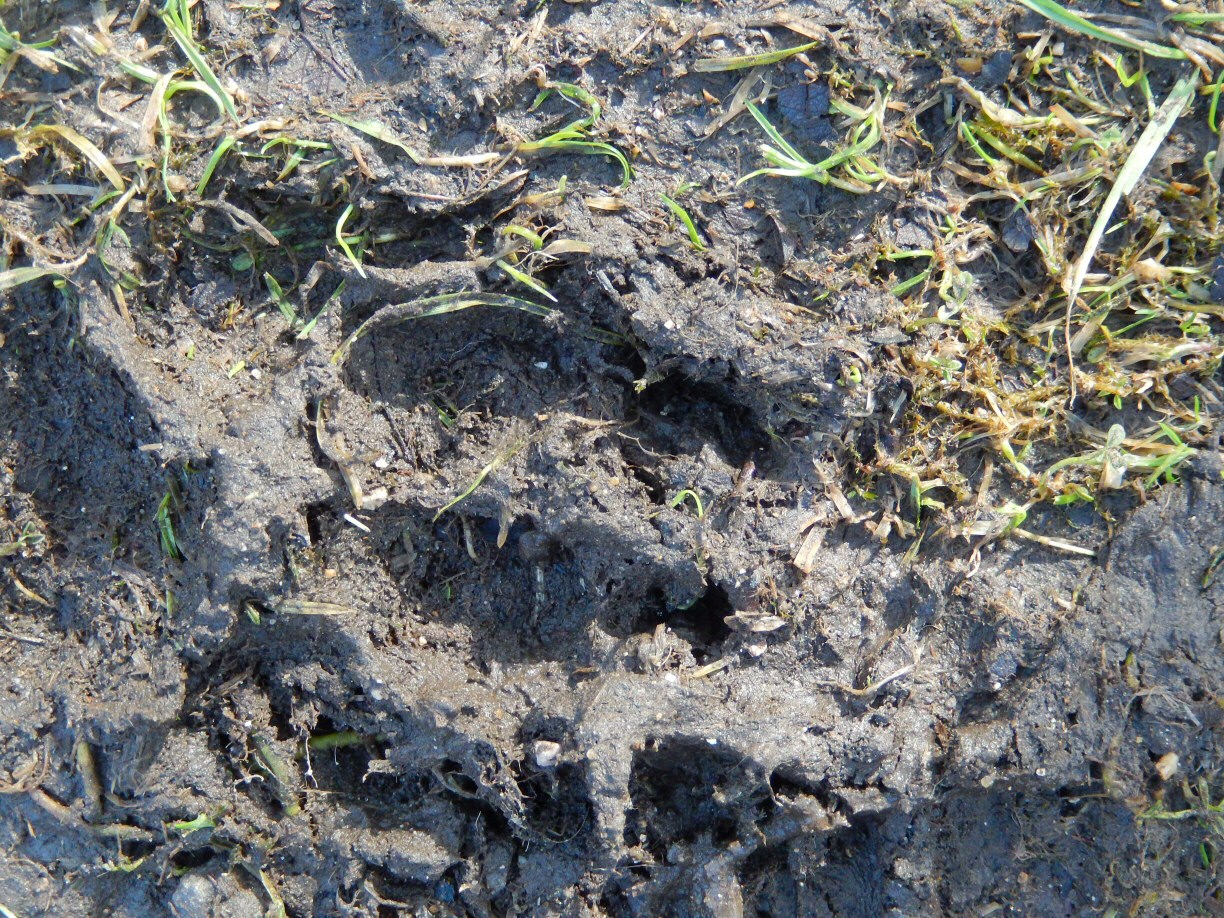
Tiny footprints: Muntjac slots
There were animal tracks too: tiny footprints of Muntjac.
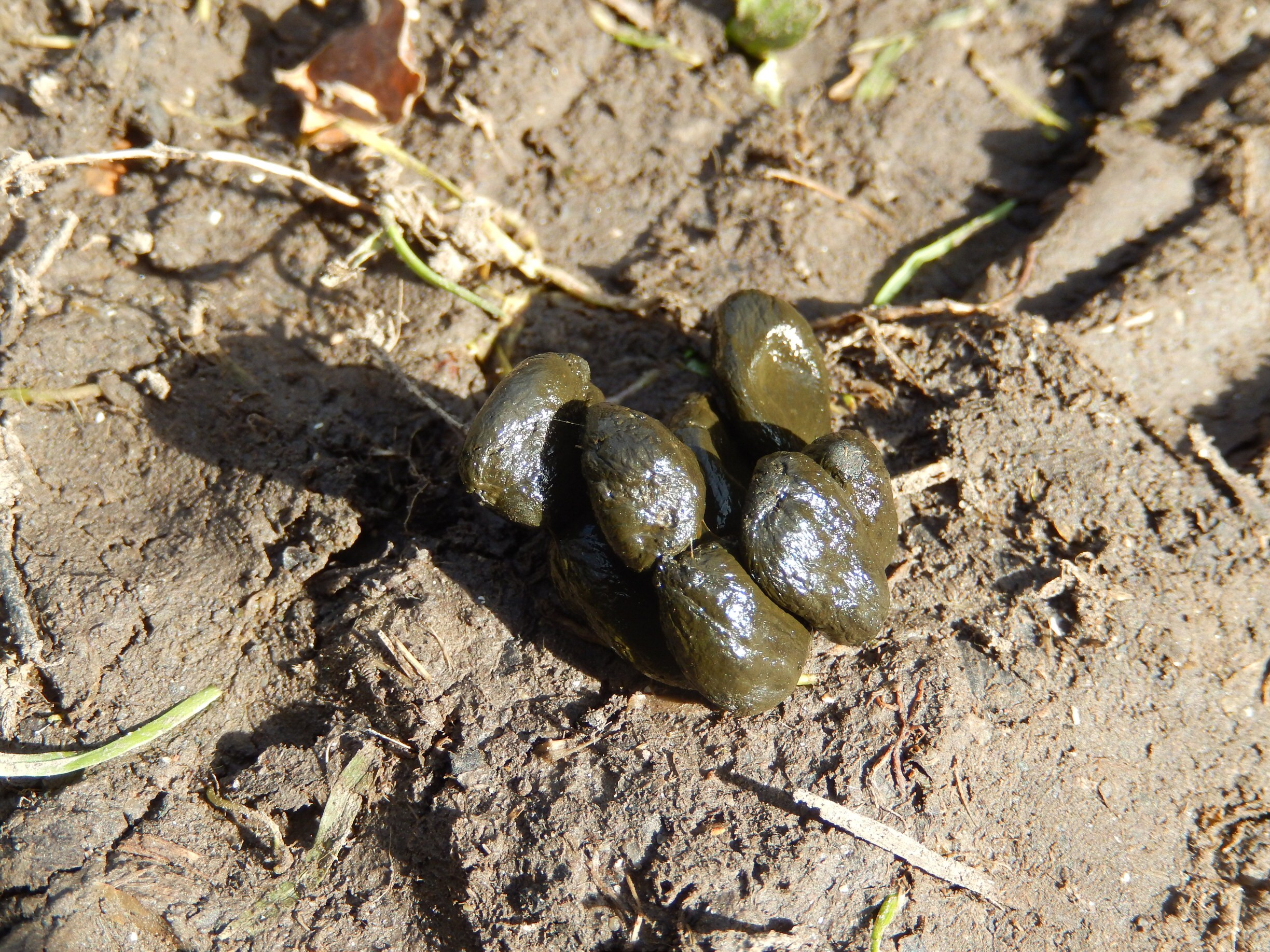
A little further, a fresh pile of tiny scat, Muntjac for sure.
Tiny scat: Muntjac
A Sparrowhawk dashed low over the willows, and disappeared as swiftly as it had arrived.
On the path, the much larger slots of Roe deer; and a Rabbit hopped quietly aside.
Larger tracks: Roe deer
The last of the winter thrushes – a flock of Fieldfares – called their chattering chack-chack from the tall boundary hedge of trees. A flock of gently twittering Goldfinches, too, served as a reminder of a winter only just passing.
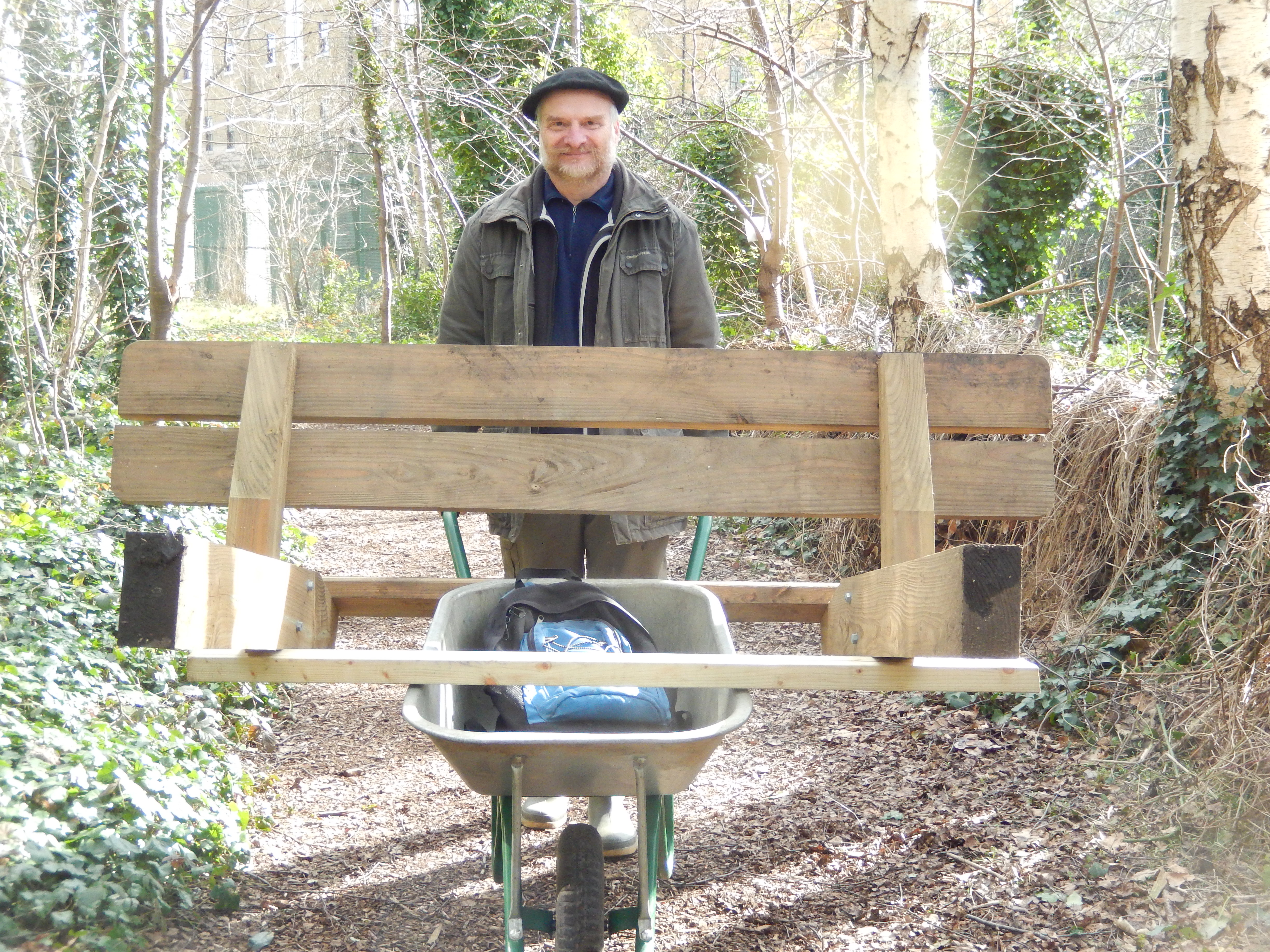
Well, it’s not every day one wheels a robust two-legged bench about a nature reserve. The team of three however managed to think of a way of balancing the bench on a wheelbarrow using a bit of four-by-two to prop up the legs, and thus poised it turned out to be quite easy to trundle along, carefully dodging trees and bushes along the way.
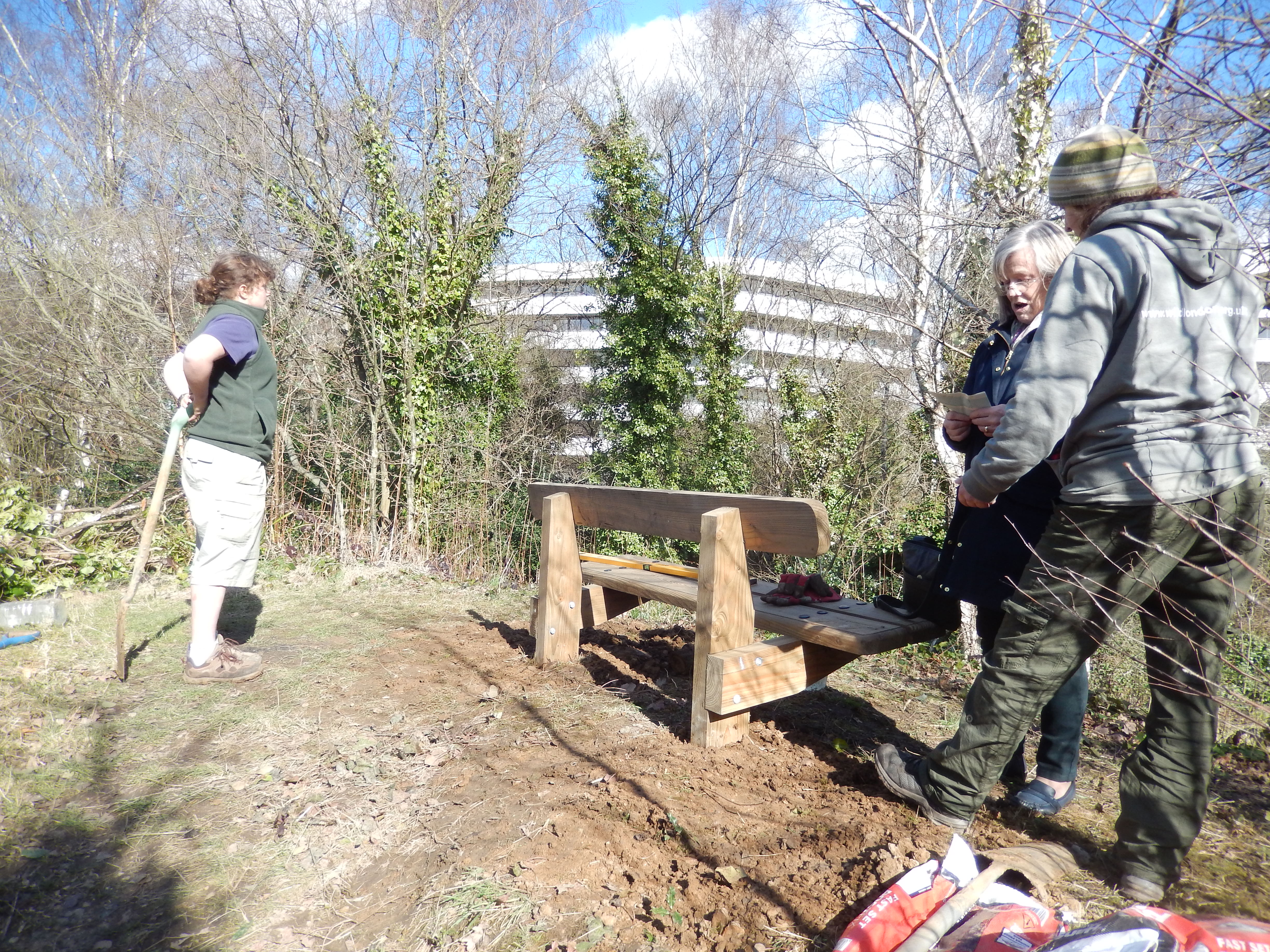
The holes were just the right depth, so all we had to do was drop in the bench, level it, pour in some water and add rapid-setting post concrete. The bit we had left turned out not to be enough, so after struggling in vain with additional pebbles, we propped it up and those with bicycles went round to the hardware store to fetch some more concrete. Second time proved lucky, the ‘crete set like custard without enough milk added, and very soon we were shovelling the spoil into the holes and stamping it down.
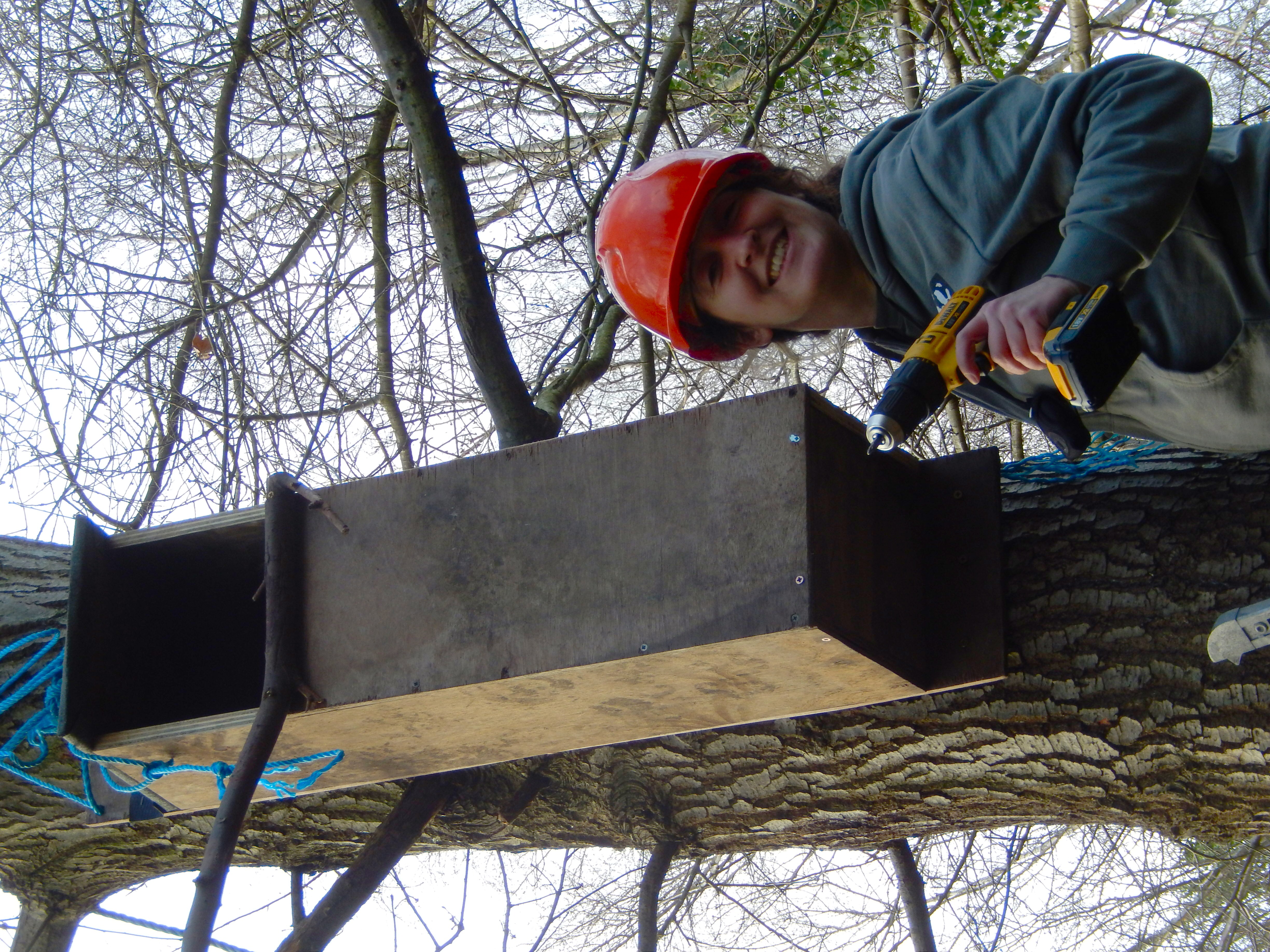
It was a very rainy workday, and with only two of us around we wondered what to do. It was time for an indoor project that we’d been putting off … make an owl box. Tawny Owls might seem surprising citydwellers, but they are around in the leafier suburbs and larger parks.
We looked at the RSPB website for instructions, calculated the measurements of all six faces of the box on a sheet of paper, and studied the bits of plywood we had available. Just whiz along with the circular saw, screw it all together and we’ll be done.
It took a little longer. To cut the wood, we needed to be outside. Where it was raining. The wood got wet and it was hopeless trying to draw lines in pencil or biro. Felt pen worked, sort of, but gave us thicker smudgier lines. We drew, went outside, held and sawed, dusted down, came inside, made another cup of tea, drew again, went outside.
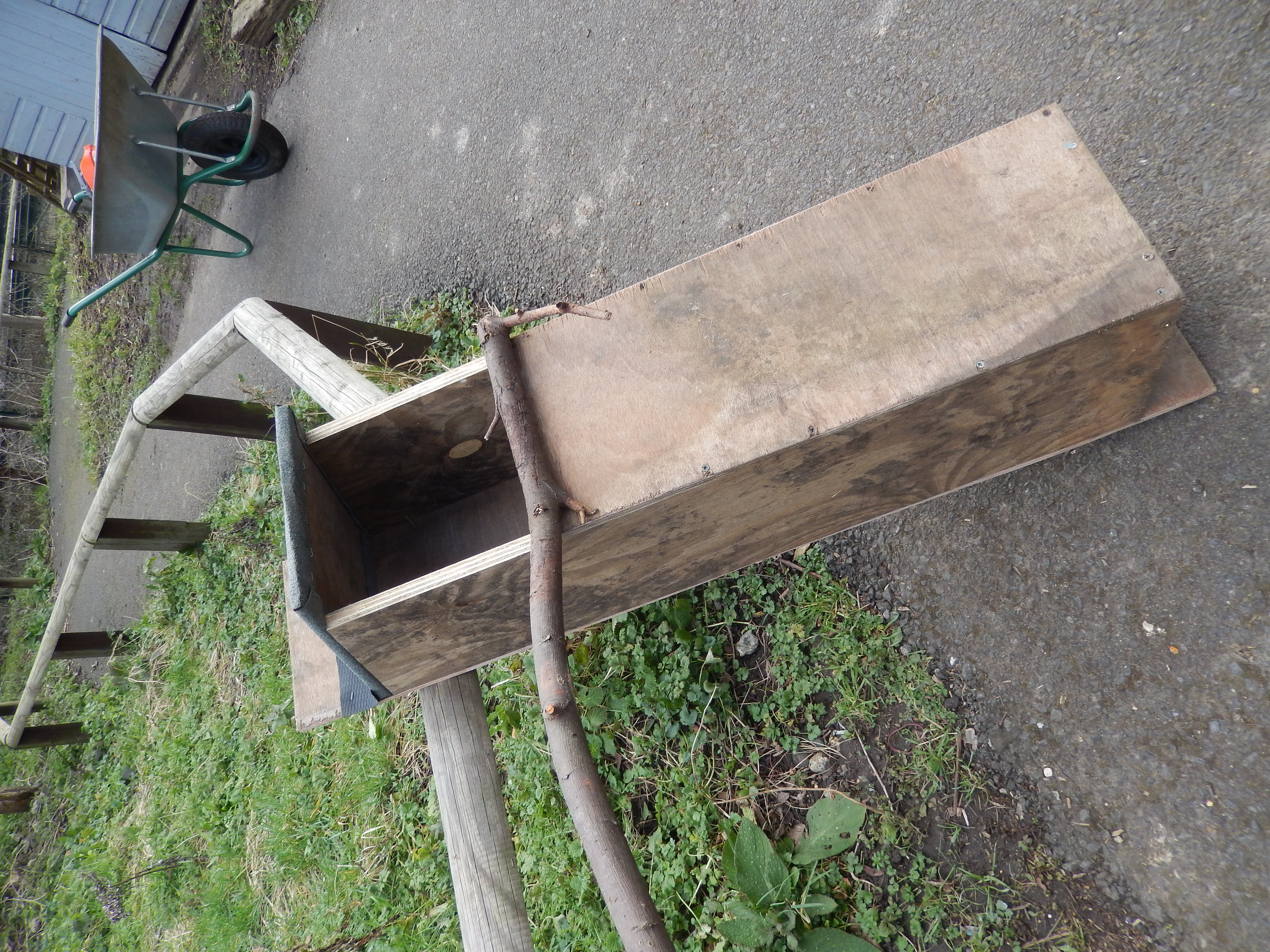
Finally we had a forlorn pile of long, dirty, improbably shaped bits. They seemed nothing like a nestbox. Let’s finish it next time, said Netty, sounding a lot less keen than she had at the start. Let’s get it done, I said. It’ll not take long now. We were a bit cold. We screwed the front to the sides, which were the thickest parts. Suddenly it had a shape. We took the extraordinarily long back and screwed it to the sides. A box. A very long box. We pushed the base into the hole. It wobbled. We pushed it down the very long hole with an umbrella and got some screws in. It was all done save the lid, which needed waterproofing with some roofing felt, and attaching with a rubbery damp-course hinge.
The next time was dry, and we took the box outside. It seemed enormous, and Netty had fixed on a long bit of dead branch as an owl-perch, but it went in a wheelbarrow and we set off with drill, ropes, and a ladder to the chosen Oak, a tall straight tree off the beaten track.
We managed to get a rope over a branch and haul the box up. Only, how to fix it and get the rope down again? We let it down, threw a thin plastic rope over the branch as well, hauled the box up, tied the thin rope onto the top of the box, and stood back. The box was up, but definitely dangling. We could easily fix some screws into the stub at the base of the box, but how to do the same for the stub at the top? We moved the ladder around the tree to find a way to reach. With the ladder in the easiest place, the box was directly above our heads. We tried it every which way, we couldn’t reach. We put the ladder back where it was. With two of us holding the ladder and one on the top rung, it was just possible. Trying to tie knots or fix a screw with one hand … is quite tricky. We were very pleased when it was done. We’ll be delighted if a family of owls takes up residence. Or even some jackdaws.
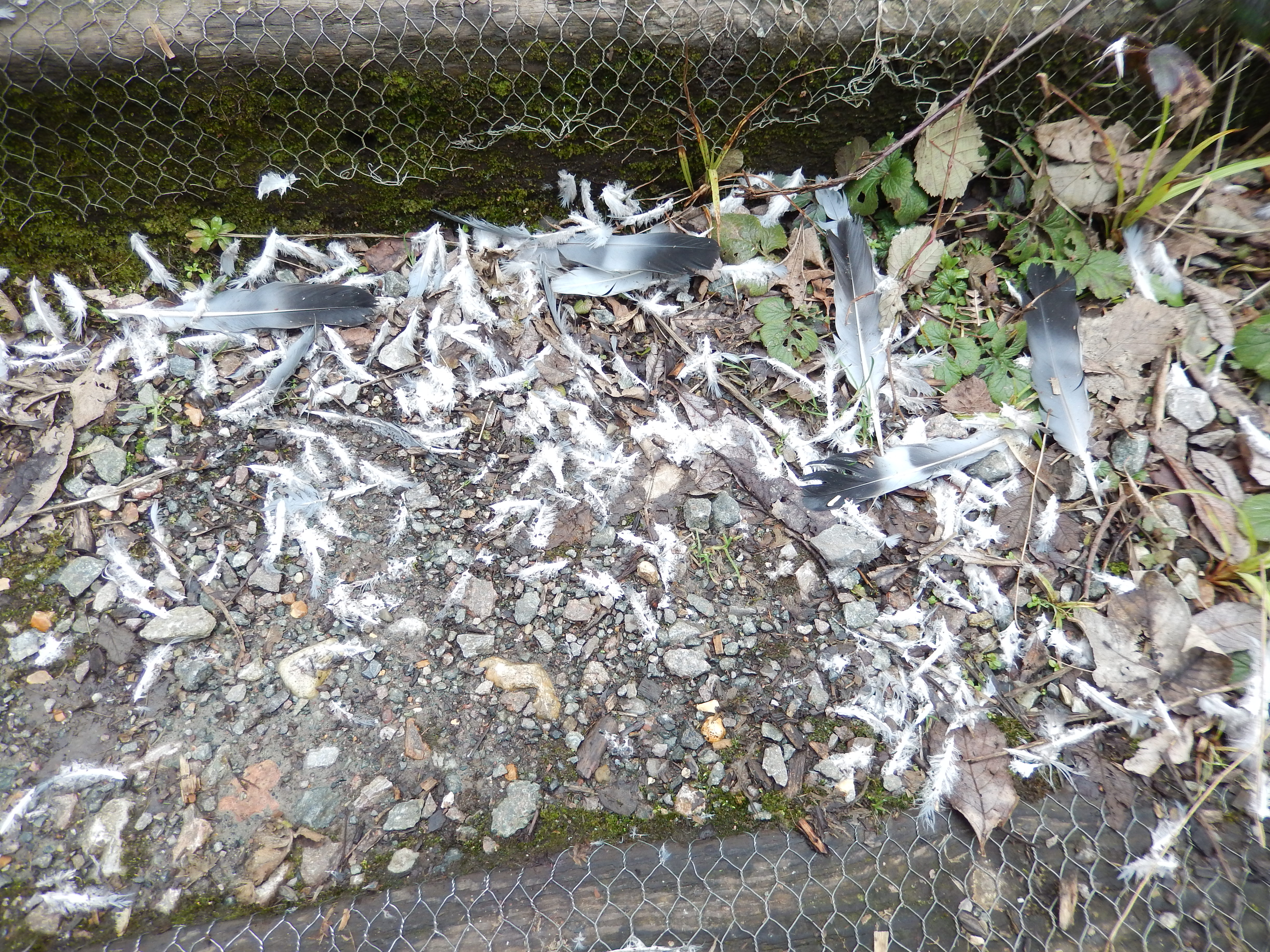
Scene of Crime in London Wildlife Trust’s Gunnersbury Triangle Local Nature Reserve
OK, you see a blizzard of feathers, the entire mortal remains of a Wood Pigeon that once proudly flew the woods, jauntily sailing away from a mere human. Who did it – Sparrowhawk or Fox? You might think it impossible, given that both eat most of their quarry, leaving little but bloodied feathers.
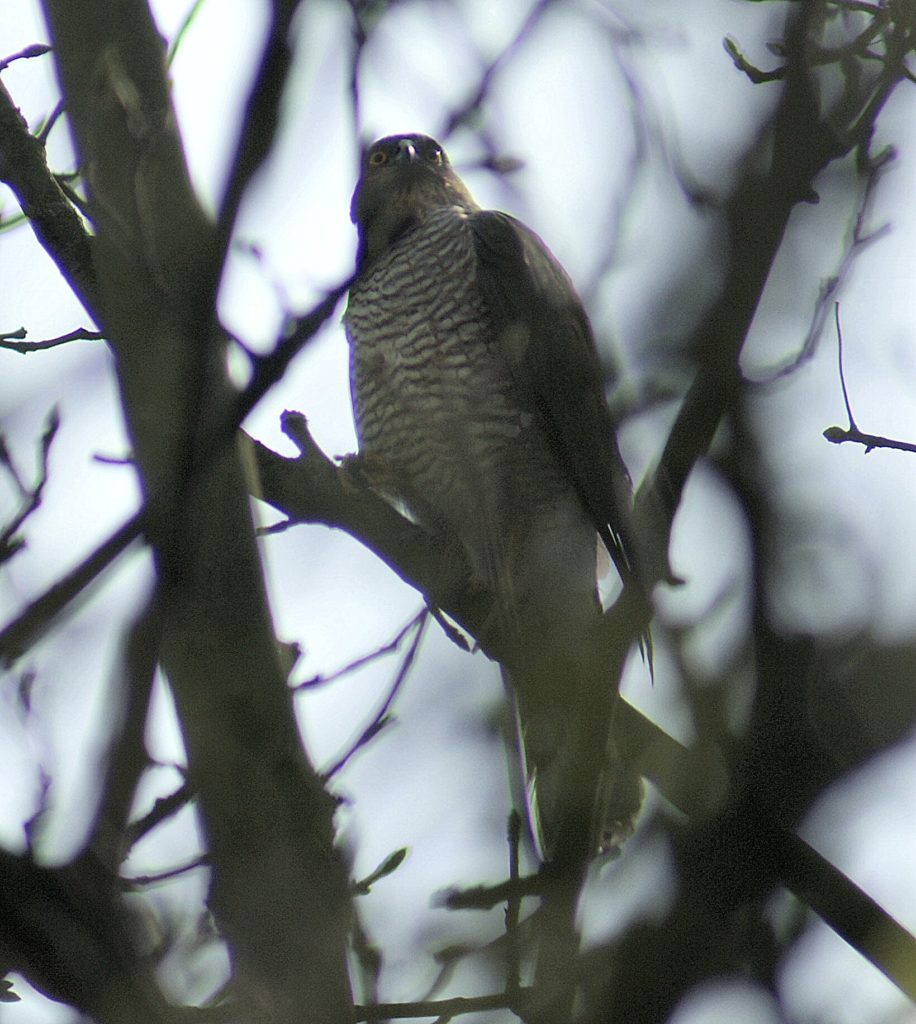
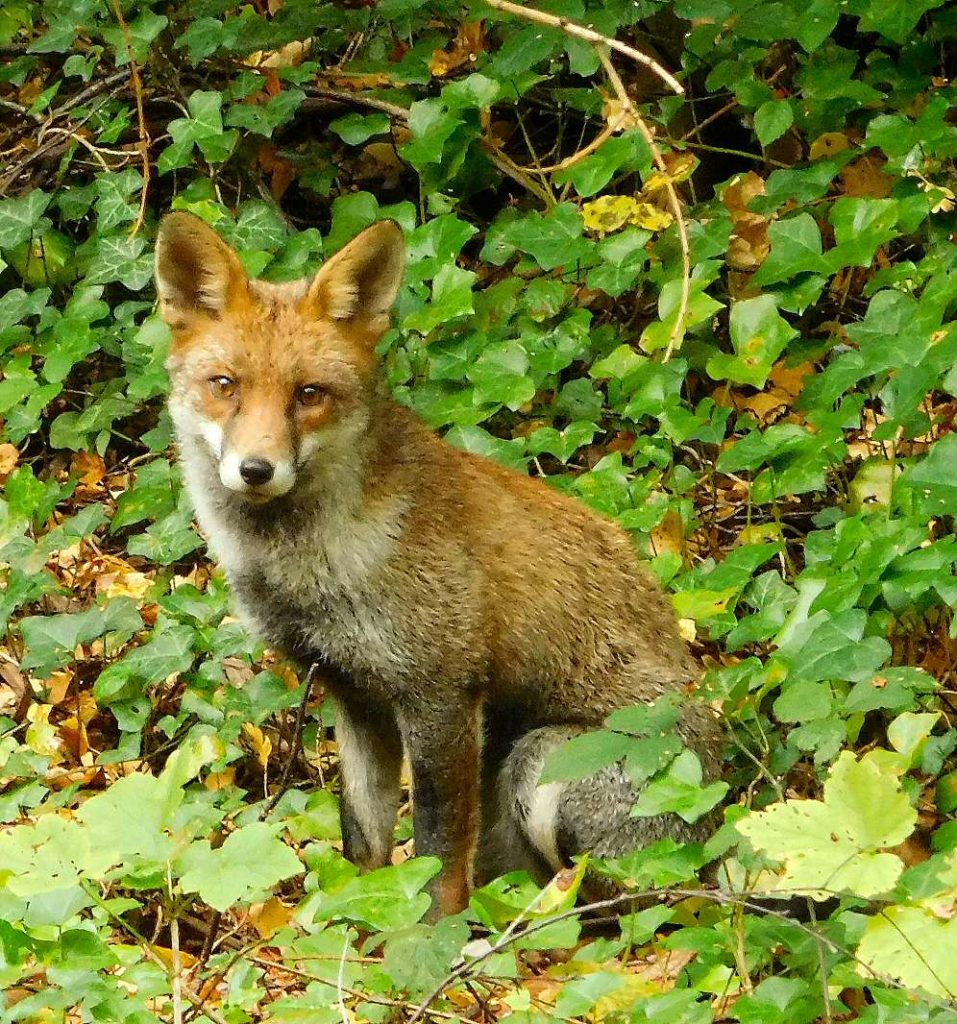
The Guilty Party? Sparrowhawk in Gunnersbury TriangleThe Culprit? Red Fox in Gunnersbury Triangle
But you’d be wrong. Each leaves distinctive clues in the debris of their dastardly deeds.
How would one tell if the brutal murder was the Butler with Carving Knife in Pantry, or Doctor with Stethoscope Hose in Library? (with apologies to Cluedo) Or rather, Sparrowhawk with Beak and Claw in Mid-air Murder, or Fox with Teeth in Ambush from Shrubbery? Here’s how to be a wildlife detective …
Sparrowhawk with Beak and Claw in Mid-air Murder
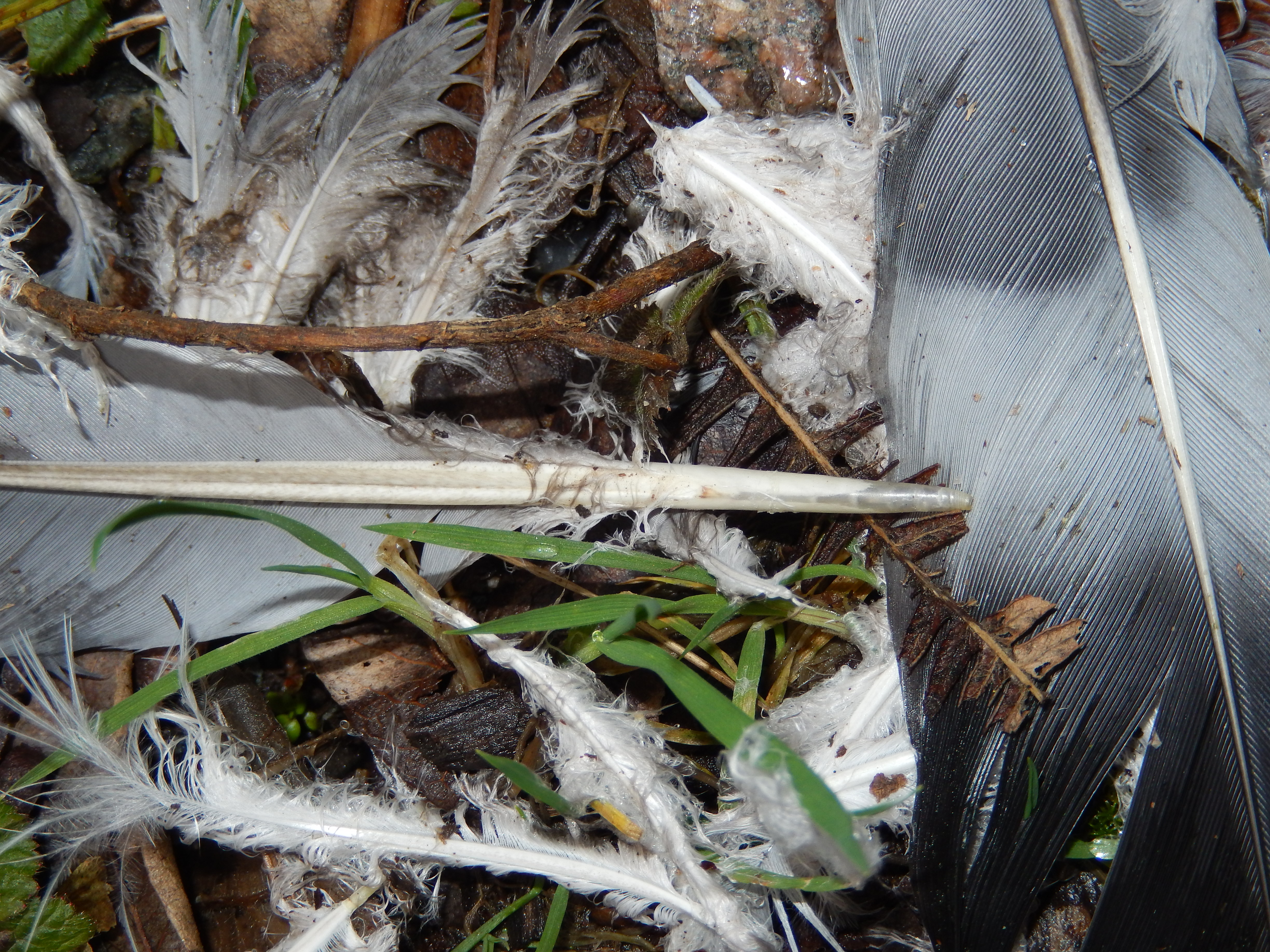
The Sparrowhawk has no teeth; and it doesn’t like to eat feathers. So, it grips each one, and boldly plucks it from the dead prey, leaving whole feathers – the shaft tapering to a point that was once inside the bird’s skin – neatly removed, each in one piece.
Pigeon plucked by Sparrowhawk, detail
Fox with Teeth, Ambush in Shrubbery
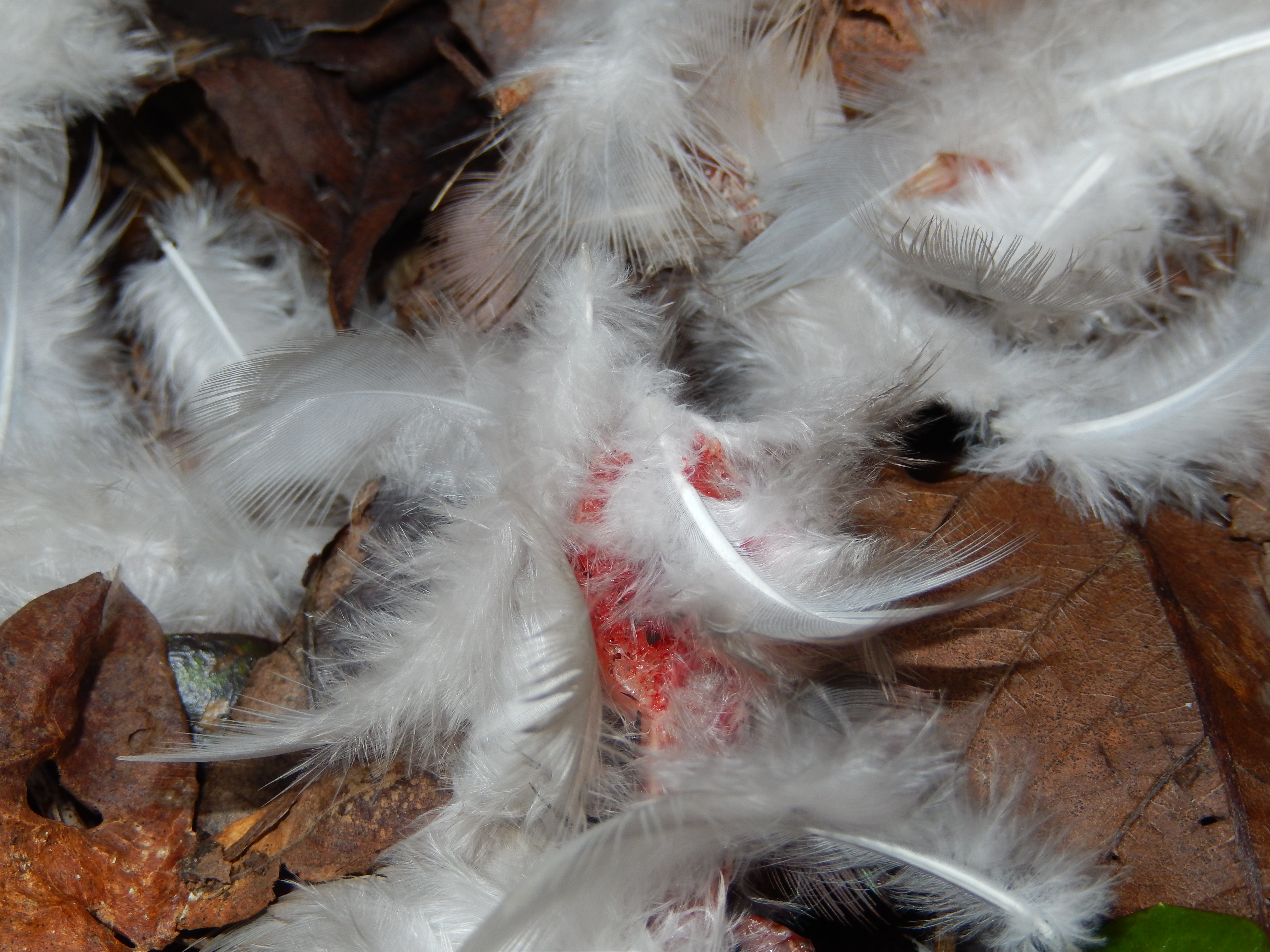
The Fox, however, wastes no time on single feathers, biting off and spitting out fluffy mouthfuls as quickly as he can. They may be bloodied, as below, when the skin gets torn, but the feathers generally have broken shafts.
Pigeon feathers bitten off by Fox, detail
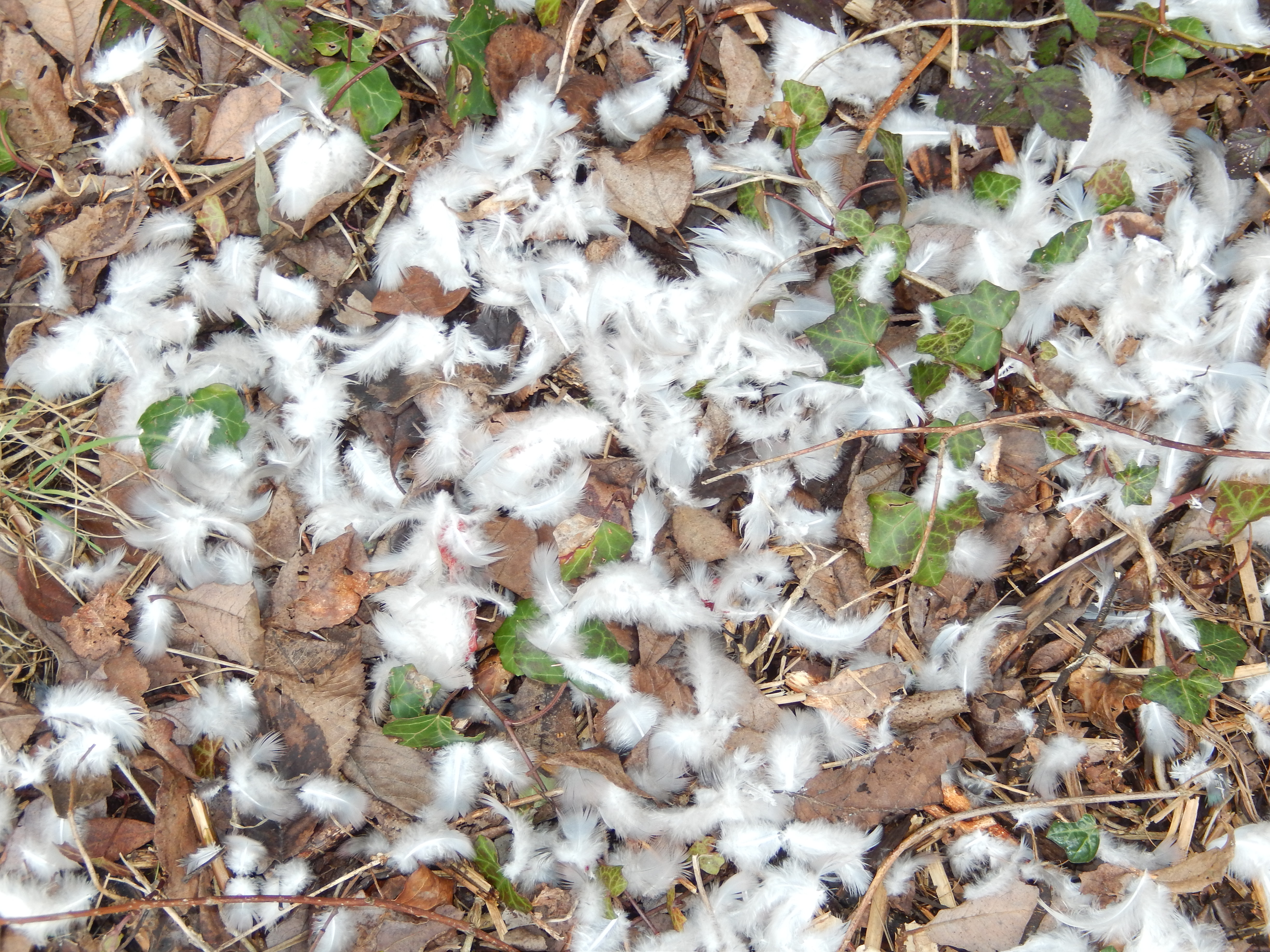
The overall effect is still a blizzard of feathers, all that remains of the ex-Pigeon. But, though the Pigeon is no more, its traces indicate quite clearly whodiddit.
Pigeon feathers bitten off by Fox
Now you know.
Sentimentality
There is a sad little postscript to this tale. Near both murder sites was a scatter of bird-seed. Some kind, well-meaning person, perhaps lonely, perhaps seeking friendship, had put out some food for the pigeons to eat in the cold weather.
Well-meaning, but unwise. The pigeons became accustomed to feeding on the ground … in poor light … without looking about them too much … and fell victim to two keen, hungry, unsentimental predators.
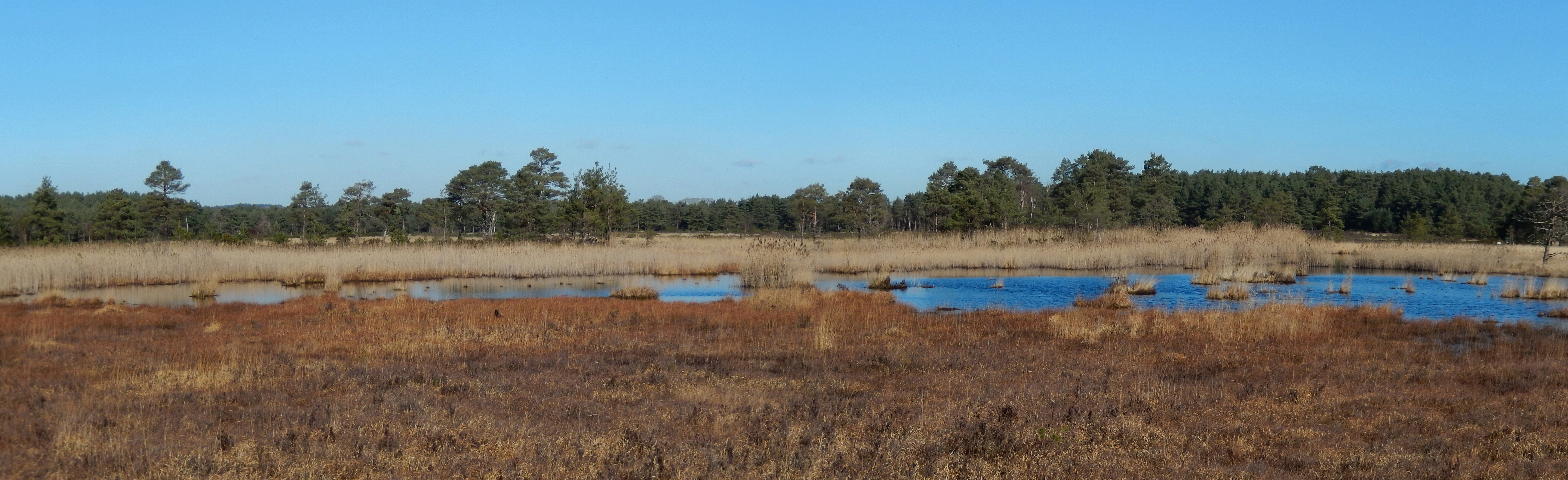
Panorama of Thursley Common bog pools (full image is 7330 x 2245)
On a gloriously sunny, still winter’s day, Thursley Common looked wonderful. There were few signs of wildlife – a Crow or two, some Stonechats hawking for flies from the tops of small bushes – but wide horizons, quiet, a sense of space and freedom.
Swirly patterns with beetle holes in dead pine
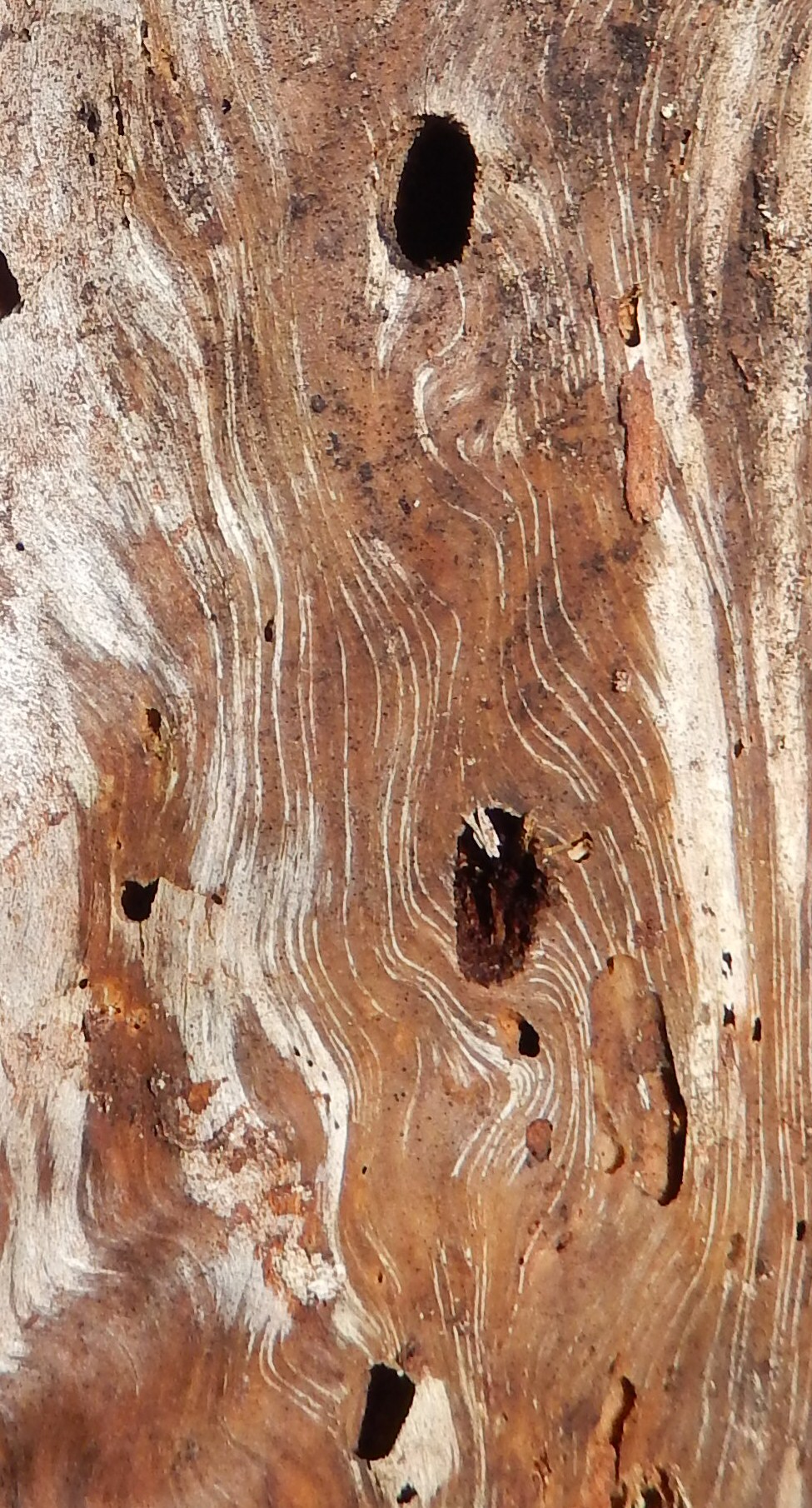
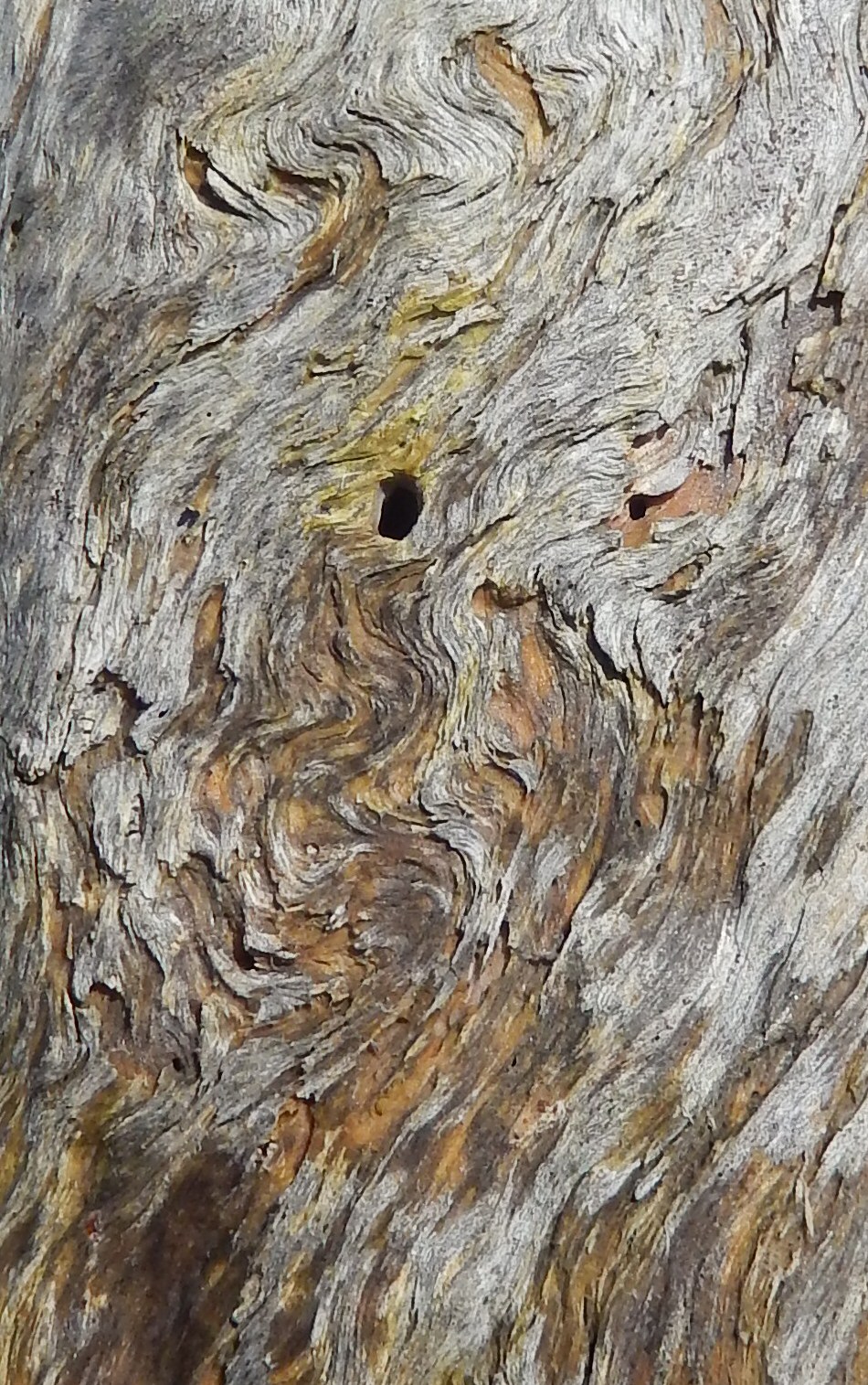
Some dead pines displayed magnificent natural patterns, the product of bare wood drilled by Longhorn Beetle larvae and exposed to the elements.
Turbulent orange patterns on softening dead pine
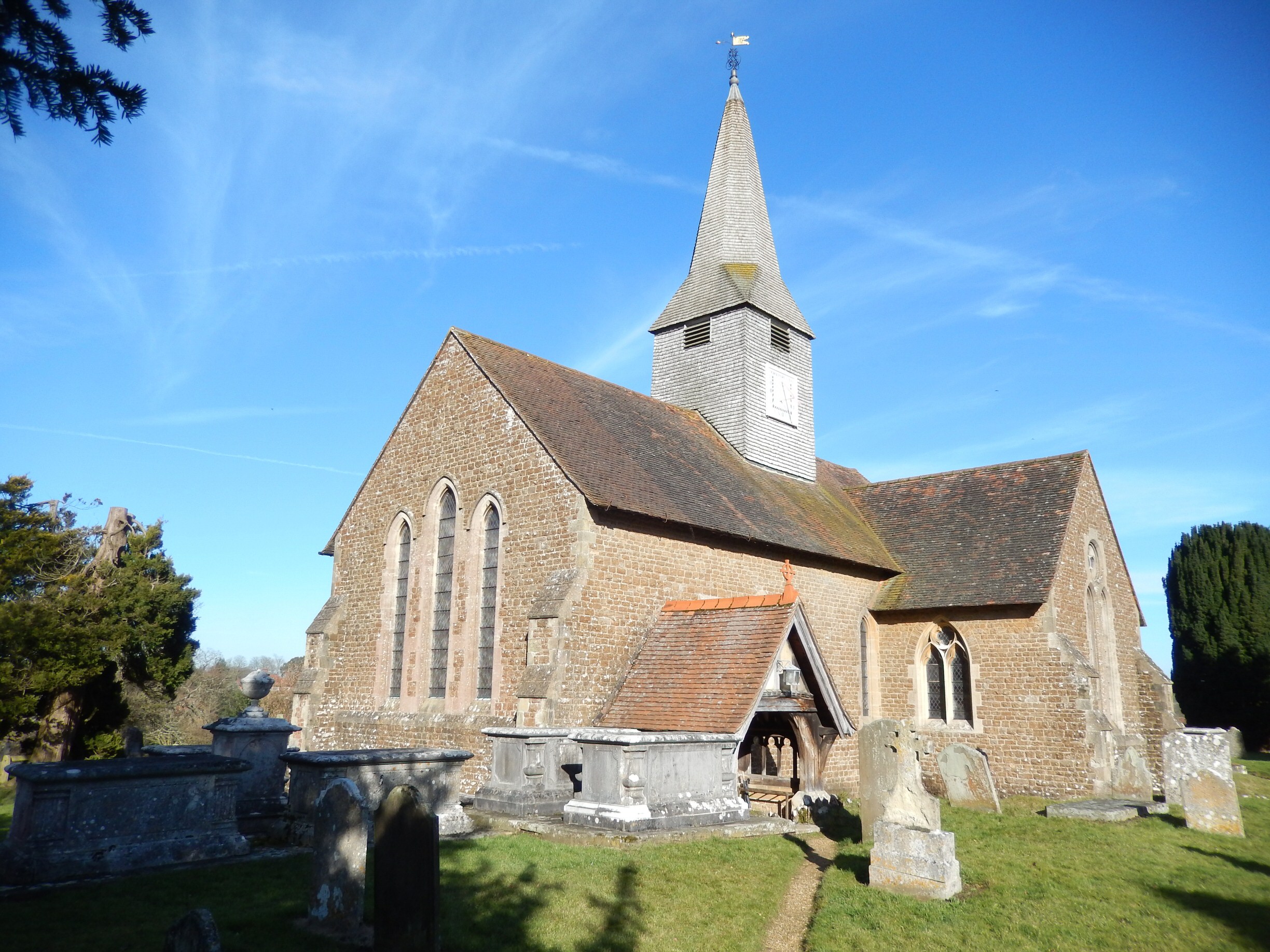
We visited Thursley’s thousand-year-old church – the north side of the choir has two small narrow Saxon windows, walled in for centuries. The church, of St Michael and All Angels, was wisely sited by the Saxons on a ridge of the Greensand, high and dry above the boggy moorland.
St Michael and All Angels Thursley
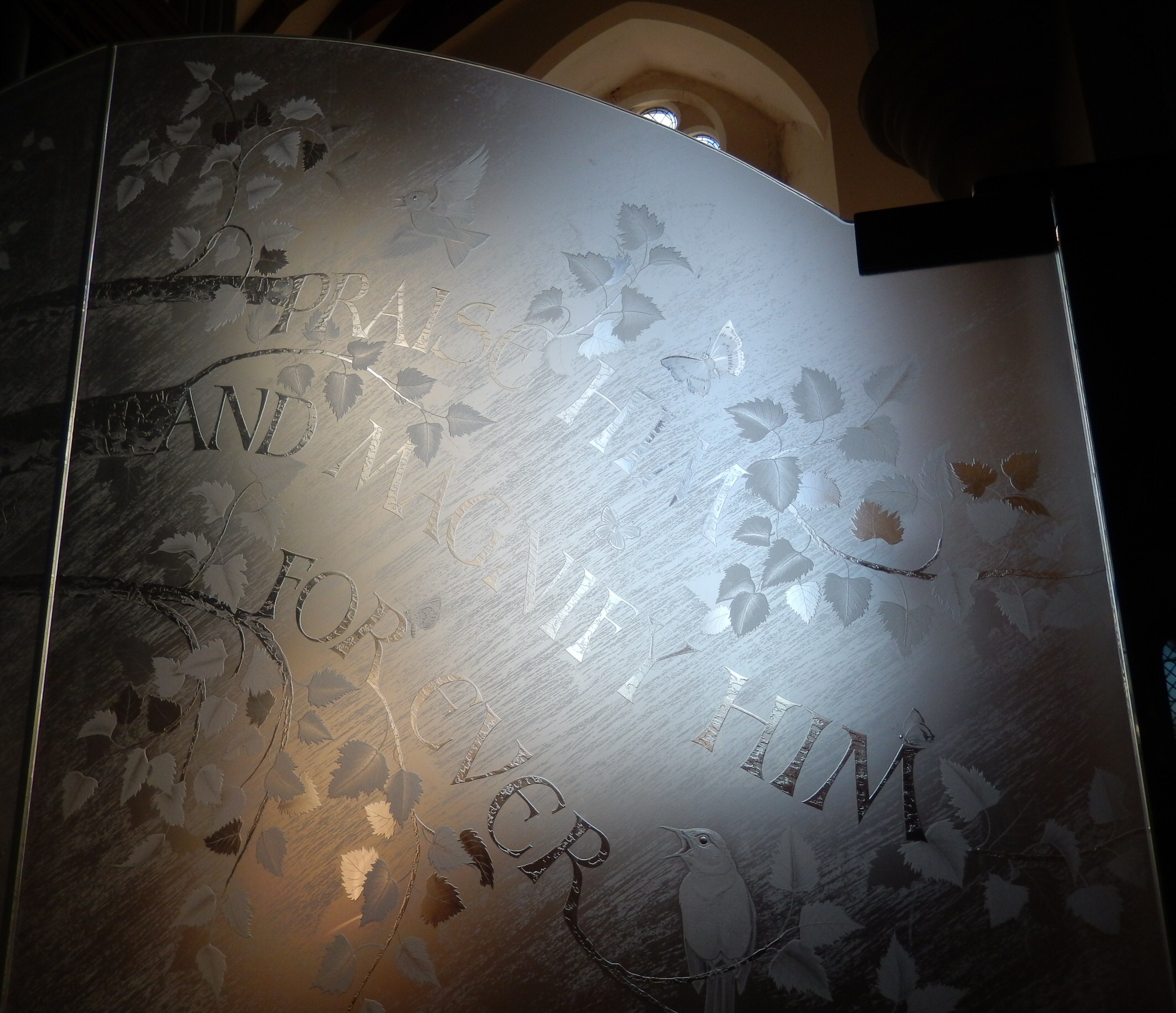
We enjoyed the modern glass doors engraved with a Tree of Life which turned out to be a Silver Birch. Among the animals praising God in the glasswork are a soaring, singing Woodlark; a perched Nightingale; a Lizard, a Purple Emperor butterfly, a Common Blue butterfly, and a selection of dragonflies: clearly the local fauna.
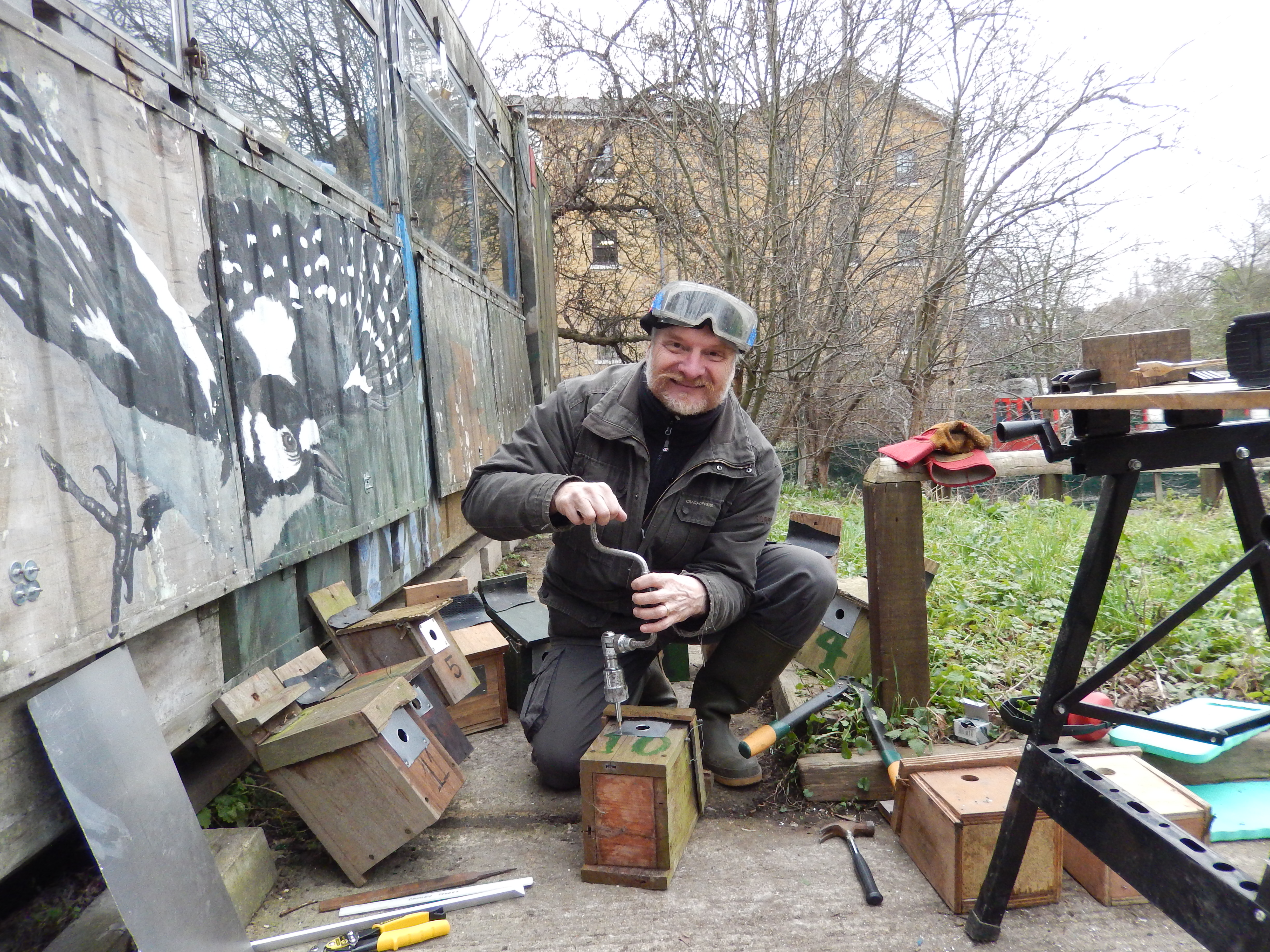
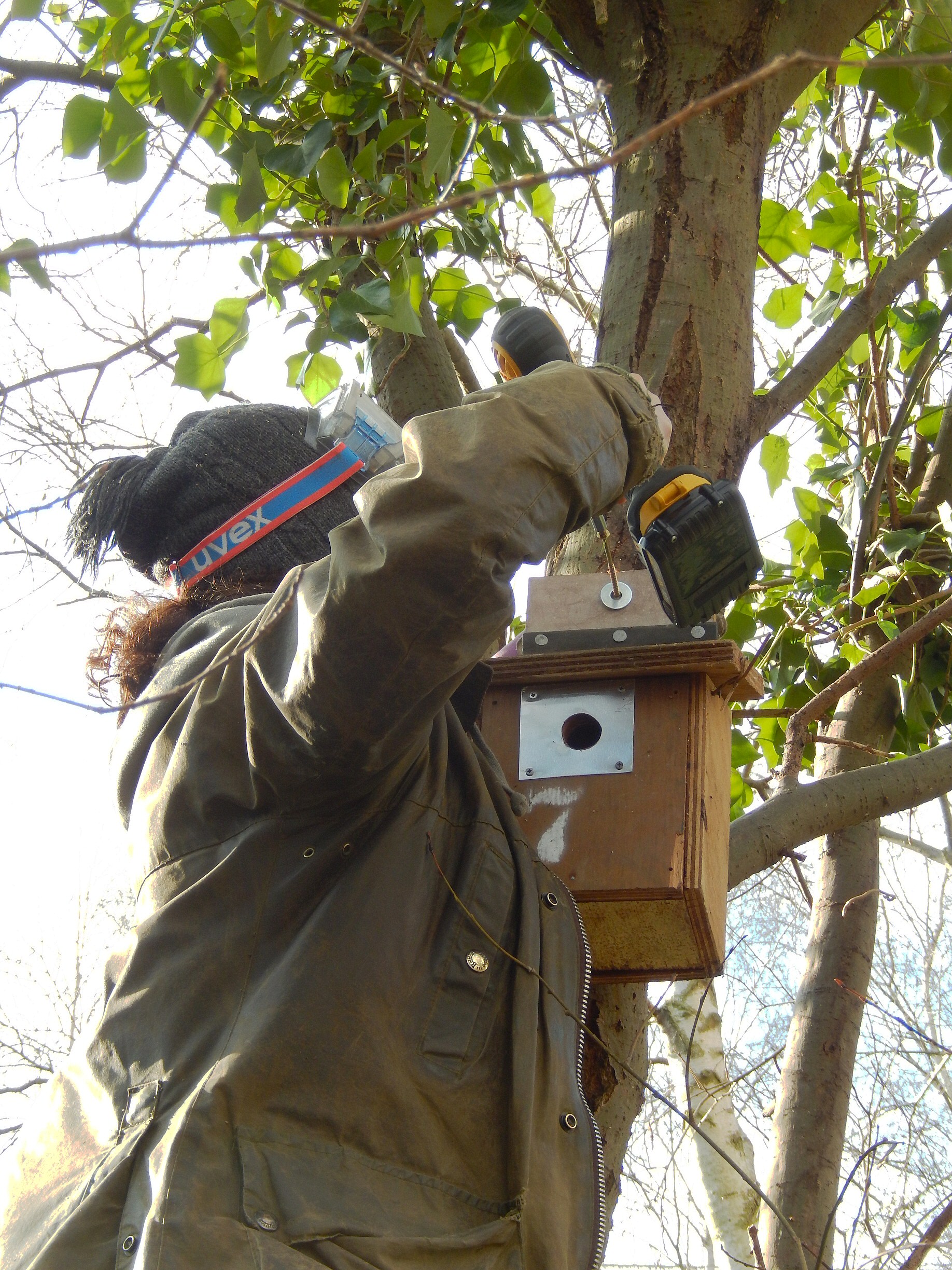
Quick! Spring is in the air, the Dunnocks are passionately singing their tuneless songs, the Great Tits are yelling Zi-Za-Zi-Za-Zi-Za endlessly, the Greenfinches are wheezing out their odd song (‘Zheee’), it’s time to fix those nestboxes. Most of those in the Gunnersbury Triangle had been “hammered” by Tits or Woodpeckers, or gnawed by squirrels. And a few had been rather roughly drilled by humans. So the warden decided that all of them should be given anti-squirrel plates; all, that is, except the Robin boxes, which have a wide rectangular opening in the front.
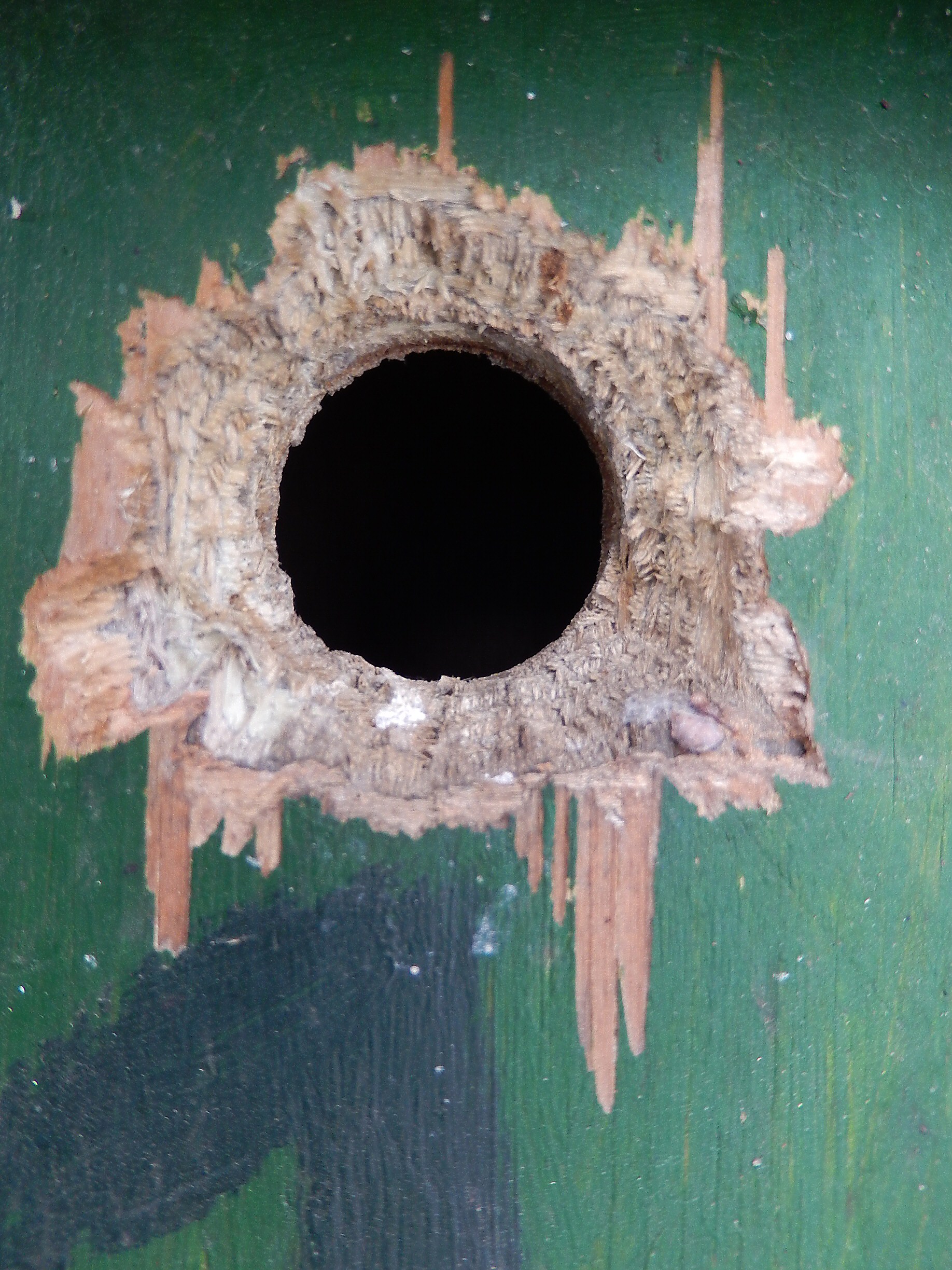
Nestbox hole gnawed by squirrel
A few of the boxes seemed to have been attacked by squirrels. This one has what could be toothmarks and signs of extensive tearing of the wood outwards at a shallow angle, which looks like gnawing rather than hammering. It isn’t obvious why the basically herbivorous Grey Squirrel should do this.
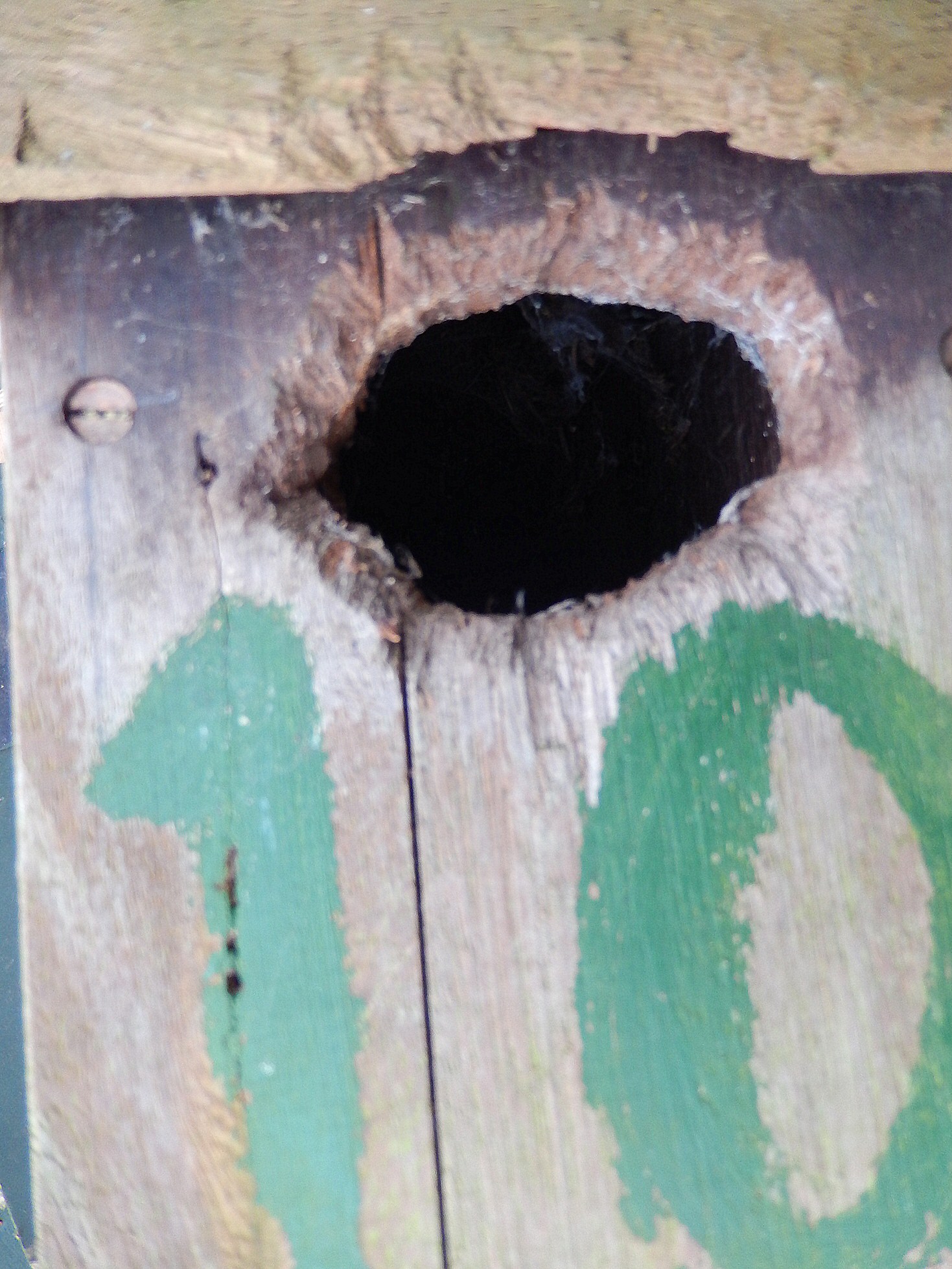
Extensively hammered nextbox
This box, on the other hand, seems to have been hammered at a sharp angle to the surface, whether by the Tits themselves (they certainly do this sometimes) or by Greater Spotted Woodpeckers preying on nests – although they mainly eat insects and seeds, they do take eggs and chicks when the opportunity arrives.
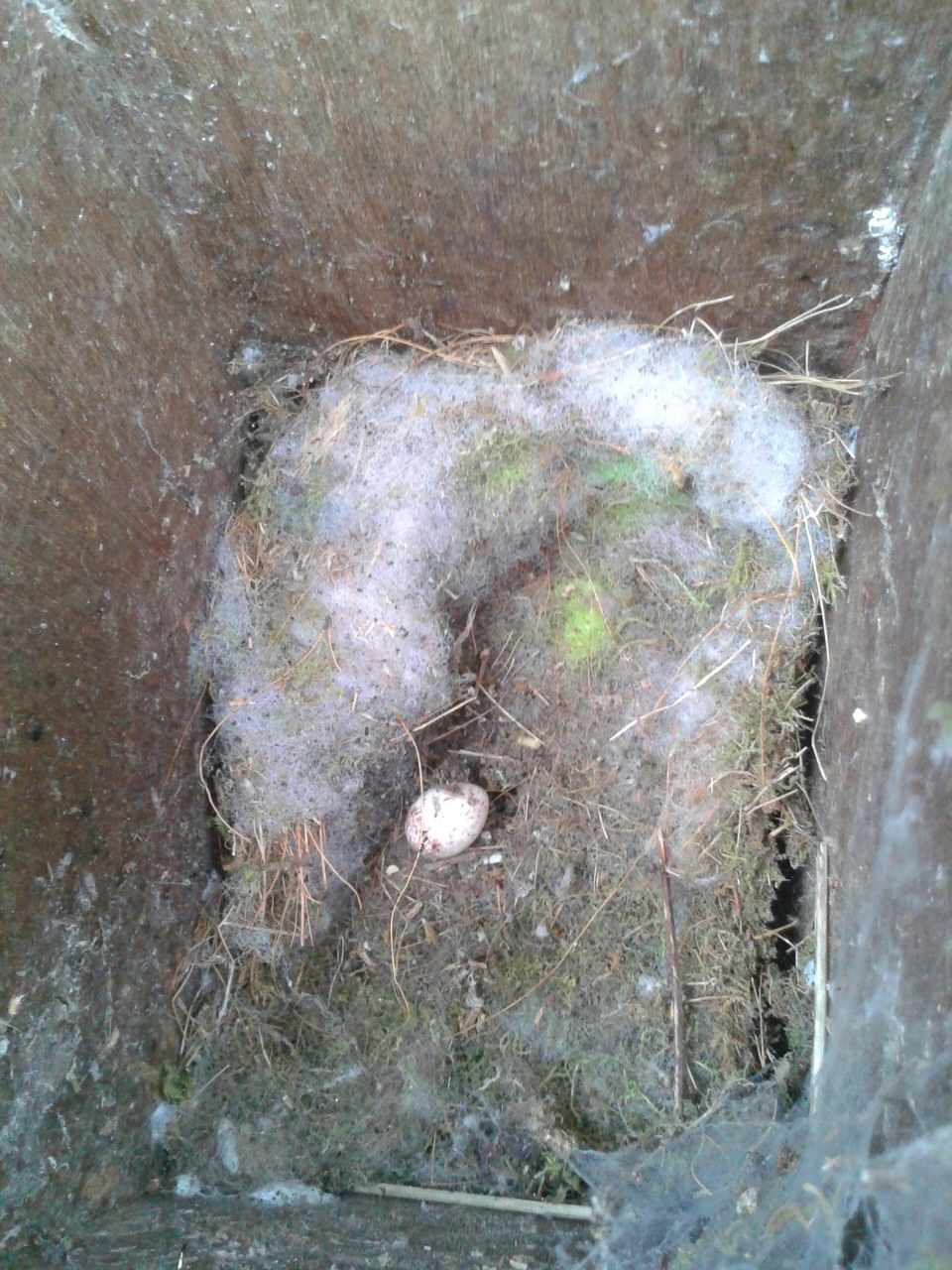
Old nest with tit egg inside nestbox
At least 4 of the nestboxes had substantial and reasonably fresh remnants of nests inside; this older one contained two long-addled tit eggs (just one shown here; it was 16 mm long) with a mixture of moss and down as insulation.
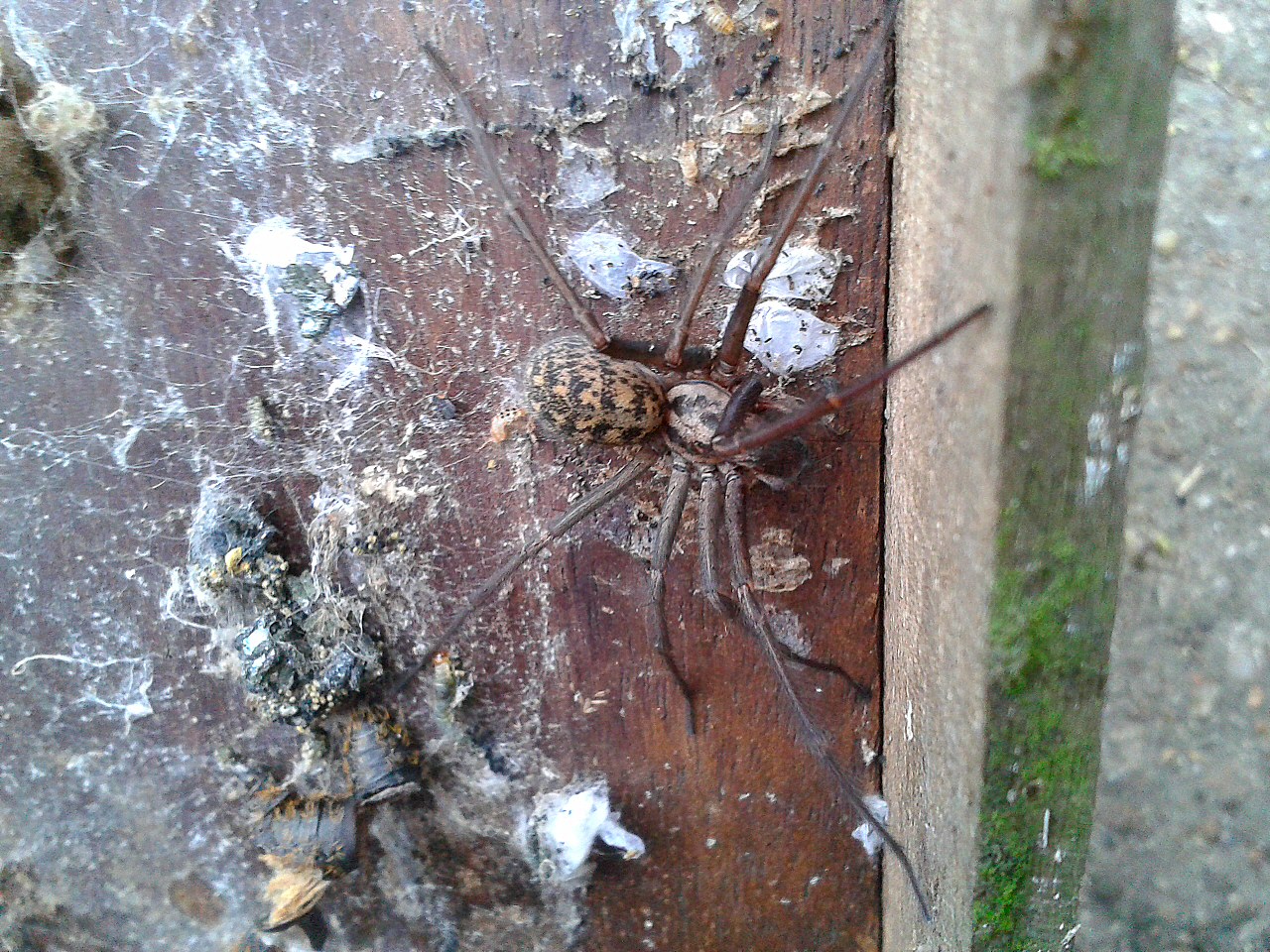
Tegenaria, the Giant House Spider, at home in a very messy nestbox
Finally, one very old nestbox, carefully engineered with beading around the hinged lid complete with little brass hooks, contained a Giant House Spider, Tegenaria, a lot of beetle pupae, and what could be Gypsy Moth pupae as well. The box was a messy tangle of thick sticky cobweb, and the spider was distinctly reluctant to leave, seeming to want to stand and fight off any intruder.
All in all, what might have seemed a mundane bit of metalwork turned out to be a day full of interesting natural history. (But the metalwork was fun, too.)
In an earlier post, Archaeology: Human Natural History, I wrote about some of the wonderfully rich history that can be gleaned from a walk along the bed of the River Thames at low tide. I delighted in the pottery and pipe-bowls, as I do still.
But today, on a gloriously sunny, still and almost warm day with the tide right out, and the Egyptian Geese honking stridently and flying about — three pairs, and an equally loud loner — my walk along the river produced unexpected and equally delightful results.
Along with a nice potshard of Maling ware (it says “S” “MAL” and half an “H”) , I found an enormous toe-bone of a horse, 95 mm long. It fits snugly in my hand; it’s roughly the size and shape of a pistol grip, and as heavy. It was a proximal phalanx – the sequence is distal (hoof bone) – medial – proximal as you go up the leg. Now, today, one can barely imagine throwing a horse bone into a river. But in the days before public health officers and EU safety regulations, it was nothing strange. For a start, London was full of horses, both fine beasts for gentlemen to ride, or to pull their carriages; and small, tired, sometimes broken-down nags that pulled the rag-and-bone man’s recycling cart, and everything in between. For another thing, people ate horsemeat, as they do today (in decreasing amounts) all across the continent of Europe. If you were poor in Victorian London, horse stew must have been a rich, warm, nutritious and welcome dish: even if the horse had died of old age.
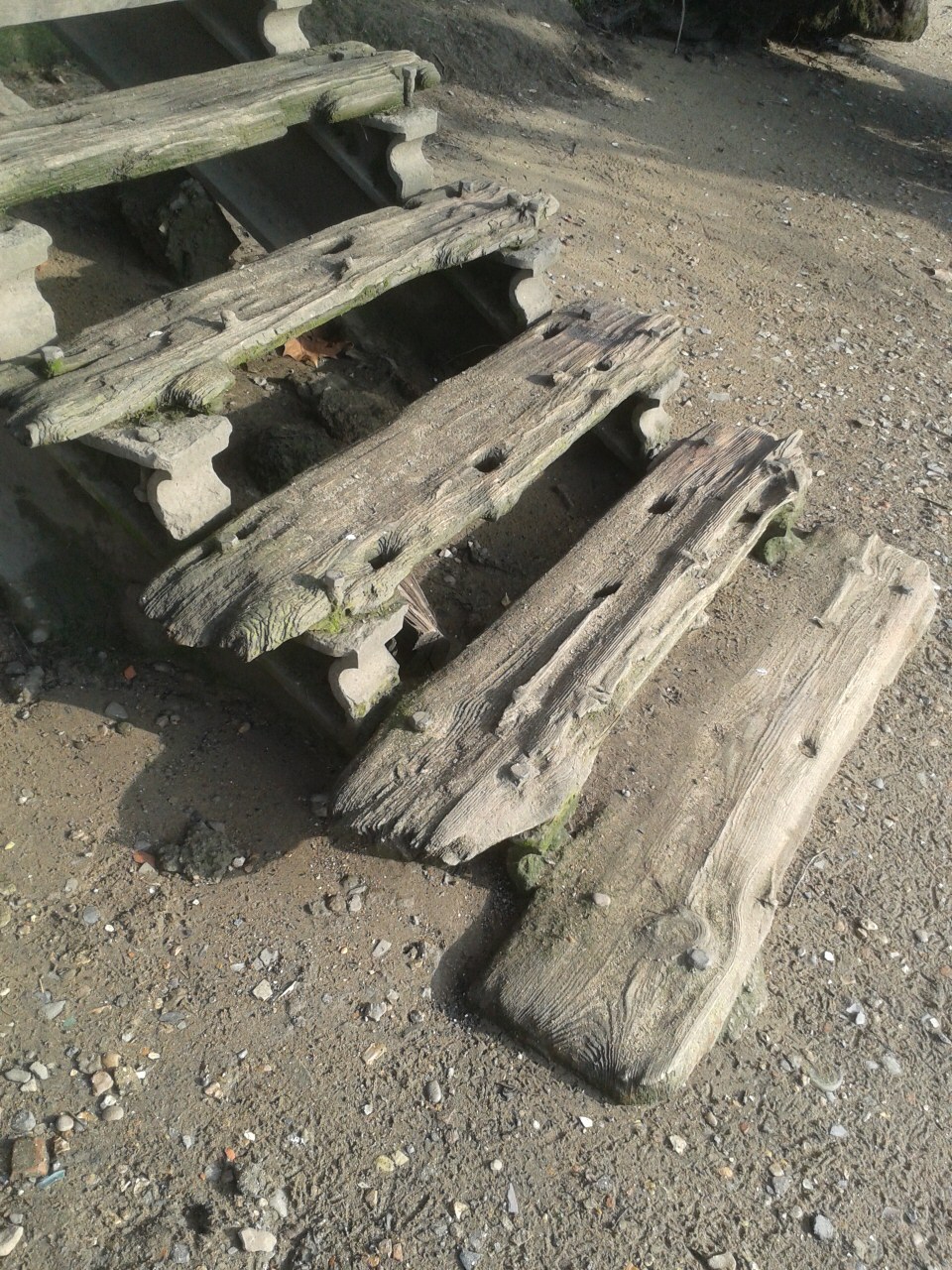
Water-worn wooden steps
In the soft light, a set of old wooden steps, the timbers worn and scoured by thousands of tides carrying currents of mud, sand, shell and even shingle, were quite beautiful in their natural simplicity, revealing the structure and fibres of the once-thick and rectangular treads.
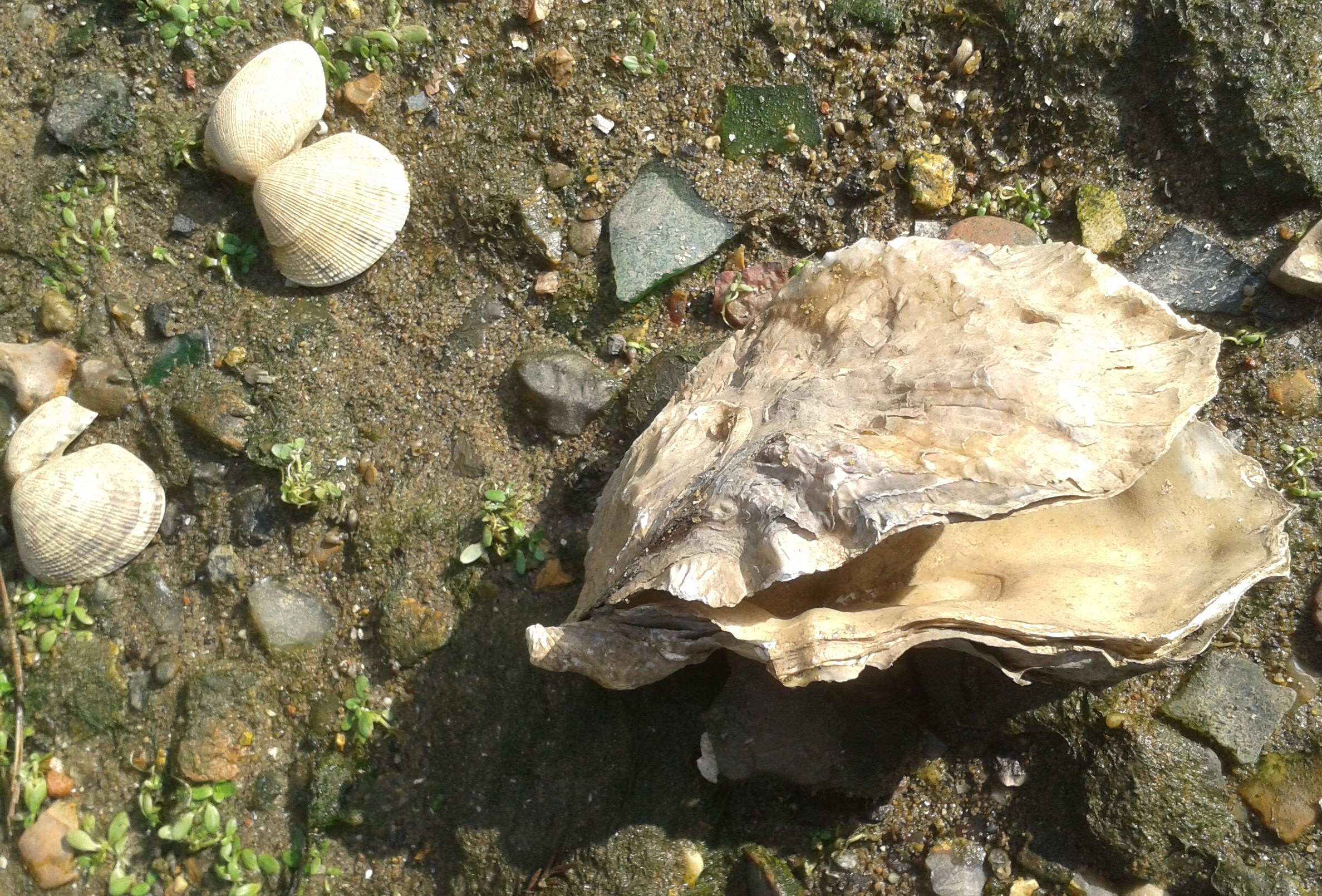
On the sand a little way further were scatters of Oysters and Cockles, with some other kinds of clam for good measure.
Cockleshells, Oystershells
Now at first sight there is nothing very surprising about finding shells in a tidal river: sea shells, sea water. But these are fully marine species: they need salt. And are they not suspiciously fresh? Indeed, they are still articulated. Someone, having enjoyed an excellent seafood dinner, has still, this year, happily thrown out their shells onto the river bed, just as their ancestors did before them through the centuries. The fresh pottery fragments indicate that broken cups, plates (and indeed also pub glasses and bottles) similarly continue to find their way into the the river’s archaeology, just as they have for centuries, if not millennia. The river of life flows on; man’s natural history, his interaction with wild-caught or farmed animals (from horses to horse mussels, perhaps) leaves behind its small detritus of bone and shell, from one generation to the next.
What will the archaeologists of 2,000 years hence make of our generation, our few varves in some long sequence of layers of lake-mud? It is a curious reflection. In the sixties we hoped that it wouldn’t be a plutonium-iridium layer for them to puzzle over. Let’s again hope that it won’t be that.
The English seem unemotional … except for their passion for nature