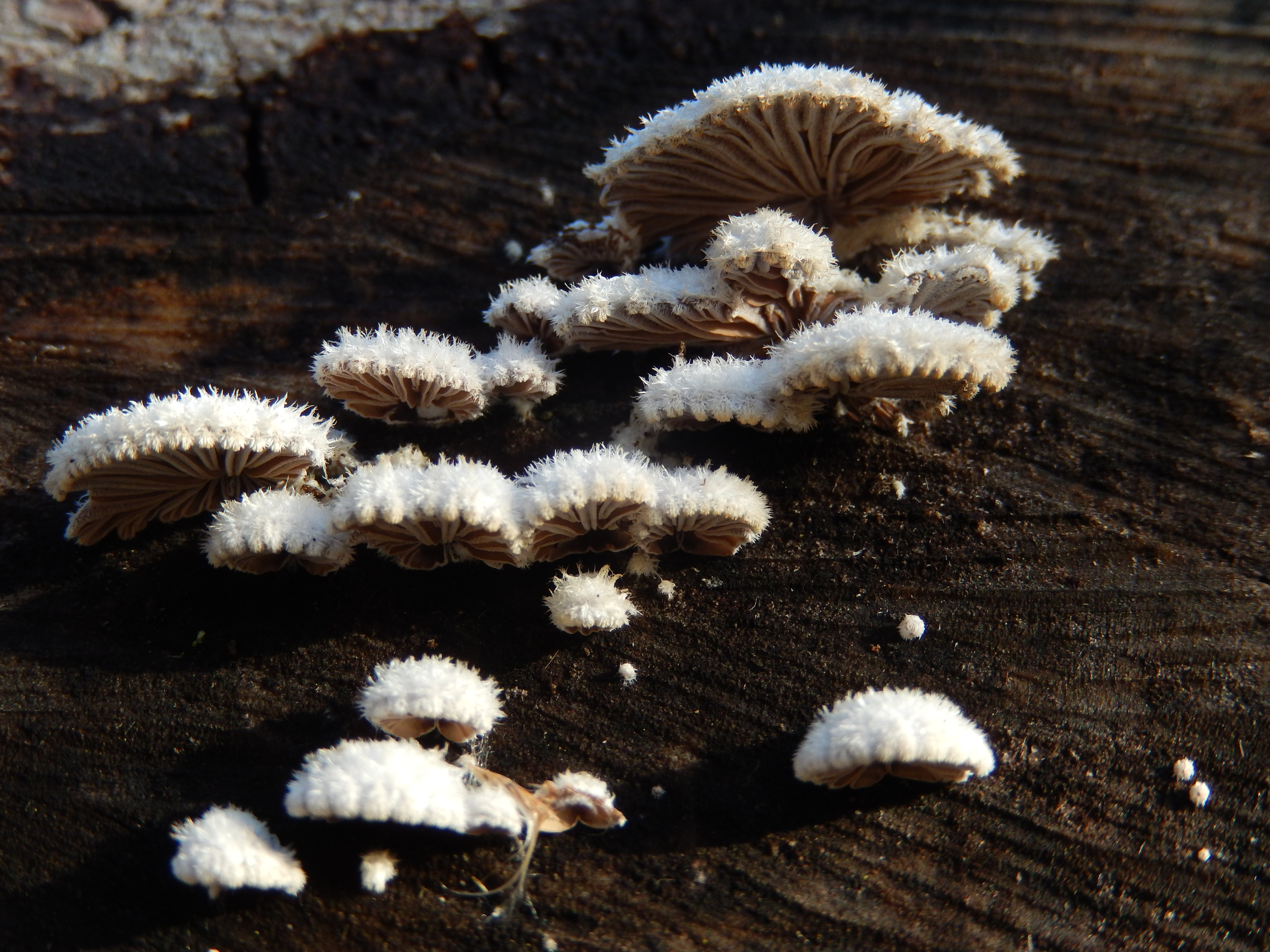
2 January may not seem like a good time for mushrooms, but even now there are interesting and beautiful species to be seen. The Variable Oysterling, Crepidotus variabilis, is as its name implies able to take on different appearances. Here its small cap is distinctly fluffy with tufts of hyphae. The gills are fairly widely spaced, and extra ones are inserted (ok, intercalated) towards the edges.
Crepidotus variabilis – small fluffy white fungi clustered on log
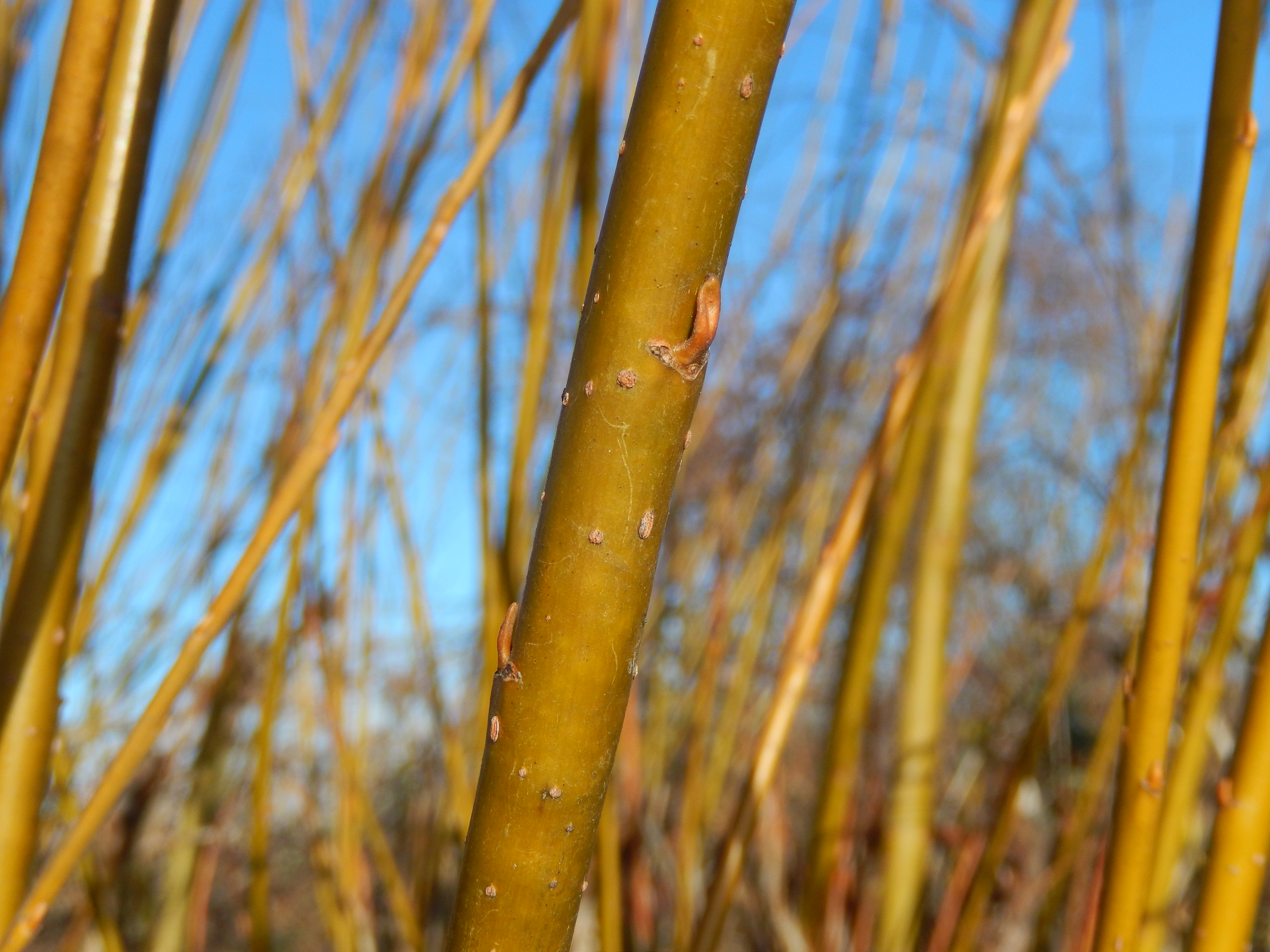
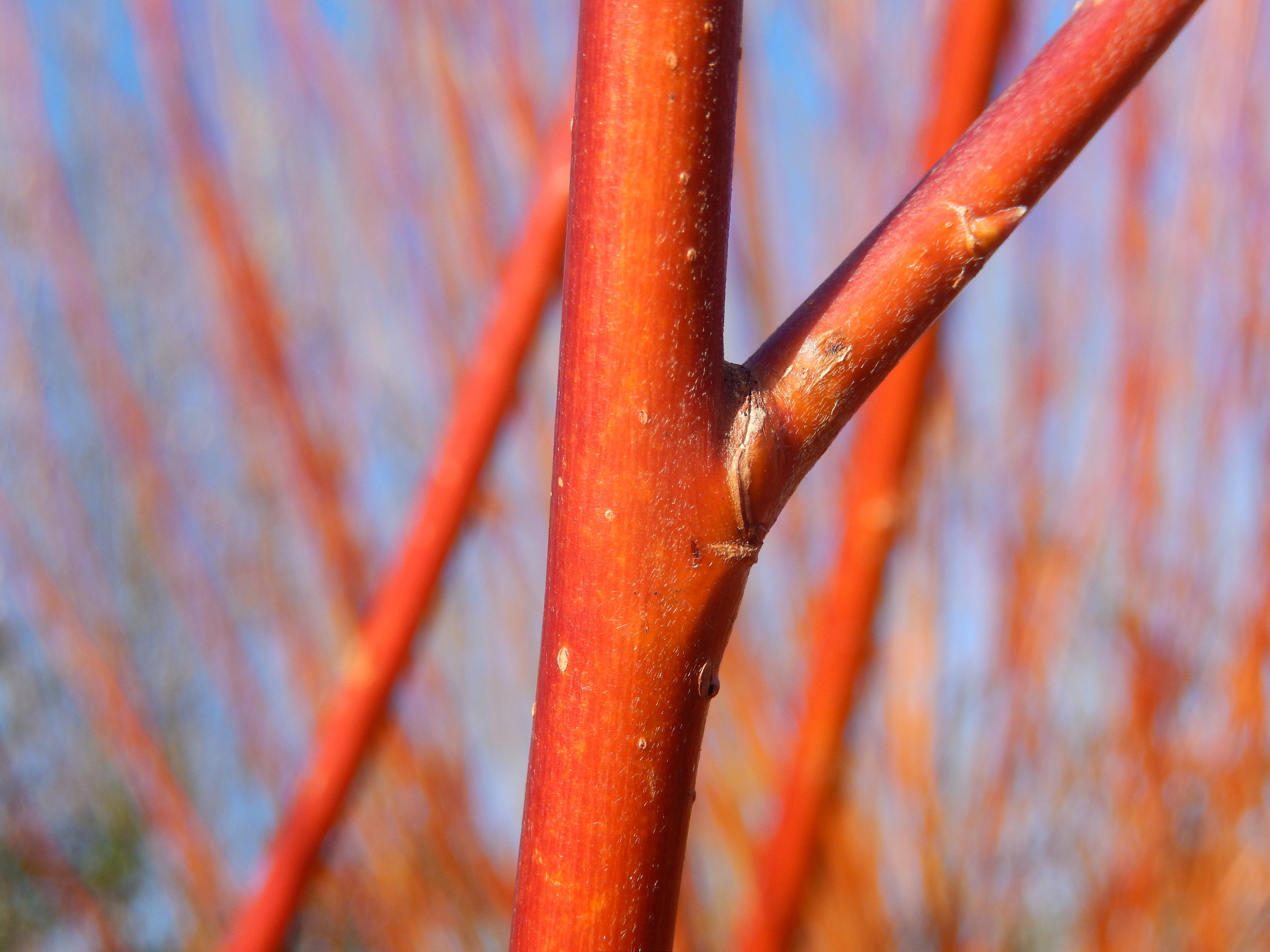
The Osiers – long thin whippy poles of willows ideal for basket-making – are seen at their most colourful in midwinter.
Green OsierRed Osier
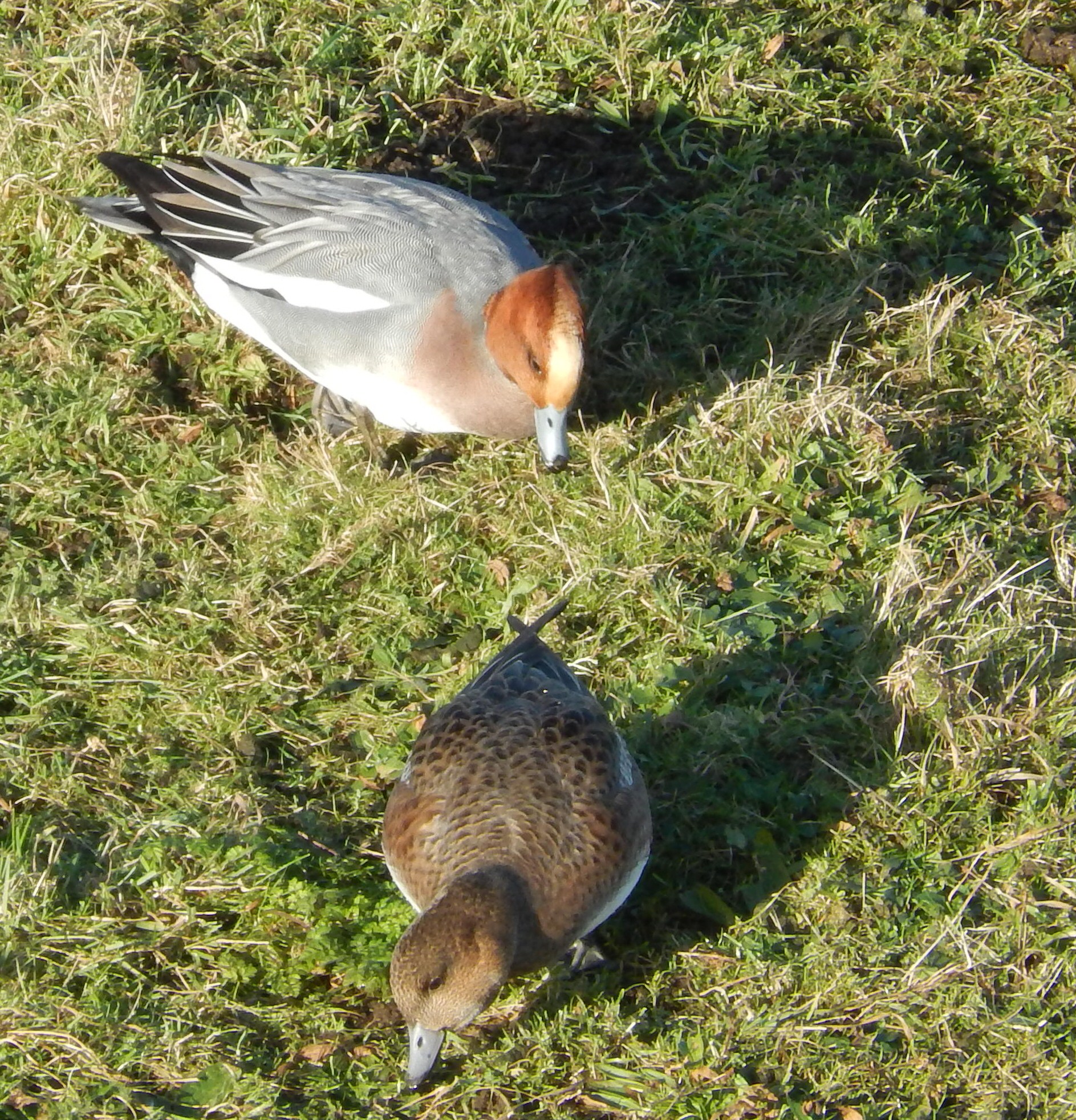
A flock of sixty or more grass-eating Wigeon, the males handsome with rufous heads complete with yellowish Mohican centre-stripe, grazed hungrily on the lush grass of the marsh. It must be a lot more welcoming than the frozen wastes of Scandinavia or Arctic Russia, where these birds have probably flown in from.
It was too sunny and warm to sit at a desk writing, so I took bicycle and binoculars and went along the Thames path to the Wetland Centre. Even in a T-shirt it was warm work, feeling more like an English July (ok, that’s not saying much) than the last day of November .
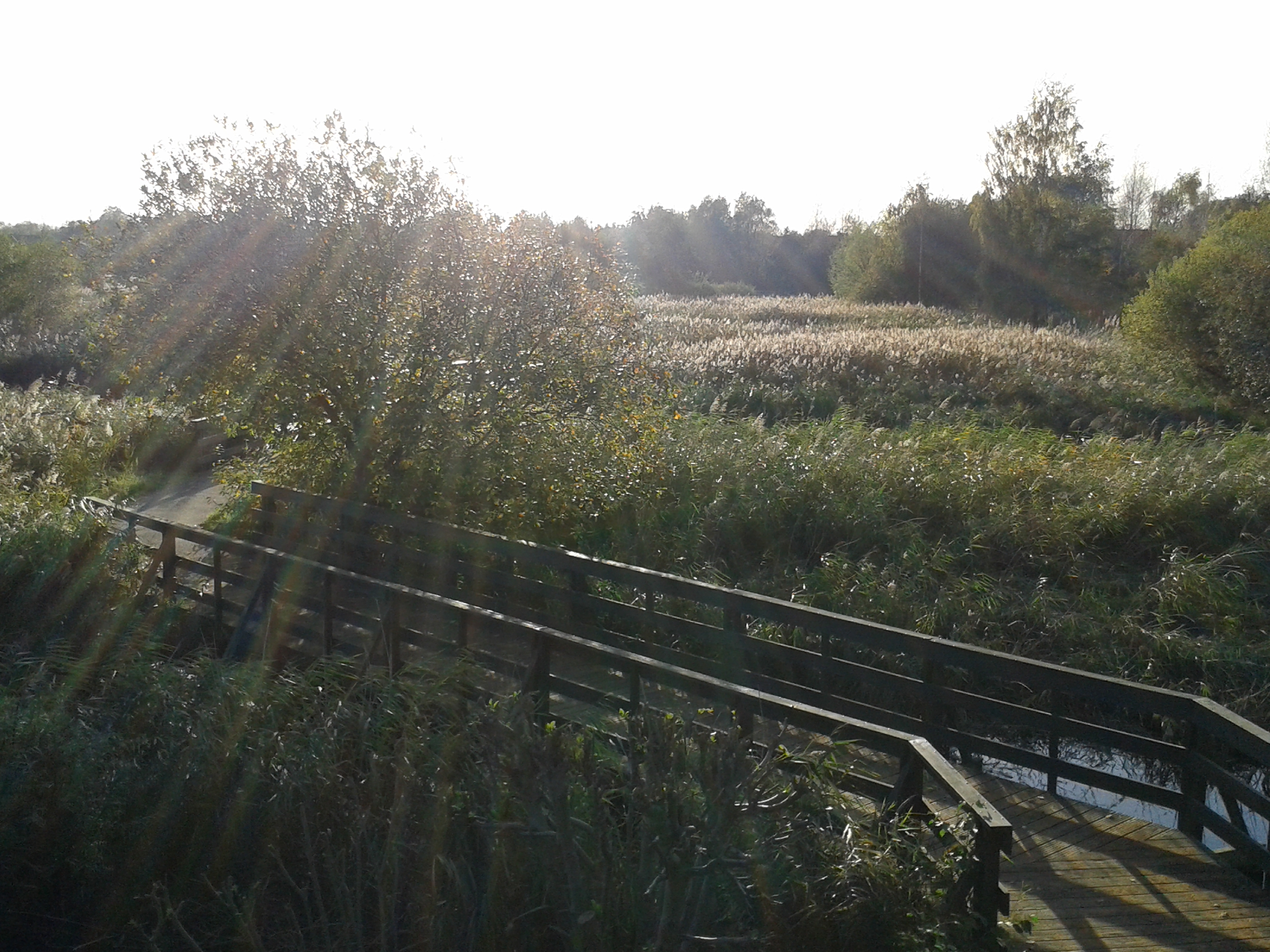
Afternoon sunbeams on a very warm Halloween at the Wetland Centre
Inside the Centre I passed some diminutive witches and warlocks: they seemed to be sweating uncomfortably inside their costumes. I took a swig of water and cooled off in a hide; two rare migrants, Green Sandpipers, bobbed daintily at the end of one of the little islands, dwarfed by a Black-Headed Gull and a Moorhen, neither of them particularly large birds. Their habit is not unlike that of the Common Sandpiper, but they lack the white streak that rises in front of the wing. One of them took flight, its slender dark wings and white belly giving it something of the look of a rather large and clunky House Martin. It felt very odd to be watching autumn migrants on such a summery day.
Over at the wader scrape, a Little Egret strutted and once fluttered across the shallow water; it is an uncommon visitor here, though becoming more usual along the south coast marshes and estuaries.
A Green Woodpecker bounded over the grazing marsh in its distinctive undulating flight, its red cap and green body showing beautifully in the hot sunshine, with a loud laughing call in case anybody was in any doubt what it was.
A Cetti’s Warbler sang its bold short song, Chwit-i-pit-i-pit, Chwit-i-pit-i-pit, as usual invisible deep in a reedbed.
Out on the open water, numbers of winter ducks are (oddly, given the summery weather) building up; several Shovelers dabbled; some dozens of Wigeon grazed; a few Teal, the drakes in glorious colour, swam nimbly about with some Gadwall.
Even on the way home, I had no need of a pullover. The BBC weather report confirmed what everyone instinctively knew: it was the warmest 31st of October ever recorded in Britain, with an astonishing 23.6 Celsius in London. Of course, a cold front is forecast.
P.S. The next morning was grey and rainy, autumn on the way. Two large grey Mistle Thrushes flew overhead, rasping out their wintry calls, like a boy blowing over a comb covered in tracing paper.
P.P.S. Four days later, after a clear starry night, the sun rose over a chilly town on a fine November morning. It was winter.
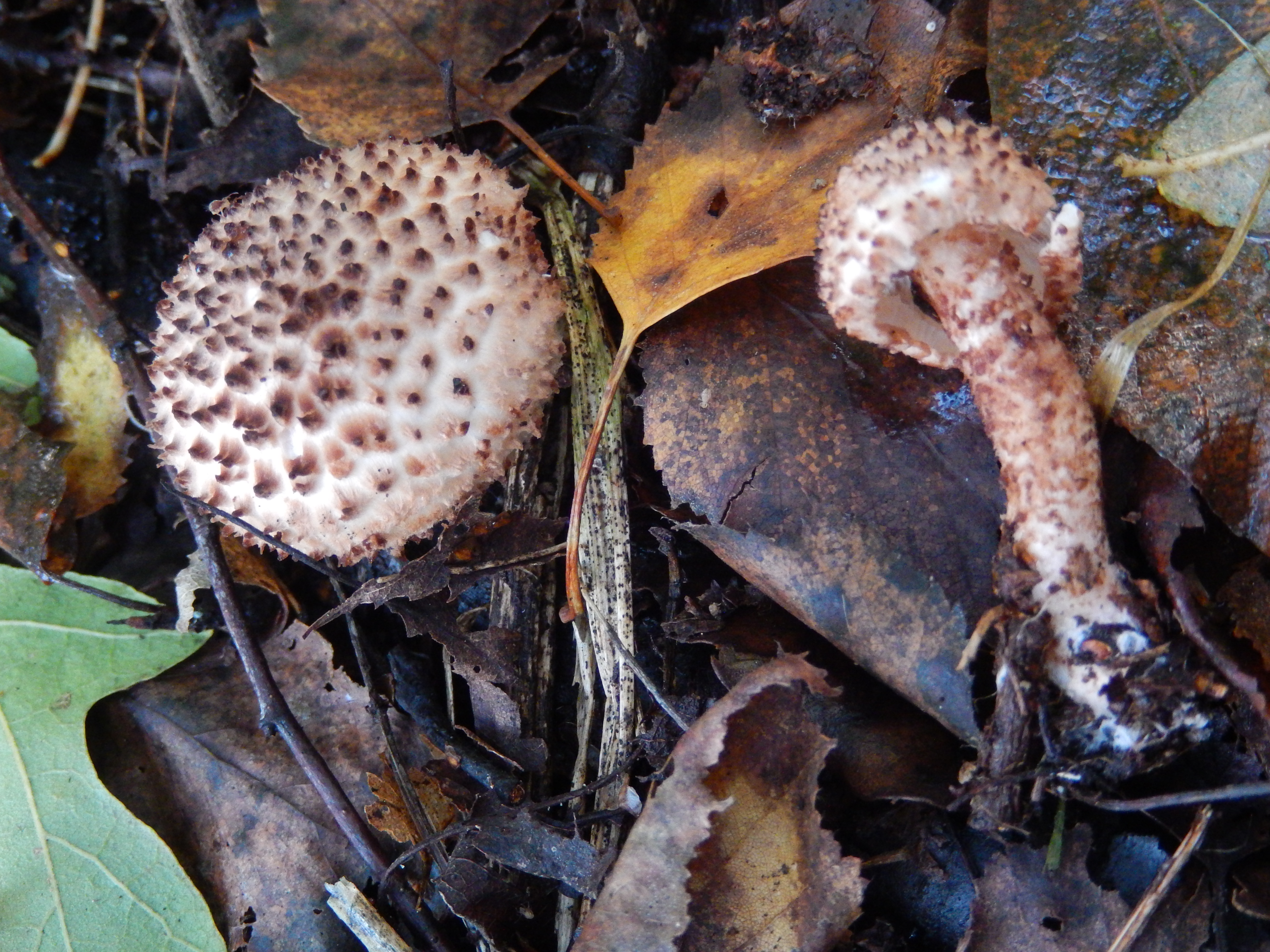
Well, despite the extraordinary warmth of both September and October – I was still working in a T-shirt down at the Gunnersbury Triangle nature reserve today, anything more being too hot – the fungi have finally come out in earnest. This small speckly Dapperling seems to be Lepiota hystrix, a rare species.
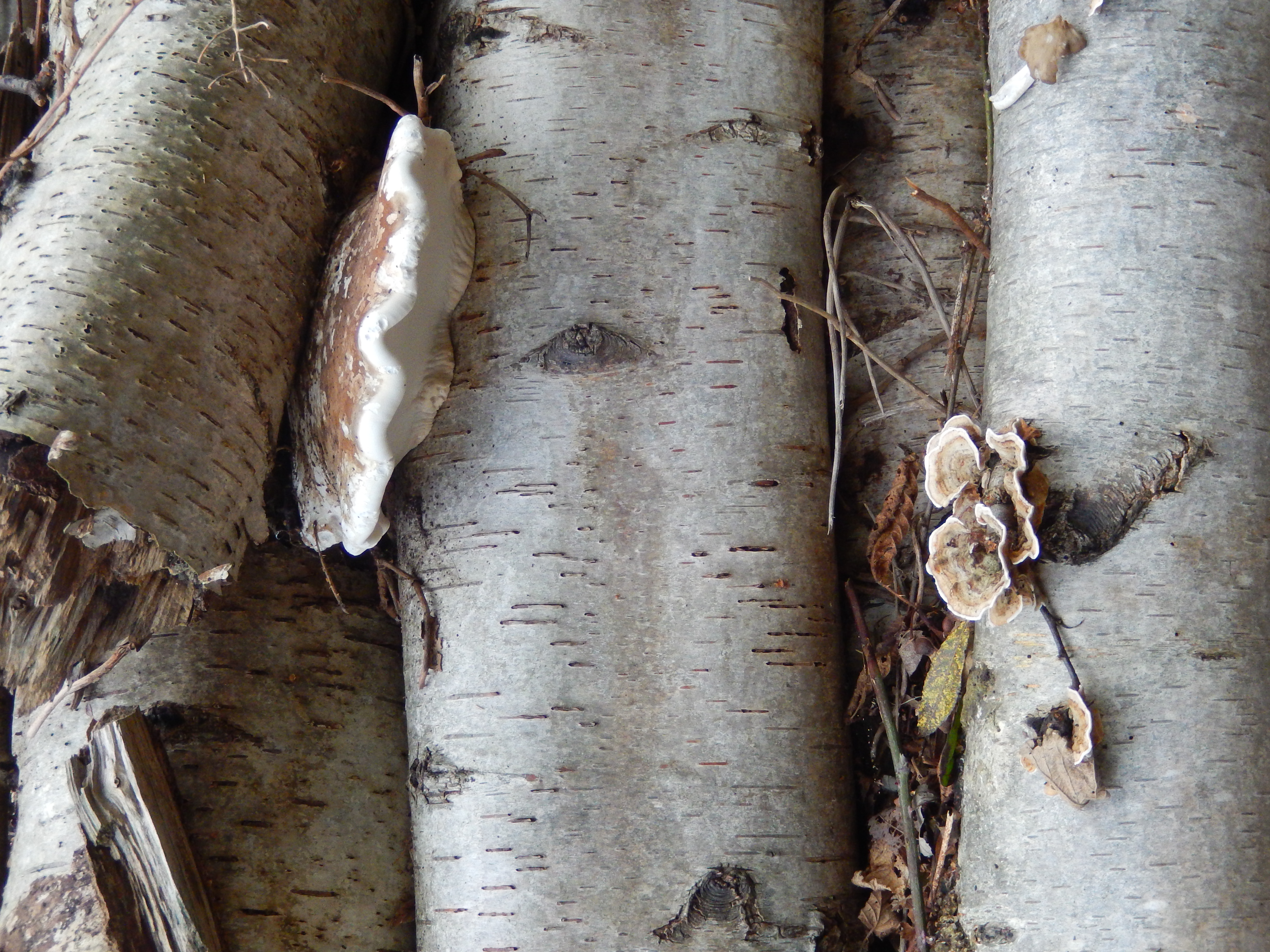
Birch Log fungi
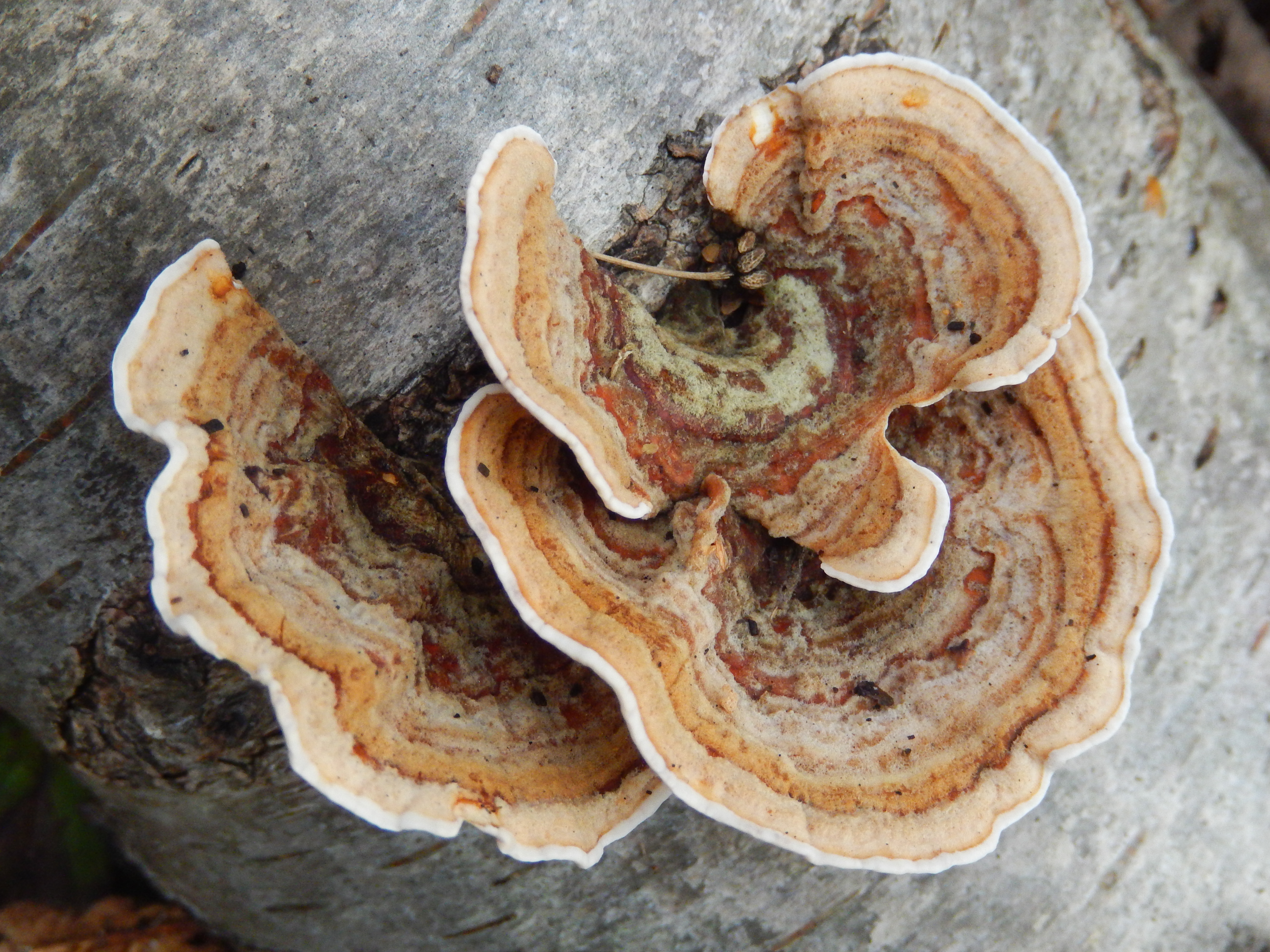
Several fungi were on show on a pile of birch logs, including a large Birch Polypore and some elegant smaller Turkeytail brackets as well as Orange Curtain Crust.
Turkeytail, Trametes (Coriolis) versicolor
These handsome Common Cavaliers were growing beside the path.
Common Cavalier Melanoleuca polioleuca (aka M. melaleuca)
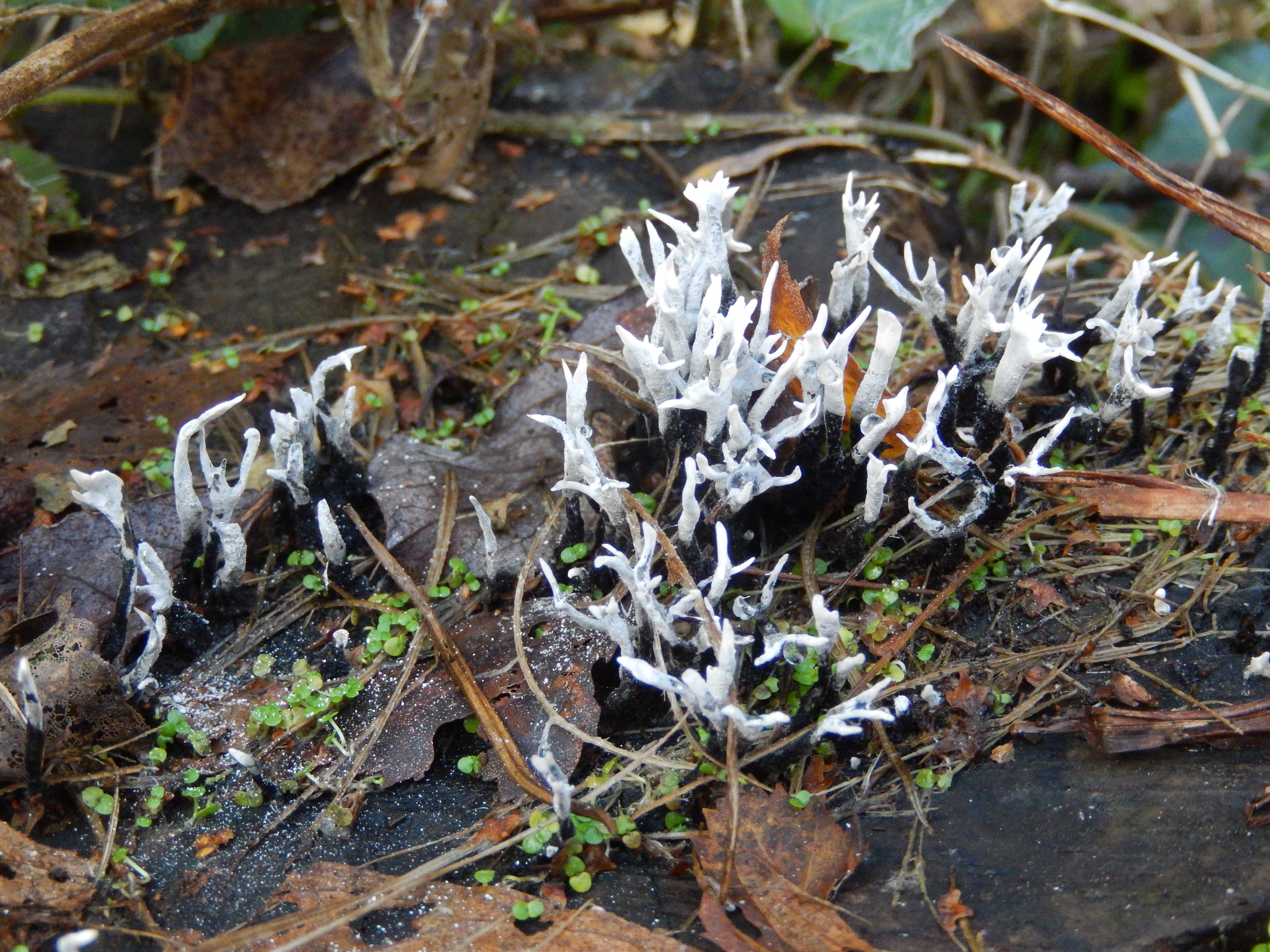
Many damp rotting sticks and stumps had Stagshorn or Candlesnuff fungus growing out of them, Xylaria hypoxylon. These were thin and stick-like early in November, well-developed by 20 November.
Stagshorn Fungus, Xylaria hypoxylon, well developed
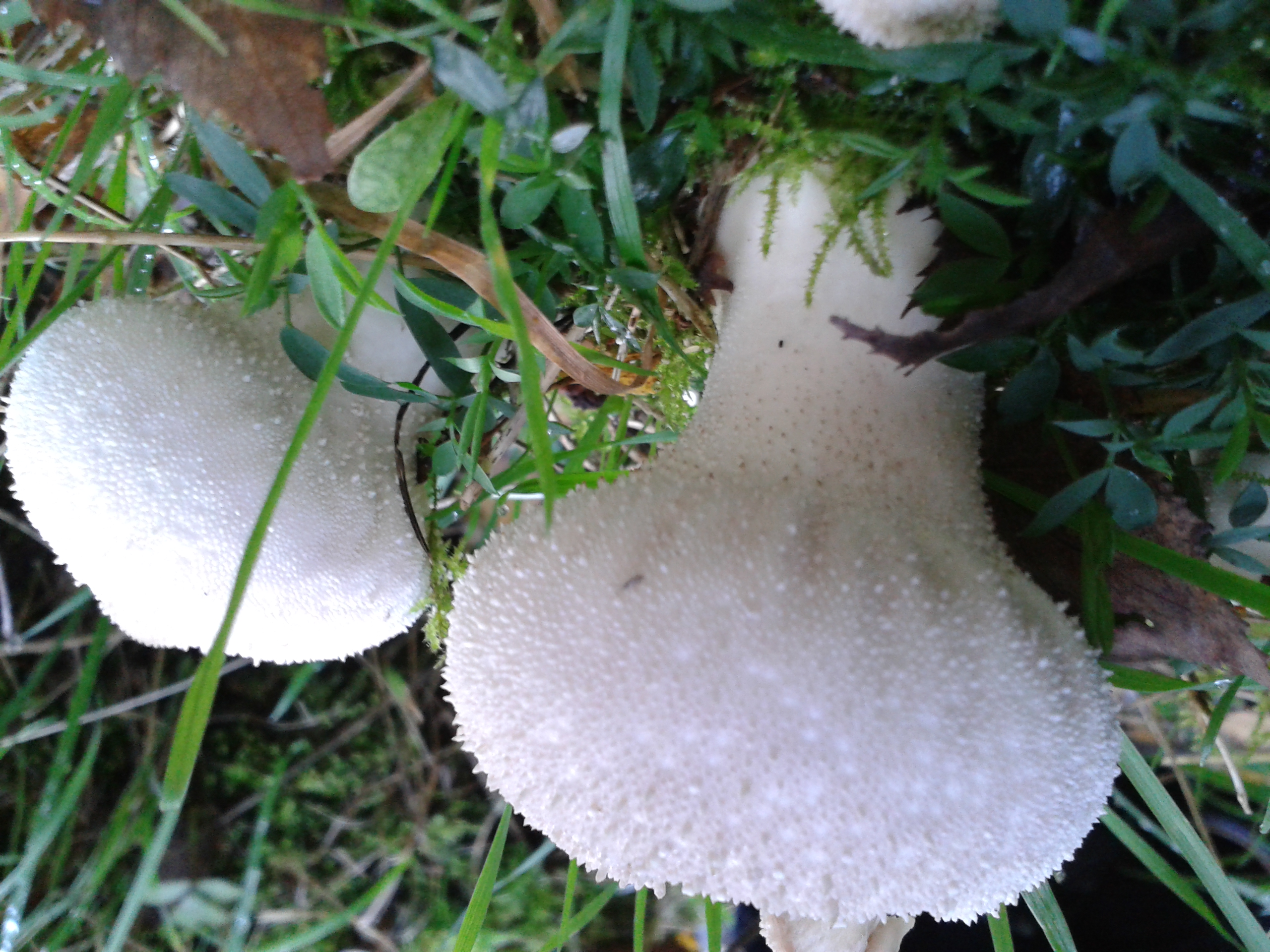
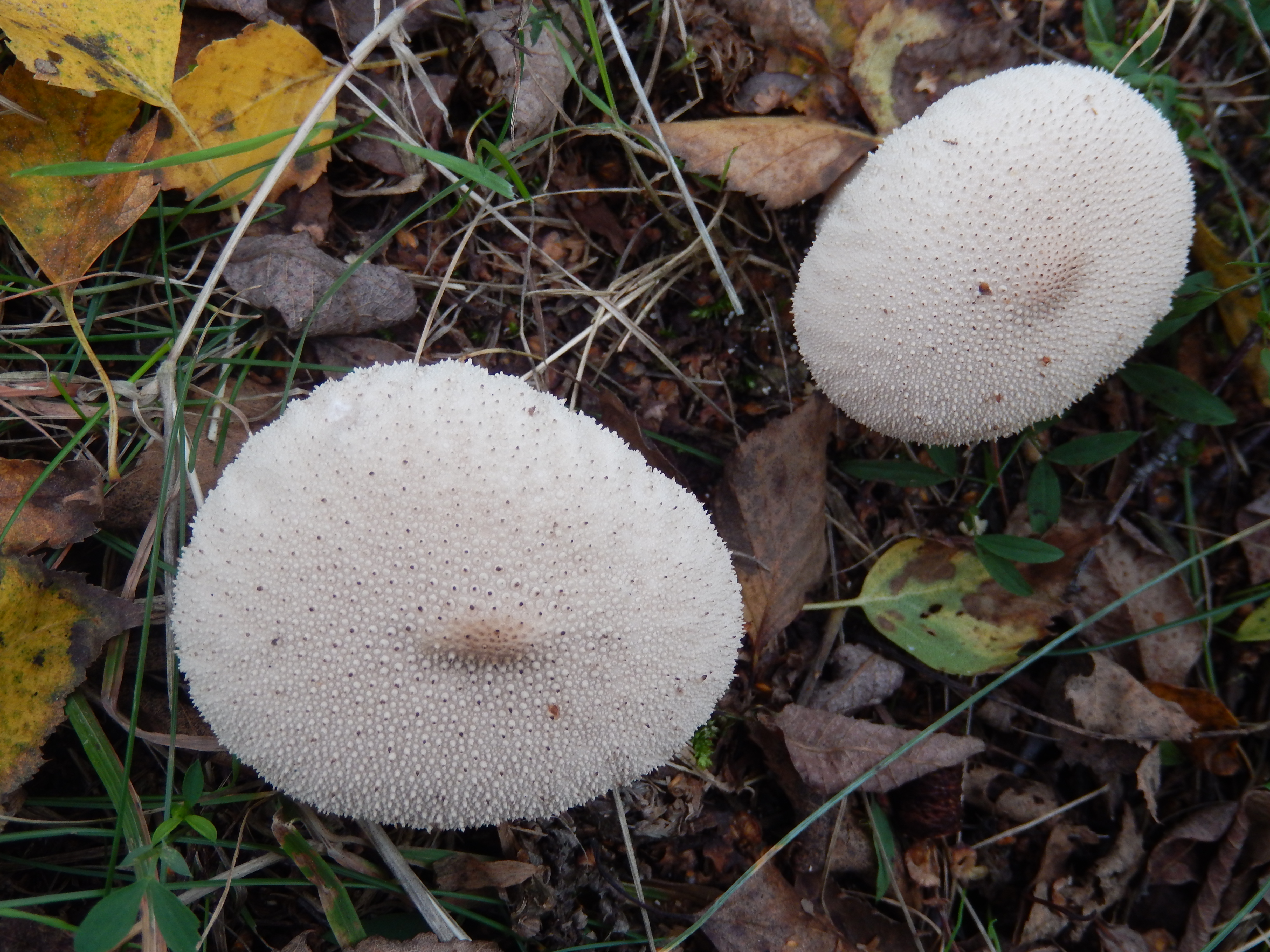
In the anthill meadow were plenty of puffballs, Lycoperdon perlatum. They certainly looked pearly, as their specific name suggests.
Good big Common Puffballs, Lycoperdon perlatum
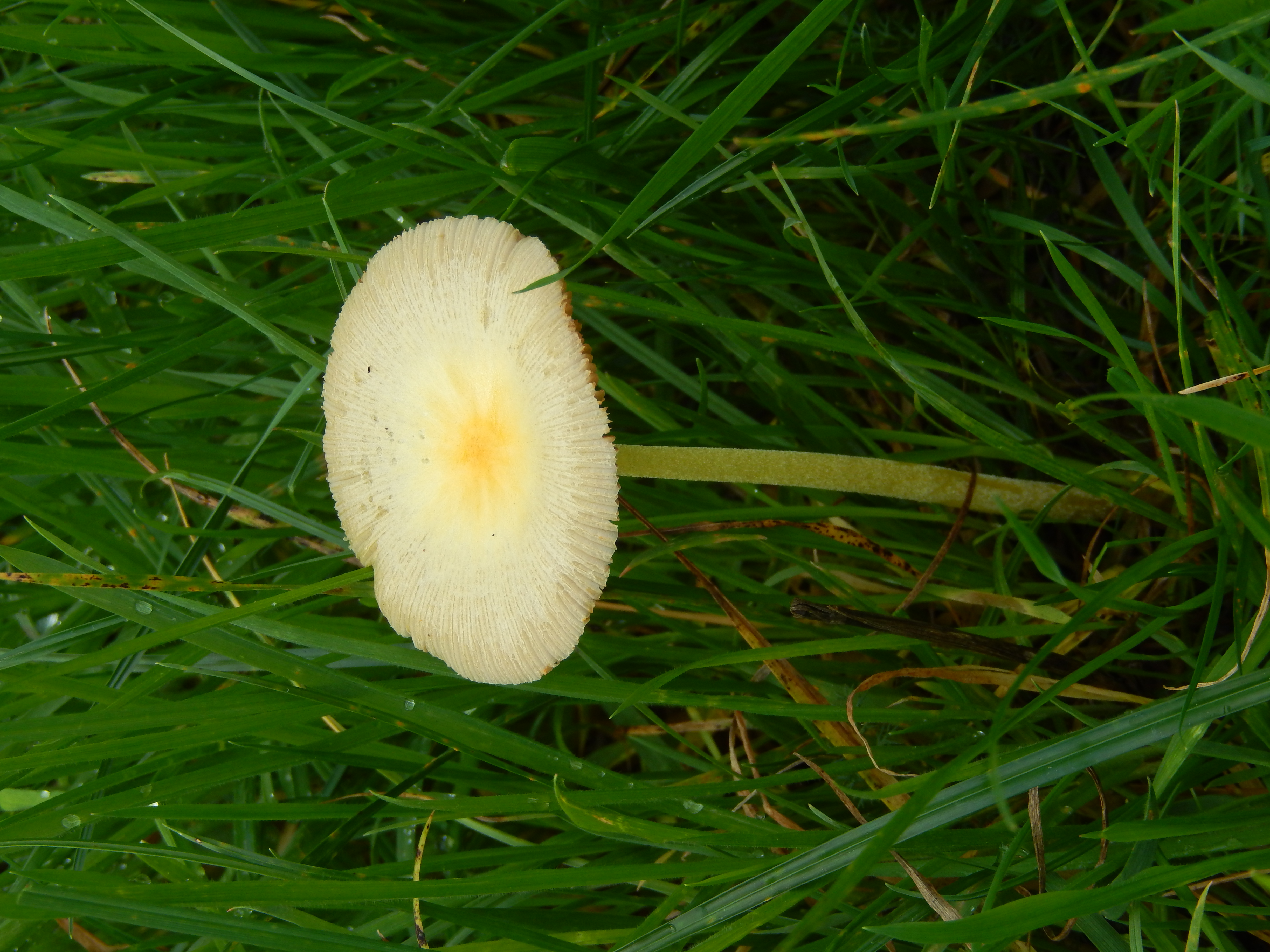
In the picnic meadow was a tall slender yellow Inkcap, Coprinus auricomus.
The delicate, lemon-yellow Coprinus auricomus
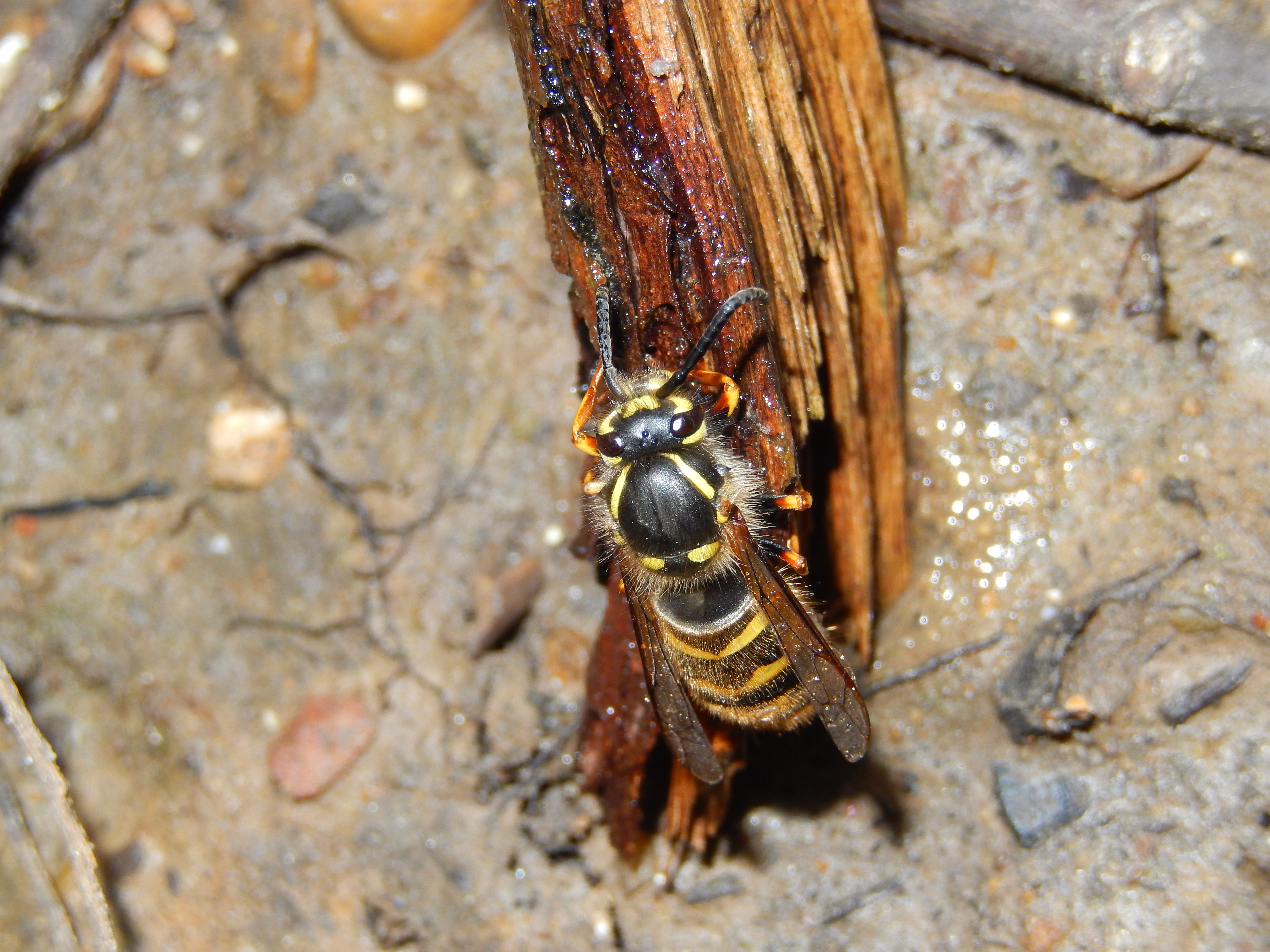
A long-bodied wasp, surely a queen, was trapped in the surface film of the pond by the parish boundary stones. We rescued her with a stick to get a closer look.
Queen Wasp
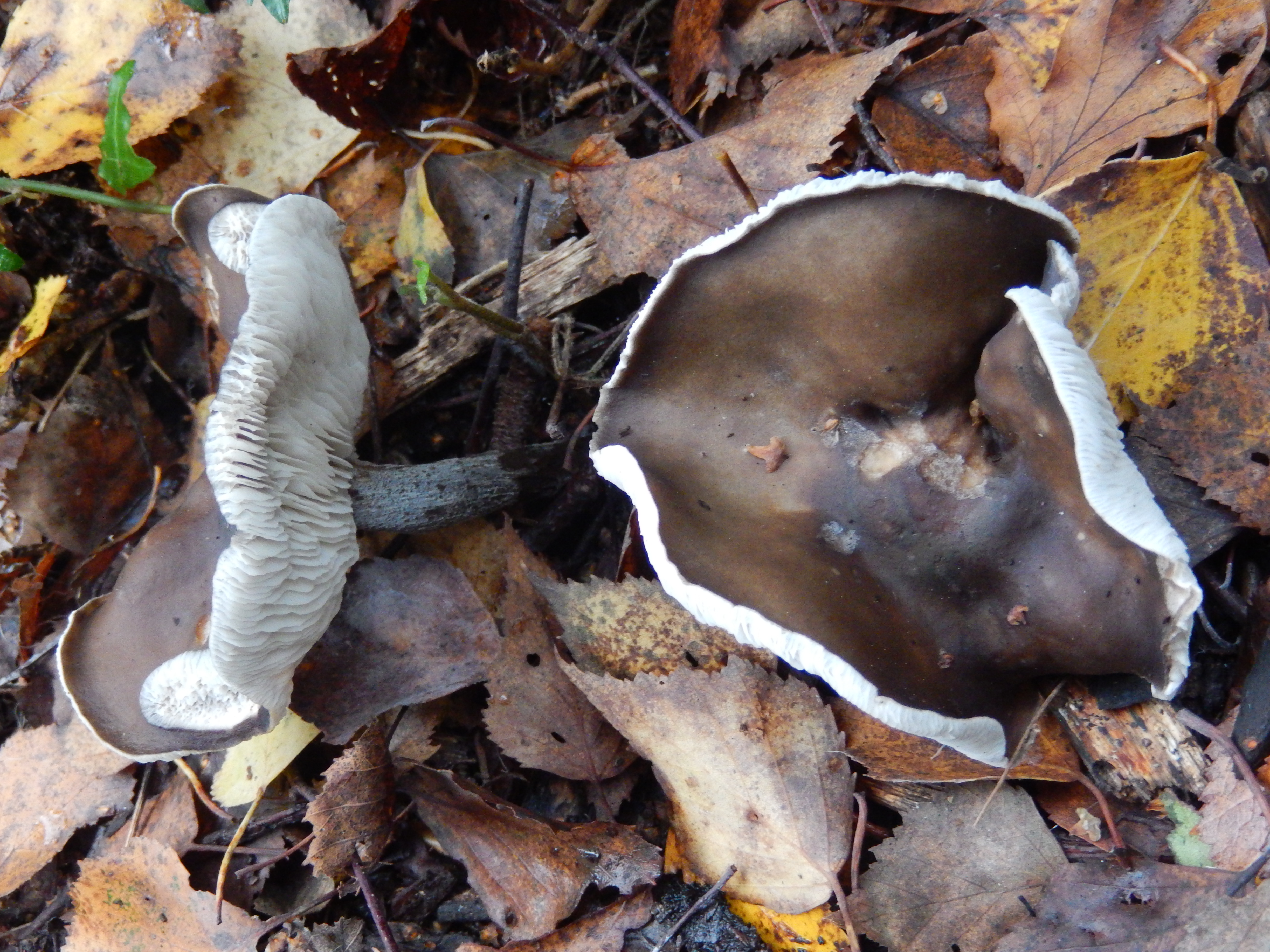
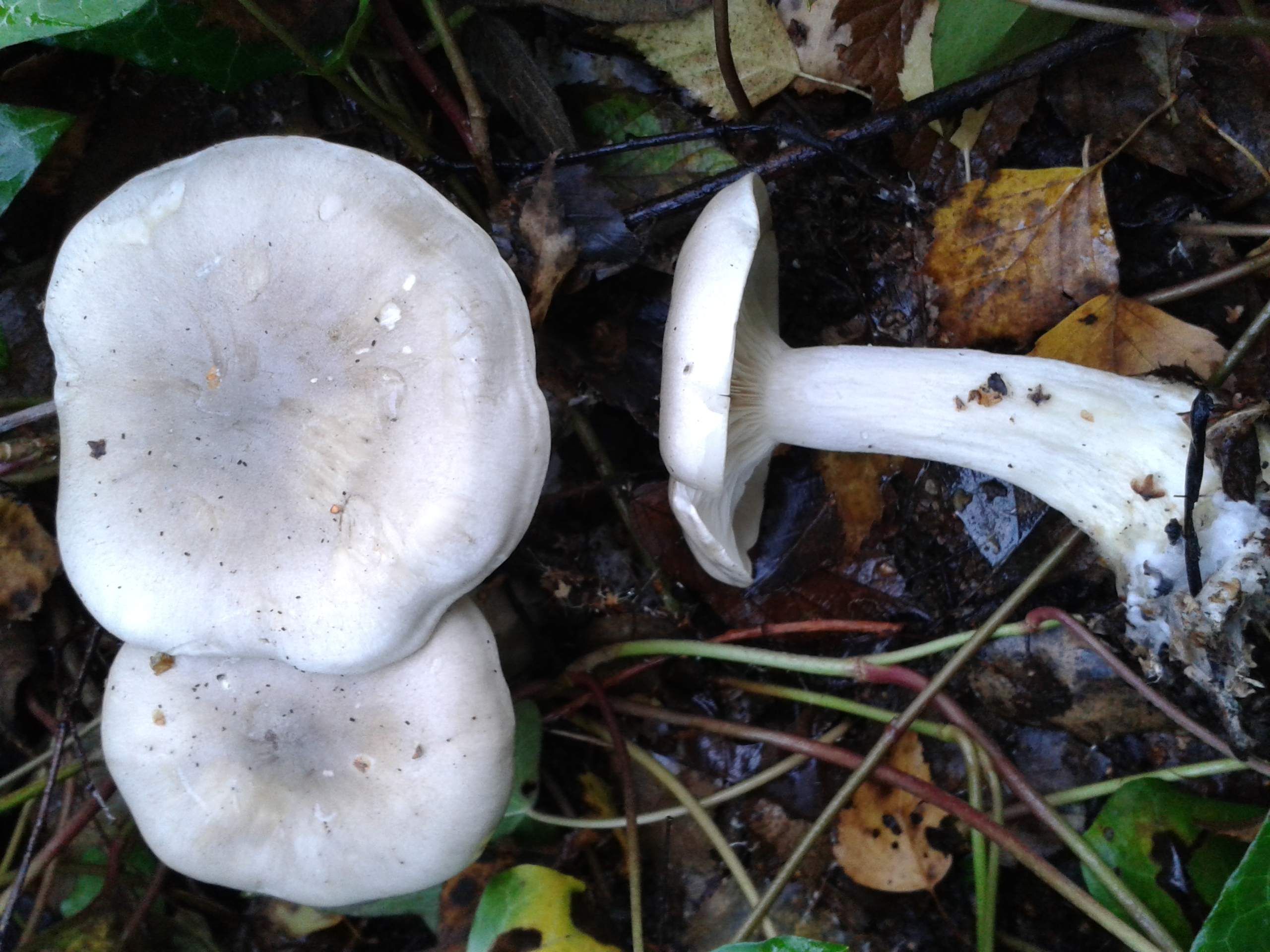
Two days later: the weather has turned more autumnal and showery. More fungi have popped up, including quite a few Clouded Funnels, Clitocybe nebularis, behind the anthill meadow. The display of Puffballs is fine, the large clean specimens having an obviously grainy, almost pearly surface.
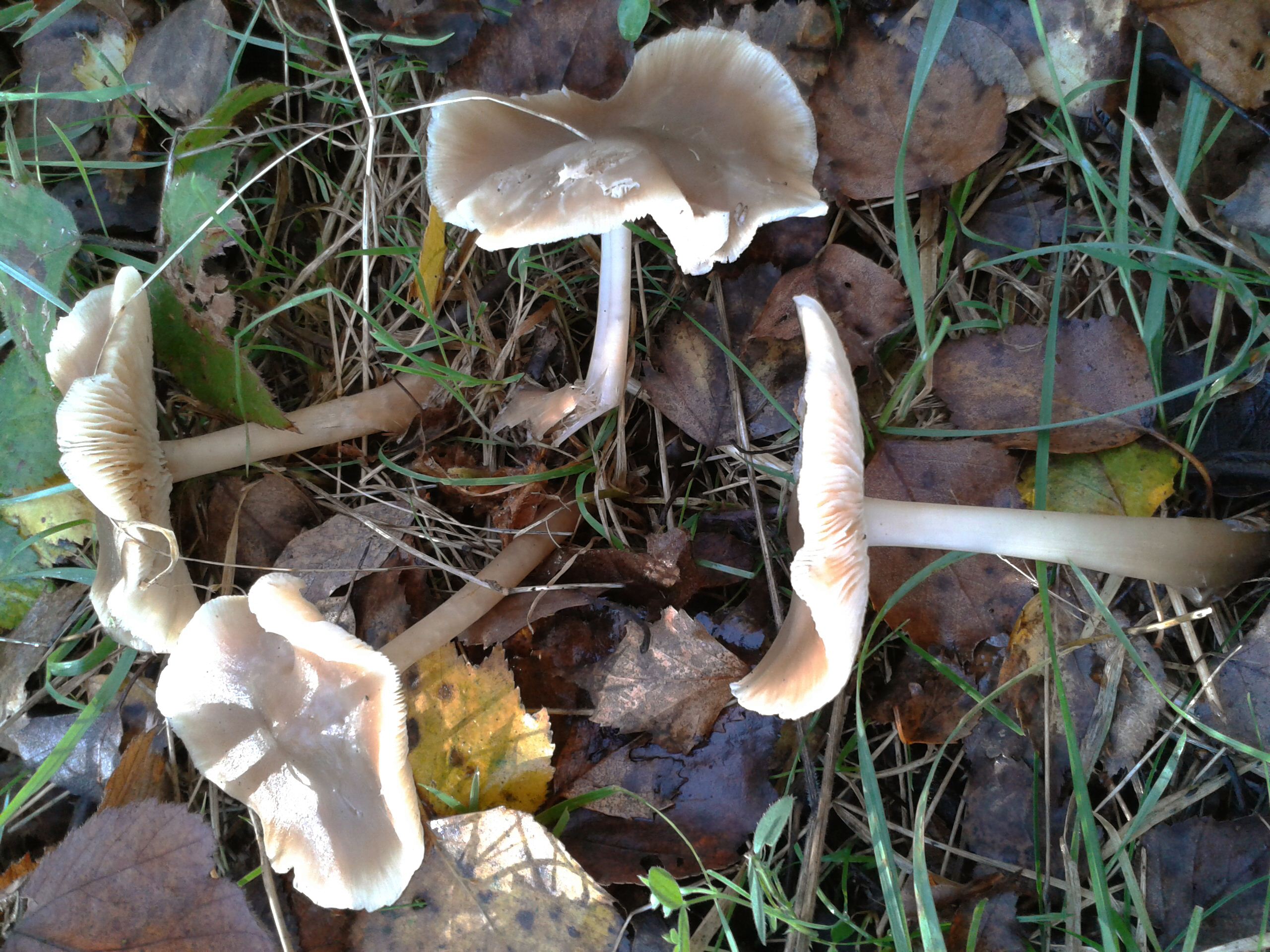
Clouded Funnel, Clitocybe nebularis
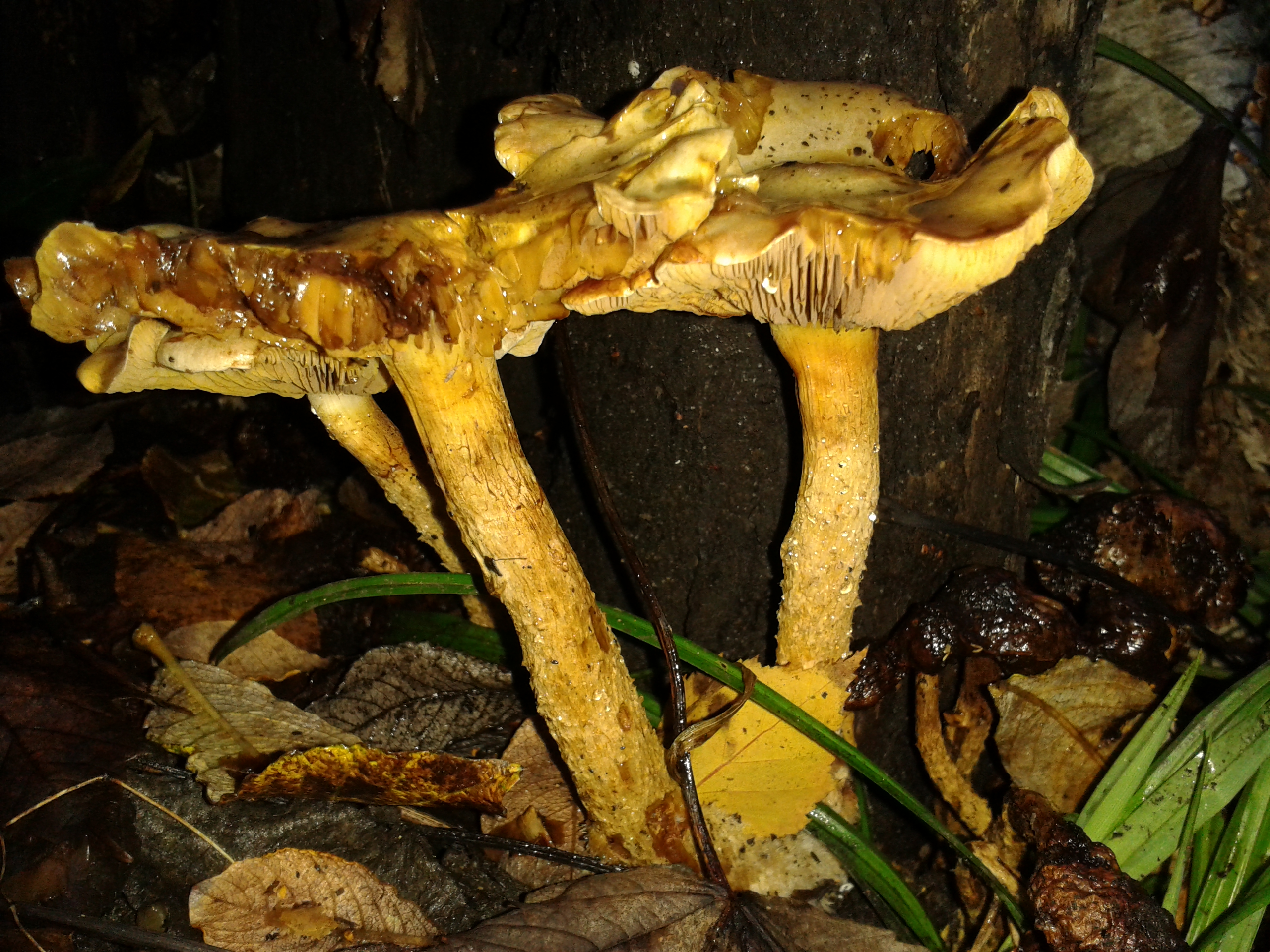
Some Sulphur Knights, Tricholoma sulphureum, have grown up behind the loggery at the base of the mound by the pond. They are deep orange-yellow, quite thick-stemmed, with an flattened or dished cap and widely-spaced gills that barely touch the stem.
Sulphur Knight, Tricholoma sulphureum
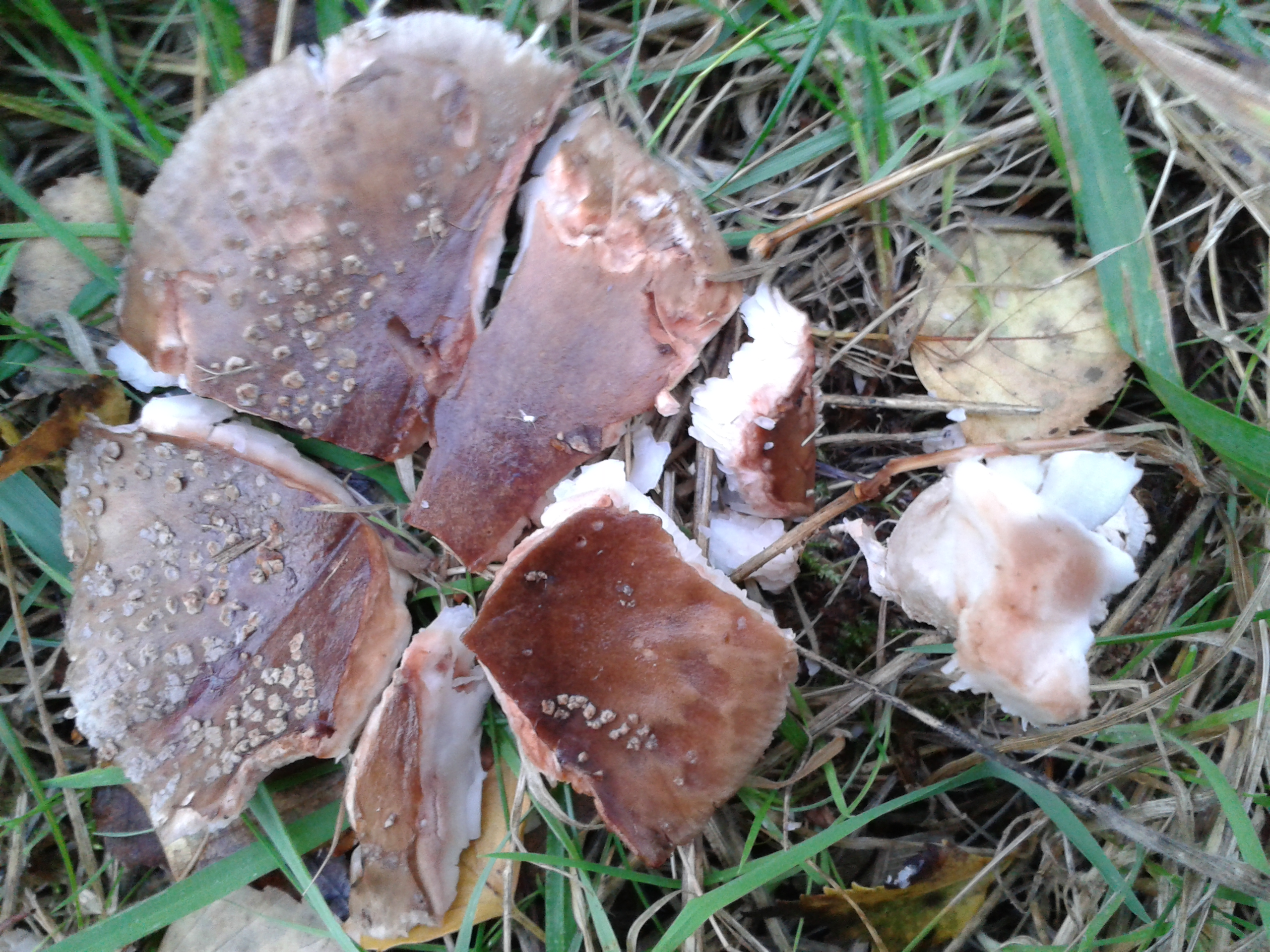
I found a broken Blusher mushroom, Amanita rubescens, in the anthill meadow. In this family of poisonous fungi, some deadly, it is edible when properly cooked, though the water it is cooked in must be thrown away.
The Blusher, Amanita rubescens (broken)
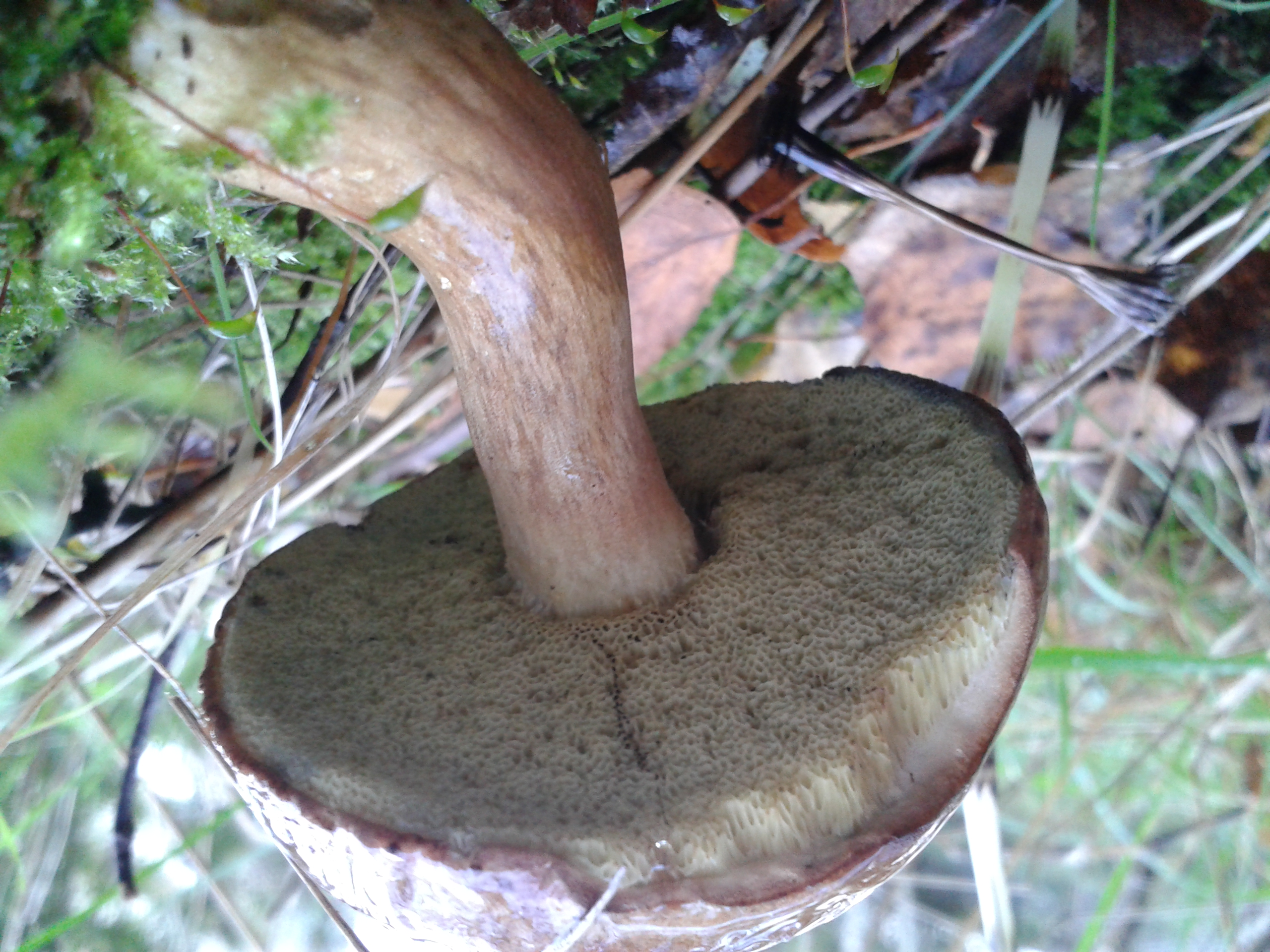
And a single small Slippery Jack, a suitably slimy bolete. It was yellower than the photograph shows, the cap appearing a shining light brown, the pore surface underneath rather yellow.
Slippery Jack, Suillus luteus
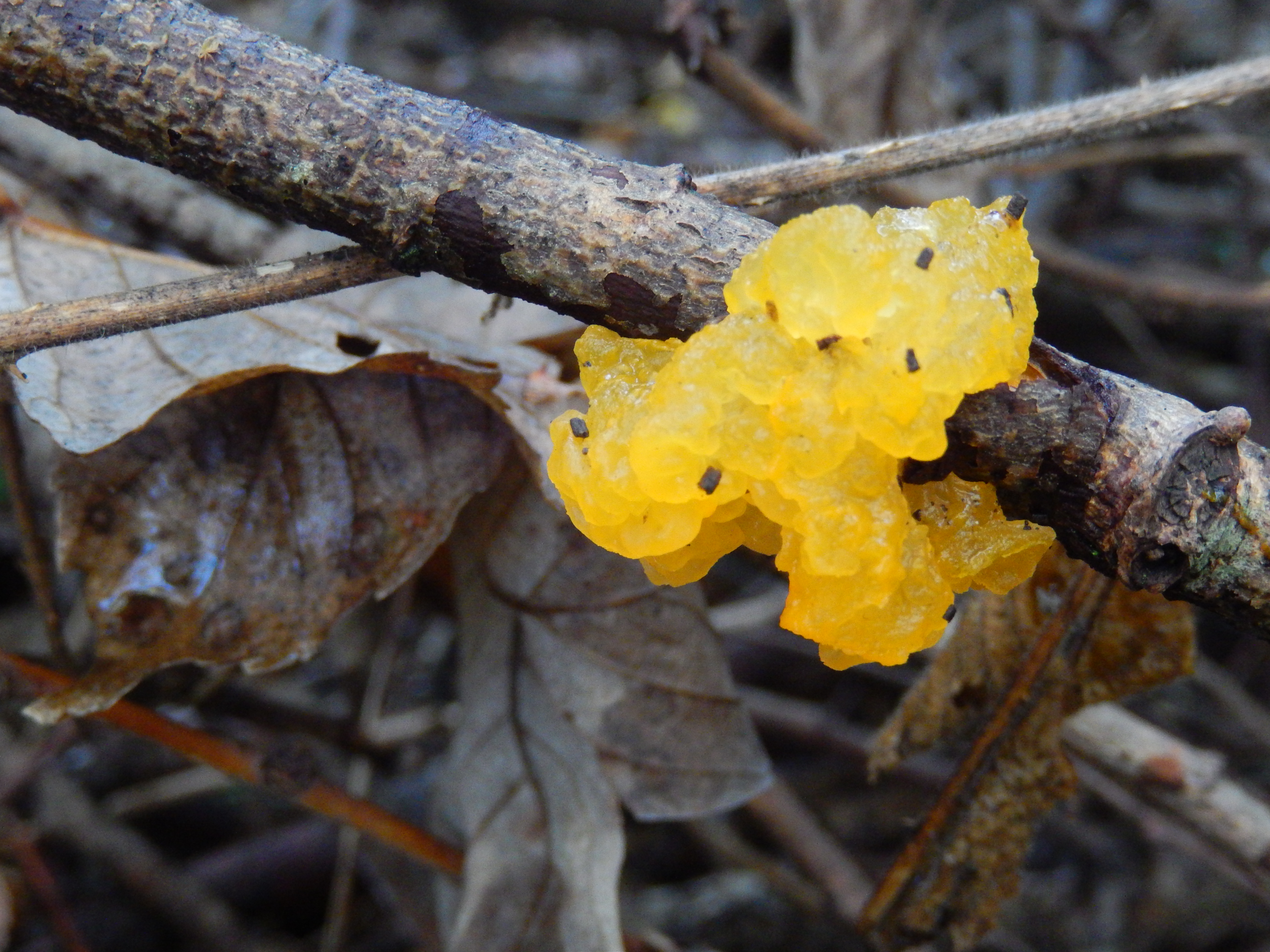
By the 6th of November it was far colder, and there were fewer species on show, with Fly Agaric, Clouded Funnel, quite a few Butter Caps, and this small gelatinous fungus on dead willow, Tremella mesenterica. I also found a small fragment of an brown Amanita with a white stem, probably A. pantherina, the poisonous Panther Cap.
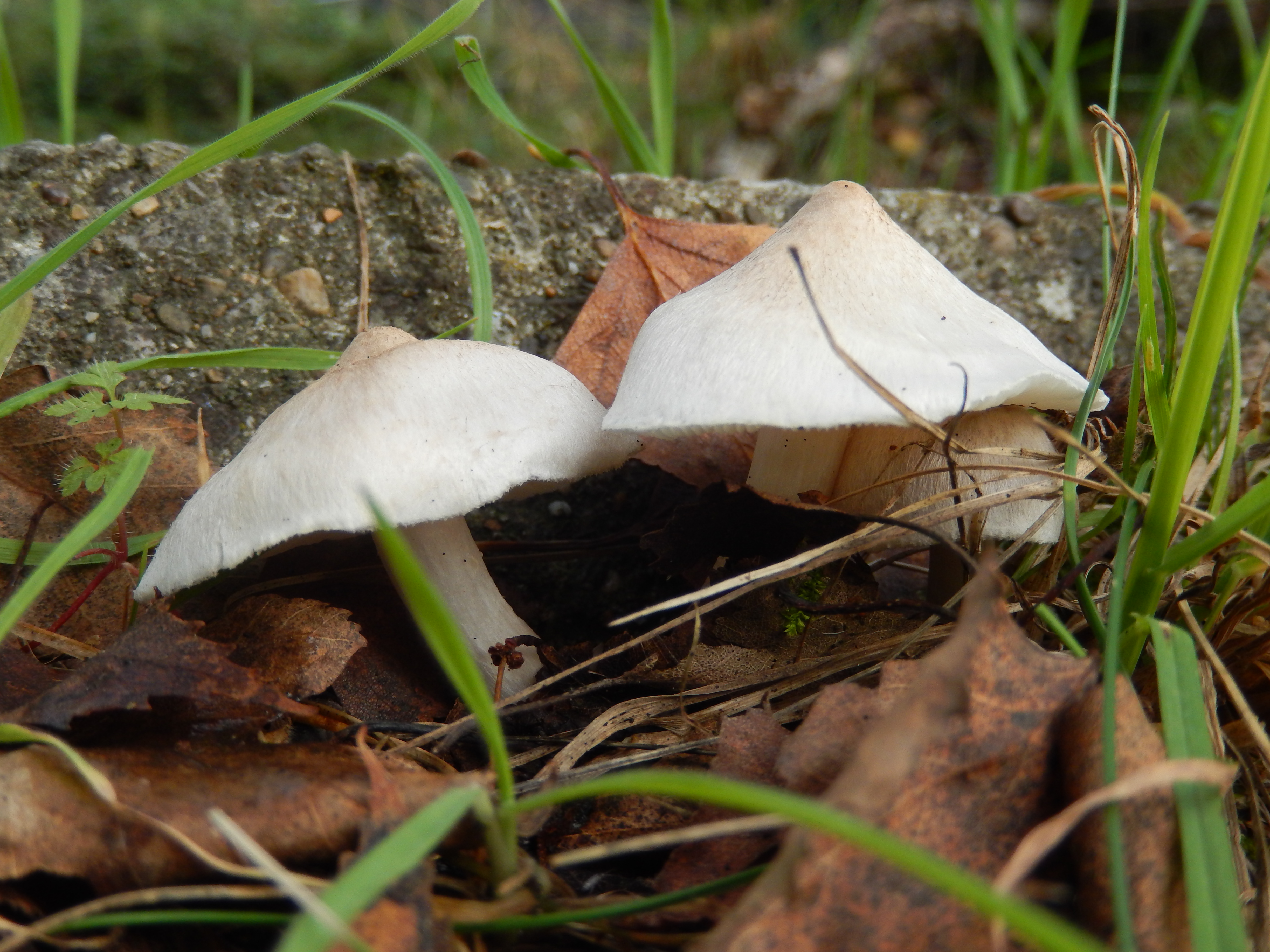
There were several Pale Brittlestem at the edge of the Anthill meadow under Birches, bordering the strip of acid grassland where the railway used to be.
Pale Brittlestem, Psathyrella candolleana
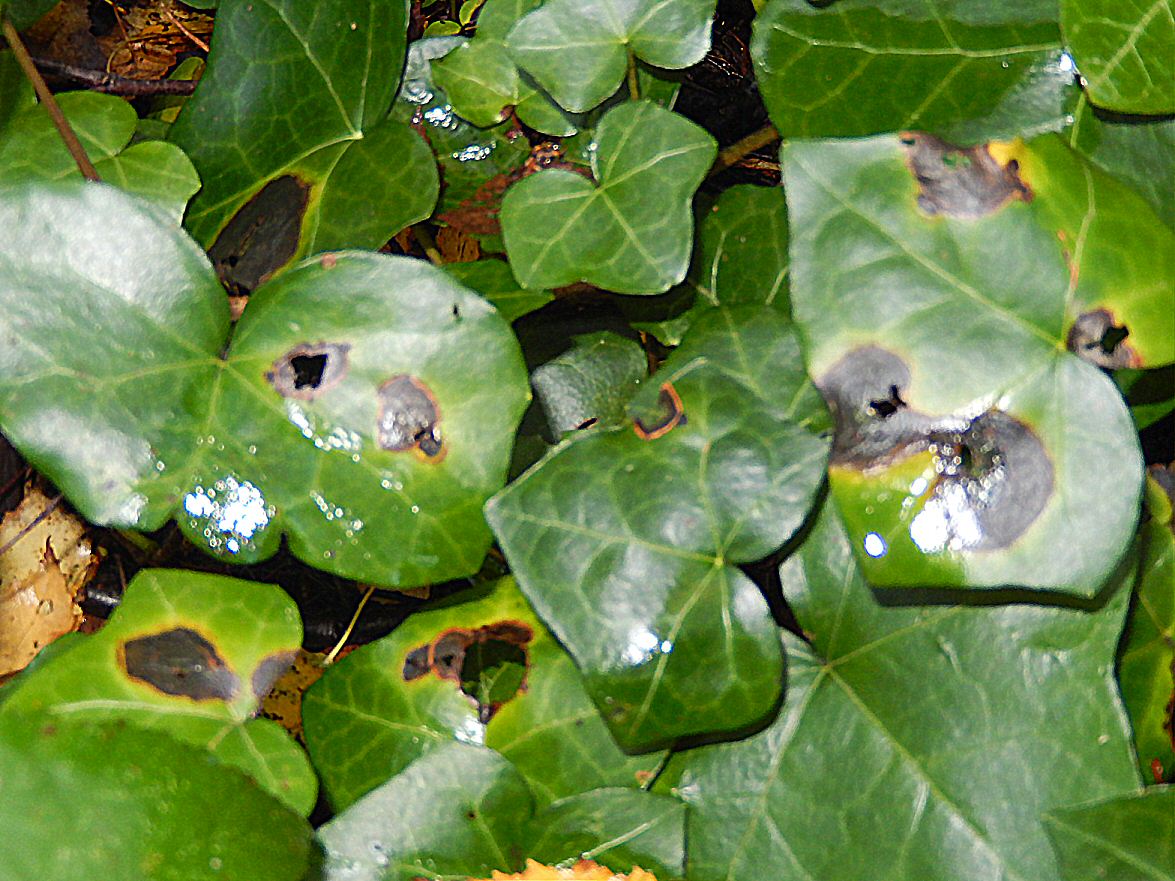
By the 9th of November, things were visibly more autumnal; the Clouded Funnels were still about, now large and more clearly funnel-shaped; a few Butter Caps persisted, along with the Puffballs. The small fungus Phoma hedericola (‘hedera’=Ivy)was by now making large obvious spots on ivy leaves.
The Ivy Spot fungus, Phoma hedericola
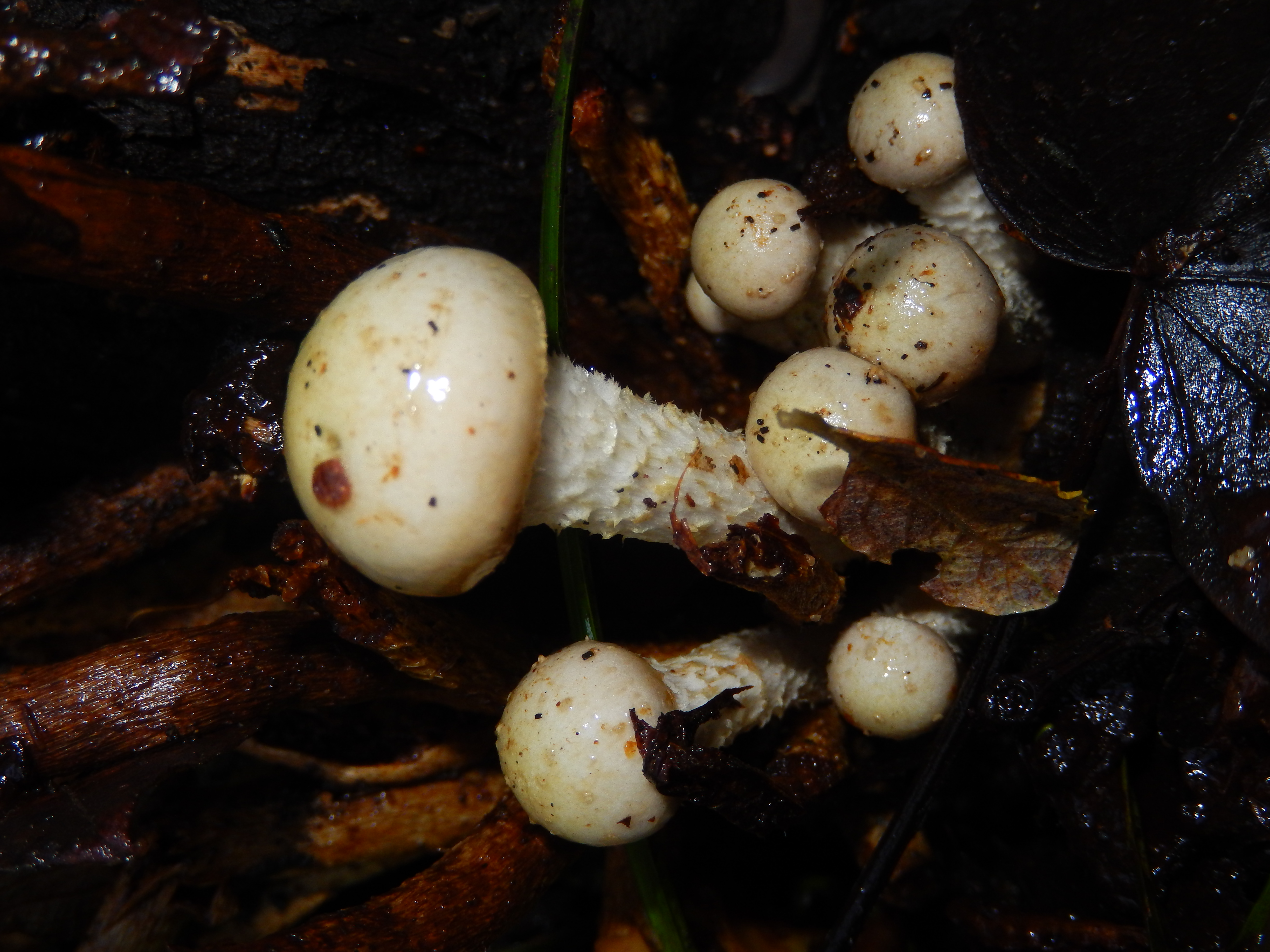
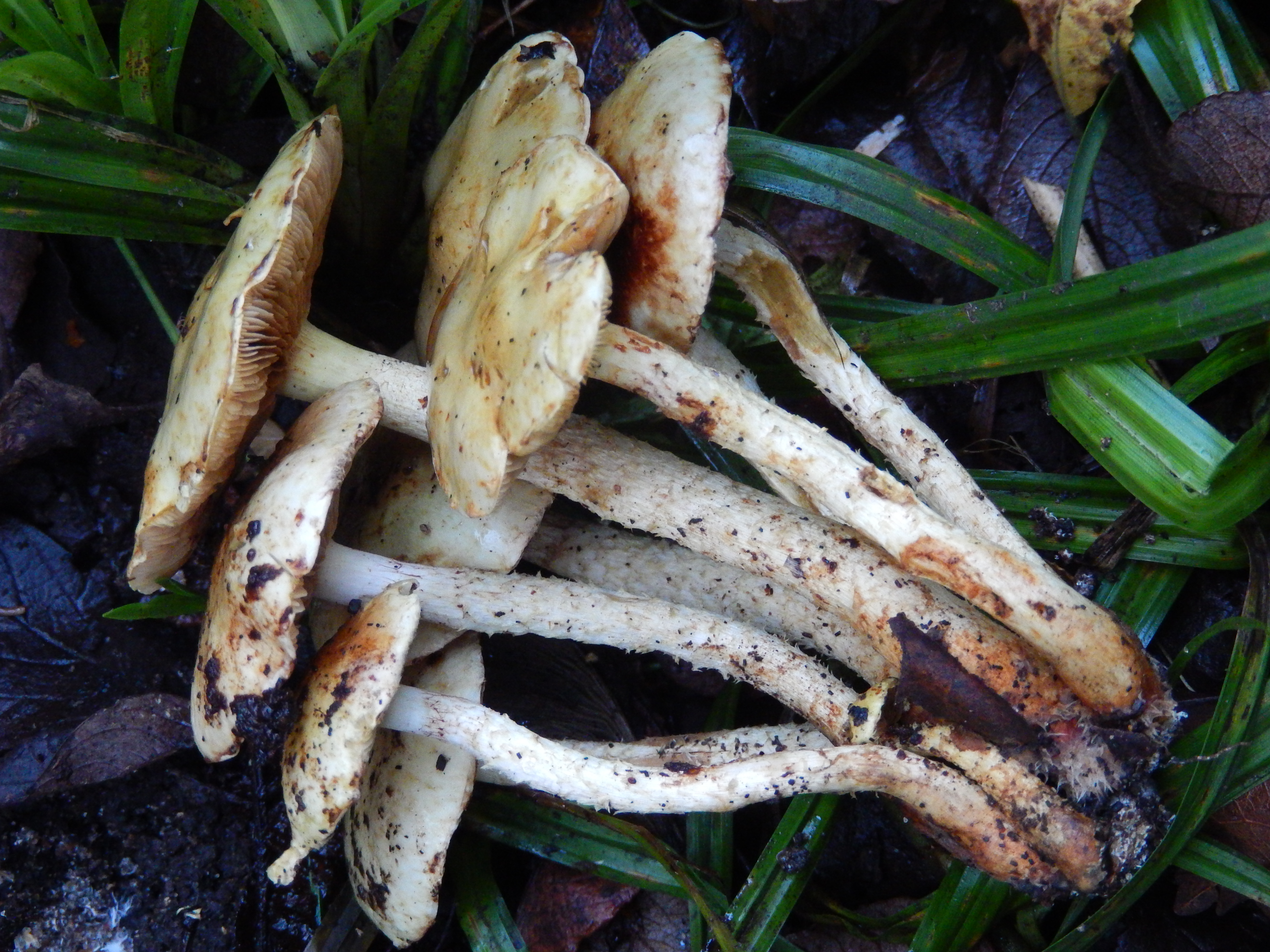
These little toadstools with a cream-coloured, slimy cap and whitish fleecy stems were growing out of a loggery, the dead wood half-buried in the soil. They may be the Sticky Scalycap, Pholiota gummosa.
? Sticky Scalycap Pholiota gummosa on 9 November Same group of ? Sticky Scalycap, Pholiota gummosa on 19 November
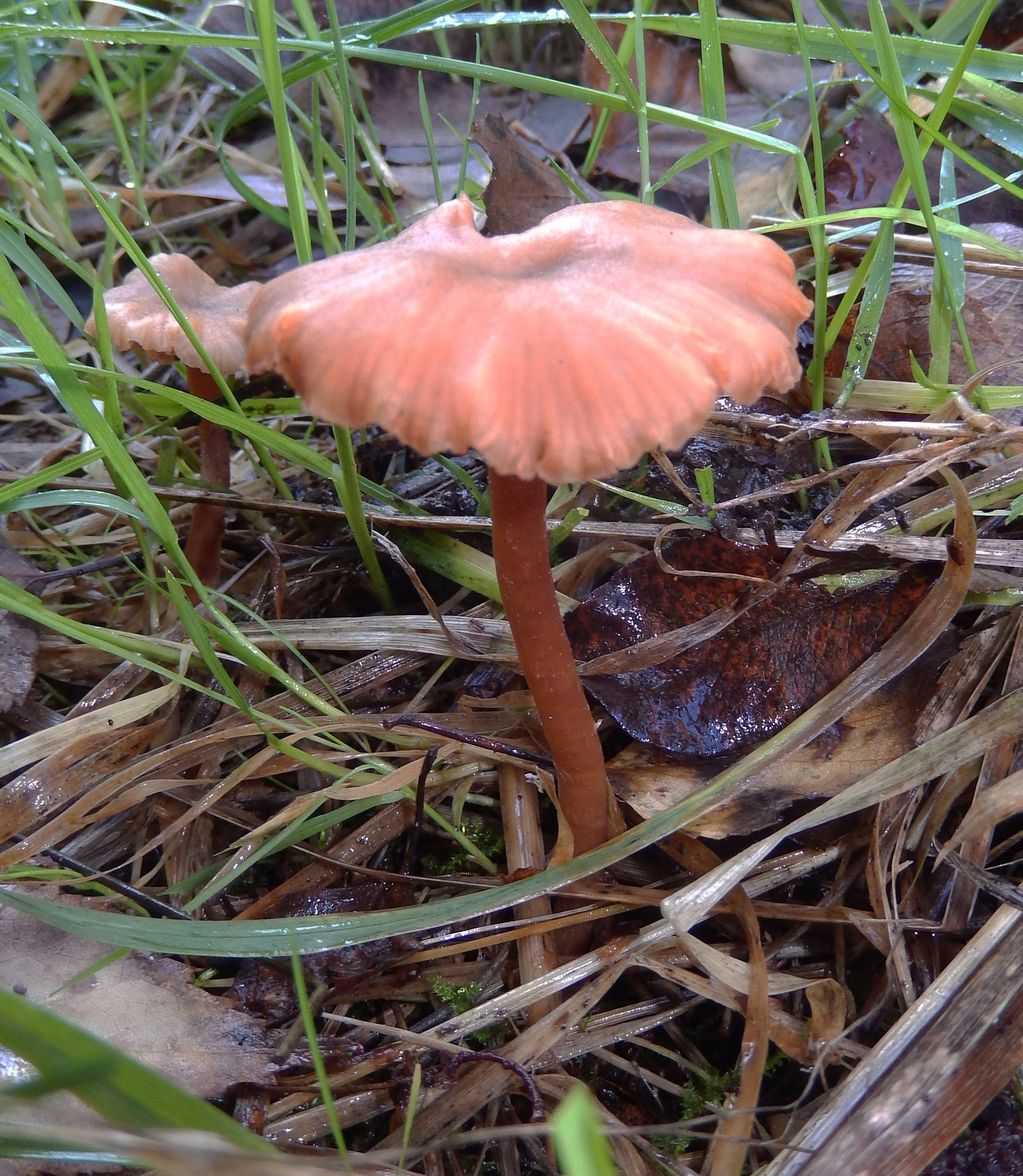
Finally, no collection of fungi is complete without The Deceiver, Laccaria laccata, which comes in a variety of sizes, shapes and colours. It’s typically rather russet-brownish and the stem is quite thin, often a bit flattened and twisted. The cap can be round or wrinkled; it begins rather globular and flattens out. It’s rather well-named. Mind you there are several similar species: this could easily be L. fraterna, given its smooth brown stalk and rather rufous cap.
The Deceiver Laccaria laccata
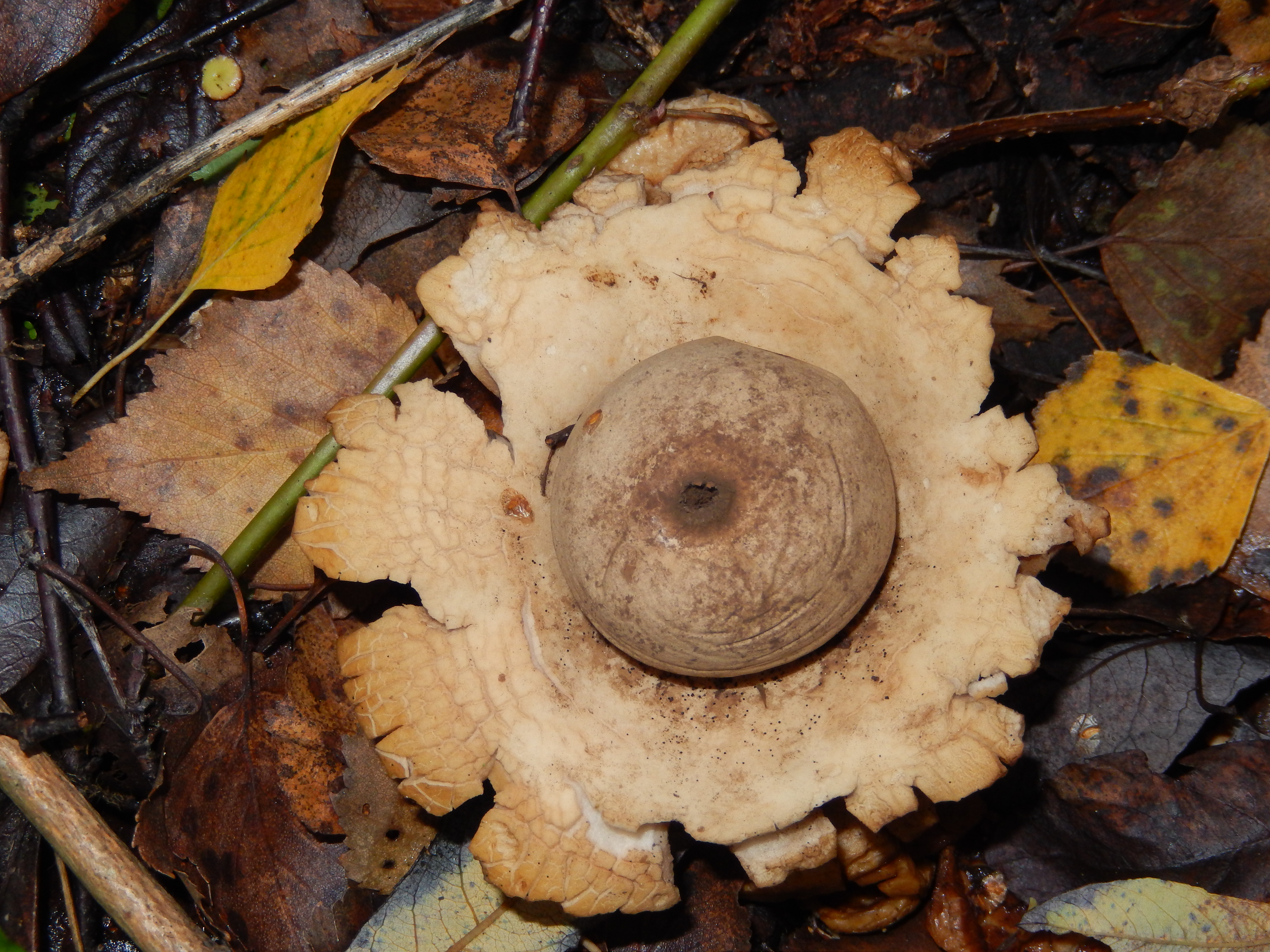
Fungi are continuing to appear as late as the 11th of November. The magnificent Collared Earthstar, Geastrum triplex, was growing under birches, willows and oaks behind the anthill meadow.
Collared Earthstar Geastrum triplex
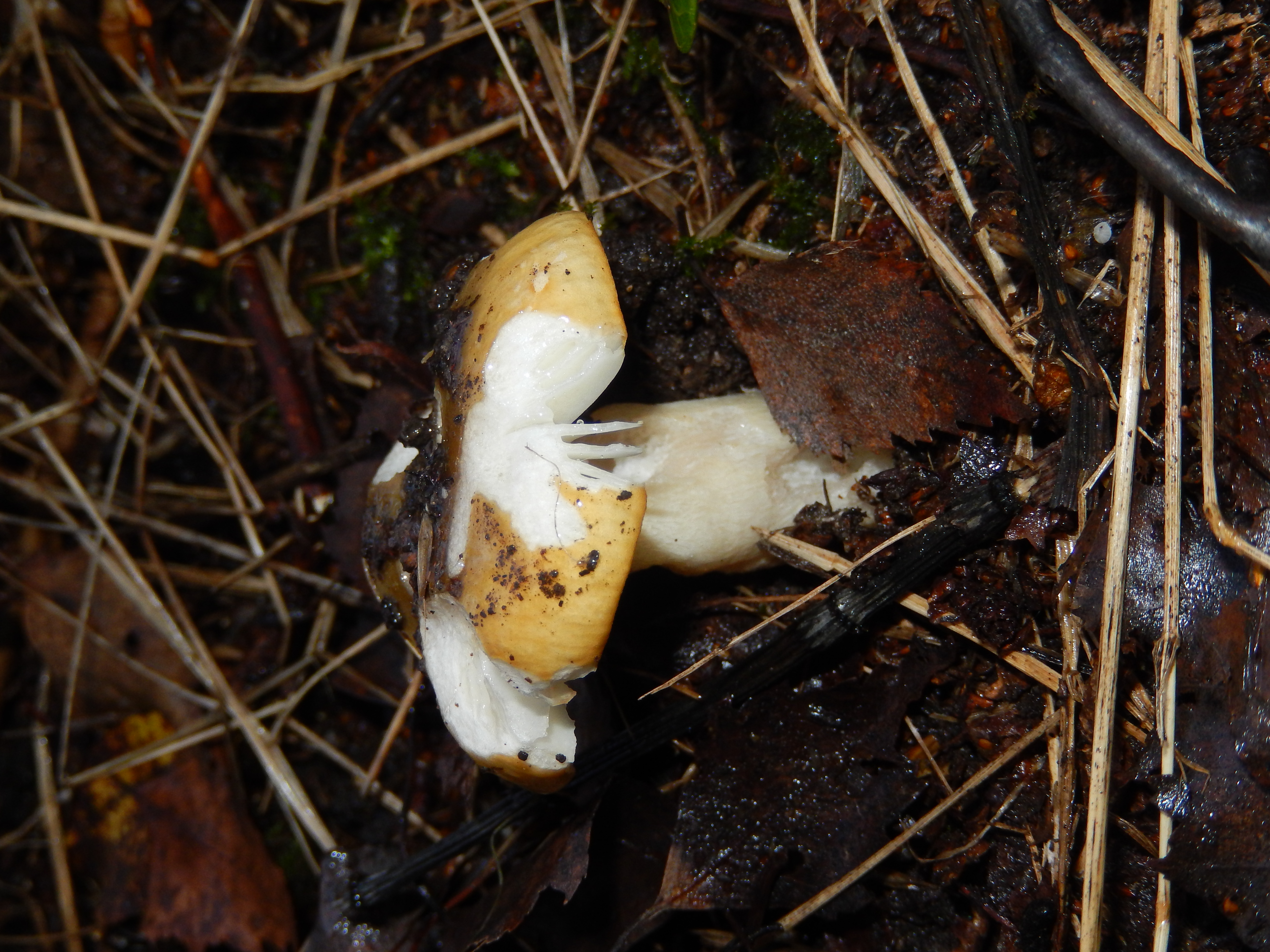
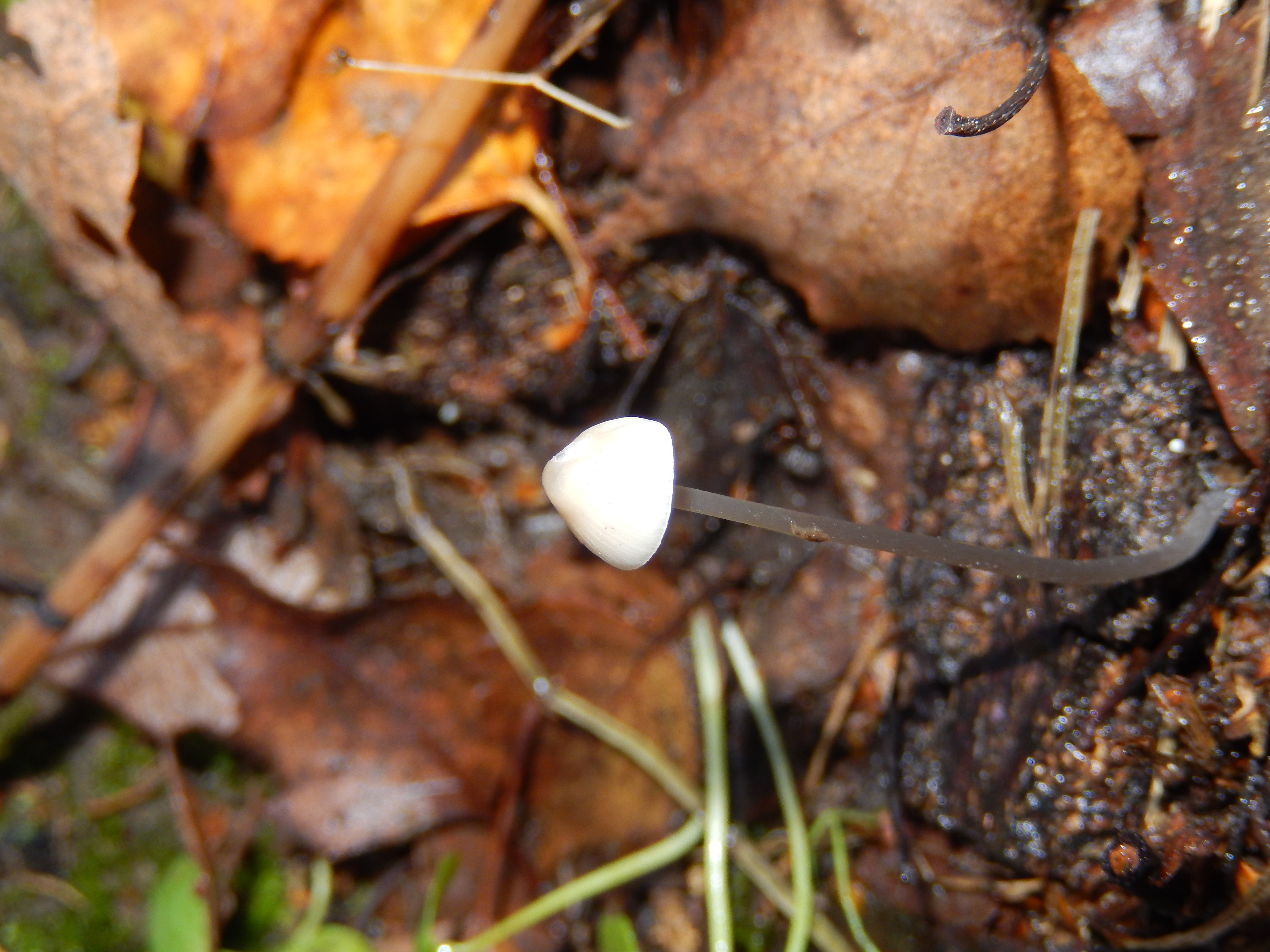
On the 12th of November:
A yellow Russula, perhaps R. claroflava (Yellow Swamp Brittlegill)A Bonnet, Mycena sp.
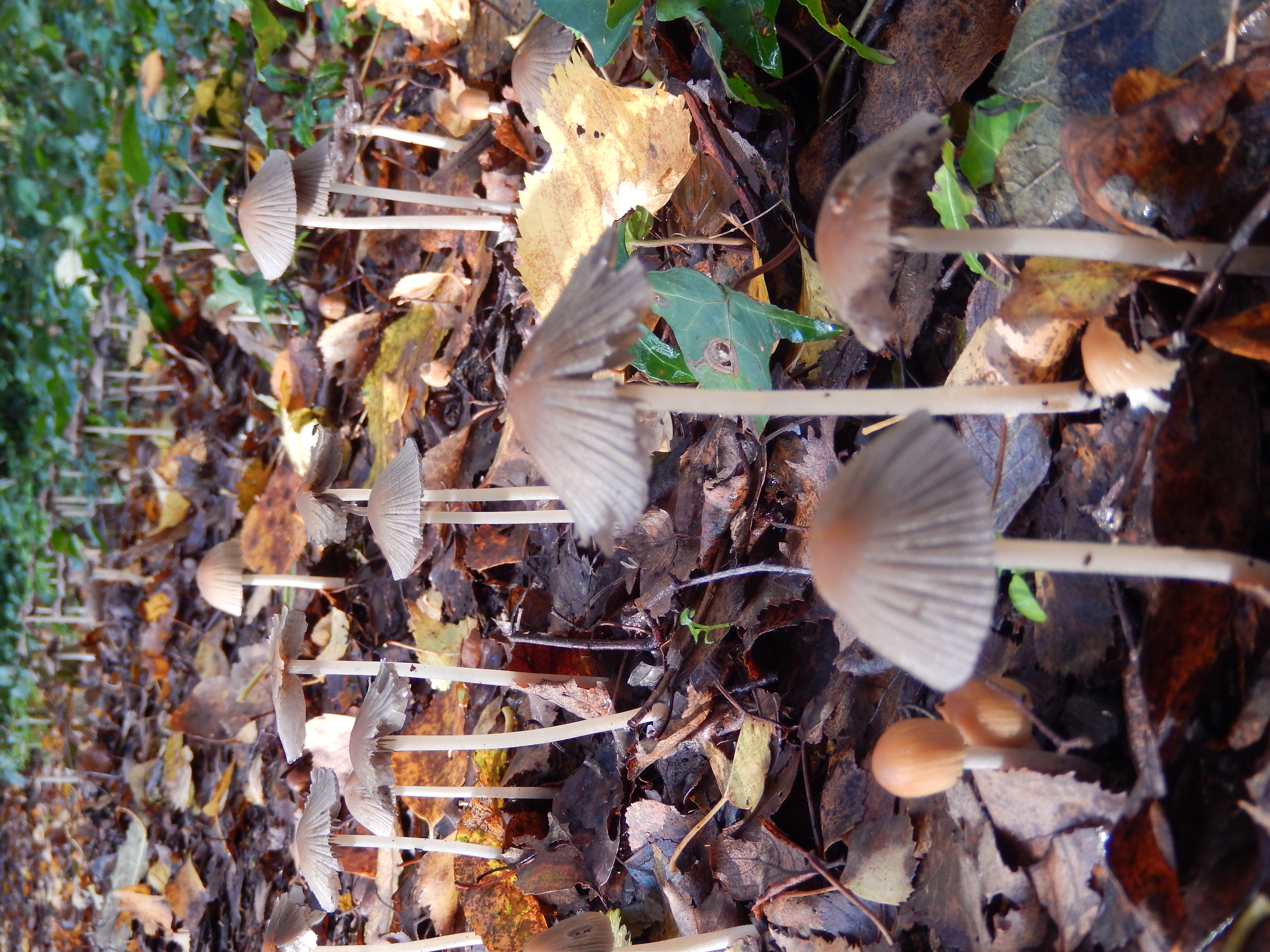
On 18th November, a troop of smallish, tall, pale Coprinus that don’t really turn to the usual black ink, growing on woodchip beside the path. Seems close to Coprinus impatiens.
Emmylou Harris sang of sunshine in December and roses in the snow. It’s only the 28th of October, so not that late in the year yet, but the mercury climbed to an improbable 18 Celsius – that’s T-shirts and sunhats for work down at the nature reserve – and there were indeed roses blooming in the garden.
For the record, also in flower today were Alpine Pink, Tayberry, Squash, Strawberry, Primula, Nasturtius, Hydrangea, the little New Zealand Sorrel that manages to grow between the paving stones, and Daisy.
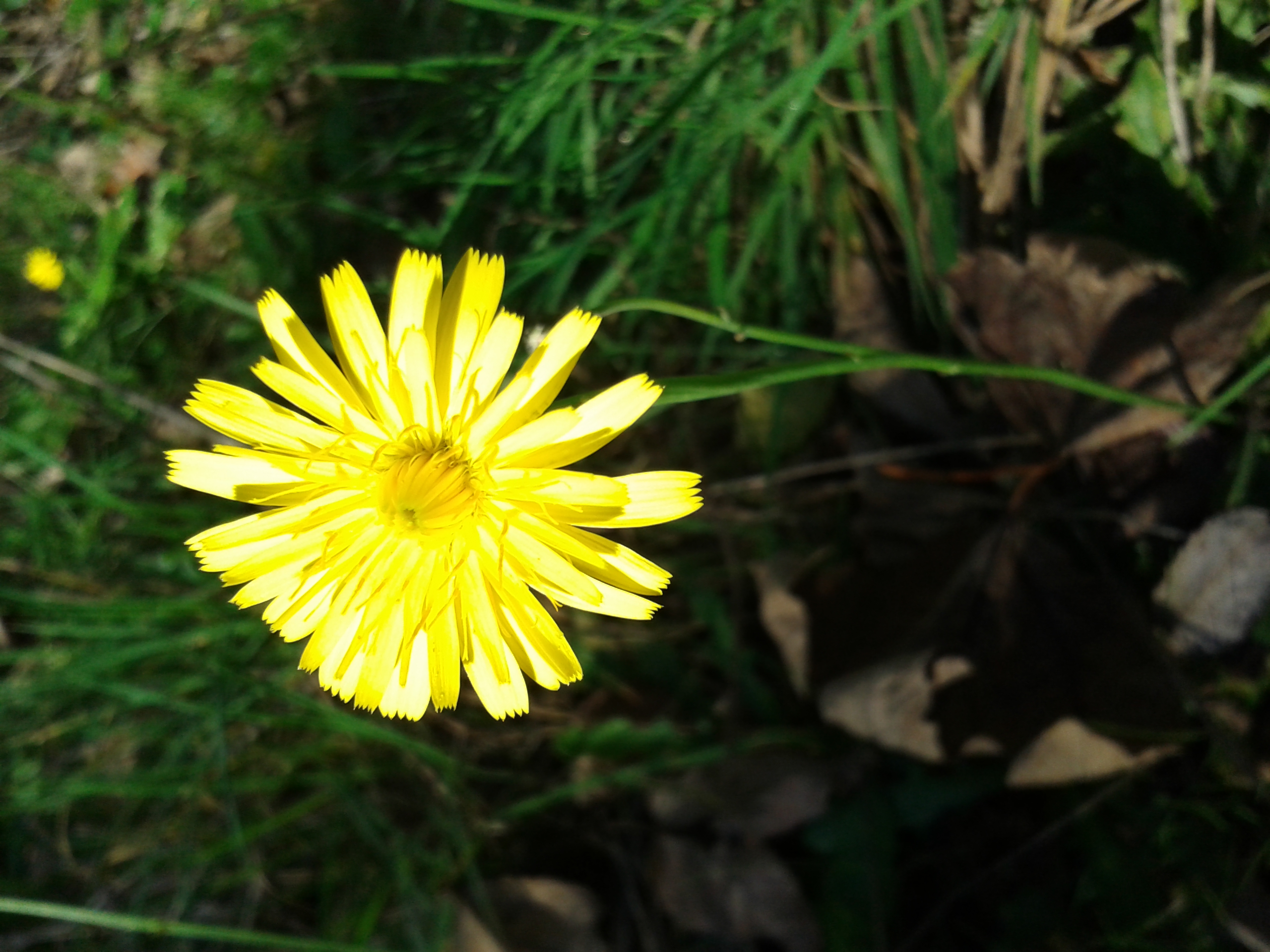
Down at the reserve, Beaked Hawksbeard has come back into flower (for the second time this year) on the picnic meadow. It seems that the warm weather has coaxed the plants to try flowering. They’ll get a bit of a shock with the change coming in the weather tomorrow, probably. It certainly feels like an odd bit of Phenology, but of course we won’t know for many years whether this is part of a long-term trend to do with global warming, especially as the global average temperature has been taking a holiday from its inexorable rise for some years now. When the temperature does take off, it will be too late to stop, and very costly to mitigate.
Judging by the feeble global co-operation on the far more obvious and immediate threat of Ebola virus, it’s hard to be optimistic about our ability to collaborate as a species on anything as large as global warming. The Drake equation, the one that predicts the number of intelligent civilisations in our galaxy, has a term for the lifetime of a civilisation, as Prof. Brian Cox recently explained in his TV series Human Universe. If it’s only a few centuries, that would neatly explain why – despite the profusion of suitable-looking planets – we haven’t been contacted by any other civilisation. That would imply that “intelligent” life never lasts very long on any planet. However hard it tries to be sensible, selfishness – which must always be favoured by evolution for short-term gain – always takes over, and people use up the resources of their home planet until – pof! – they wipe themselves out. Just clever enough to be really stupid. What a cheerful thought.
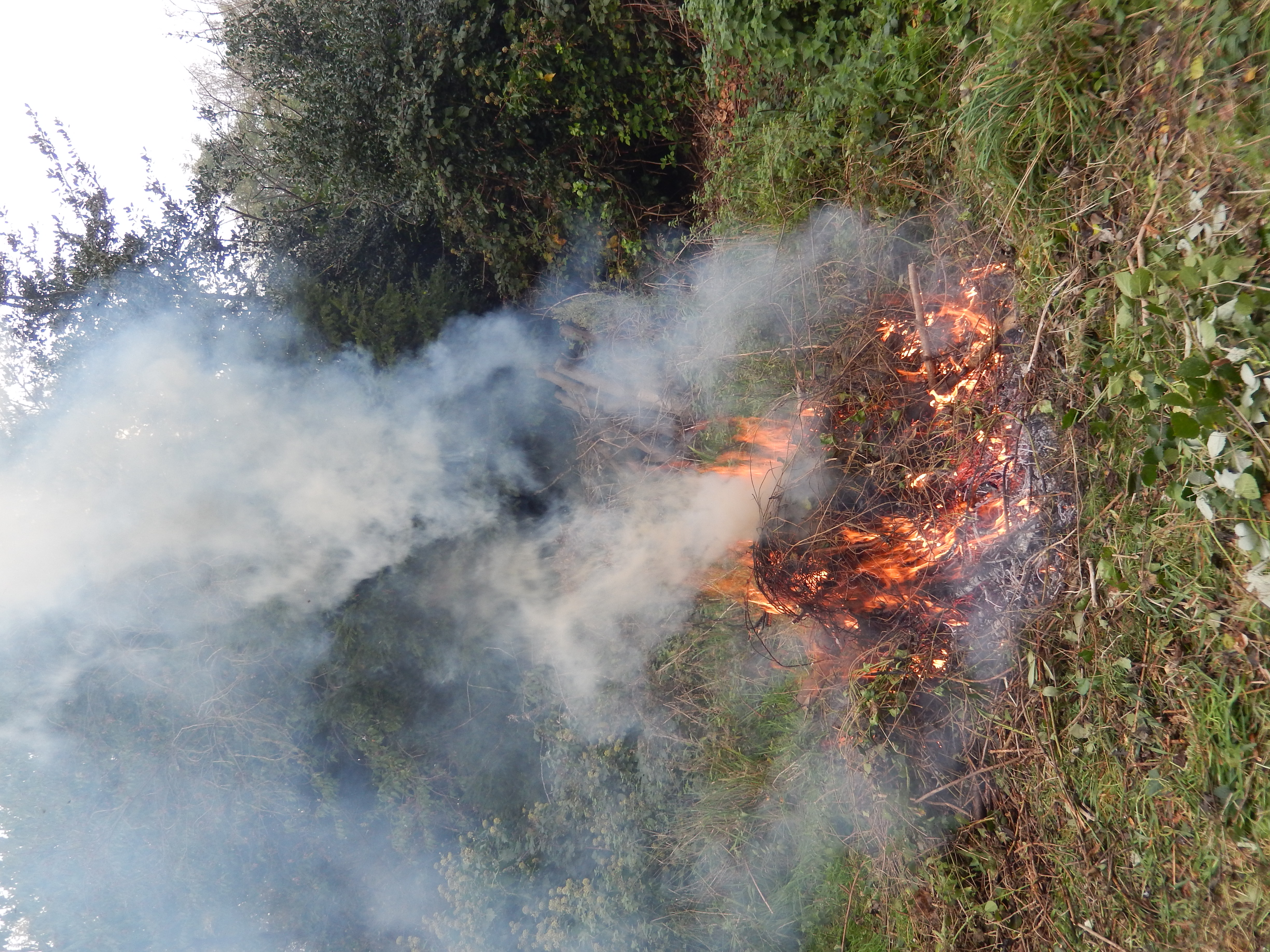
Today, with dry weather, damp ground and a gentle breeze it was perfect for burning some of the brash that we had cut in the past few months. Three enormous piles of wood and brambles were eaten up by the flames. As we raked up the remains, a few little frogs, charmingly bright green, hopped away. A red admiral butterfly fluttered energetically around an ivy bush.
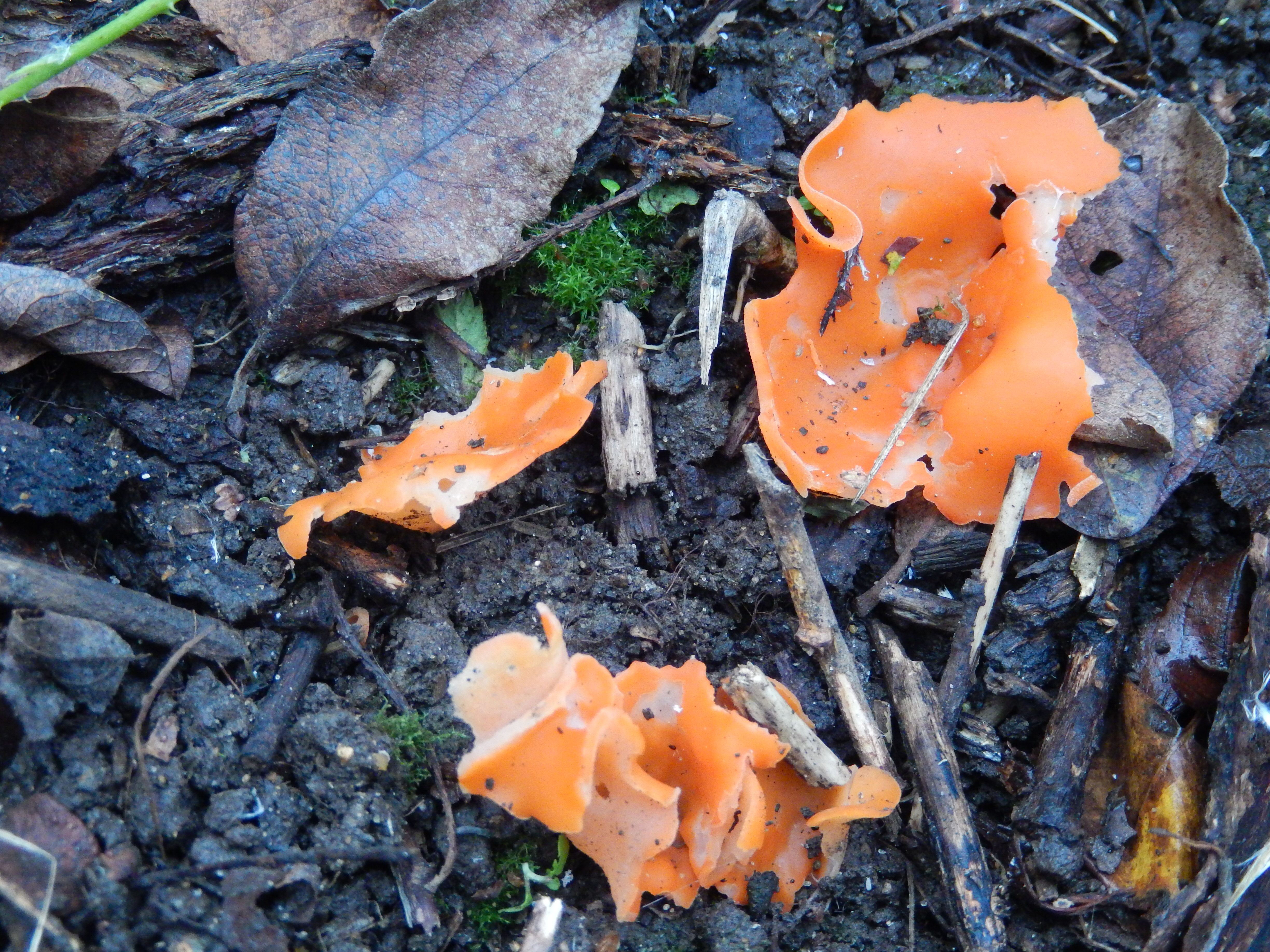
Orange Peel Fungus Aleuria aurantia
On bare ground in the open meadow was a good clump of Orange Peel Fungus, Aleuria aurantia. With its brightly coloured open cup, it’s clearly an Ascomycete. It’s said to be edible; it looks as if something – maybe a snail – has been eating away at this one.
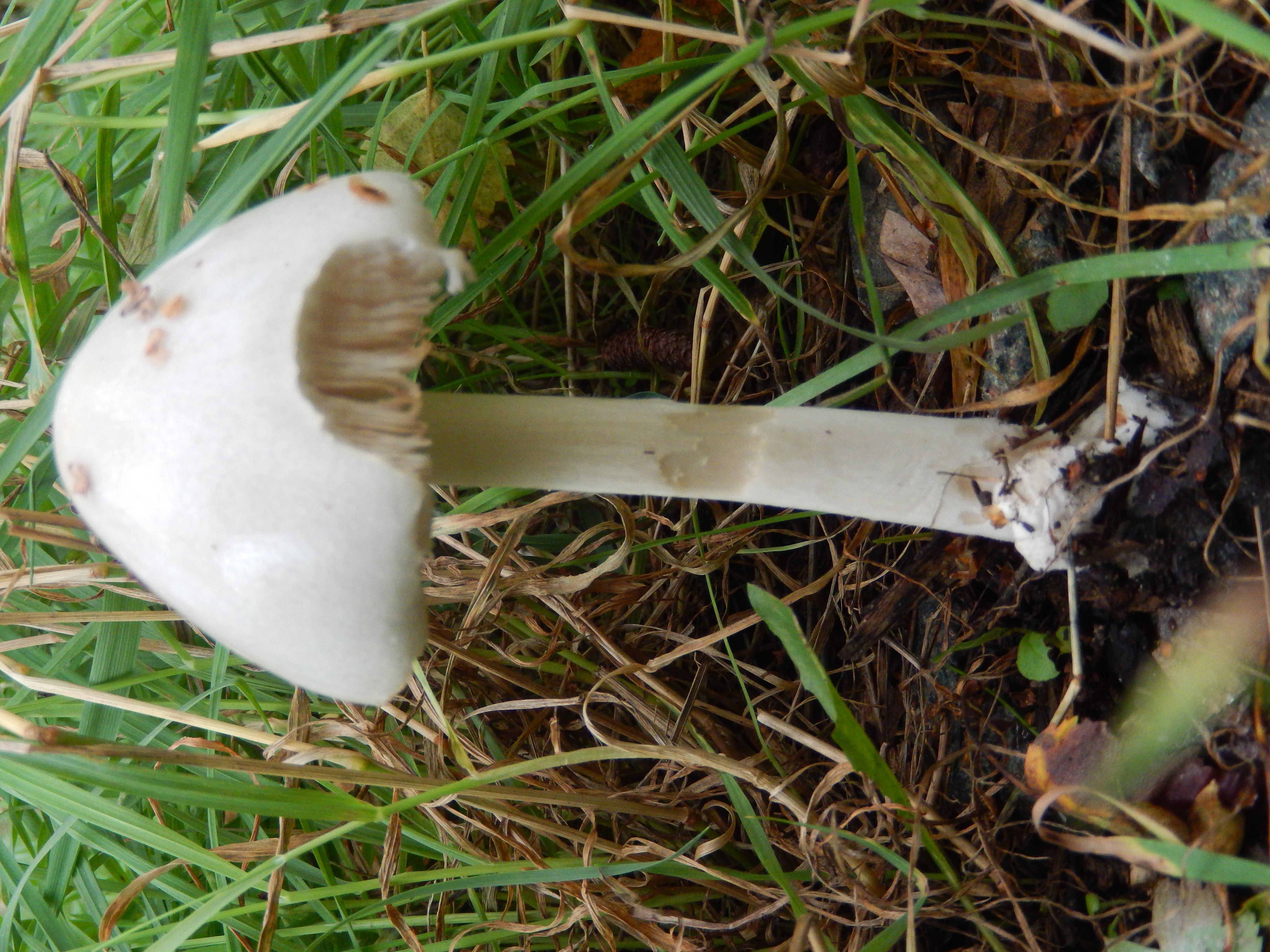
The acid grassland is dotted with large handsome puffballs; under the birches are a lone destroying angel, a small spherically-capped fly agaric, a brown birch bolete, and many smaller fungi including the amethyst deceiver.
The tail end of Hurricane Gonzalo is blowing leaves off the trees; the reserve is quite sheltered, and it is pleasant to work in the passing showers and bursts of sunshine, pulling up ivy and brambles, making space for grassland to regenerate and for new saplings to sprout. But with the mushrooms and the wind, it is at last starting to feel like autumn.
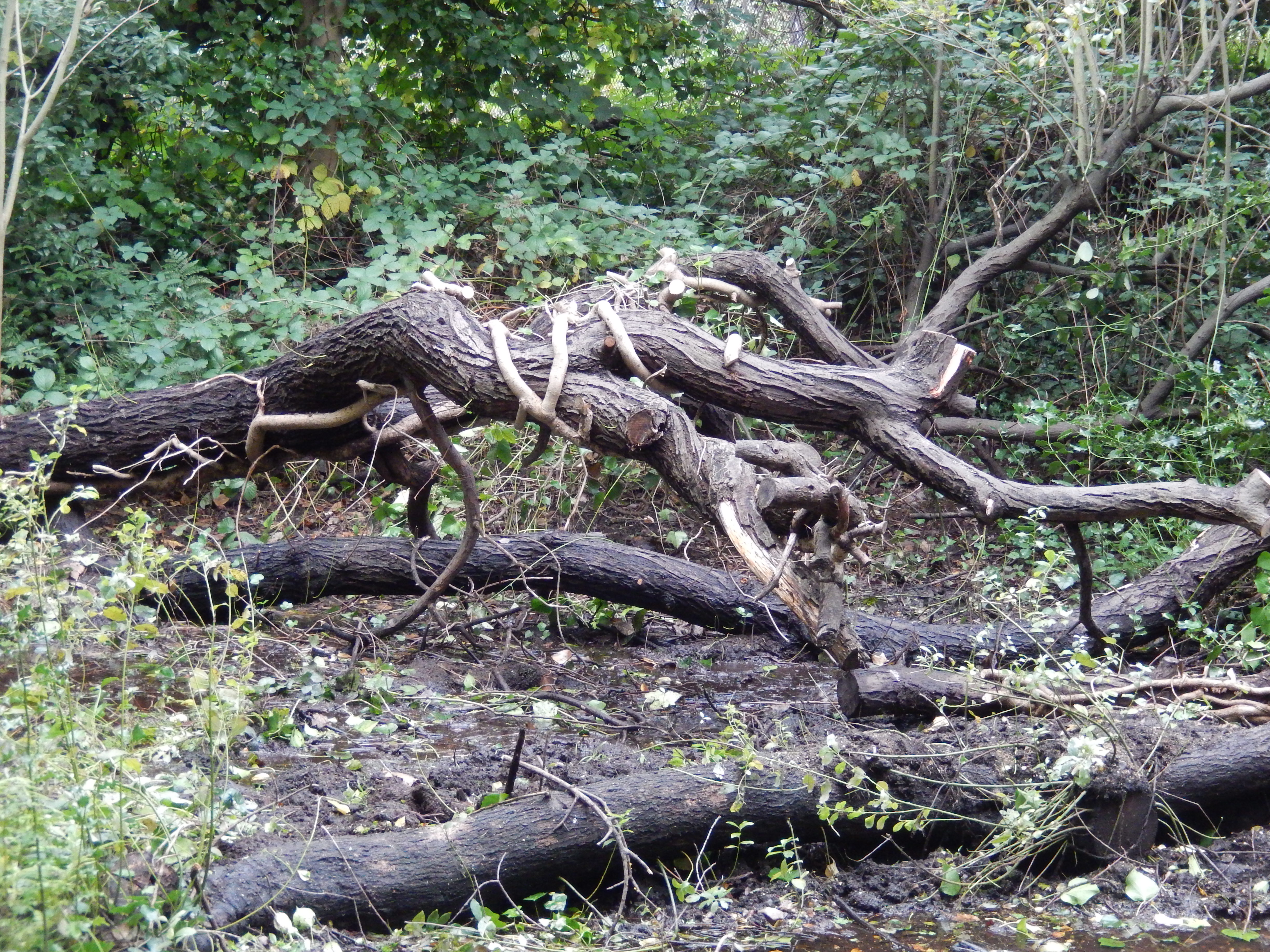
Most of my last few visits to Gunnersbury Triangle have been taken up with untangling a mass of fallen Willow trees in the mangrove swamp. One tree fell on the next, which fell on the next … and the whole lot were in sticky mud with a rising autumn water table, covered in ivy to boot. I lopped, chopped and carried branches and lumps of ivy away, getting happily hot, tired and dirty in the process.
Lopped Trunks in the Mangrove Swamp
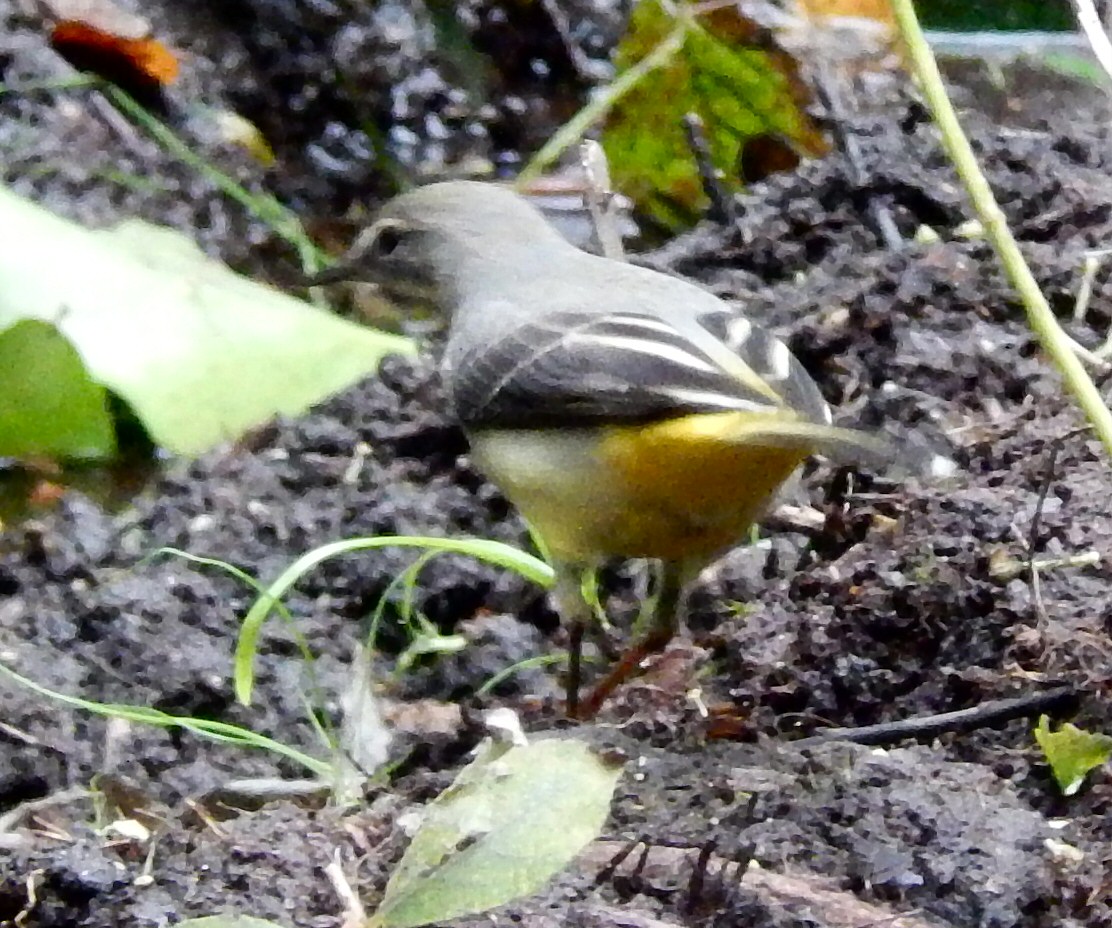
Yesterday I wandered around with no tools other than camera and binoculars, and was rewarded with the sight of a Grey Wagtail, a Robin and a Wren hopping about and feeding in their different styles, exactly where I had been clearing.
Grey Wagtail: it is blurred as it was moving and wagging its tail
The wagtail was gobbling mouthfuls of grubs that it grabbed from the soft mud. It constantly bobbed and wagged its tail, displaying its yellow rump in the process. Could that be aposematic – is the yellow, in other words, a warning that the bird is distasteful? If not, why does it constantly flash yellow, even when no other birds of its species are about?
Today, I finished lopping the fallen Willow branches; as these last ones were over on the side, it was a cleaner and drier job. Then I joined in with a corporate group from Lend Lease, a well led and relaxed team … of property developers. They were incredibly pleasant to be with. The next surprise was at the hut when we all had a cup of tea: a nice Indian businessman in a suit came and asked us if his firm of engineers could use the reserve … for a group meditation. They stood about quietly and respectfully in a group, at least one person with hands pressed together in the ‘namaste’ position. We went on clearing and coppicing in the delightful autumn weather.
I got a small winged bug in my mouth; it released a pungent taste of cinnamon oils. Probably that is a chemical defence too: certainly a powerful taste, probably unpleasant in any quantity; but it was not bad in a one-off dose.
I ended my day sawing off some of the tree-stumps left over from the coppicing, together with one of the very capable and enthusiastic London Wildlife Trust trainees. It’s tremendous to see such good work going on in the reserve. And a piece of excellent news: a new warden has been appointed to manage work on the reserve, along with a West London warden who will be based here, but will have the massive task of keeping all the Hillingdon reserves from getting totally overgrown with hawthorn and blackthorn, among other things. So, suddenly, the place is full of life! Let’s hope we soon get our new visitor centre, we need it.
Conservation work with property developers; meditating engineers. You couldn’t make this up, or if you did, nobody would believe you. People say nature opens your mind, helps you feel relaxed. It does, you know.
Today, down at the nature reserve, it was a day for work and weather rather than natural history. A vigorous Low was working its way across the top of Britain, with a brisk, freshening southwesterly wind bringing little showers across town. The water table had risen appreciably in two days, and I was glad of my gumboots, as I had decided it was time to do something about the overgrown ‘Mangrove Swamp’ in the middle of the reserve.
I should explain at once that we don’t have any coral reefs or fringing banks of Rhizophora mangroves here in Chiswick: that would be a fine thing. What we do have is a wet hollow – probably once a tributary of the long-gone Bollo Brook, one of London’s lost rivers – with attractive carr vegetation. Carr means wet woodland: we have willow of various species (probably mainly crack willow), birch and an assortment of other trees in the drier places – sycamore, hazel, holly, rowan, cherry, oak. But down in the Mangrove Swamp the willows predominate, their feet in the water for half the year. They grow rapidly, and then fall over; or branches get shaded out and die. The result, quite soon, is a tangle of lodged trunks and dead wood that cuts off the view and fills up the hollow, part of the natural succession, but tending to make the reserve less diverse (I think) and less interesting to look at. (I’m reflecting on whether one should be “managing” a “nature reserve” at all, given what George Monbiot says in Feral – he’s all for leaving nature to itself – but in a small reserve in town, management does seem necessary. Perhaps it’s a nature garden or something, not really a reserve at all.)
I cleared a mass of broken or cut dead wood from the wet floor, putting it to one side – it will still be available for fungi and beetles to consume. I then cut several long, heavy willow branches, mostly dead or dying, that had fallen most of the way to the ground across the mangrove swamp. A couple of hours hard work (I completely forgot about the brisk wind) had the main area cleared. We then set to and cleared what seemed to be a dark shrubbery near the boardwalk, but which was actually a large fallen tree shrouded in a six-foot thick mass of ivy. It was satisfying to get it clear; the tree trunk will need chainsawing, however.
After a well-deserved cup of tea, I pruned the hedge that was overhanging the street, pulling down a mass of strong twining hops that had scrambled all over the hawthorn. Blood-red haws rained down but there were plenty left when I had finished. Around the reserve, the rowans were in fine fruit, with some roses covered in scarlet hips.
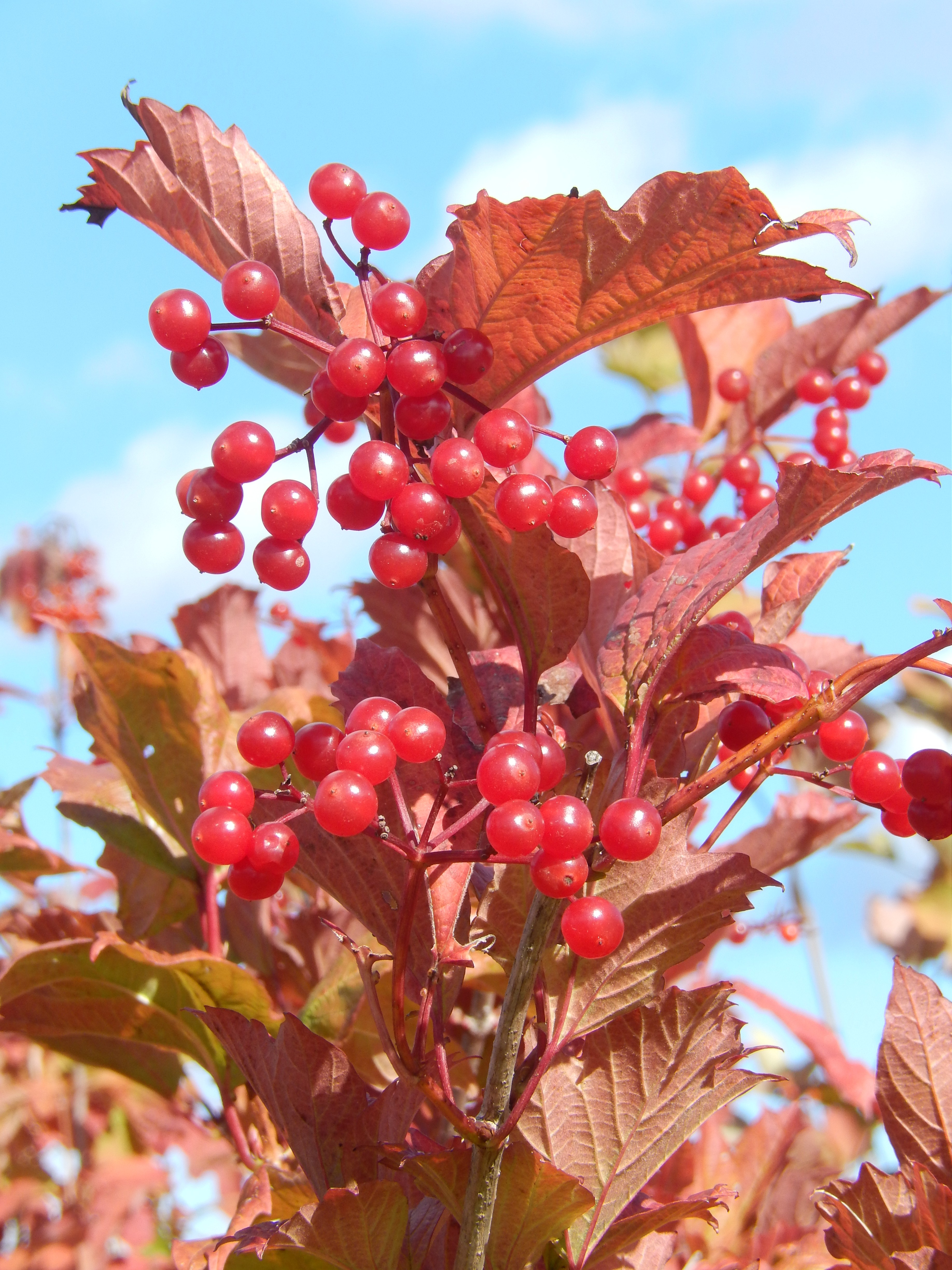
Autumn Reds: Guelder Rose at London Wetland Centre
Today a brisk southwesterly wind blew the ragged clouds away, and it suddenly felt very much like autumn. The willows have lost many of their leaves, while other trees are still fully clad in green. Down at the Wetland Centre, the Guelder Roses were resplendent in scarlet: the photo is exactly as taken.
Down on the grazing marsh, a few migrant birds were giving the resident birdwatchers a treat. The Peacock Tower echoed to excited calls as a Whinchat perched on a faraway reed to the left, a Jack Snipe bobbed obligingly among some dead reeds to the front, and a Stonechat perched momentarily on a reed to the right. To my own surprise I saw all of them, even confirming that the Jack Snipe was bobbing up and down and had a dark stripe down the centre of its head. When it sat still it was marvellously hard to see, even in a telescope zoomed in and centred on the bird, its disruptive patterning doing an excellent job of breaking up its shape and matching the light and shadow of the vegetation around it.
Round on the wildside of the reserve, a few (Migrant) Hawker dragonflies and some Common Darters were still flying; and overhead, five House Martins, presumably on their way down south from somewhere far to the north, were busy refuelling on the many small insects flying over the water.
I didn’t even bother to struggle round the Fungus Foray in the afternoon, as it was obvious from the dry weather of the last month that there wouldn’t be any mushrooms to speak of. So I wandered along to say hello to whoever came along, and perhaps see some other wildlife.
Sure enough I met Alick Henrici, the indefatigable mycologist; he leads fungal forays in every county, even the Grampian Fungus Group, so he gets about a bit away from his home patch in Surrey, especially Kew Gardens. He said there was nothing to see, barring a few certainties like Phoma hedericola (Hedera=Ivy) which forms small dried-out looking patches on “almost every Ivy leaf”.
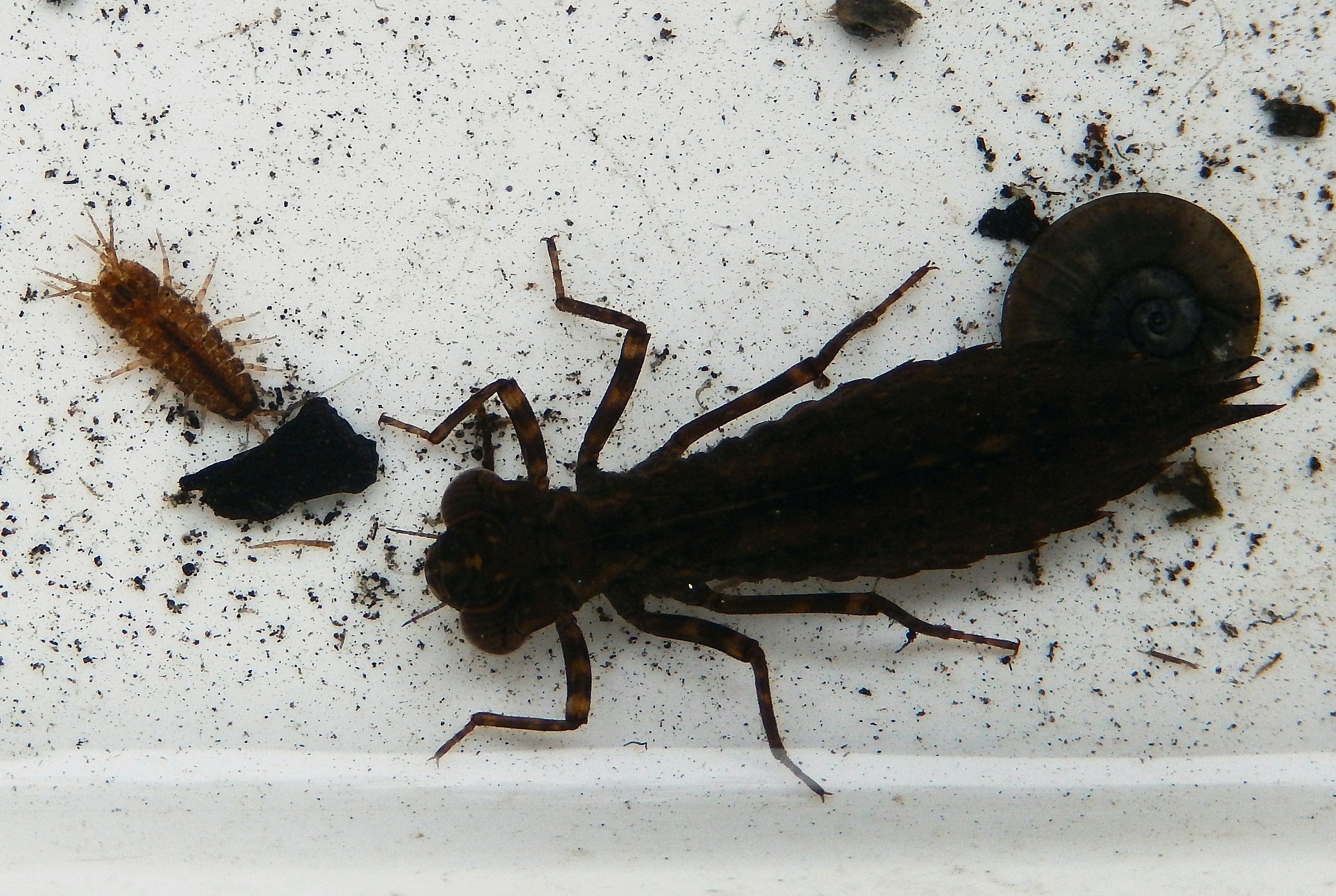
Around the corner, as he had said, some children and their mothers were thoroughly enjoying pond-dipping. Most of the summer animals were nowhere to be seen – not a newt anywhere, hardly a waterflea – but I saw some Pond Skaters, a Water Boatman, a few tiny damselfly nymphs, a Hoglouse or two, and a couple of plump dragonfly nymphs.
Hoglouse, Dragonfly nymph, Ramshorn snail
A weird, soft screeching noise was coming from a small oak above the pond. It wasn’t quite the harsh screech of a jay, and if it was a crow it had a seriously odd high voice. I climbed up to have a look. A grey squirrel was the source. It was alone so it wasn’t clear why it was calling.
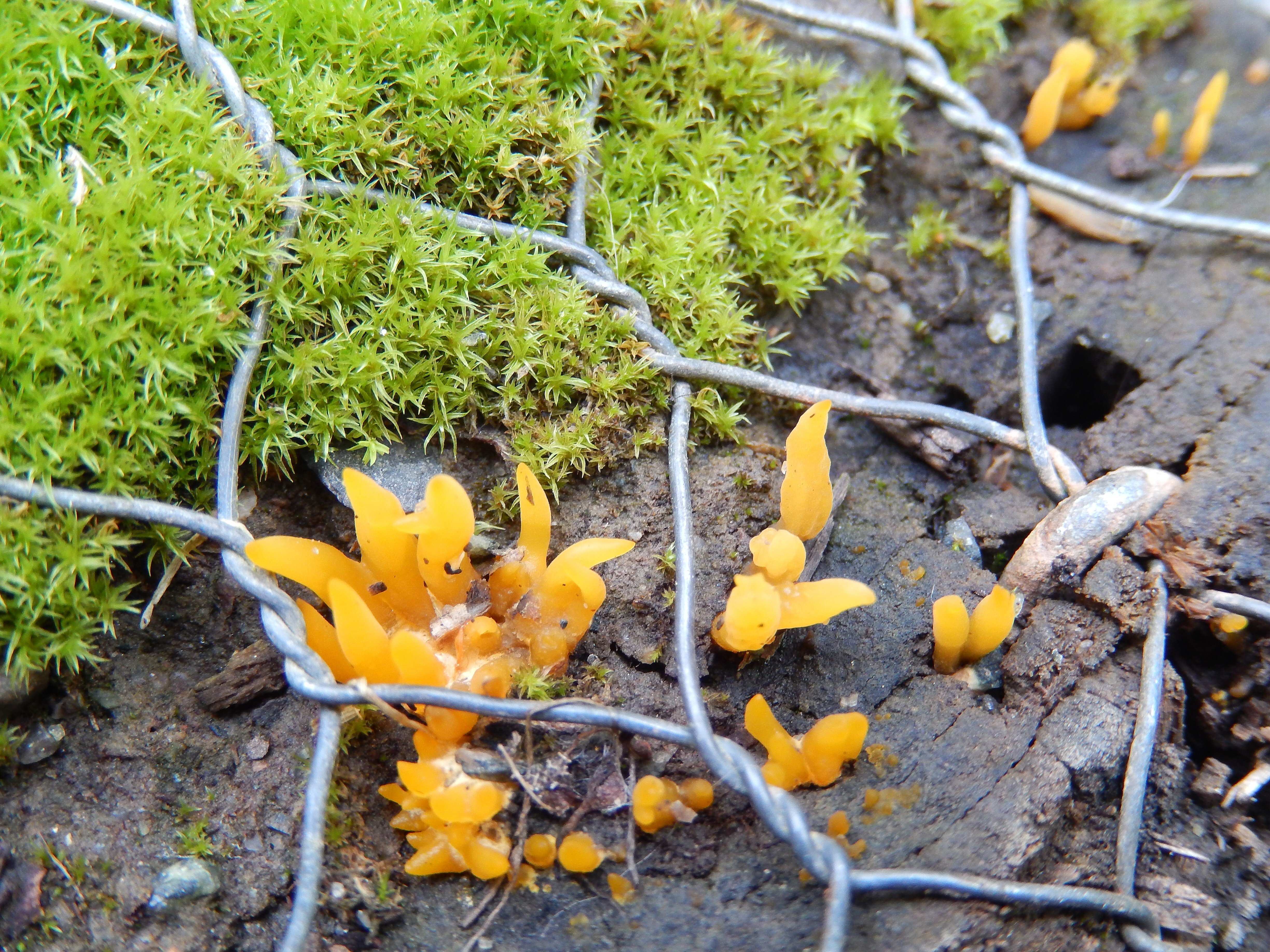
On the steps over the mound are some wooden posts to keep the uprights in place. And peeping through the wire netting on the mossy top of one of these posts was a teeny tiny clump of a yellow Ascomycete fungus, the ‘Golden Spindles’ toadstool, Clavulinopsis fusiformis. The holes in the netting are about a centimetre across.
Clavulinopsis fusiformis
The English seem unemotional … except for their passion for nature