Digging a ditch on the reserveNewly dug ditches … turning into a seasonal pond
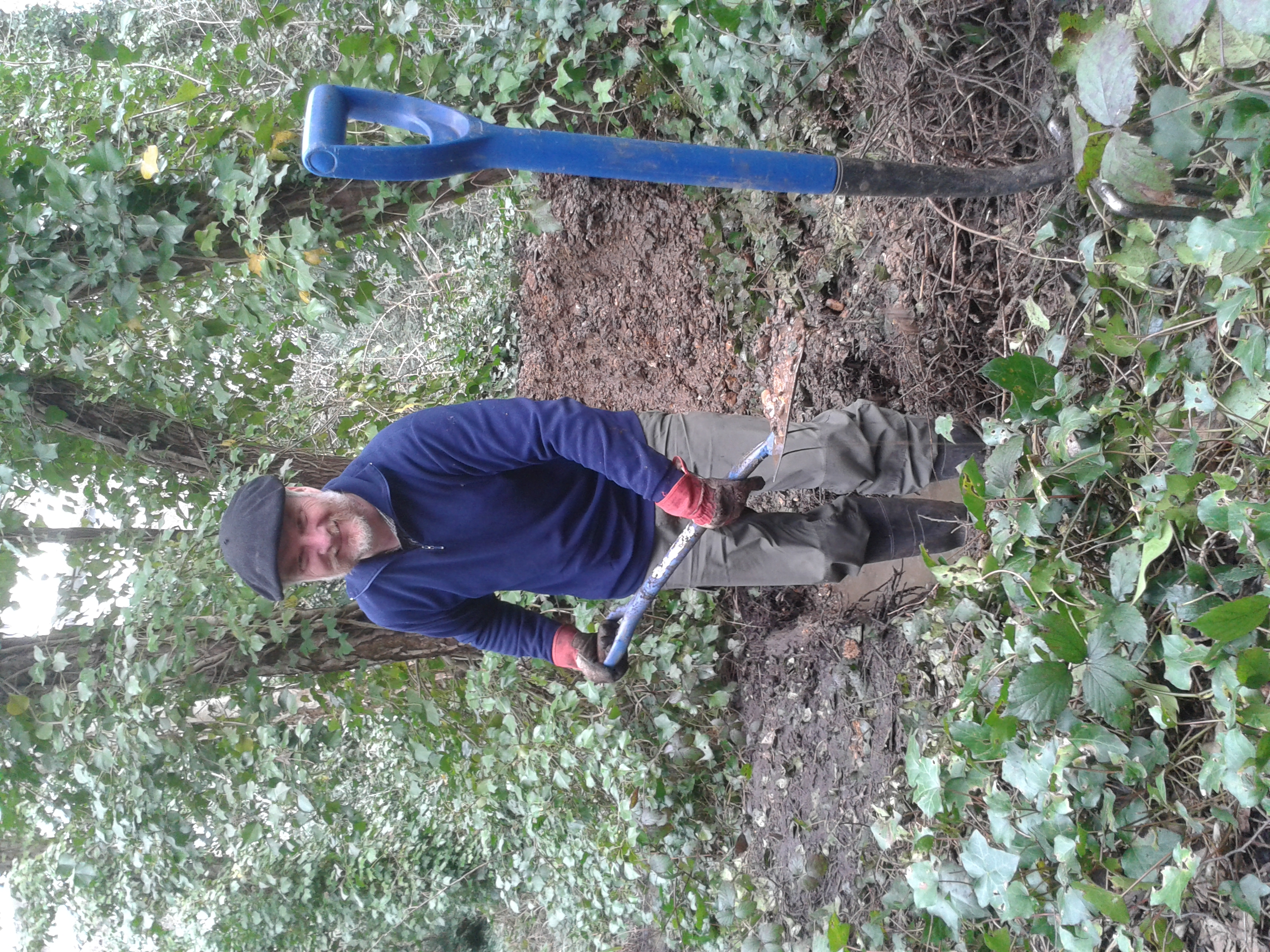
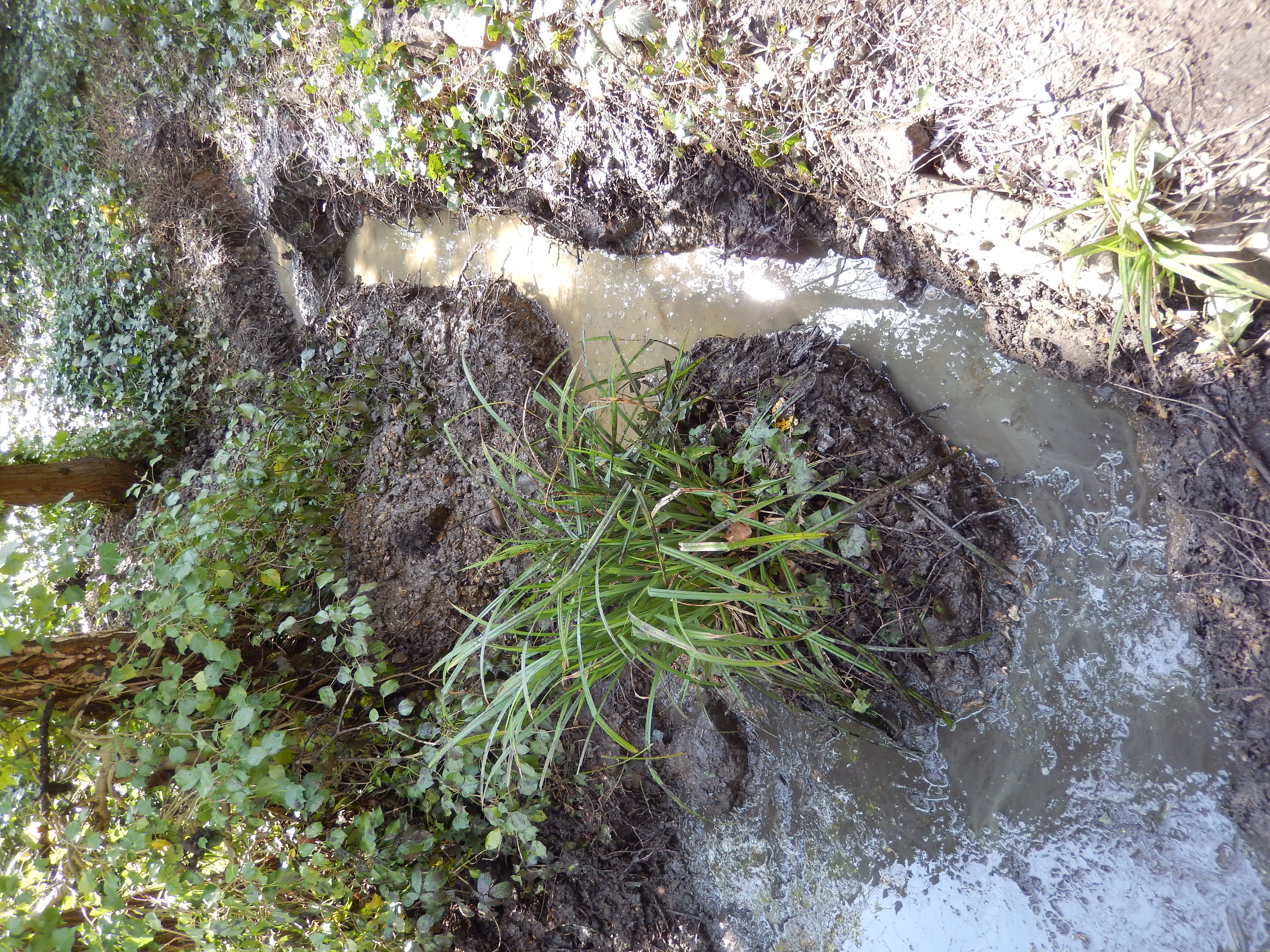
After just three short sessions of ditch-making, we have a little network of waterways, an island sporting a natural tuft of Pendulous Sedge, some impressively high banks of muddy, gravelly spoil, and a new feature for the reserve. We hope to extend the ditch down the natural line (was it a ditch before?) to the trees at the end. The existing seasonal pond certainly had a ditch-like extension to just across the path (from where the lower photo was taken), and we intend also to clear that out – it shouldn’t be difficult as, unlike the current ditchworks, there are no stones, roots or ivy entanglements to cut through.
Today (7 April) the sun shone in a cloudless spring sky, and we worked to the song of a Chiffchaff. Two Blackcaps were singing elsewhere in the reserve, along with Wrens, Dunnocks, Great Tits, Blue Tits and some non-vocal Magpies, a Jay, Wood Pigeons, a Heron and Mallard. The insects, too, have emerged to exploit the sudden warmth, with plenty of Peacock butterflies, a Brimstone or two, and a Holly Blue; I saw a Small White in my garden. There was a 7-spot and a Harlequin ladybird, and the pond was alive with a new crop of Pond Skaters.
The grass is racing up; Broom is coming into its handsome yellow pea-flowers; several tufts of garden-escape Mahonia and Daffodils are richly yellow; red deadnettles tempt several species of bumblebee including buff/white-tailed and carders, and the honeybees are active.
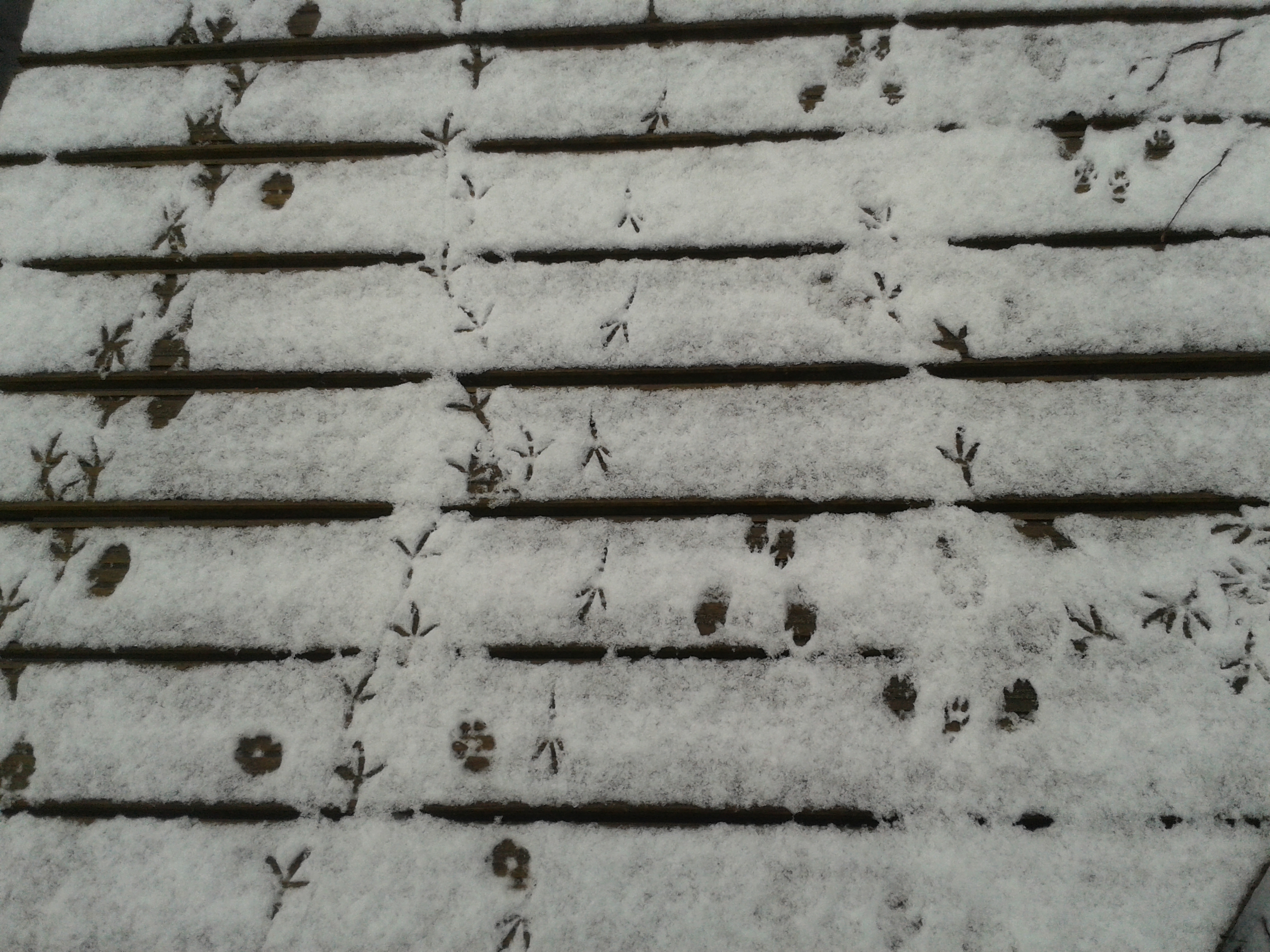
Animal tracks: Fox, Crow, and Squirrel prints on a snowy boardwalk
Today we woke to a snow-covered city, just a light dusting; and as often with snow, the weather was appreciably warmer than before the snow arrived.
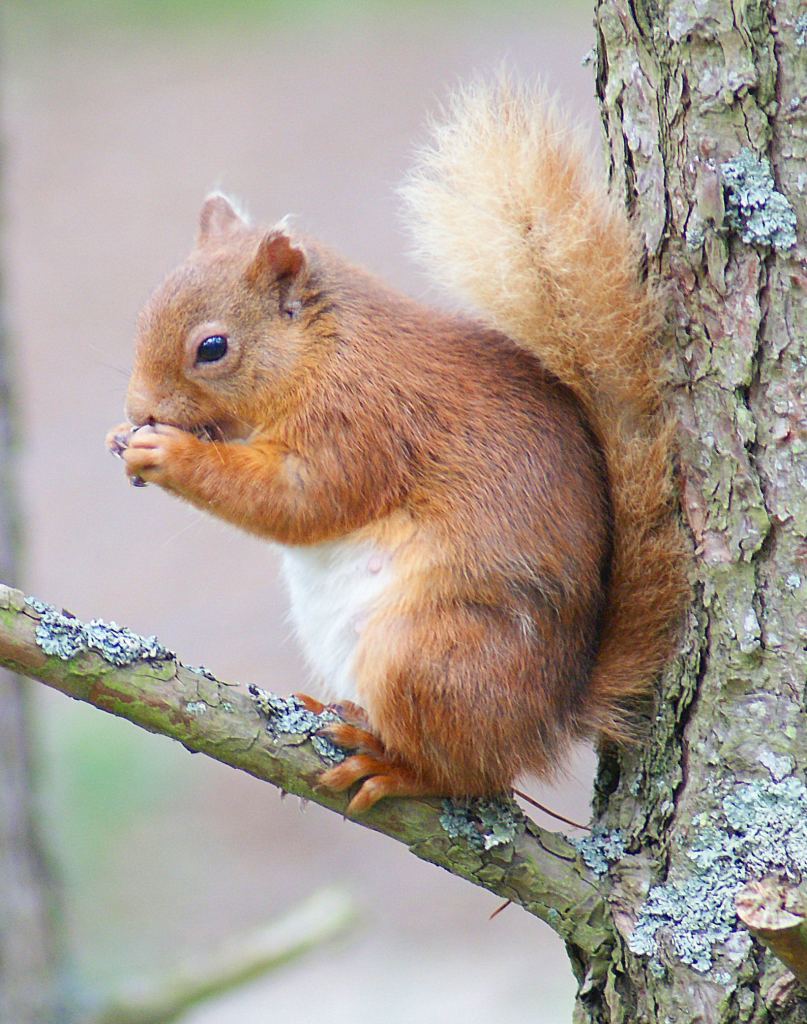
Down at the nature reserve, the paths were empty of human footprints, but thickly sprinkled with animal tracks. Here some crows had walked to and fro across the path; there, a fox had jogged along the trail. But better was to come: the boardwalk across the pond was interlaced with tracks. On the left, a fox had gone the length of the boardwalk. In the centre, a crow had walked unsteadily along, the same way as me; and it, or another, had walked more rapidly back. On the right, more birds’ footprints: and the four-feet-together group of a squirrel, the smaller front prints clearly showing the marks of the sharp claws.
On a Birch branch above the anthill meadow, a Green Woodpecker hammered in search of food. Down by the ‘mangrove swamp’, a Jay screeched harshly, either for us or for a fox. Near the picnic meadow, a Sparrowhawk flew from its high perch, wheeled above the treetops, dived rapidly out of sight.
We carried tools and a ladder to visit the nestboxes and take down all that needed repairs. While I held the ladder, a party of four Long-Tailed Tits blew by, crossing from one Birch to the next one at a time. One of the boxes contained not just a mossy nest (like three others) but two old addled eggs, probably of Great Tit. While we struggled to prise off a somewhat too well attached box for maintenance, a Robin perched nearby, in hope of eating any grubs we might have disturbed. Several boxes had had their openings enlarged by much hammering by Blue Tits or Great Tits: nobody knows why they might do this, as it increases the threat to their nests from predators. We will make aluminium plates for the fronts of all the Tit boxes (the ones with circular holes): the Robin boxes just have a wide rectangular opening, which they definitely prefer. Inside one of the boxes was a mass of woodlice in the moss; another had a plump dead Noble False Widow Spider (Steatoda nobilis) inside.
Winter has definitely set in. The spinach beet in my garden was all frozen, the air at -3 Celsius and the ground presumably rather colder under a clear night sky. Fearing it might all be lost, I picked some and went out to see what there might be today down at Wraysbury Lakes.
Almost the first thing I saw was a bulky little finch high in a waterside willow. It called ‘deu’ quite loudly, fidgeted about and flew before I could focus on it. Still, there was no doubt it was a Bullfinch: the call, its shape, its solitary habits, and its shyness all pointing the same way. It is never an easy bird to see, even where it is resident (it is regularly ringed at Wraysbury). Leafless trees and the rising energy of the coming breeding season provide one of the few opportunities to catch a glimpse of this less well known finch.
At first sight there seemed to be no birds out on the lake. Finding a small illicit patch cleared by a fisherman I set up the telescope and looked about. A Pochard or two; some Tufted Duck and Coot; a male Goldeneye… but the Smew and Goosander of a week or two ago were nowhere to be seen. The old truth is that you never know what you’ll see: but it’s often a delightful surprise, and almost always energizing to be out in nature.
I walked on and looked about again: some rather white ducks caught my eye in the distance. Two male Goldeneye, each with a female in tow. The males threw their heads forward a few times, pretended to preen; one threw his head back and forth, then lowered his head and stretched it out and in. His female swam after him, her head resting on her back as if she were asleep! But she was certainly watching the display, and swimming to keep up a few lengths behind.
A loud squawk betrayed a Heron; it flapped out of cover at the end of the lake and landed on the bank behind the ducks. A few Mallard panicked from the water below me; a Moorhen briefly took flight.
Away from the lake, a few Robin and Dunnock hopped in and out of the bushes. A solitary Fieldfare or two gave their chack-chack call from the hawthorns, watchful and flighty. Another Bullfinch calling, this time atop a bare hawthorn bush – or maybe the same bird, half a mile on – and again I couldn’t get binoculars on to it, despite my stealthiest movements: it had surely seen me at once, and just took a few seconds to decide when to flee.
A Kestrel hovered beyond the tall poplars: no Buzzards or Red Kites today, but really the Kestrel feels almost more special than them, its numbers declining across Britain.
A few Jackdaws, Carrion Crows and Wood Pigeons on the horses’ hill; some Fieldfares in the trees, with a single Redwing; a Stock Dove flying low.
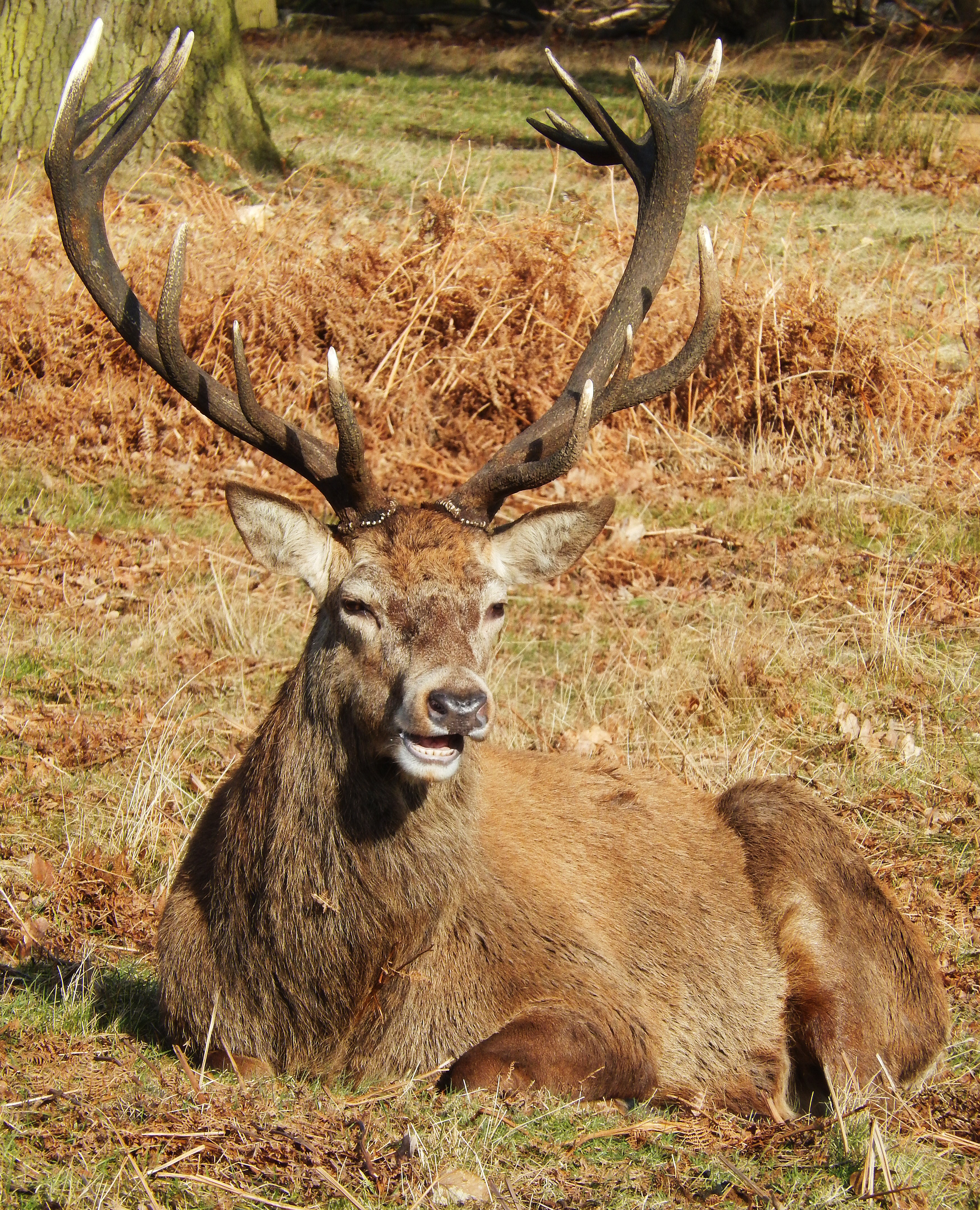
In Scotland, the male of the Red Deer is called simply a Stag, all other male deer (presumably Roe in that country) being known as Bucks. Down here, with Sika and other species about, it may be wise to name the species explicitly. There are signs up warning of the impending cull, so now may be the best time of year to see fine large stags resting quietly, the rut over.
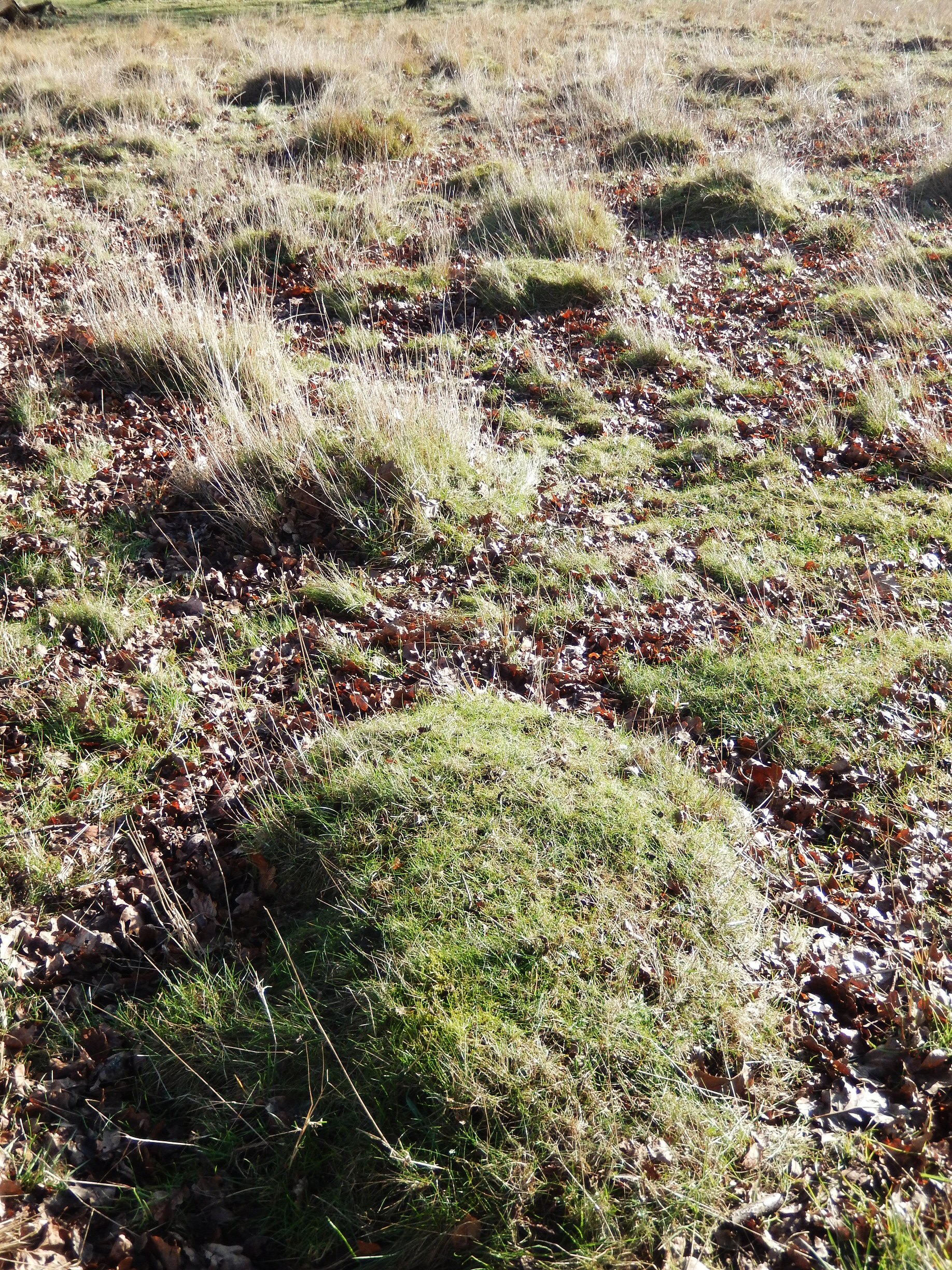
Richmond’s splendid anthills
I was welcomed to the park by a flock of Jackdaws chattering in the trees. Down in the valley, last year’s grass stalks are whitening, the fine big anthills well outlined in the low winter sunlight.
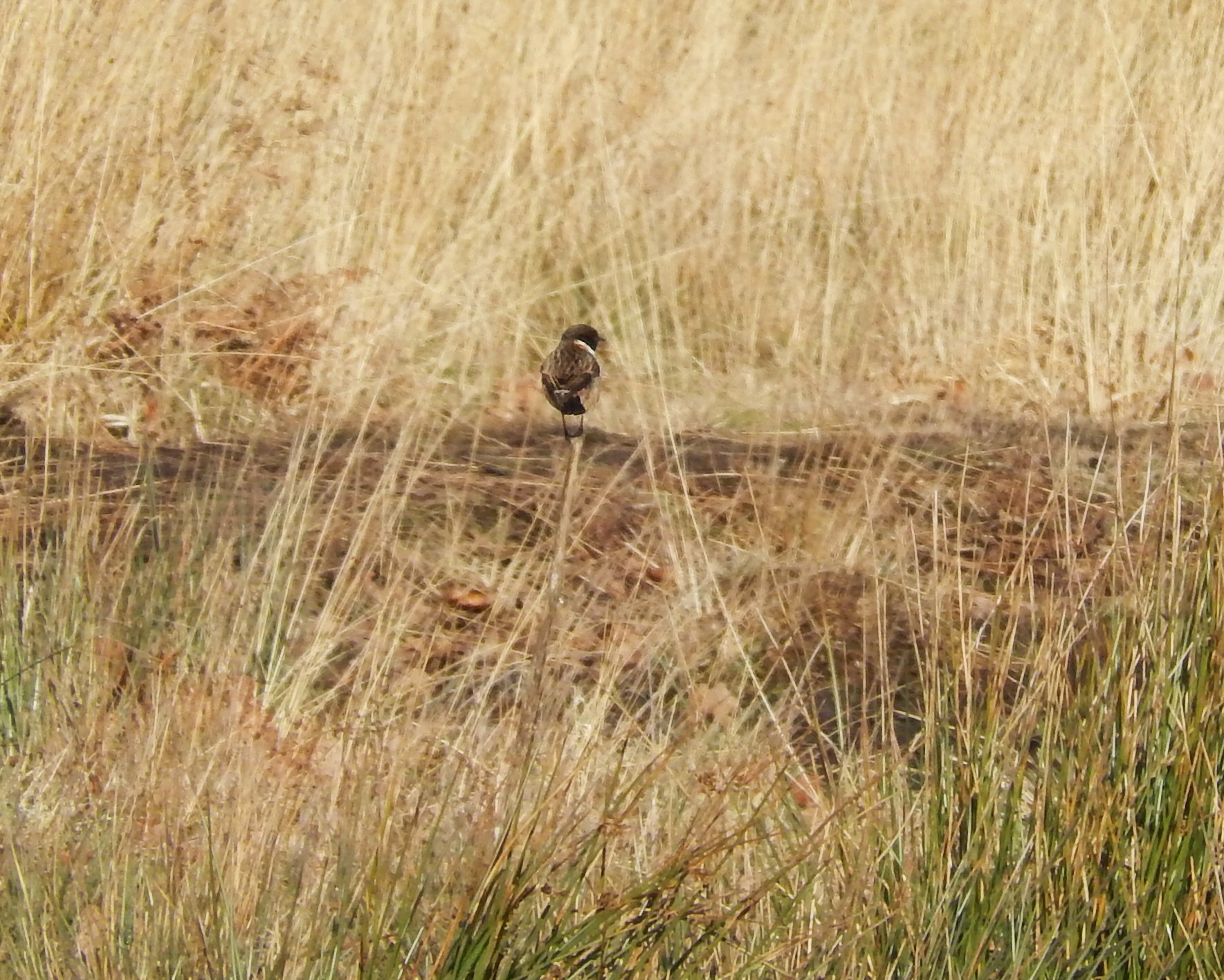
A Stonechat was perched on a slender stalk, level with the tops of the grass; there cannot be much in the way of insect food to catch just now.
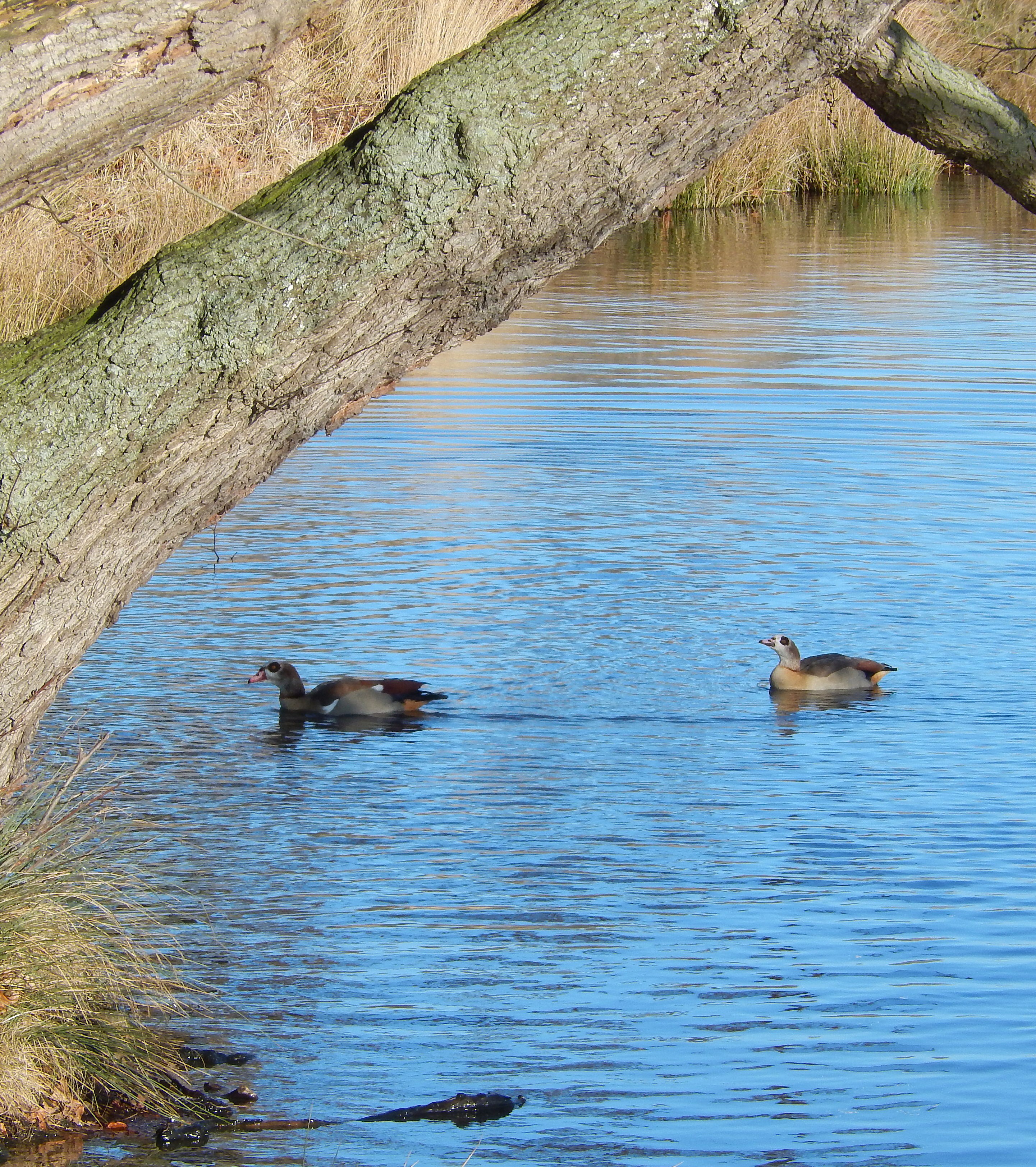
Egyptian Geese under the Willows
On the Pen Ponds, there were remarkably few waterfowl of any kind, but the lower pond had half-a-dozen Pochard. the males handsomely rufous-headed, a pair of Wigeon, the male with a conspicuous white wing-bar, and tucked in a corner under the willows a pair of Egyptian Geese, taking to the water and protesting with short dry honks when molested by a dog.
Male Stonechat
Walking back up the hill, a Kestrel hovered briefly, rested in a tree giving a good view of his spotted breast and back. Two herds of Red Deer, one at the base of the hill, one at the top, both with all ages and both sexes together, grazed silently. In the muddiest places, footprints of men, dogs and deer clustered together.
Emmylou Harris sang of sunshine in December and roses in the snow. It’s only the 28th of October, so not that late in the year yet, but the mercury climbed to an improbable 18 Celsius – that’s T-shirts and sunhats for work down at the nature reserve – and there were indeed roses blooming in the garden.
For the record, also in flower today were Alpine Pink, Tayberry, Squash, Strawberry, Primula, Nasturtius, Hydrangea, the little New Zealand Sorrel that manages to grow between the paving stones, and Daisy.
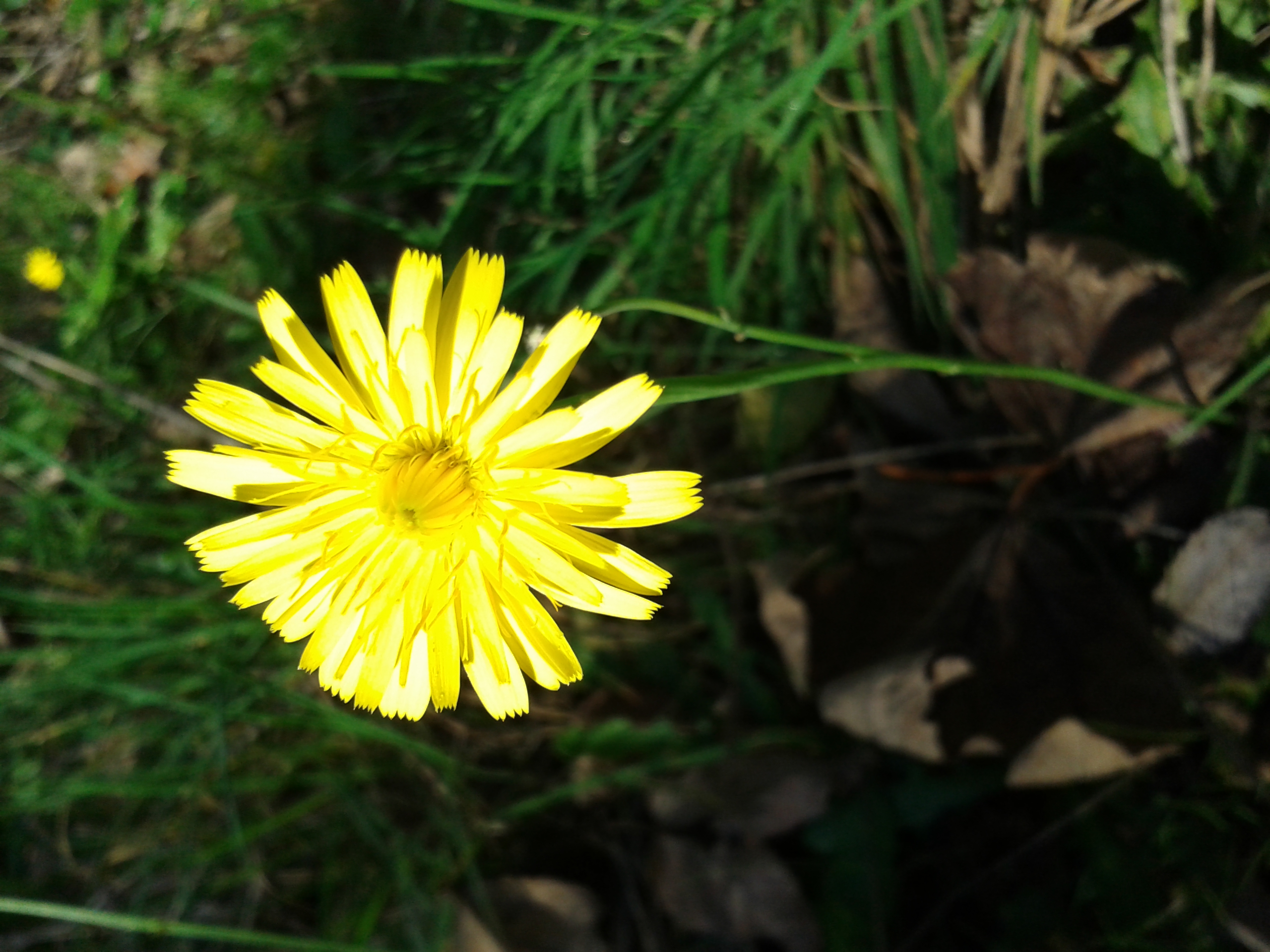
Down at the reserve, Beaked Hawksbeard has come back into flower (for the second time this year) on the picnic meadow. It seems that the warm weather has coaxed the plants to try flowering. They’ll get a bit of a shock with the change coming in the weather tomorrow, probably. It certainly feels like an odd bit of Phenology, but of course we won’t know for many years whether this is part of a long-term trend to do with global warming, especially as the global average temperature has been taking a holiday from its inexorable rise for some years now. When the temperature does take off, it will be too late to stop, and very costly to mitigate.
Judging by the feeble global co-operation on the far more obvious and immediate threat of Ebola virus, it’s hard to be optimistic about our ability to collaborate as a species on anything as large as global warming. The Drake equation, the one that predicts the number of intelligent civilisations in our galaxy, has a term for the lifetime of a civilisation, as Prof. Brian Cox recently explained in his TV series Human Universe. If it’s only a few centuries, that would neatly explain why – despite the profusion of suitable-looking planets – we haven’t been contacted by any other civilisation. That would imply that “intelligent” life never lasts very long on any planet. However hard it tries to be sensible, selfishness – which must always be favoured by evolution for short-term gain – always takes over, and people use up the resources of their home planet until – pof! – they wipe themselves out. Just clever enough to be really stupid. What a cheerful thought.
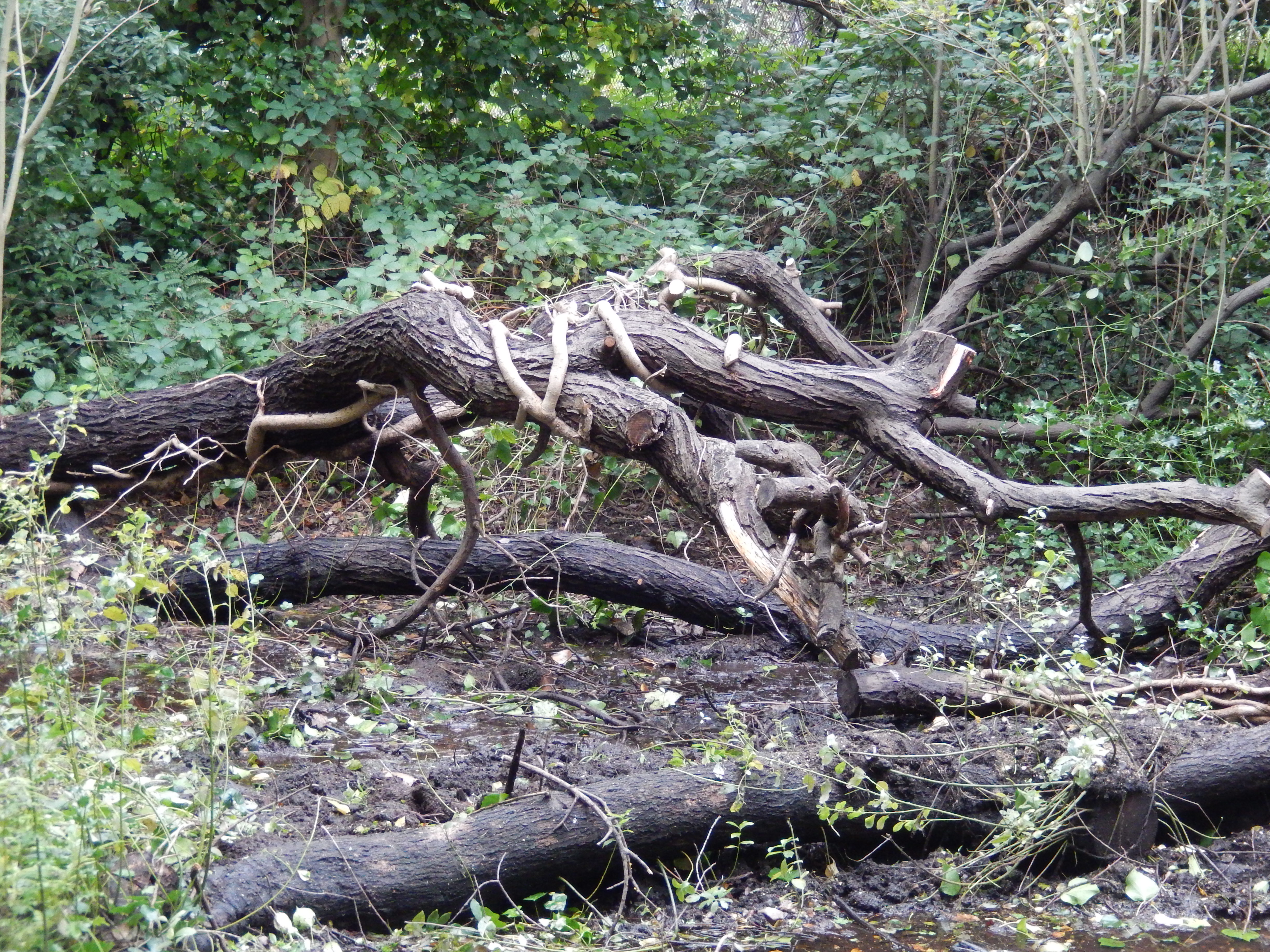
Most of my last few visits to Gunnersbury Triangle have been taken up with untangling a mass of fallen Willow trees in the mangrove swamp. One tree fell on the next, which fell on the next … and the whole lot were in sticky mud with a rising autumn water table, covered in ivy to boot. I lopped, chopped and carried branches and lumps of ivy away, getting happily hot, tired and dirty in the process.
Lopped Trunks in the Mangrove Swamp
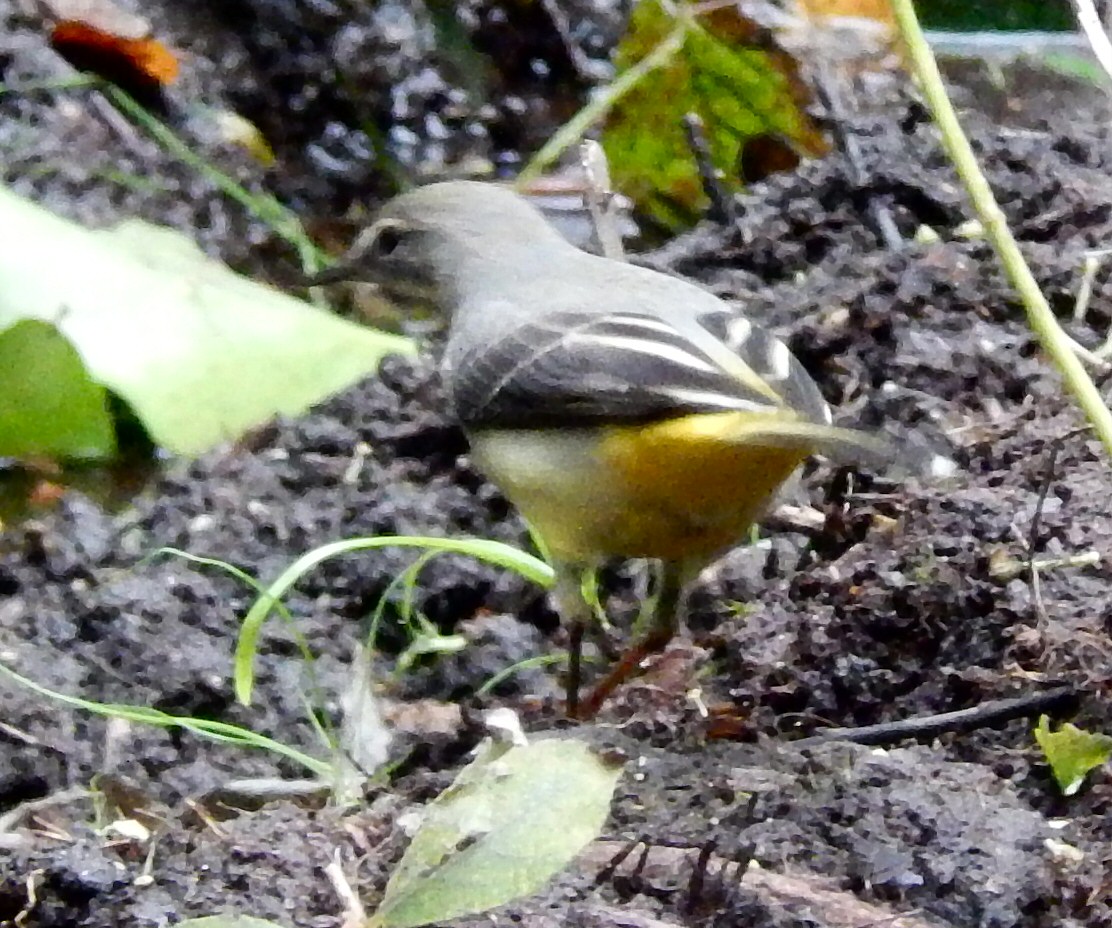
Yesterday I wandered around with no tools other than camera and binoculars, and was rewarded with the sight of a Grey Wagtail, a Robin and a Wren hopping about and feeding in their different styles, exactly where I had been clearing.
Grey Wagtail: it is blurred as it was moving and wagging its tail
The wagtail was gobbling mouthfuls of grubs that it grabbed from the soft mud. It constantly bobbed and wagged its tail, displaying its yellow rump in the process. Could that be aposematic – is the yellow, in other words, a warning that the bird is distasteful? If not, why does it constantly flash yellow, even when no other birds of its species are about?
Today, I finished lopping the fallen Willow branches; as these last ones were over on the side, it was a cleaner and drier job. Then I joined in with a corporate group from Lend Lease, a well led and relaxed team … of property developers. They were incredibly pleasant to be with. The next surprise was at the hut when we all had a cup of tea: a nice Indian businessman in a suit came and asked us if his firm of engineers could use the reserve … for a group meditation. They stood about quietly and respectfully in a group, at least one person with hands pressed together in the ‘namaste’ position. We went on clearing and coppicing in the delightful autumn weather.
I got a small winged bug in my mouth; it released a pungent taste of cinnamon oils. Probably that is a chemical defence too: certainly a powerful taste, probably unpleasant in any quantity; but it was not bad in a one-off dose.
I ended my day sawing off some of the tree-stumps left over from the coppicing, together with one of the very capable and enthusiastic London Wildlife Trust trainees. It’s tremendous to see such good work going on in the reserve. And a piece of excellent news: a new warden has been appointed to manage work on the reserve, along with a West London warden who will be based here, but will have the massive task of keeping all the Hillingdon reserves from getting totally overgrown with hawthorn and blackthorn, among other things. So, suddenly, the place is full of life! Let’s hope we soon get our new visitor centre, we need it.
Conservation work with property developers; meditating engineers. You couldn’t make this up, or if you did, nobody would believe you. People say nature opens your mind, helps you feel relaxed. It does, you know.
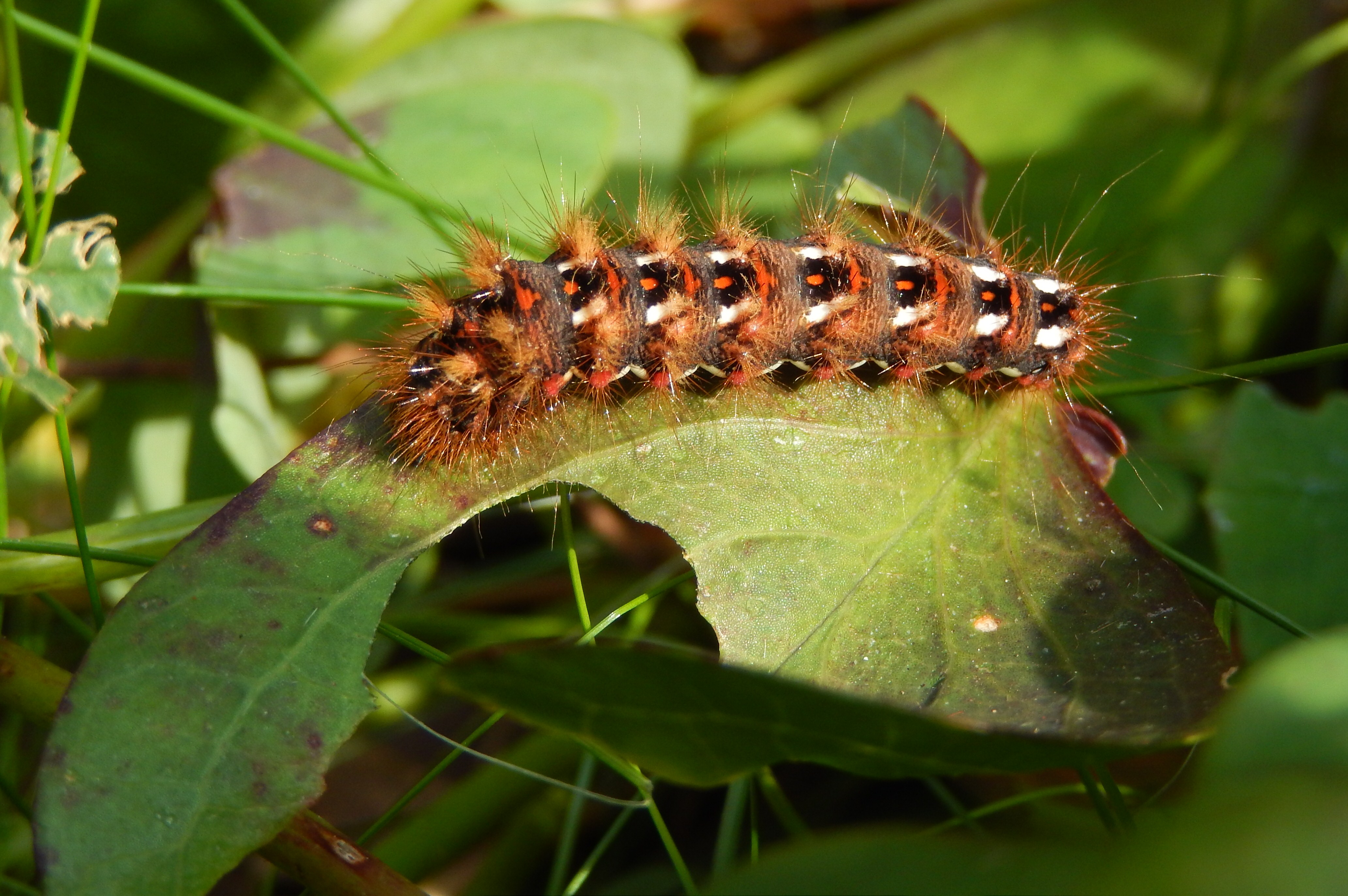
Knotgrass Moth Caterpillar, Acronicta rumicis, in garden, on a beautiful autumn day. It has eaten a substantial portion of the leaf. Its aposematic black-red-white coloration and bristling setae advertise it conspicuously as foul-tasting or poisonous.
Ah, poaching. It sounds so romantic. The merry strains of the English folk song, “The Lincolnshire Poacher“, that we sang at school come into my ear:
When I was bound apprentice in famous Lincolnshire
Full well I served my master for nigh on seven years
Till I took up to poaching as you shall quickly hear
Oh, ’tis my delight on a shiny night in the season of the year.
We think of the cheerfully naughty countrymen pushing a hare or a pheasant into their bag, making off home and delighting their wives with something to put into the pot for their families. We hardly spare a thought for the landowners, and if we do, it is with a pantomime image of greedy, fat, rich and selfish characters who “will not sell their deer”. Cue a chorus of boos and hisses from the gallery.
But (like most rose-tinted views of the world) this is all wrong. Poaching on that scale may or may not still exist: but much worse forms of it certainly do.
In Britain, poaching is organized crime, and becoming big business. Stolen game, farm animals and wild fish, especially salmon, find their illegal way into the human “food chain” (the term is borrowed from an older view of ecology, where it has fallen into disuse, and of course it has shifted its meaning: we consumers do not eat slaughterhouse workers, or supermarket shelf-stackers). There is no inspection of the unlawfully sold meat, which may be infected with tuberculosis (TB), may have been handled unhygienically, or may simply be past what should have been its sell-by date. There is no attempt to manage the ‘crop’ sustainably. If a wounded deer escapes, it will receive no veterinary treatment for its injuries or infections. In short, the whole sorry business is about money, with none of the usual protections that we expect in food and farming.
Across the world, matters are even worse. As roads cut into rainforests all through the tropics, the poor go into the remaining wildlife-rich areas to kill anything worth eating for bushmeat. In lawless areas, hunting the last of the game animals is an easy way for anyone with a gun to earn a little money. Once common and widespread species in many groups – monkeys, deer, snakes, birds, you name it – are being driven towards extinction.
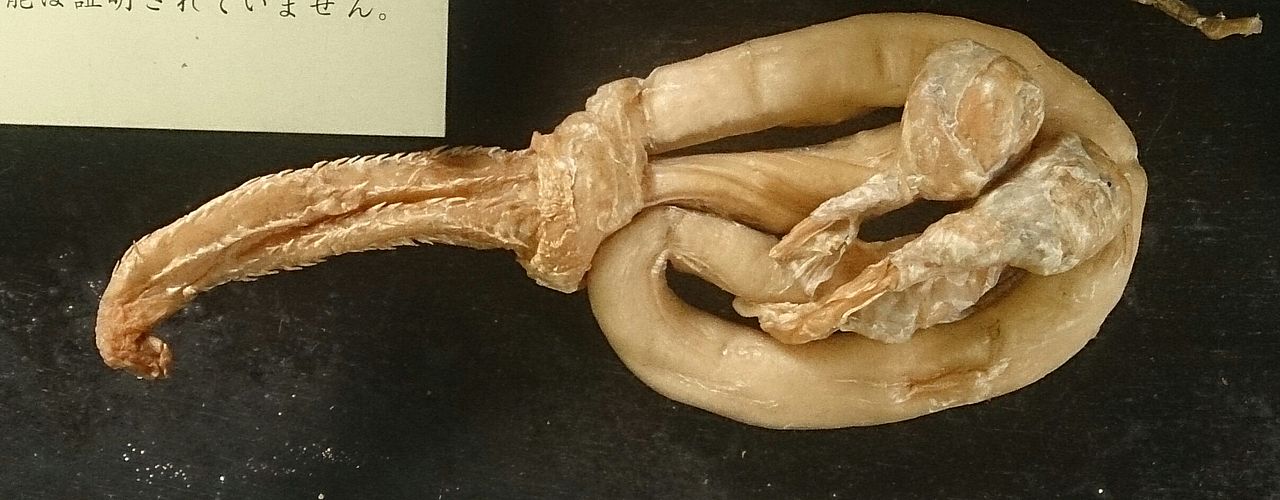
Tiger Penis is supposedly aphrodisiac. Image by ProjectManhattan on Wikimedia Commons.
And of course, poaching can mean killing elephants for ivory, rhinoceroses for their horns, tigers for their skins or their penises, bears for the bile from their gall bladders. Frankly, even the most beautifully carved ivory statues cannot compensate for the loss of elephants in the wild. Even if a dose of tiger penis brought an erection so huge that a horde of beautiful women were to flock about me, an unlikely result, it would not make up for the loss of one of these magnificent animals, let alone their extinction. If you have erectile dysfunction, Viagra might help you; animal body parts certainly won’t.
There is nothing romantic about poaching. It is incredible that, although it is illegal in Britain, it is not a notifiable crime: the police do not have to keep any record of how many animals are killed, how much property damaged, how many crimes committed.
With wars and refugee crises, human suffering and epidemics of tropical diseases from Malaria to Ebola virus, it is no wonder that poaching gets scant mention. Yet all the while, when there is money to be made, wildlife gets short shrift. Satellite imagery shows deserts expanding, forests burning. The destruction wrought by poaching is less visible, but it is having a terrible effect on hundreds of species.
You can do something about it. Support a wildlife charity. Campaign against the use of animal body parts in traditional medicine. Lobby your member of parliament, your government. Vote for a greener government next time. Now is the time to get on with it.