After a chilly grey start, the clouds dispersed and it turned into a brilliant winter’s day, the sky crisp blue, the air clear. I grabbed the telescope and went down to Wraysbury to see if the winter ducks had finally arrived.
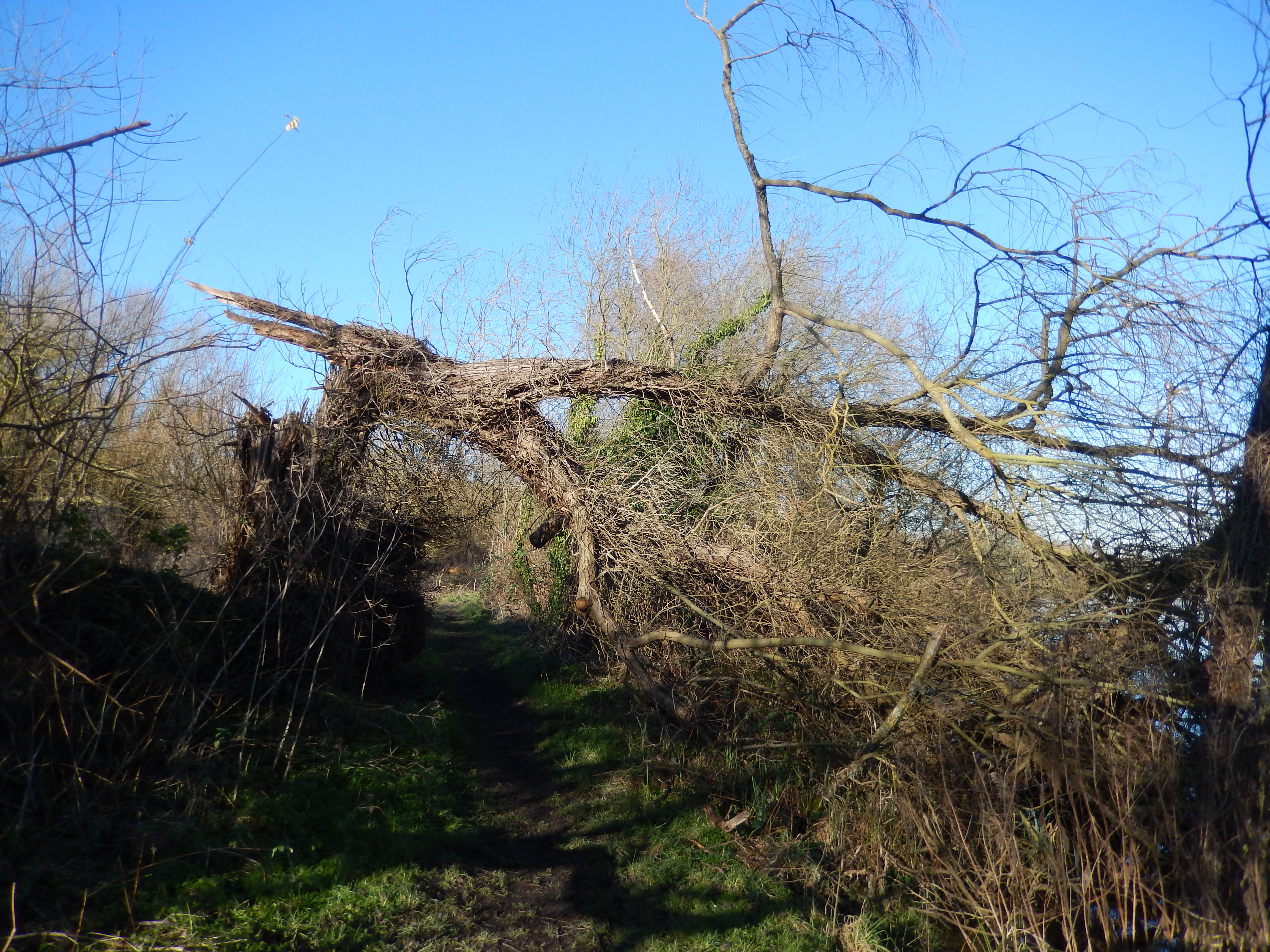
Snapped tree (Poplar) over path
The first thing I saw was a sign of the violence of the recent storms; a Poplar, always a fast-growing and short-lived tree, had snapped off and fallen over the path. But a way had already been cut beneath it.
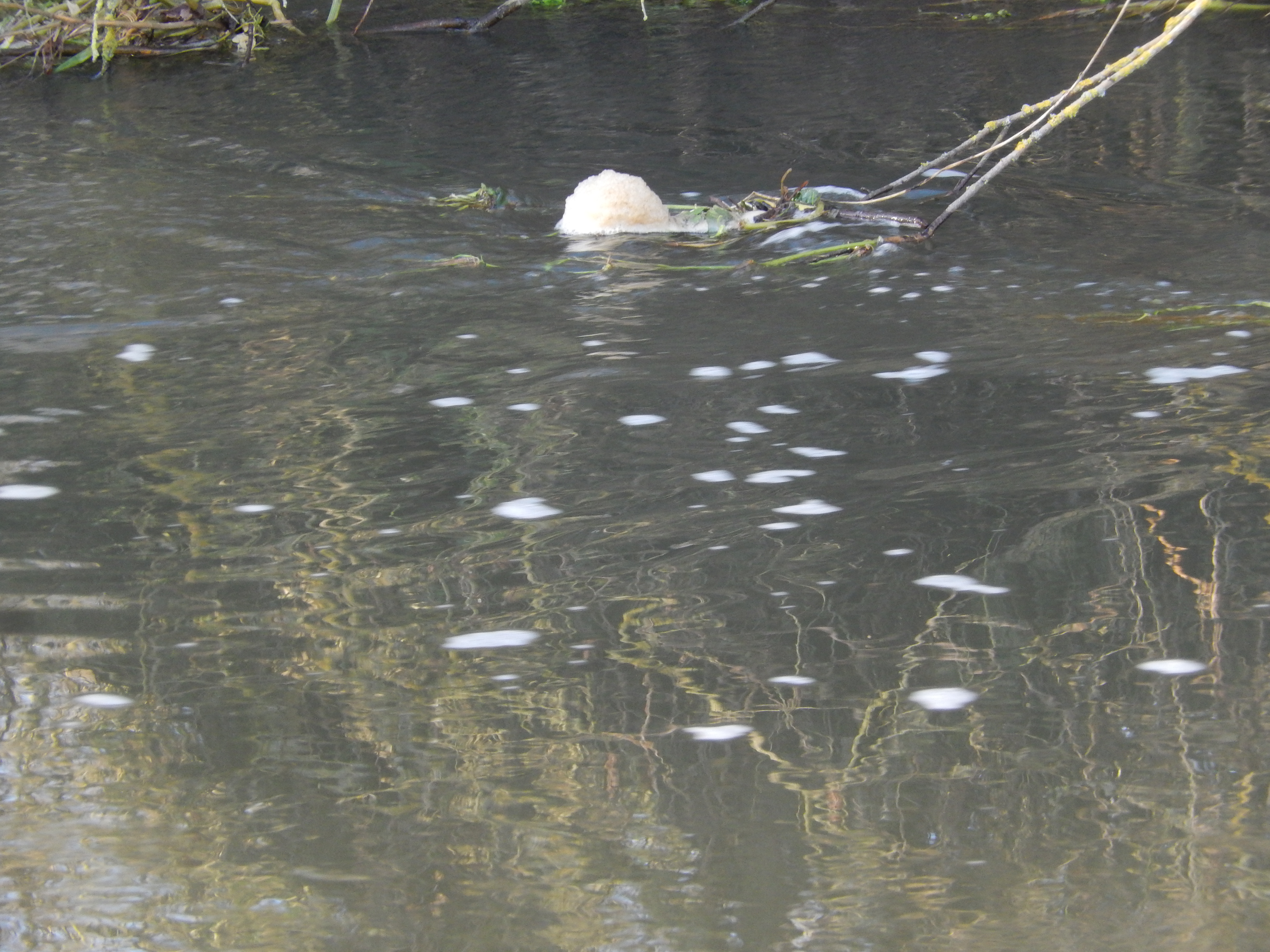
Soapy Pollution in River Colne
The next sight was a sad one: for the first time I can remember, the River Colne was obviously polluted, with lumps of foam drifting rapidly by, or caught on branches in the normally clean water. The river supports Kingfishers, wagtails and assorted waterfowl, so I hope the cause is a brief one-off event.
On the lake were four or five Goldeneye, the males waving their heads up and down to signal to the females – or to warn off rival males – the bold white patches on the sides of their heads visible without binoculars.
A little further on was a small party of Goosander, a male and two redhead females, their long serrated hooked bills and distinctive long bodies instantly recognisable, a sign of winter in this part of the world as they come down from their chillier breeding grounds.
Then, just as I was moving on, the bold whiteness of a male Smew caught my eye. With him was a redhead female, both ducks far smaller and shorter than the rather big Goosanders. A few grebes and tufted ducks vied unsuccessfully for my attention.
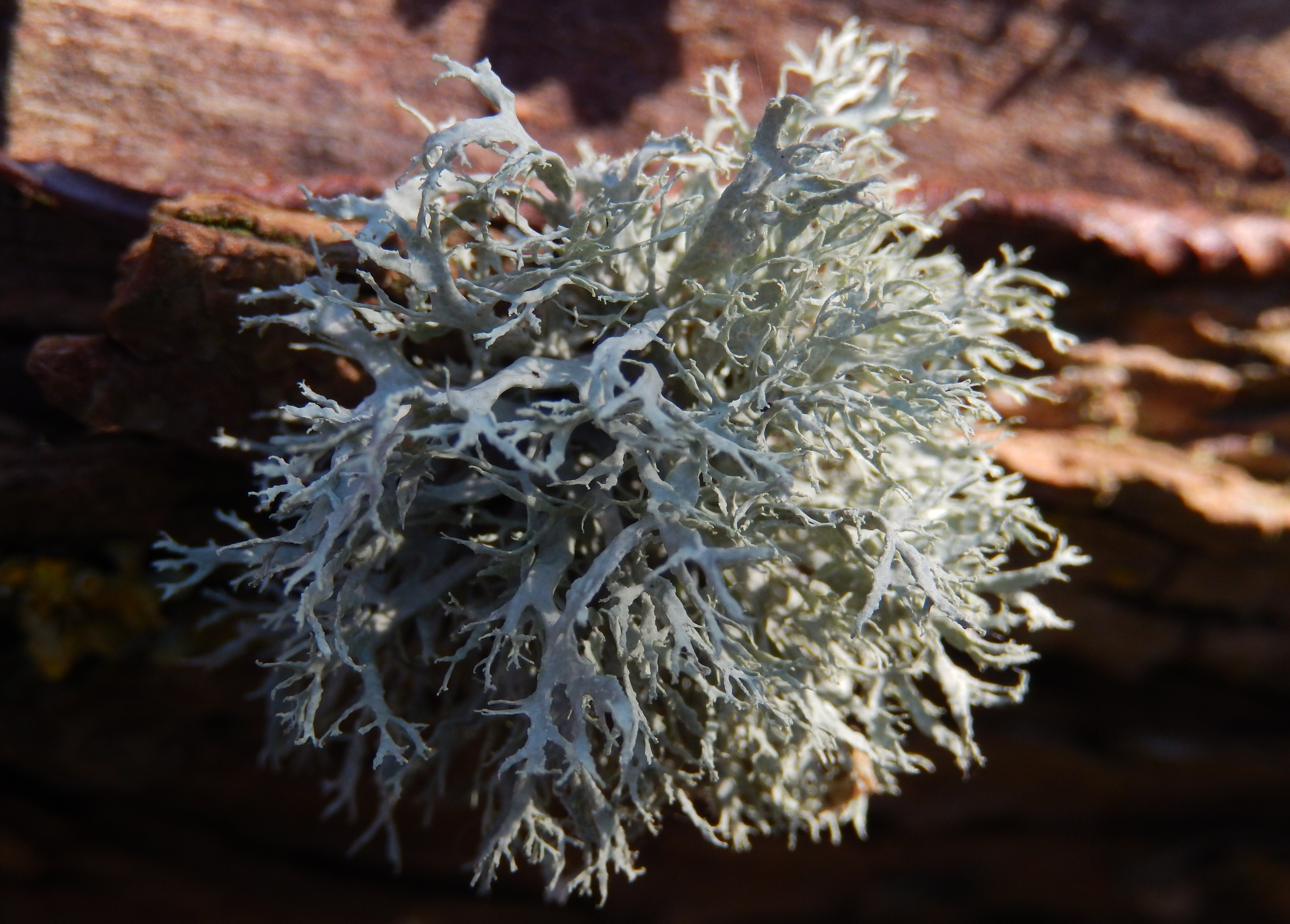
Ramalina lichen on Poplar
Some of the poplars, half-fallen, offered normally out-of-reach branches for close inspection. Along with the usual Common Orange Lichen and the grey leafy lichens (Parmelia sulcata and such) were a few bristly tufts of Ramalina, easily told for being rather stiff, slightly forked, and the same grey-green on both sides. You’ll probably have seen the genus on rocks just above the high-tide mark by the sea, or on big old stone-age megaliths. It’s a lichen that demands clean air, so it’s rather a nice surprise to see it so close to Heathrow Airport. Perhaps the prevailing Westerly winds keep most of the atmospheric pollution away. There is no doubt, though, that London’s air quality is far better than it was a generation ago: hardly anyone burns sulphurous coal any longer, and while there are hotspots of nitrogen oxides (Heathrow for one, Oxford Street for another) and diesel particulates, these aren’t as harmful to lichens as sulphur dioxide was.
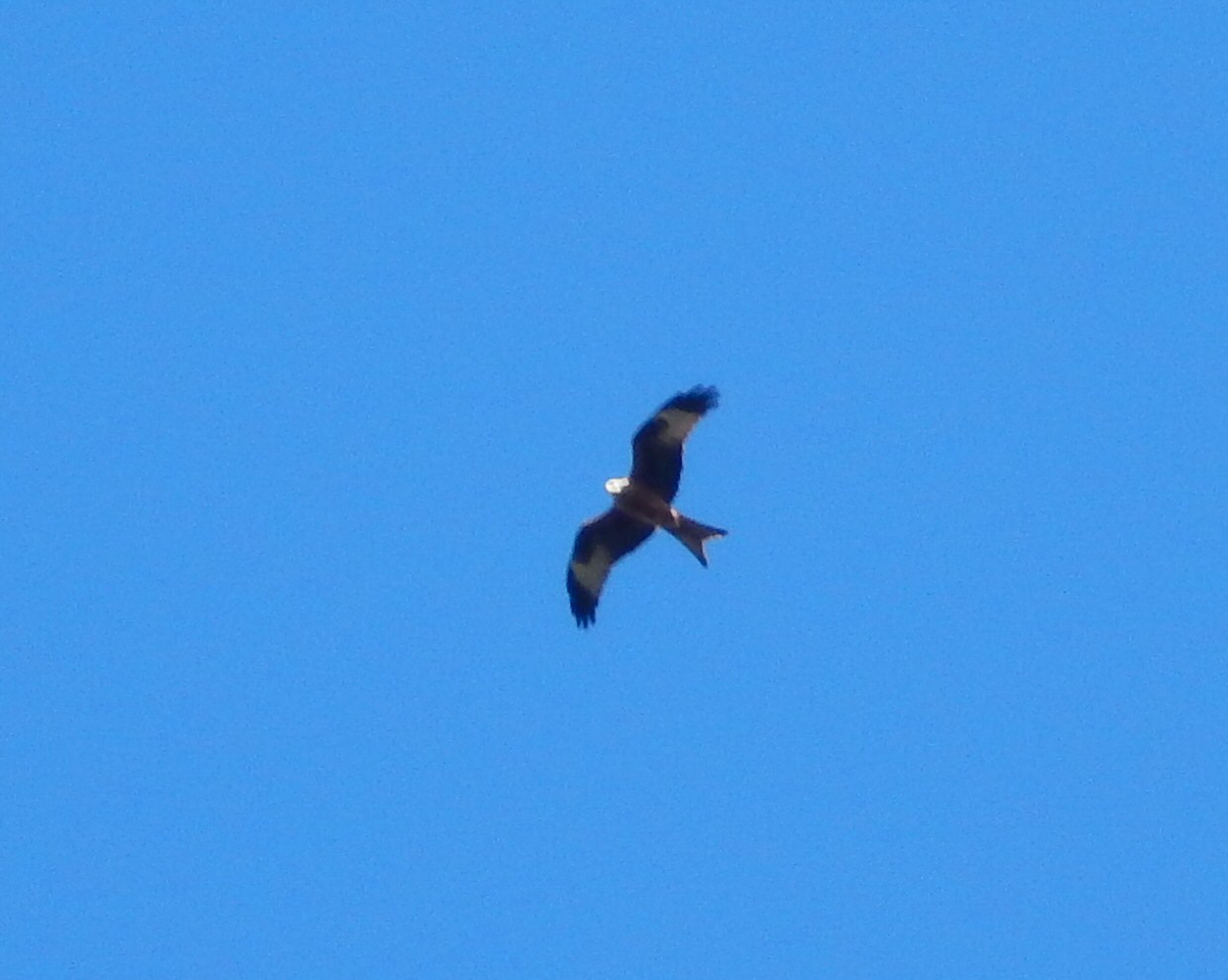
Red Kite
Around the corner into the area of wet grassland and scrub, I was delighted to be surprised by two Red Kites circling silently overhead against the brilliant blue, their long wings and forked tails a welcome sight that would have been familiar to Shakespeare but was missing until their recent reintroduction to lowland Britain. There was plenty of professional angst about whether the new Chiltern population should be encouraged to interbreed with the remnant Welsh population: but in the event, the birds easily dispersed the couple of hundred miles involved, and soon the gene pools mixed all by themselves.
Ponies and Hay
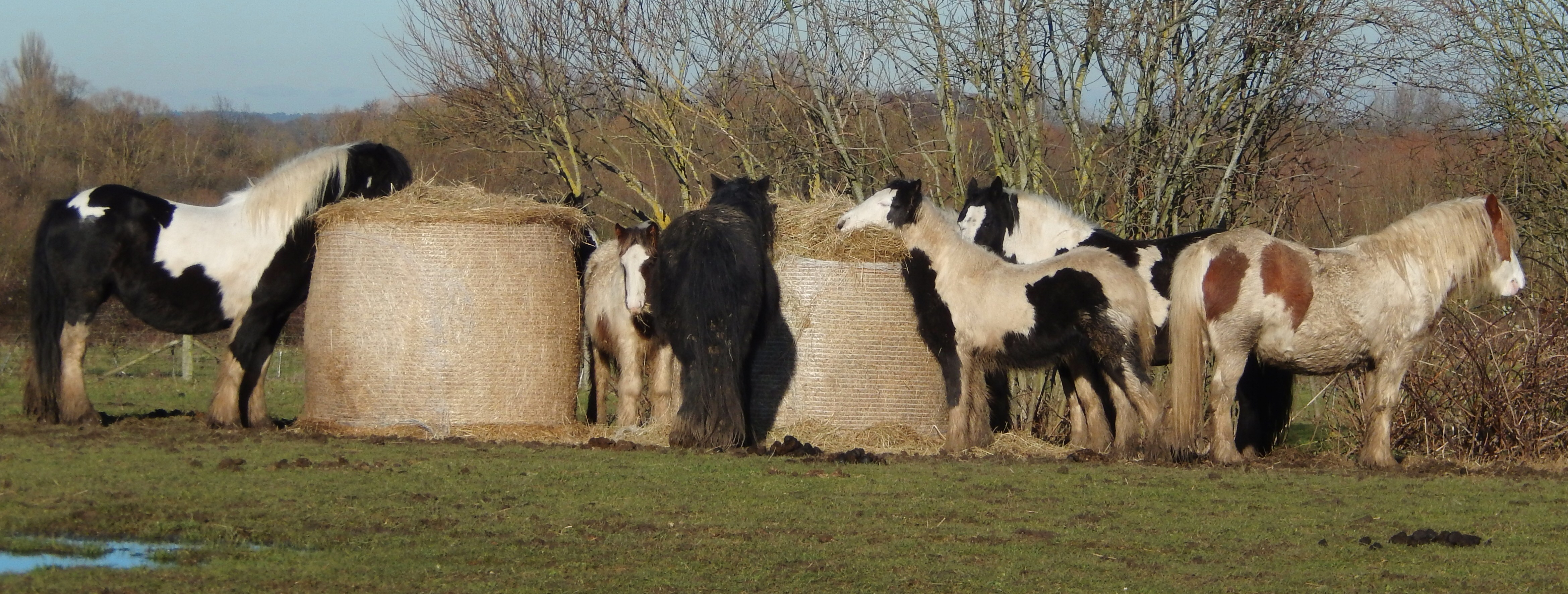
Up on the smooth green hill that was the old rubbish mountain and is now home to a dozen ponies and horses, the distant chack-chack of Fieldfares drifted to my ears. At least fifty of them were standing, watchful but constantly feeding, on the bare grass, flying up and chattering at the least warning. A solitary Mistle Thrush stood big and grey with its boldly spotted breast among them; a flock of a hundred Starlings moved flightily between trees and grass. A Wood Pigeon panicked and all the Fieldfares flew into the trees, still chacking. I splashed through the ankle-deep mud and puddles on the somewhat flooded path to the road.
“We have a clear signal that our climate is changing, and when you look at the evidence it’s because of human activities. The evidence is so strong I don’t know why we are arguing any more”.
So said Don Wuebbles of the University of Illinois. He pointed out that the world has just had the hottest year for 1,700 years, very probably for 5,000 years.
NOAA 1880-2014 global average temperature anomaly: recent decades, and especially the most recent twenty years, have been the warmest since records began. Global warming is under way
Thirteen of the fifteen warmest years ever recorded in Britain have been since 2000: the others were just before then. 2014 had the hottest summer for 350 years (when local records began). There is no doubt that we are experiencing climate change in these islands.
Around the world, the pattern is as clear as crystal: rapid, global warming, especially strong in the furthest northern climes, as in Alaska. There, the warming is drastic. Permafrost, which stores enormous reserves of carbon locked away in frozen peat, is melting: and the fossilized plant material, exposed to the air for the first time in millennia, is starting to oxidize. There is nothing to stop all the rest of it melting away.
Actually, the story up in the far north is more frightening than that. The warmer it becomes, the more three different positive feedback cycles collaborate to speed up global warming even more.
First, as mentioned, the permafrost is melting. That releases carbon to the air, as the greenhouse gas carbon dioxide, which accelerates the warming and melting.
Second, as the ice vanishes, the albedo (reflectivity) of the once-frozen north goes down dramatically, from icy white (reflecting most of the sunlight that hits it) to muddy brown or black (hardly reflecting anything). The ground absorbs more sunlight, so it becomes warmer, accelerating the melting and oxidation of carbon; and it directly contributes to having a warmer planet.
Thirdly, as the lakes and pools lose their ice cover, enormous amounts of methane hydrates, chilly masses of carbon-rich material in the icy mud, collapse and release streams of bubbles of methane gas, a far more potent greenhouse gas than carbon dioxide. If it were to be burnt, carbon dioxide would be released; unburnt, it accelerates global warming still more rapidly.
Back in Britain, everyone noticed that the weather in late 2014 was exceptionally warm. October and November in my childhood were leafless windy months with what seemed to be incessant grey skies and driving rain that churned football pitches into cold greasy mud. This time around, it was possible to work outside in shirtsleeves to the end of November. The change? Out of all recognition. It was a wholly new climate.
But the weather is not the climate. Britain is now in winter’s grip. Scotland shivers down to -15 Celsius. Here, under clear blue skies, the Birch trees glitter in the nearly horizontal sunlight. A greater spotted woodpecker, calling “Chik!” loudly, flies into the canopy of a Birch, clings to the elegant white trunk, the few remaining triangular leaves shining a rich yellow. The woodpecker bounds off, its wings whirring in short bursts.
The cold weather, like the increasingly violent storms that brought down two trees in the reserve last week, is part of the warming pattern too. The atmosphere has more energy than before: warmer air masses meet cold ones with a higher difference in temperature, releasing more powerful storms than we ever used to see. Winters can be colder, wetter, and windier as a result: more trees fall; more valleys flood. It may not feel warmer, but this is a direct consequence of climate change. Feel like denying it? Look at the evidence. It’s all around you.
Crustose and Foliose lichens on a street tree in West London
Amidst the grim news of habitat loss and species in retreat or going extinct, it is pleasant to be able to observe a small conservation success story. Lichens, which had almost disappeared from Britain’s cities by 1970 – I was there, and I remember looking about in Hyde Park with some disappointment – are creeping back into London’s streets, and (I don’t doubt) streets all over Britain.
Back in 1970, if you wanted to see a lichen in Britain, you basically had to travel westwards, to Cornwall, Wales, the Lake District, or the Highlands and Islands. Those places had what lichens need: good rocky habitat, or old forest trees; and one special ingredient: clean air. For, we had unintentionally discovered, lichens are sensitive indicators of air quality.
Or, to put it bluntly, air pollution. Tiny concentrations of sulphur dioxide gas are enough to kill all the lichens in an area. Britain today has rather few volcanoes belching out clouds of dangerous sulphurous gases. The sulphur came from fossil fuels, mainly coal. When it was burnt, the sulphur was oxidised to sulphur dioxide (SO2) , and when mixed with rainwater, it fell as sulphurous acid (H2SO3). Where did it fall? Initially it just trickled out of small chimneys, of homes and factories, polluting the cities and creating “London fog” – in reality, a poisonous yellow photochemical smog, a witches’ brew of sulphur and nitrogen oxides.
This problem was interestingly addressed by the Tall Chimneys policy. The smoke was carried up much higher than before, so Britain’s prevailing Westerlies blew the stuff much further afield. The concentration of noxious gases around our factories fell satisfactorily; London’s romantic Dickensian “fogs” disappeared. The gases travelled across the North Sea, causing acid rain in Scandinavia, and depriving Stockholm and the beautiful clean-looking pine forests and islands of its Archipelago of their lichens. I know, I looked for them in 1986, and I remember finding one small colony in a morning’s walk.
Back to here and now. Nearly all our coal mines have closed, and with them most of the shipyards and steelmakers too. Houses are heated by clean natural gas – nearly pure methane. Houses are no longer blackened by smoke; a shirt worn in the city for a day does not have a black collar in the evening. And lichens are creeping back into the streets.
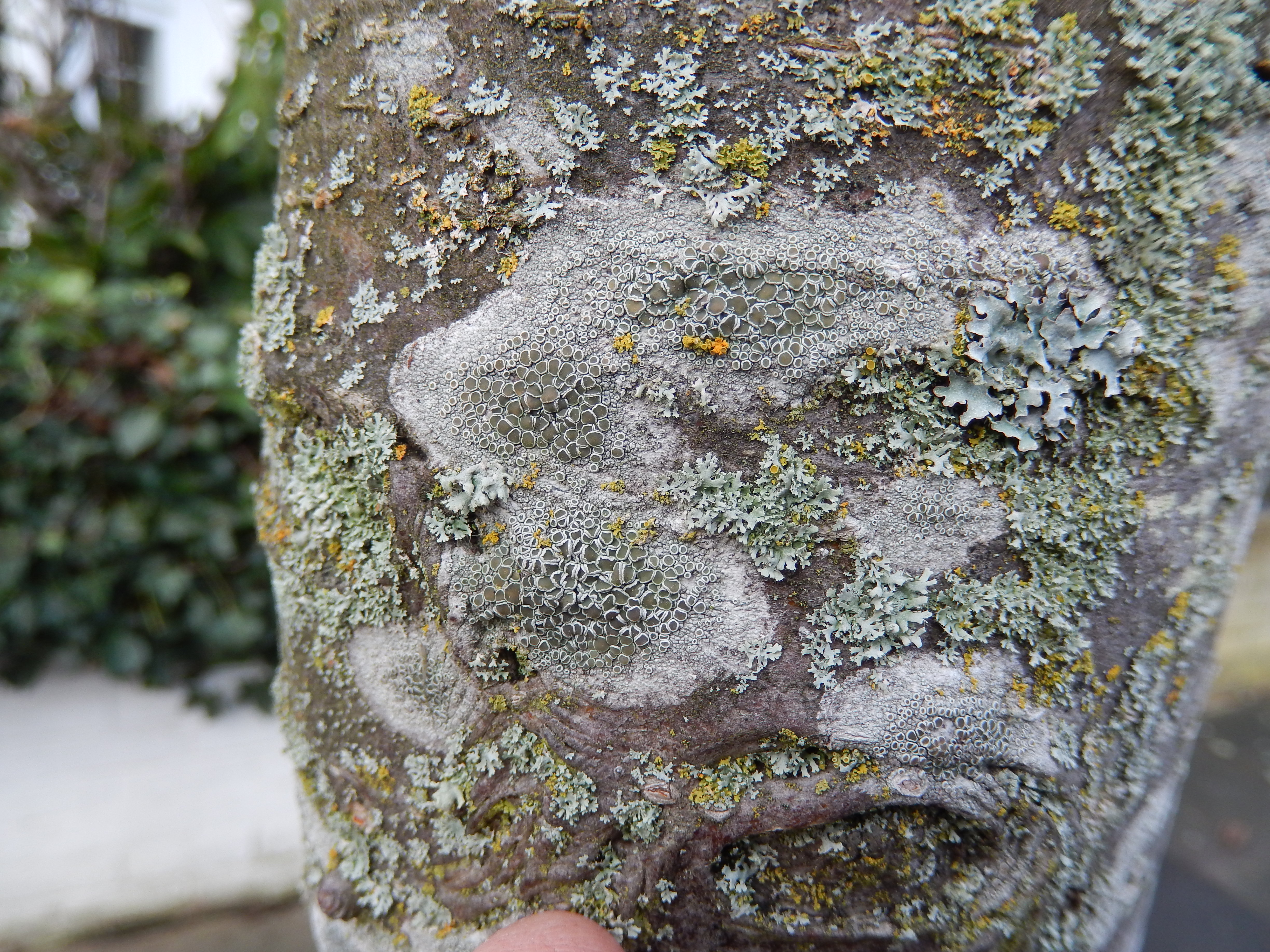
In the photograph, you can see at least four species of lichen. There are the large rounded colonies of crustose lichens in the centre, with olive-disked apothecia (fruiting bodies containing masses of spores) rimmed with white. There are small grey foliose (leafy) lichens of the kind I still call “Parmelia“. There is a much larger, greyer “Parmelia”. And there are many small colonies of an orange foliose lichen, probably the Common Orange Lichen, Xanthoria parietina. Perhaps there are more. (If you are a lichen expert, I’d love to know what they all are. Do contact me.)
Apparently there are now 17 urban lichens, up from, well, one rather tough species – Lecanora conizaeoides. It’s a tiny, rather flat grey species, and it alone can tolerate a moderate dose of sulphur dioxide; at least, it could be found in sheltered places even in London, even in 1970, away from the worst of the smog.
Is this a conservation success? The Tall Chimneys were a health measure; the death of Coal was mainly an economic matter. Still, it’s nice to see the lichens coming back. Perhaps in a few decades’ time (lichens are rather slow-growing) we may see big yellow splashes of lichen on roofs, walls and trees in every street. Let’s hope so.
On the PM programme on Radio 4, the presenter Eddie Mair regretted the long, long wait until polling day, given the inevitable length of the campaign with a fixed-term parliament. He sympathized with listeners at having to endure the same old party political ding-dong as the rivals seek to batter each other into submission. He suggested that we listeners tell him what we would like to know about the next general election.
What politicians want to talk about
The parties seem to want to tell us about the NHS (Labour) and the Economy (Conservative) and Immigration (all of them), so I’d like to hear about, well, anything else: especially nature.
Politicians don’t even call nature by its name any more.
They burble about “Sustainability“, but making our cities larger every year is not sustainable: that would mean a steady state. Think about it. Sustainable living is imaginable, but it would be nothing like how we live now. Everything – I mean everything – would be recycled. We’d use glass not china, so it could be melted down and reused when it broke. We’d burn no coal, oil, or gas. We’d design every product to be broken down into its components for recycling, as they’ve started to do in Germany. In short, current politico-talk about sustainability is just waffle, greenwash. You may have a ruder word for it.
They mumble about the “Environment“, as if nature impinged on our lives solely through dirt or noise in the places where we live. But our impact on the natural world is far, far greater than that. We have ravaged every habitat, every ecosystem on the planet. The African bush, home to elephants, rhinos, gazelles? It’s in free fall. Grasslands and meadows? We’ve lost 98% of ours. Wetlands, marshes, reedbeds? Disappearing everywhere. Mangroves and coral reefs? In crisis wherever they (used to) occur. Rainforest? You know the answer.
They waffle about “Biodiversity“, as if the word were a charm or mantra, calling for impact assessments for each major building project, which the planners then immediately ignore. But the diversity of life in England, like that of the whole world, is in crisis. Many people alive today will witness the mass extinction of perhaps a third of all the species now alive; man-made global warming and the resulting changes to the climate; the catastrophe being visited on all the oceans through overfishing; pollution, overpopulation, deforestation: the worldwide destruction of nature.
They ramble on about “Conservation“, as if nature would be fine if limited to a few nature reserves here and there, and try to change the conversation to the economy/the NHS/immigration (delete according to taste) as soon as possible. But nature is the whole of our planet (including us, if you prefer, but that’s another story). We depend on plants and algae for the oxygen we breathe. We depend on plants and animals for the food we eat. We depend on bees and other insects to pollinate many of our crops. We depend on bacteria to detoxify our sewage and rubbish. We depend on plant genomes for our medicines and our crops’ resistance to disease. We depend completely on nature.
What I’d like the politicians to tell me
I’d like to know what they will actually do for Nature, for everyone’s benefit:
what each party’s policy on nature really is
how they will prioritize nature
how children, NHS patients, and old people will be given access to nature for education, rehabilitation, wellbeing
how fisheries will be protected
how the decline of wildlife on farms will be reversed
Direct answers, please.
Well, I’d like to know a whole lot more, given the global disaster I’ve outlined, but that should be enough to start with. What would you ask?
While inveighing against all things Brussels, the English gentleman was able to take the fullest advantage of the Common Agricultural Policy, developing the agribusiness of the seventies and eighties, expanding subsidized yields by grubbing up hedges and copses, ploughing up verges and making vast stretches of monoculture kept sterile by aerial doses of pesticide. As a result, millions who grew up before this onslaught mourn the loss of grasshoppers, skylarks, the songthrush, even the common [house] sparrow, and many unseen others, which their children will never know. The countryside of Shakespeare and his successors in all the arts, Vaughan Williams’s ‘The Lark Ascending’, for instance, no longer has a true point of reference.
— Maureen Duffy. England. The Making of the Myth from Stonehenge to Albert Square. Fourth Estate, 2001. Page 250.
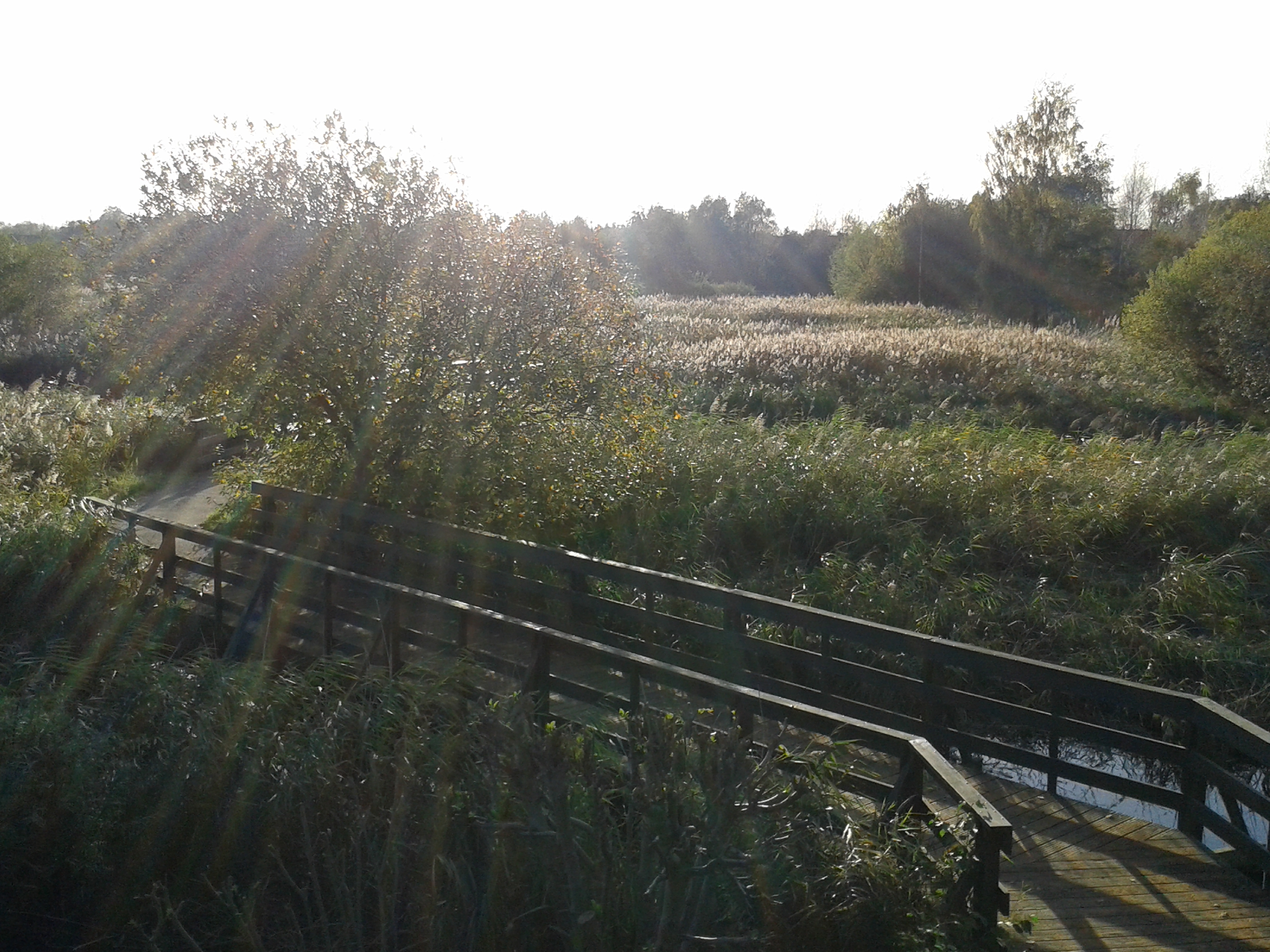
It was too sunny and warm to sit at a desk writing, so I took bicycle and binoculars and went along the Thames path to the Wetland Centre. Even in a T-shirt it was warm work, feeling more like an English July (ok, that’s not saying much) than the last day of November .
Afternoon sunbeams on a very warm Halloween at the Wetland Centre
Inside the Centre I passed some diminutive witches and warlocks: they seemed to be sweating uncomfortably inside their costumes. I took a swig of water and cooled off in a hide; two rare migrants, Green Sandpipers, bobbed daintily at the end of one of the little islands, dwarfed by a Black-Headed Gull and a Moorhen, neither of them particularly large birds. Their habit is not unlike that of the Common Sandpiper, but they lack the white streak that rises in front of the wing. One of them took flight, its slender dark wings and white belly giving it something of the look of a rather large and clunky House Martin. It felt very odd to be watching autumn migrants on such a summery day.
Over at the wader scrape, a Little Egret strutted and once fluttered across the shallow water; it is an uncommon visitor here, though becoming more usual along the south coast marshes and estuaries.
A Green Woodpecker bounded over the grazing marsh in its distinctive undulating flight, its red cap and green body showing beautifully in the hot sunshine, with a loud laughing call in case anybody was in any doubt what it was.
A Cetti’s Warbler sang its bold short song, Chwit-i-pit-i-pit, Chwit-i-pit-i-pit, as usual invisible deep in a reedbed.
Out on the open water, numbers of winter ducks are (oddly, given the summery weather) building up; several Shovelers dabbled; some dozens of Wigeon grazed; a few Teal, the drakes in glorious colour, swam nimbly about with some Gadwall.
Even on the way home, I had no need of a pullover. The BBC weather report confirmed what everyone instinctively knew: it was the warmest 31st of October ever recorded in Britain, with an astonishing 23.6 Celsius in London. Of course, a cold front is forecast.
P.S. The next morning was grey and rainy, autumn on the way. Two large grey Mistle Thrushes flew overhead, rasping out their wintry calls, like a boy blowing over a comb covered in tracing paper.
P.P.S. Four days later, after a clear starry night, the sun rose over a chilly town on a fine November morning. It was winter.
In 1942 the scholar of Middle English, christian apologist and author of the Narnia books, C.S. Lewis, published The Screwtape Letters. The explanatory subtitle was Letters from a Senior to a Junior Devil, indicating the purpose of the book, to educate the young devil in the most effective means of corrupting humans from the paths of goodness and righteousness. Of course, we believe (or are free to imagine) the book to have a different purpose altogether for its human readers. In that spirit, here is some Advice to a Young Property Developer.
—o0o—
Dear Frango, you are trying to get planning permission for a huge, ugly glass and concrete stump in a beautiful area that is already fully built-up with attractive rows of houses and their little gardens, small friendly shops and peaceful parks. I understand you like strolling around the area at lunchtimes. Enjoy it by all means, but do not allow your feelings for the area to intrude on your work. Professionalism must come first. Your company’s existence, your job and those of your colleagues depend absolutely on your being able to work unsentimentally and methodically towards the goal of making money through development. You must use all means at hand, within the law or where necessary without it, taking all due precautions of course, to achieve the desired ends in good time. Time is money, as you will become aware. Each month’s delay costs the company a month’s salary for all the employees involved, as well as a month’s interest on the money it has borrowed from the City. It also delays by a month the necessary returns to the company’s owners and shareholders, and your jobs depend ultimately on their confidence in your professionalism and reliability. Therefore, do everything you can not just to get the job done, but to overcome opposition quickly. Leave your feelings for lunchtimes and evenings. All the best, Nick.
Dear Nick, thank you for your letter. I’ll do my best, but we are heavily tied down by planning law, especially the need to consult widely and to provide 40% social housing. What a nuisance! It takes ages and the social housing will cut our profits down terribly. Any ideas? With many thanks again for your help, Frango.
Dear Frango, you are quite right to ask. The good thing about the rules on consulting is that you only have to do it within a fixed distance – I think it’ll be 500 metres in your case. This may sound a lot, but if you choose a site at the boundary of a park or commercial estate, or beside a river for instance, you’ll immediately halve the area involved as you’ll only have to consult in half a circle. Even better, if you can find a place near a borough council boundary, you can forget about the people in the other council! What an excellent rule! Of course, if you’re near an administrative boundary and also beside an industrial estate, then hardly any local residents will ever get to hear about your project, until it’s too late. Things are pretty well stacked in our favour!
As for the 40% social housing, I wouldn’t get too hung up on the percentages. We can easily offer the council some cash “in lieu” of the social housing: they can announce they will be using it somewhere else, some time in the future, to build some social housing, somehow or other (certainly not with us, there’s no money in it, but I’m sure if they offer a building contract, there’ll be some builder willing to take their money off them to throw up some matchwood stuck together with spit for the deserving poor. As soon as your council smell the money – we can call it Section 106 you know, even if it isn’t exactly compensation – they’ll be eating right out of your hand. Your affectionate uncle (may I call myself that?), Nick.
Dear Nick, of course you can be my uncle if you like! Thank you so much for your helpful suggestions. They are just what I needed. My team leader was really impressed in our weekly meeting this morning. We’ve got a suitable site lined up and think we may be able to get away with a 42-storey tower! I couldn’t have imagined we’d be able to risk anything so profitable around here. All the best, Frango.
Dear Frango, delighted to hear it’s all going so well. Do be careful not to get your hopes up too early: remember there are many steps to the process, and “obstacles” to be overcome. Take things one at a time, though, and you’ll soon be in management. Your affectionate uncle, Nick.
Dear Nick, you were right. We’d hardly got started when an incredible busybody of a local nuisance – I think she’s got a lawyer for a husband – has started complaining to all and sundry, and we haven’t even put in a planning application yet. She’s pointed out that we’re in breach of the Local Plan, and that we can’t use Section 106 money to compensate for lack of social housing. If only we could shut her up… Your stressed-out “nephew”, Frango.
Dear Frango, something like this always happens. The good news is, we’re still here, and we have deep pockets. Of course we don’t want the delay and expense, but the fact is, we can cope with it, as we have done on every previous project. You’ll find a way around it. Remember that the busybody and her husband have no funds to fight us with, and plenty of other things to worry about – they have to earn their living, and fight off all our “friends” who are planning developments in the same area. Did you hear about the combined housing/office/retail development just off the high street, and the swimming pool/cinema/housing complex where the old tennis courts were? They’ll be run off their feet, you’ll see, and we can reapply with a marginally different proposal if your 42-storey tower actually gets rejected. So I wouldn’t worry too much if I were you. Your affectionate uncle, Nick.
Ah, the environment. I remember a time when I was driven by a landowner through the English countryside. He was disgusted at the litter of discarded plastic bags that had stuck in the hedges. His rural landscape was visually contaminated with the worthless outpourings of careless city-dwellers. He was furious at this despoliation of the environment.
What is the environment? It’s a vague enough thing to some people, everything around us from the end of our nose to the end of the universe. Defined like that, it’s (almost) the whole of Nature, the world, the universe. Defined by my landowner, it was probably more narrowly understood: the visible landscape, or perhaps the immediately visible world, landscape, skyscape and maybe waterscape in his neck of the woods.
To politicians, in this final party conference season before the British general election next May, the environment is something rather unimportant. The odd landowner and the occasional grumpy ex-soldier, “Disgusted of Tunbridge Wells”, may complain about litter; Prince Charles may sound off about modern architecture and hideous glass stumps invading the landscape; but for the rest of us practical folk, the environment frankly doesn’t matter, compared to urgent questions like the economy, health, education, pensions, war and winning the next election.
But “environmentalists” aren’t worrying about the odd plastic bag, or the visual impact of an occasional skyscraper, however horrid those things are.
As the zoologist Gerald Durrell said, people think I’m trying to save fluffy animals. But I’m trying to save life on Earth.
There’s nothing fluffy about it. Habitats everywhere are being destroyed. Global warming is moving vegetation zones towards the poles and up mountains. Anything that is trapped at a north coast or on an isolated mountain top is doomed if it can’t move further. Species everywhere are heading towards extinction. Things that are beautiful, useful for the genetic diversity of our crops, valuable for medicines; things we haven’t even named yet; things that perform vital services, giving us oxygen, forming the web of life of which we are part: all these things are being recklessly eliminated. We’re axing our own life-support system in this little ball-of-rock spaceship, with nowhere else to go to for untold billions of miles in every direction. The human race, under the direction of our political leaders, is racing to spend what’s left of our inherited family silver, happy that there’s a little bit left for the next few years. After that? We have no idea.
Why should politicians put “the environment” at the top of their agendas for the next election? Because it’s an emergency, for all of us.
Ah, poaching. It sounds so romantic. The merry strains of the English folk song, “The Lincolnshire Poacher“, that we sang at school come into my ear:
When I was bound apprentice in famous Lincolnshire
Full well I served my master for nigh on seven years
Till I took up to poaching as you shall quickly hear
Oh, ’tis my delight on a shiny night in the season of the year.
We think of the cheerfully naughty countrymen pushing a hare or a pheasant into their bag, making off home and delighting their wives with something to put into the pot for their families. We hardly spare a thought for the landowners, and if we do, it is with a pantomime image of greedy, fat, rich and selfish characters who “will not sell their deer”. Cue a chorus of boos and hisses from the gallery.
But (like most rose-tinted views of the world) this is all wrong. Poaching on that scale may or may not still exist: but much worse forms of it certainly do.
In Britain, poaching is organized crime, and becoming big business. Stolen game, farm animals and wild fish, especially salmon, find their illegal way into the human “food chain” (the term is borrowed from an older view of ecology, where it has fallen into disuse, and of course it has shifted its meaning: we consumers do not eat slaughterhouse workers, or supermarket shelf-stackers). There is no inspection of the unlawfully sold meat, which may be infected with tuberculosis (TB), may have been handled unhygienically, or may simply be past what should have been its sell-by date. There is no attempt to manage the ‘crop’ sustainably. If a wounded deer escapes, it will receive no veterinary treatment for its injuries or infections. In short, the whole sorry business is about money, with none of the usual protections that we expect in food and farming.
Across the world, matters are even worse. As roads cut into rainforests all through the tropics, the poor go into the remaining wildlife-rich areas to kill anything worth eating for bushmeat. In lawless areas, hunting the last of the game animals is an easy way for anyone with a gun to earn a little money. Once common and widespread species in many groups – monkeys, deer, snakes, birds, you name it – are being driven towards extinction.
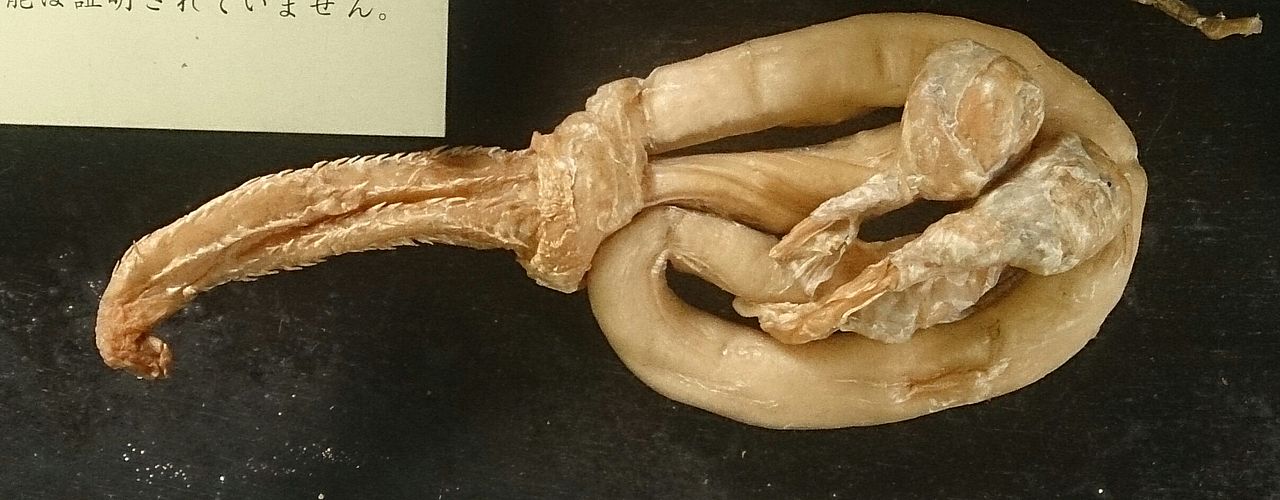
Tiger Penis is supposedly aphrodisiac. Image by ProjectManhattan on Wikimedia Commons.
And of course, poaching can mean killing elephants for ivory, rhinoceroses for their horns, tigers for their skins or their penises, bears for the bile from their gall bladders. Frankly, even the most beautifully carved ivory statues cannot compensate for the loss of elephants in the wild. Even if a dose of tiger penis brought an erection so huge that a horde of beautiful women were to flock about me, an unlikely result, it would not make up for the loss of one of these magnificent animals, let alone their extinction. If you have erectile dysfunction, Viagra might help you; animal body parts certainly won’t.
There is nothing romantic about poaching. It is incredible that, although it is illegal in Britain, it is not a notifiable crime: the police do not have to keep any record of how many animals are killed, how much property damaged, how many crimes committed.
With wars and refugee crises, human suffering and epidemics of tropical diseases from Malaria to Ebola virus, it is no wonder that poaching gets scant mention. Yet all the while, when there is money to be made, wildlife gets short shrift. Satellite imagery shows deserts expanding, forests burning. The destruction wrought by poaching is less visible, but it is having a terrible effect on hundreds of species.
You can do something about it. Support a wildlife charity. Campaign against the use of animal body parts in traditional medicine. Lobby your member of parliament, your government. Vote for a greener government next time. Now is the time to get on with it.
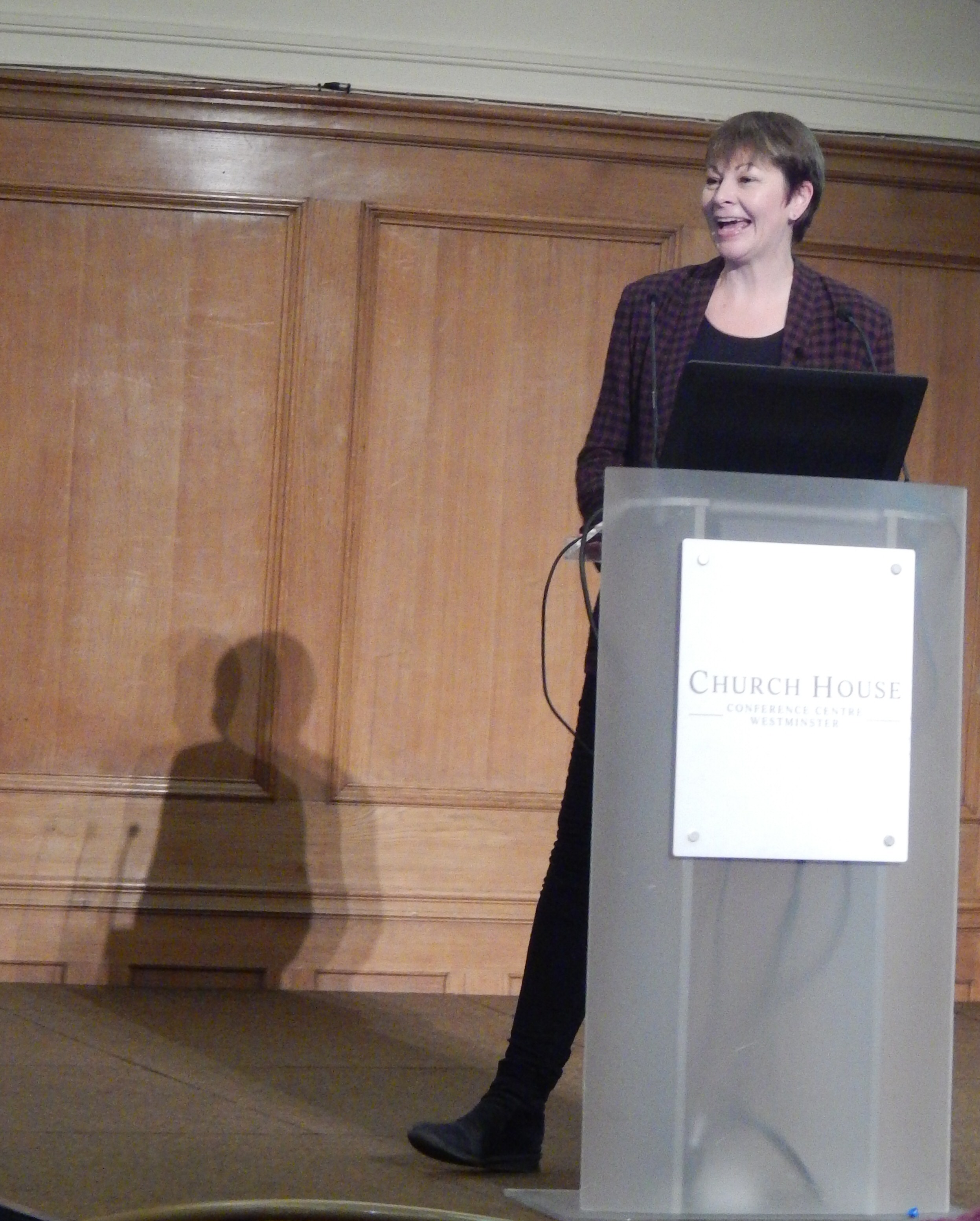
Green Politics: A cheerful Caroline Lucas, MP, briefing members of the RSPB and Wildlife Trusts on how to lobby their MPs
It has been said that nature-lovers are left-wing on all political questions except immigration, where they are distinctly right-wing.
This can readily be explained by guessing that nature-lovers essentially choose to prioritize in the following order:
Themselves (well, everybody does)
Wildlife and the Environment
Other people
Big business
Immigration is unpopular both because it conflicts with #1: it puts pressure on resources near the home, and because it conflicts with #2: it puts pressure on land.
I’ll return to the question of putting nature above people later, but first I want to note that this set of priorities is radically different from those of the right (say, the Republican party in the USA, or the Conservative party in Britain), who we may guess have these priorities:
1. Themselves
2. Big business
3. Other people
4. Wildlife and the Environment (if they rate this at all)
On this rather simple view of politics, left-wing people (say, the Democrat party in the USA, or the Labour party in Britain) are imagined to have these priorities:
1. Themselves
2. Other people
3. Big business
4. Wildlife and the Environment
The reason left-wingers may put business above wildlife is that, despite all the left-wing rhetoric, they do recognize that business generates the money needed to pay for welfare and shared services such as health care and education. So, although there has been a historic rich vs poor, Upstairs vs Downstairs polarity between left and right, they do actually agree on most of their priorities.
If you’ve followed the argument this far, you’ll see that at least in countries like Britain and the USA, this places anyone who has ‘green’ political views, favouring wildlife and the environment, in a tricky position. There is nobody with any reasonable likelihood of getting into power that they can vote for with any confidence.
In countries like Germany with a proportional representation system for voting, smaller parties are able to flourish, and Green parties can become significant in regional and national parliaments. In countries like Britain and the USA, which have “first past the post” (winner takes all) voting systems, smaller parties usually get trodden underfoot, along with any more subtle points of view than left vs right.
I would love to be able to tell you (I assume you are a nature-lover) that I have a brilliant solution for you, but I doubt there is one. Instead, you have a few possible choices.
You could carefully study, and ideally question, your candidates from left and right about their views on nature conservation in the hope of finding or provoking a spark in some of them. (I’m trying this myself.)
You might consider joining their party so you can lobby them more effectively; you might attend policy forums and try to push the environment up the agenda (I don’t hold up much hope on that one, though I know energetic people who are trying it).
If you have money, you might give donations to either side, accompanied by whatever pressure you can apply.
If you are persuasive, you might speak or write to the candidates, arguing that saving the environment is good for people (their health, exercise, mental state, and so on) or for jobs (tourism, conservation work, pollination of crops, that sort of thing).
Or you could move to Germany, work hard, and apply for citizenship. You could give up on politics altogether, and immerse yourself in practical conservation, campaigning and suchlike.
If you don’t find any of those suitable, you do have another option, but it’s very long-term. You campaign for a fair, democratic, voting system that will actually represent your views, along with those of other minorities: you fight for proportional representation. If you thought that was a dull, dry piece of constitutional reform, think again. It’s the only way things that matter to you and to me will ever be taken seriously. We greens need seats in our legislatures, in direct proportion to our numbers. That might be 30 or 40 green MPs in Westminster, for example. Now that would be talking. Until then, frankly, we’re disenfranchised. And that’s wrong.
It’s time to come back to the awkward matter, for green politics, of at least seeming to put nature above people. To put it at its mildest, it can look somewhat self-indulgent in the well-off with money and leisure enough to enjoy looking at wildlife in beautiful places to argue that conserving nature is more important than dealing with the pressing social issues of the day: hunger, homelessness, unemployment, poverty, disease, and all the side- and after-effects of war: trauma, grief, coping as refugees, orphaned or widowed. And that is to hint at the hidden, unspoken issue for green politics, migration, which numbers among its many causes inequality, war, and climate change.
The cause of green politics is not simply an open-and-shut case of selfishness, however. There are arguments that can be used in its favour.
A key one, perhaps, is the moral argument for care for other living things, and for the environment as a whole: we are just one species among millions, and we have just one world to look after, not just for ourselves (the poor, homeless, unemployed and so on) but for all Earth’s species, and for all future generations, our children and our children’s children. If all species were valued equally, and why should they not be, then wildlife should score a millionfold more than any purely human priority. It seems, of course, that nobody can quite bring themselves to value other species anywhere near as highly as Homo sapiens: indeed, even the assertion that a million other species might be worth nearly as much put together as humankind would raise eyebrows – who cares about a rainforest or two when business or livelihood is at stake?
The somewhat more selfish argument that we need nature for a large number of ‘ecosystem services’ such as pollination of crops, a ready supply of timber or fish, genetic variety in the shape of ancestral species related to valuable crops (wild potatoes, wild maize, wild apples) or a list of candidate pharmaceutical drugs from as-yet-undiscovered species of plant, fungus or micro-organism, may have a little more traction. Here, nature is worth conserving for its enormous utility, of which we currently have only a hazy notion, but which we already perceive to be much larger than we ever imagined. Most clearly, the cost to farmers of hand-pollinating every fruit tree is becoming frighteningly obvious as bees of many species vanish from the ploughed and pesticide-sprayed countryside.
A slightly less utilitarian argument concerns the value of nature for human well-being, both now and for future generations. We wouldn’t want to live in a world with no ‘charismatic species’ such as elephants, giraffes, lions, gorillas and tigers. Yet, we could easily find ourselves there, with perhaps a few miserable beasts desperately keeping their species alive in zoos and safari parks. More mundanely, we know that city-dwellers are happier and more relaxed, better able to focus clearly at work, if they have a little time in a park or garden with trees and flowers, and perhaps with bees and butterflies too (if that isn’t too much of a luxury).
If we accept any or all of these quite good reasons for saving life on Earth, then we must make nature conservation a high priority: which means making it a higher priority than at least some human political priorities. And that is a ‘green’ agenda. If anything, it is alarming to anyone who reflects on the question just how little effort is in fact being spent by governments on keeping the world’s ecosystems in existence: we are all so busy fighting wars and economic collapse that such larger matters spend their whole time on the back burner, if not (to mix metaphors disgracefully) on the ‘too difficult’ pile.
Let’s suppose, for the sake of argument, that all the non-human species in existence add up in moral terms to our single species (leaving aside any idea that this grossly undervalues them). Let us suppose, too, that all future generations add up in moral terms to the generation which is alive today (and yes, we’ll ignore any idea that this undervalues them, too). Then all our conventional political goals should be given 1/3 or thereabouts of the total weight: the other 2/3 belong to nature, and to future humanity (who of course may care about nature also). And Nature should then easily top the political agenda.
Or we can look at green politics in space rather than in time. The politics of big business, and of the social systems of rich nations, ignore the rest of the world, where injustice, drought, poverty, dictatorship, war, tropical disease and famine are major factors. Worse, our greed and selfishness has inflicted post-colonial disaster (think of the Anglo-French agreement to draw borders for the new kingdom of Iraq after the First World War) and exploitation of minerals on many parts of the world. We owe it to everyone to put these matters straight, which means protecting the environment: their environment, in the places where we are stripping them of their resources, or already did so, or where we are dumping the wastes that we don’t want to deal with ourselves. This way too, justice means green politics, but more clearly Nature and suffering humanity need to be safeguarded together.
Green politics is not a luxury for the idle rich. Making wildlife and the environment, biodiversity and conservation a top priority is vital for everyone, rich or poor, on the entire planet.
The English seem unemotional … except for their passion for nature