When I first acquired a macro lens for my camera, I raced about the meadows, photographing every insect I could: and many of them were species new to me, though I must have seen them flying past (or away) many times. For the close-up lens and detailed images gave me something I had never had: the ability to study shy insects as if I had caught them and pinned them to a Victorian collector’s card. Suddenly those speckled orange butterflies resolved themselves into Spotted Fritillaries, or for that matter Glanville, Queen of Spain, Silver-Washed, Small Pearl-Bordered and High Brown Fritillaries. It was a revelation, and a delight.
It was also sobering: in all my journeys around the British Isles, the only Fritillary I ever saw was a Small Pearl-Bordered, and that was on the north coast of Cornwall, only a few miles from Land’s End, as if almost the whole of Britain had been scrubbed clean of butterflies, but a few remote corners with the last few surviving individuals had somehow been overlooked.
But as far as rural France was concerned, once up in the wooded hills with their mosaic of old coppiced woodland, little meadows, fruit trees and ponds around old tumbledown farms and barns, or out on such steep chalk grassland hillsides as remain, the butterflies, beetles and wild flowers remained much as they must have been a century ago. I clicked away and framed a postcard-sized print of each species, 8 to a clipframe, and returned each day to the meadows to photograph more.
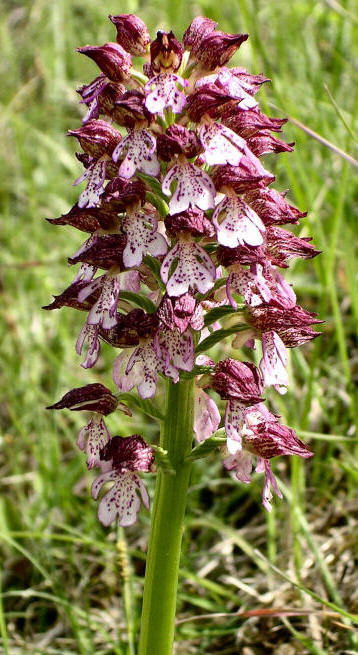
Lady Orchid in Dordogne
It was the same with the flowers, especially on the chalk, as soon as I finally managed to get down here in springtime to see the orchids, rather than in high summer to see dry brown grass (and perhaps burnt-out orchid seed-heads, the colour of well-cooked toast). Everywhere there were Pyramidal Orchids and Chalk Fragrant Orchids, so numerous as to have a wealth of variation in size, shape and height, evidently frequently hybridizing. In damper places were Early Purple Orchids; and here and there were species I had never seen in Britain – Lizard, Military, Lady, Green-Winged, Fly, and Butterfly Orchids. They all went on the wall, printed as close-ups.
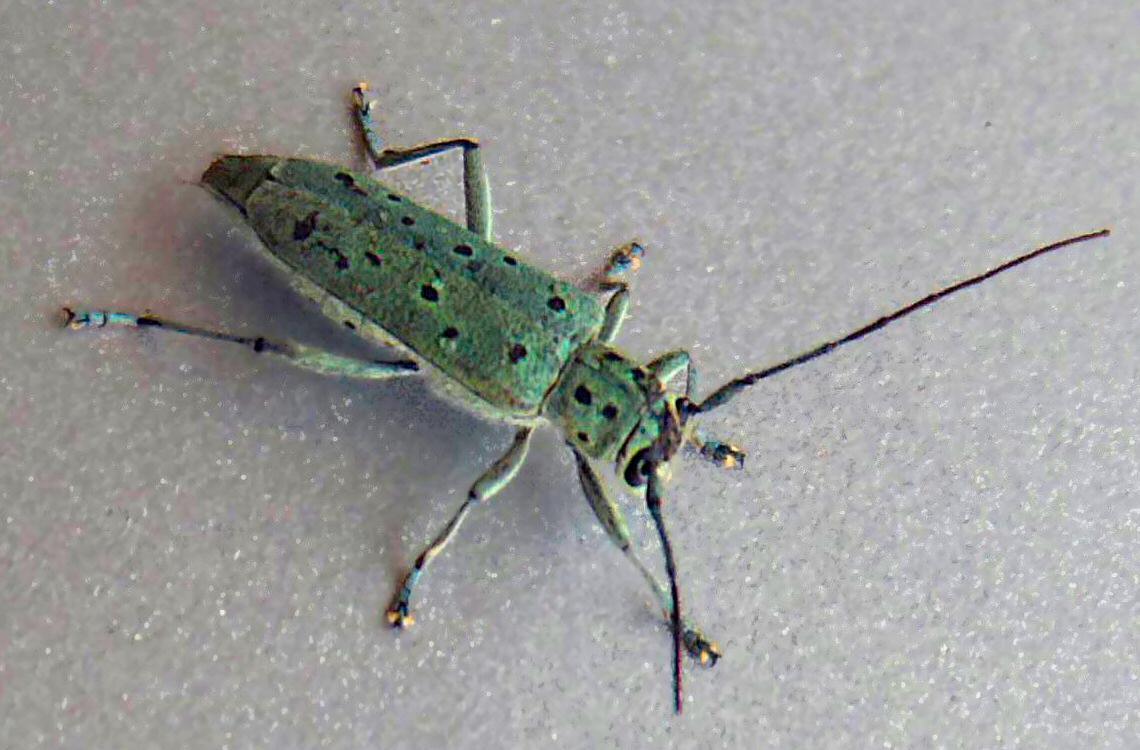
A green longhorn beetle with black spots: I’m delighted to learn from the Romanian Longhorn Project that it’s Saperda punctata (Linnaeus, 1767)
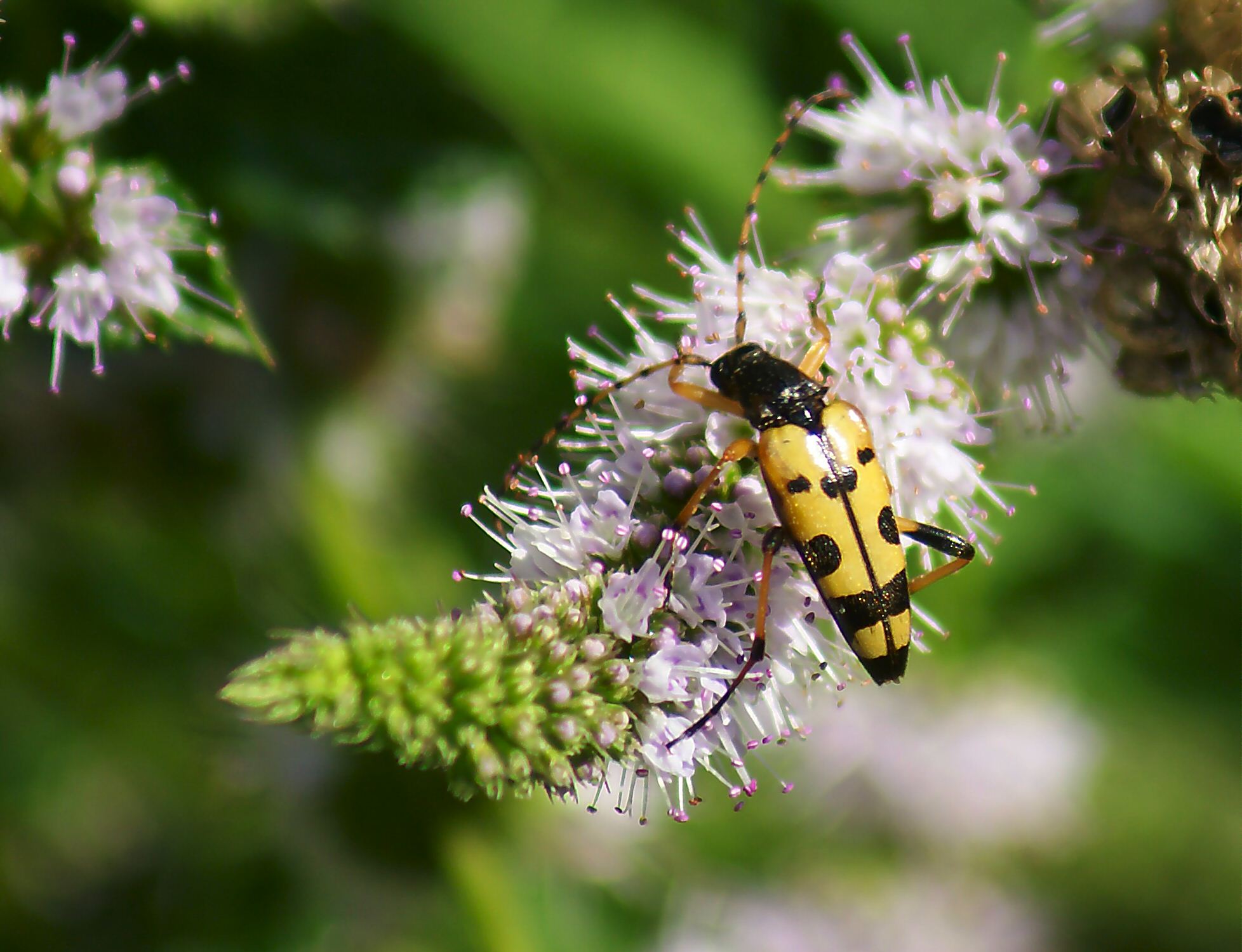
As for the beetles, the only really large species that I’d seen at all frequently in England was the Stag Beetle. Here, I photographed at least 8 species of Longhorn, from the mighty Tanner to two kinds of wasp-coloured beetle (Clytus and Strangalia) and a magnificent green kind with black spots, Saperda punctata. The Romanian Longhorn Project kindly identified it from the photo, saying that it is protected in Central Europe: such splendid insects are becoming rare, and not only in England.
Waspish beetle: Strangalia maculata on Mint
Yet perhaps it was really the wasps that caught my eye and stole my heart. Yes, wasps. As well as ordinary-sized social wasps, the area was home to great spherical nests of the European (Red) Hornet and the new, darker, slimmer and far more aggressive Asiatic Hornet. And besides those were Sphecid or Digger Wasps of many kinds, all solitary and often handsome; Ichneumons with narrow waists and enormously long ovipositors like overgrown stings (though wasp stings are actually modified ovipositors, so only females have them); and marvellously beautiful and imposing Potter Wasps with black and yellow legs and long slender yellow waists. These are shy and wary of large animals, so photographing them was always a challenge: but eventually I managed it.
Now, as the years go by, I find I recognize these insects not only by their size and shape and patterns, but by their habits of flight, the kind of weather that brings them out, which plants they like to visit, where they nest. In short, they have become familiar: and with familiarity has come a comfortable feeling of friendship and of being at home, of things being in their right places. The excitement of the new has been replaced by the appreciation of this particular ecosystem, where ‘eco’ means what its Greek etymology implies: οικος (oikos), house: this is my and their home, the place where we live together.
One of the constant difficulties with talking about nature is deciding whether man is part of it or not. People constantly talk about liking nature, or working with nature, or conserving nature, as if it were a separate thing like clay or copper that one could consider objectively, and might interact with or not according to taste and profession. And when people choose to watch a nature film instead of a Nordic detective series, they are exactly choosing to reflect on some aspect of nature when they otherwise would not do so.
But if we instead appreciate that nature is all-encompassing: that the environment begins at the end of my nose and continues to the end of the universe (as some wag of an ecologist had it in the 1960s), then we have no choice but to interact with it, for good or ill. And if we observe that, like other animals, we eat other organisms – animals, plants and fungi, and occasionally bacteria and algae too – then we are clearly part of the global ecosystem. Further, the insects that bite us, the worms, flukes, parasitic amoebae and bacteria that cause us disease, and the bacteria that break down our bodies after death show that we play many roles in that ecosystem, not simply that of consumer or top predator.
In short, man is in many ways a part of nature, and one could say that the main problem with the natural vs artificial distinction is the idea that anything is outside nature. Bees make honeycombs; potter and mason wasps make houses of mud; chimpanzees and crows make tools; man makes spears and hand-axes and wheels and computers and nuclear weapons: it’s all part of nature.
From that point of view, everything we make is natural, and any judgement on a thing must be on grounds of taste (aesthetics) or efficiency (how well does it do its job, at what cost). It isn’t possible to do anything that isn’t part of nature, part of the world, but things can be done well and attractively, or not. The question of what ‘cost’ means is a large one, but one cost on a planet of fixed size is the use of non-renewable materials. We may, for example, use as much paper as we like, as long as we plant as many trees as we cut down, and the processing does not poison the rest of the ecosystem. Similarly, we may use as much glass as we like, as long as we recycle it after use, preferably efficiently (by washing it out and refilling it, rather than smashing it up and re-melting it, though melting and reusing is better than nothing).
Ceramics, on the other hand, are more problematic. Like glass, they are made from quarried materials; but once fired, they can generally not be re-melted, so they are hard to recycle. We should have very good reasons to use such materials; and we should find ways to recycle them.
Rooves across much of the south of Europe are traditionally made of moulded terracotta, an Italian word that descriptively means ‘cooked earth’, ‘fired earth’. The traditional variety comes in many colours and varying shapes. The colours range through whitish buff; pale or deep ochre; reddish brown; brownish purple, and combinations and intergradations of these basic tones. The shapes vary from quite sharply cambered to rather flat, specially at the broader end; and both size and weight vary rather considerably. The effect on a roof – still better, on a whole town of such rooves – is of diversity of colour and line, with overall harmony of tone and style. The speckled and dithered appearance of such a roof is reminiscent of the ‘abrash’ that makes a traditional, hand-made, vegetable-dyed Turkish carpet such a lovely and valuable thing. Nothing is exactly uniform or mechanical; but the whole is a skilfully-crafted work of art, strong, colourful and useful, and to many people’s eyes much finer than anything that can be made in a factory in imitation of it.
Modern clay roof-tiles are made in identical moulds, filled by machine with a fixed amount of evenly-mixed and coloured clay, and fired for an identical period in an oven of exactly-controlled temperature. All the resulting tiles are the same orangey-red, and you might expect them to be stronger and more durable than traditional tiles, in compensation for their deficiency in colour and abrash.
But they’re not. The new tiles are many times more vulnerable to frost damage than traditional terracotta. Why this should be is a matter of speculation: perhaps the factory uses any clay it can get, with no regard to frost resistance; perhaps indeed it uses the cheapest clay on the market, who knows. Or perhaps it tests a sample of its tiles for a short period – say, 5 years – and is happy to sell its products certified as having passed such a test, knowing they are of that specific quality. The traditional tiles carried no such certificate: their badge of quality was that the maker, like his father before him, was known and trusted to produce strong, durable tiles that could last a lifetime, and they did. Perhaps ‘harmony with nature’ means having a long-term, personal business relationship with your roof supplier.
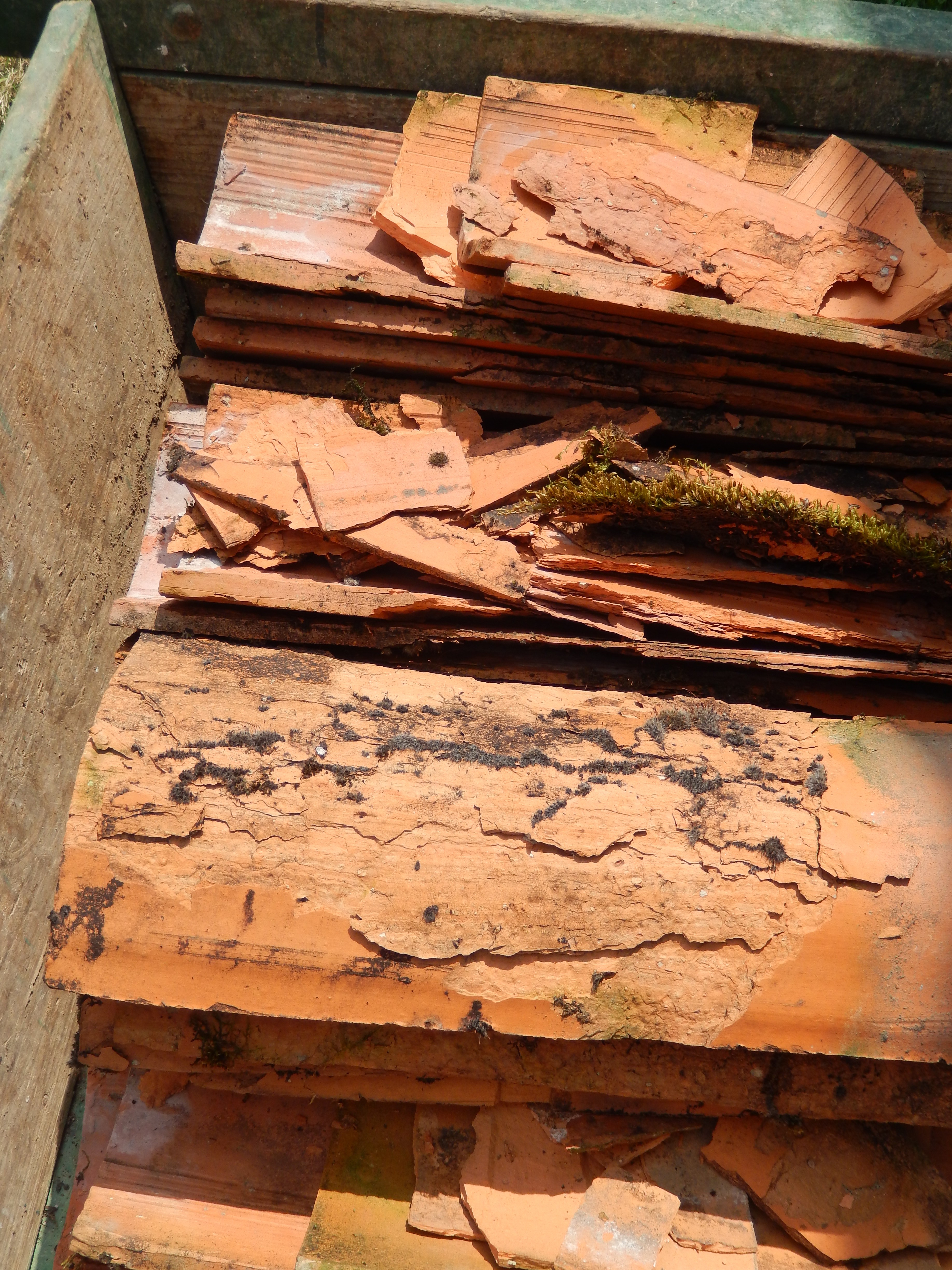
Factory-made roof tiles flaked by frost
The tiles shown in this photo have worn thin as frost has successively split flakes from their surfaces. Once the initial surface has flaked off, water penetrates more easily, and frost breaks more and more of the tile until it shatters in wind, rain and especially hail. To be sure, a severe (50-year) hailstorm can smash strong new tiles, but it will do far more damage to an already weakened roof.
On the recycling front, I found the split and broken tiles ideal for filling in holes in a track. It’s quite a humble form of reuse, but reuse it certainly is.
The rest of a traditional house, too, was made of local materials – stone, lime rather than cement (perfect for allowing lizards and solitary bees to nest in the walls), timber from the forest. When anything needed replacing, further materials were close to hand, and the old materials hardly needed recycling: they simply returned whence they came.
Maybe modern construction has something to learn from traditional methods. And maybe true sustainability is rather harder than glib talk of ‘sustainable development’ would suggest.
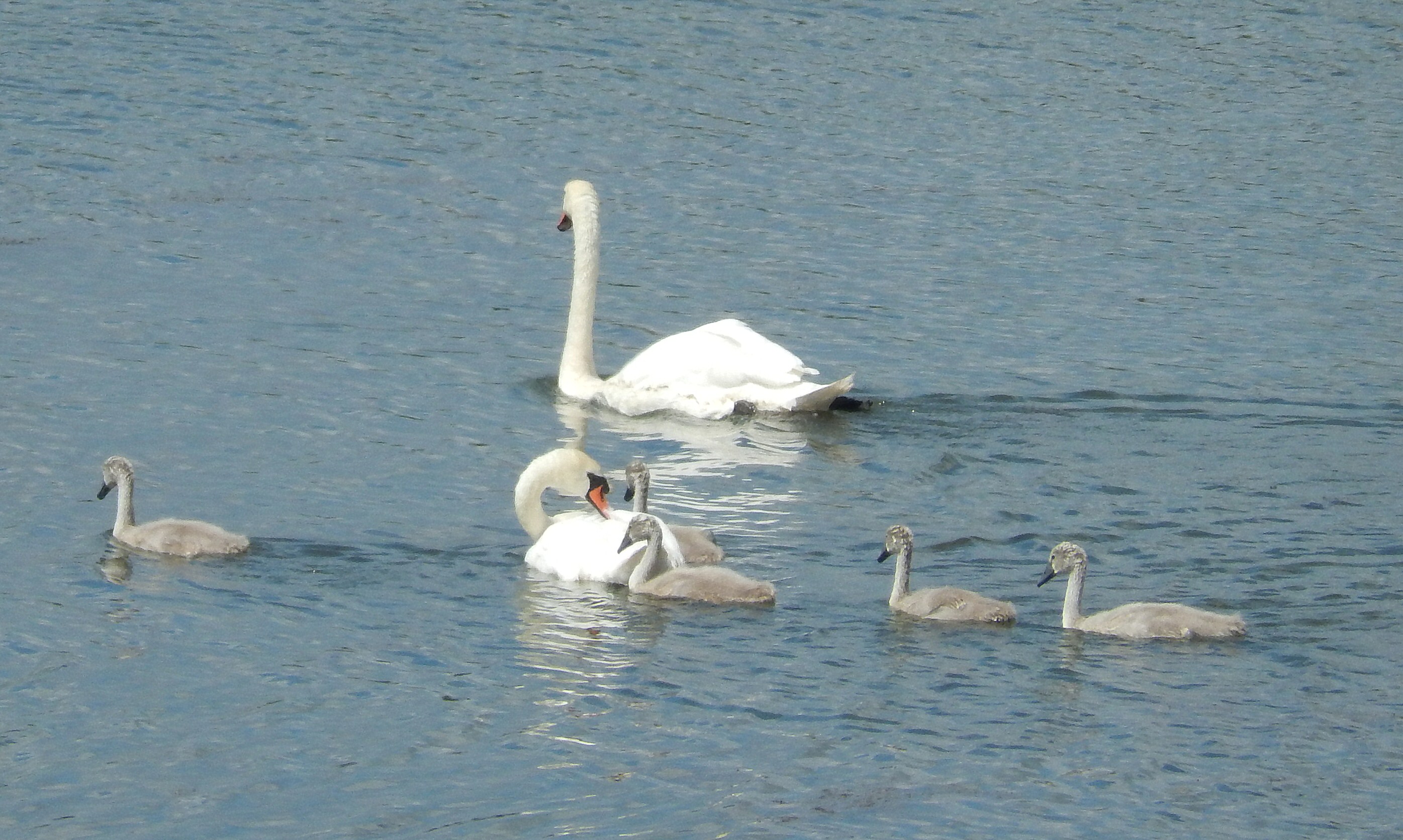
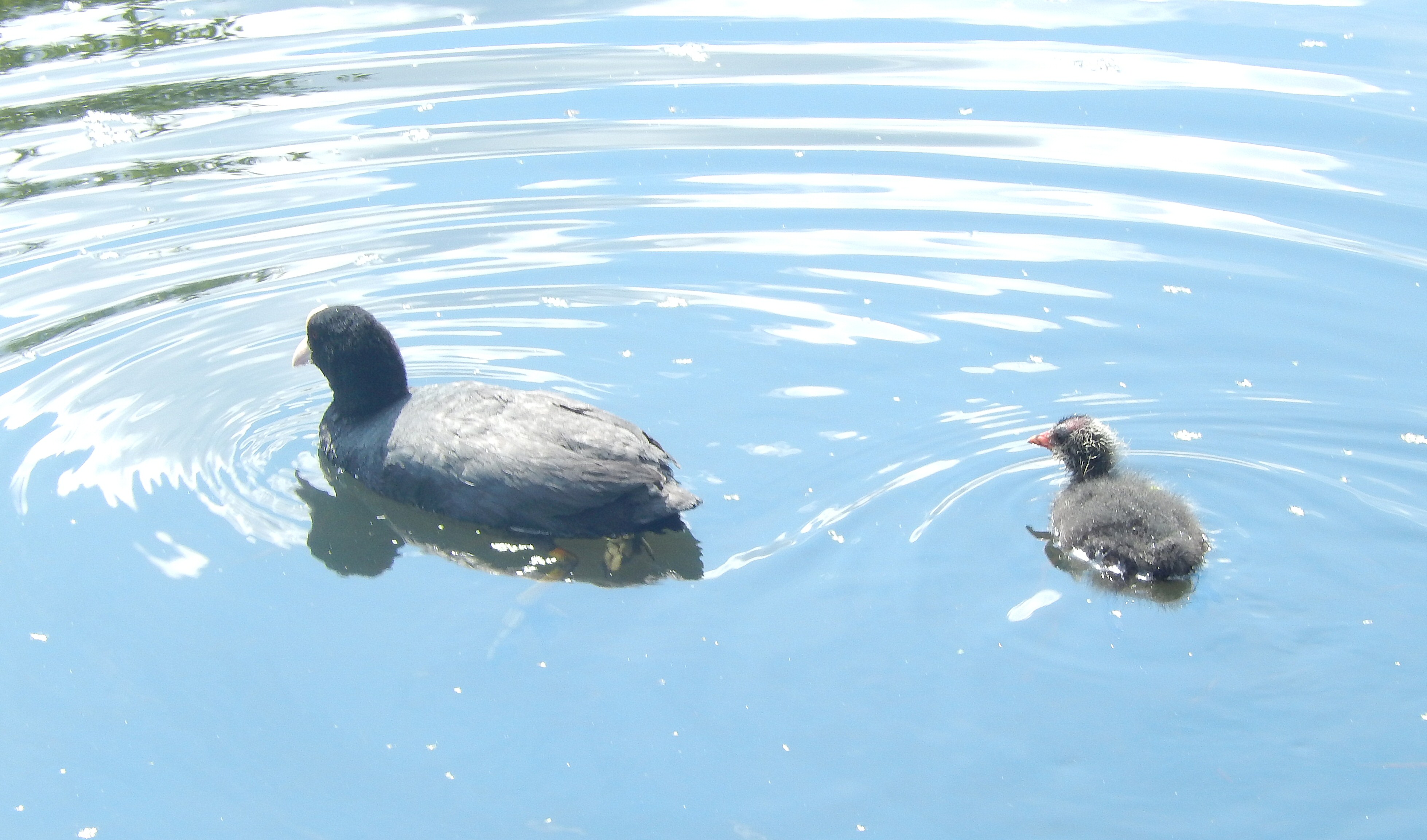
Aah. Ducks with ducklings. Coots with Cootlings. Geese with Goslings. Swans with Cygnets. Moorhens with … chicks. Whatever the charmingly mediaeval diminutive nouns, it was a day for walking around the London Wetland Centre, enjoying the ‘sunny spells’ and the bright display of wild flowers, artfully seeded, and delighting in Mother Nature’s ability to conjure up fluffy sentimental feelings about roughly duck-shaped balls of fluffy down feathers.
Coot with Cootling
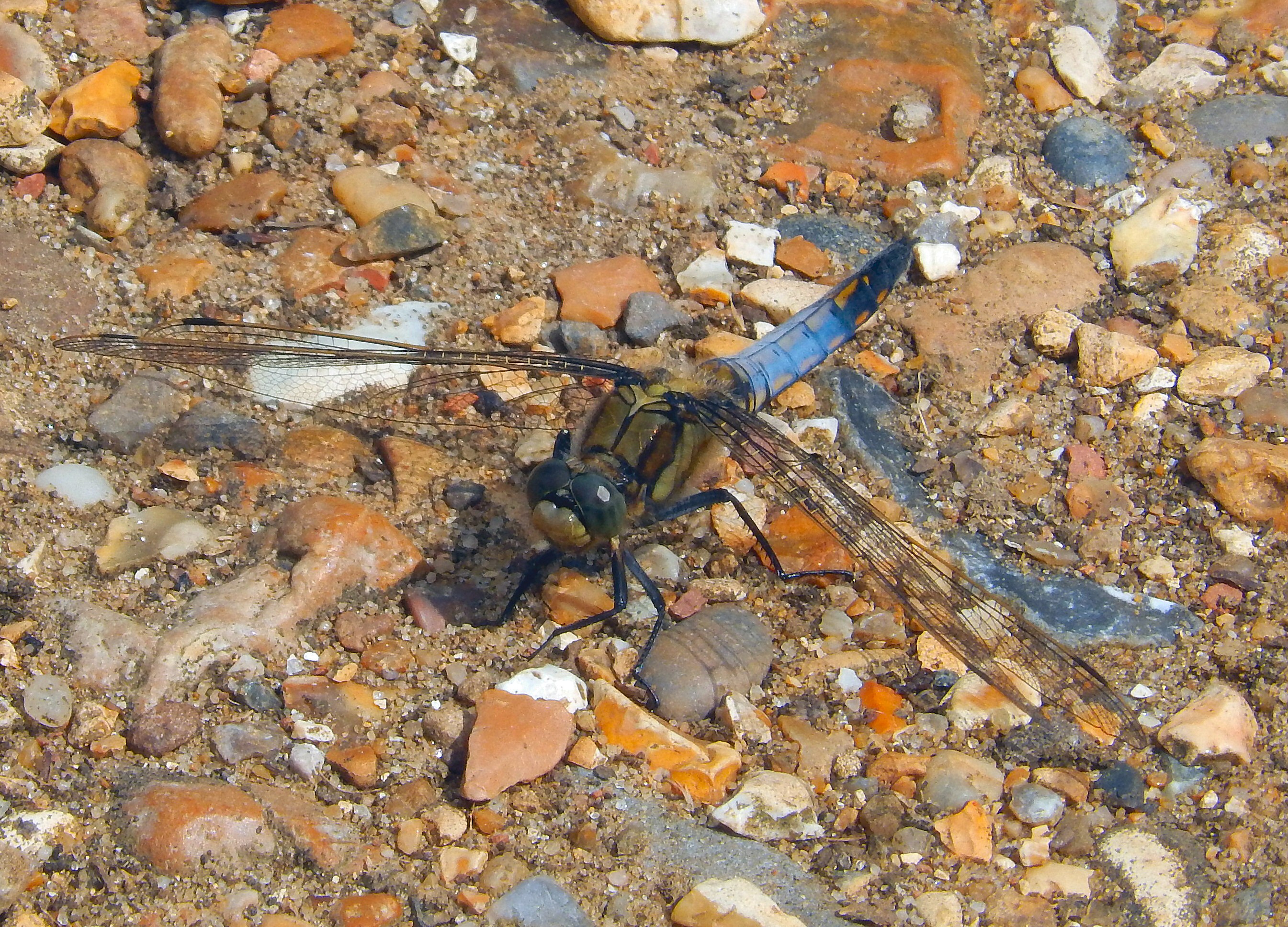
I’d gone alone to see if there were any interesting dragonflies, but there weren’t many about: a warmer day is always better. But there was a Black-Tailed Skimmer basking on one of the ‘wildside’ paths.
Black-Tailed Skimmer
Apart from that, I glimpsed one Hawker dragonfly – probably a Hairy dragonfly, as the only kind other than the Emperor seen there in the past month; and there were plenty of Common Blue and Bluetail damselflies about.
As for butterflies, it was alarmingly empty: a couple of meadow browns, a small white or two, and a female brimstone the highlight. My alarm at the lack of insects in general in England is growing. If it’s neonicotinoids – hot on the heels of all the earlier insecticides, many now rightly banned for their destructive side-effects on wildlife – then we are watching a manmade calamity. The BBC noted that some ditch water was toxic enough to be used, just as it was, as an insecticide spray for crops. The effect of that on dragonflies can only be imagined: a sad thing, as (living in rivers and ponds rather than on farmland) they have to some degree escaped the disaster that has all but eliminated our farmland birds, bees and butterflies.
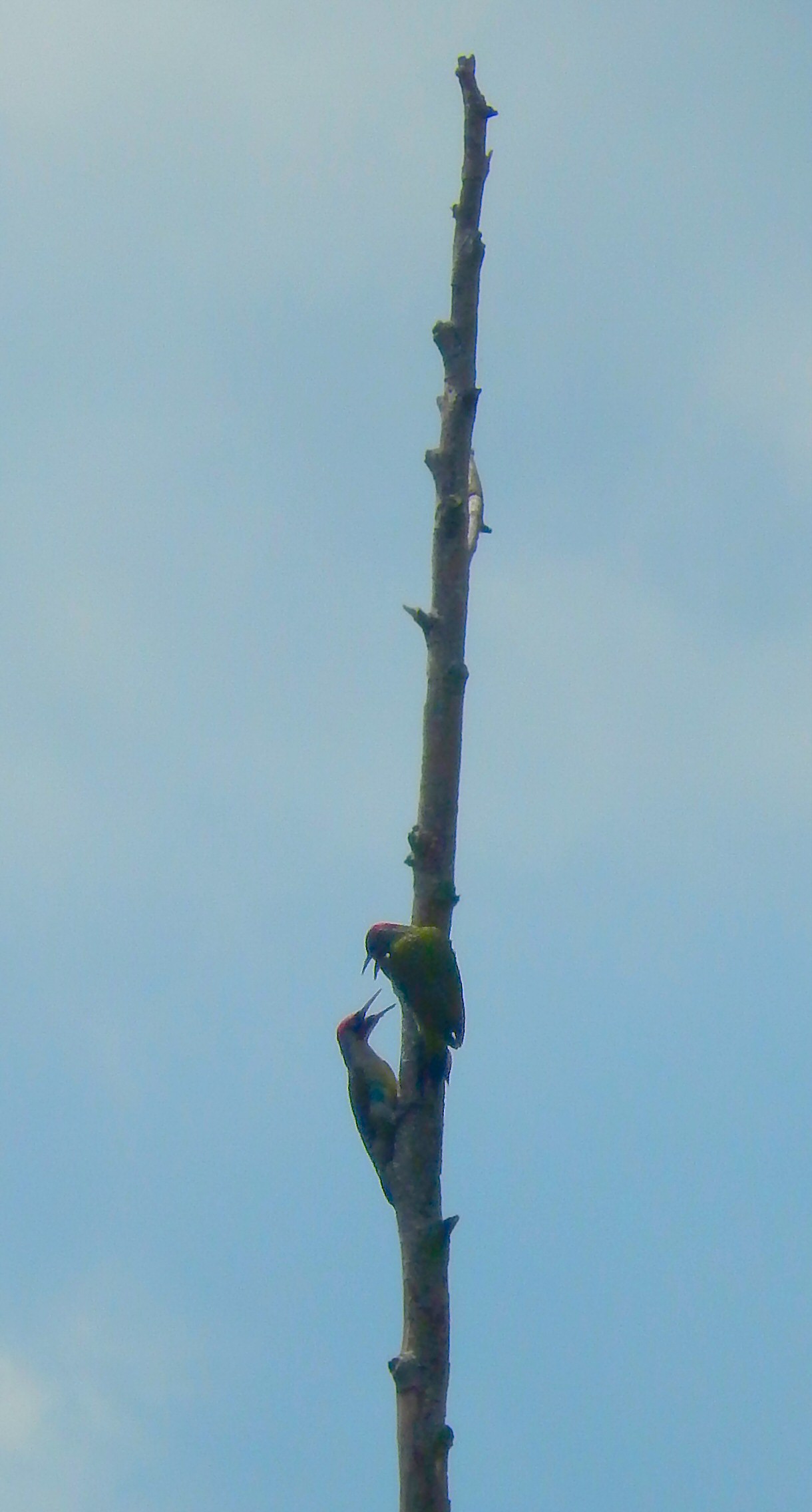
But on a dead tree, wildside, was another fluffy-duckling sight, this time from a distinctly arboreal bird.
Parent and juvenile Green Woodpecker
Two Green Woodpeckers, presumably a parent and a newly-fledged juvenile, were clinging to a dead tree, the parent a little higher up, the youngster apparently begging for food with open beak. The family drama went on for several minutes.
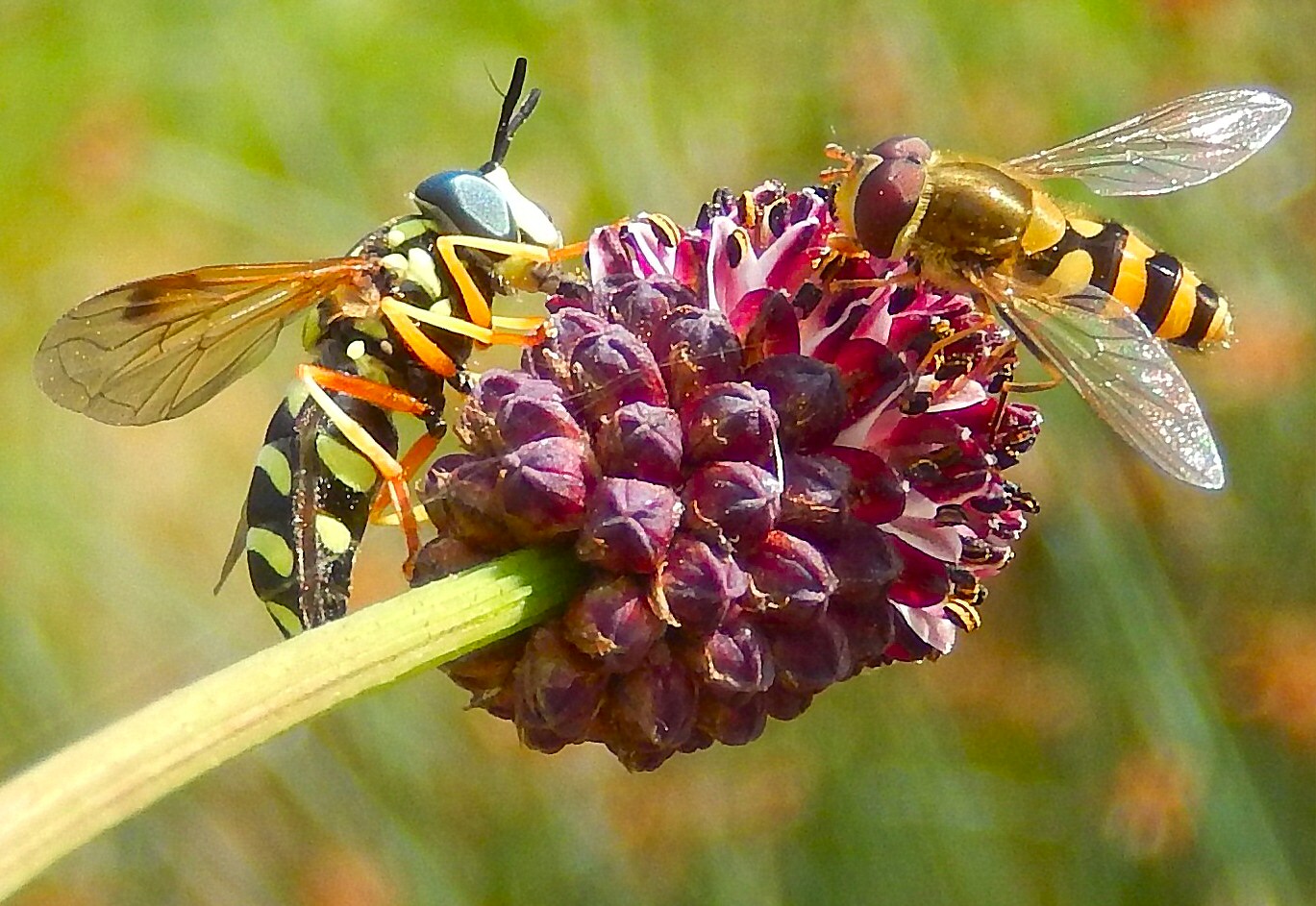
Two different Hoverflies on Burnet
Tiny wildlife shows were visible on the flowers: here, two hoverflies of different species, busy being Batesian mimics of dangerously stinging wasps (but harmless as doves) are feeding, slow and relaxed in the sunshine, on the small flowers in a Great Burnet’s flowerhead. They didn’t seem at all bothered by each other, or by any risk from predators. But despite their glorious colours, it was duckling day today.
People laugh at the Victorian taboo on talking about sex, while prostitution was rife in London at the time. Today, too, we have curious taboos: people don’t talk about death, for instance. But the taboo I have in mind is different: population control. It’s just not done to speak about it. But I’m going to, and I’m not sorry. It’s vital.
Back in 1972, Donella and Dennis Meadows and Jørgen Randers published a book that, even at the time, I found distinctly curious. It was called The Limits to Growth.
The Limits to Growth, by Donella and Dennis Meadows and Jørgen Randers, 1972
It was commissioned by the Club of Rome, a non-profit think tank. It argued, in a nutshell, that a model of the Earth’s resources and human usage of them predicted, under certain scenarios, ‘overshoot and collapse’ of the whole system in the 21st century. The model was called World3 and it contained subsystems for agriculture, industry, population, non-renewable resources, and pollution.
The basic idea of The Limits to Growth was Malthusian, after Thomas Malthus’s 1798 book, An Essay on the Principle of Population. Malthus argued that population would continually increase; assuming the ‘means of subsistence’ started ‘equal to the easy support of its inhabitants’ – that food supply and consumption were in balance – then consumption would always tend to run ahead of food supply (and of wages), leading straight to poverty, though war, famine and disease could also intervene.
Malthus observed that either the death rate could increase to cut down a population through positive checks like famine, disease, and war; or birth rate could be lowered by celibacy, late marriage, birth control or abortion, to prevent population growth. He attacked the idea that agricultural production could grow indefinitely. He was attacked, unjustifiably, for being uncaring of the poor, and replied that it was ‘vicious and cruel’ of a government to allow population to grow without preparing to feed (and we might add, to house, educate, and care for) it, in other words for society to rely on human misery instead of proper planning for a stable and happy population.
The Limits to Growth was similarly attacked, perhaps with rather more justification. What seemed to be its ringing certainty about how we would really soon now run into unalterable limits imposed by nature was shredded by the critics. Its over-reliance on what was, after all, only a model into which one could put different numbers was in hindsight distinctly naive. By making itself look like a cranky doomsday prophecy, it became only too easy to dismiss.
But the Malthusian argument, updated a little, is unanswerable. If you have a finite planet and exponential growth – heck, ANY growth – then you must run into limits eventually. If growth is rapid, that ‘eventually’ will be soon. In 2011, Ugo Bardi’s The Limits to Growth Revisited argued that reality seemed to be following the 1972 prediction after all.
What the critics seized on in The Limits to Growth was, especially, its naive assumption that resources were known and fixed. Big Oil argued that new discoveries would (always) be made, only to find that discoveries declined rapidly, and became steadily more inconvenient, polluting or dangerous – far out at sea, high in the Arctic, or as dirty and difficult oil shale, necessitating the invention of fracking.
Big Oil and the economists argued, correctly up to a point, that when a resource becomes scarce, its price rises, and that enables formerly too-expensive alternatives to be developed. In the case of oil, that begins with deep, dangerous and dirty ways to get more oil. Failing all of those, it continues with alternatives to mineral oil, which might include synthesising oil from plant materials, or perhaps directly from sunlight, water, and carbon dioxide. Failing that, it could continue with alternative forms of energy, such as wind and solar power used with batteries, and so on, as the excess of demand over supply pushed prices steadily upwards. All of this is pretty basic economics, but it overlooks the real attachment of today’s economy to resources such as oil, and the pain that is starting to result as resources start to run short. Wars and tensions in the Middle East over both oil and water (especially for irrigation) illustrate the point.
The economists further argued that economic growth was not ineluctably tied to population growth, nor to growth in the use of resources. The economy might grow (we could phrase it today) through services like insurance, or banking, or software, or games, or videos, none of which in themselves logically entail physical resources, however much bankers build themselves flashy headquarters and huge IT centres full of hot computers and power-hungry air-conditioning systems. In theory, wellbeing and the economy could improve without using more resources. So while it looks and feels as if every industry and service depends hugely on oil today, in theory, argue the economists, you could have one without the other. So, oil, qua energy, isn’t quite the solid roadblock that it appears, nor are mineral resources like copper, or tantalum, or germanium, or gold, however vital they each may look to today’s world of electronic devices. I hope I’ve stated the economists’ case fairly.
Oil as a chemical feedstock is another matter: many years ago one of my science teachers observed that when we have burnt all the world’s oil, our descendants will bitterly regret our folly in using millions of years of chemical wealth just for energy. Paint, plastics, dyestuffs, fertilizers, medicines (yes, and pesticides and explosives) – oil has a hand in thousands of manufactured substances and materials that we all rely on every day. It sounds grim: no oil, no feedstock. Well, not quite: we already have ‘plastic’ bags made of cellulose from plants. With enough effort, chemical feedstocks like methanol can be made from wood, or carbon dioxide and water: we could one day learn to recycle carbon endlessly, and carbon will then be enthusiastically scavenged from the atmosphere as a vital resource.
Ah, carbon. The outpouring of carbon dioxide has already warmed the planet, changed the climate, moved ecological zones towards the poles, acidified the oceans. It is apparently in the process of sending perhaps half of all the species on the planet to extinction in the coming centuries. It seems incredible that such verifiable facts should be disputed; or that such urgent warnings should be ignored. But disputed they are, and ignored too, drowned out by the incessant tinnitus of wars, elections, recessions, politics, selfishness and greed, and simply the sheer bustle of daily life.
But carbon contributes to one thing that humans are definitely tied to: food. If the population rises, more food is required. Even this, though, is not a straightforward 1972-style equation, N people x C kilos consumed = F kilos of food required. If we all became vegetarians with the modest diet of a traditional Indian villager (just rice or chapatis every day, with a little oil, a few onions and chilis, rarely anything else) then the world could sustain many more of us than if we all demanded Texan portions of steak made from methane-producing cows, each animal guzzling the grain that might have fed dozens of vegetarians.
Still, for any given agricultural productivity and any given area of land there is a maximum population that can be sustained. Let’s try a thought experiment: say we achieved optimal efficiency in converting sunlight to grain, over the whole land surface of the earth, deserts, forests and all, we might increase productivity fivefold, and the productive area fivefold, for a 25fold increase. Perhaps we could grow food all over the oceans, hard as that might be; the production would double again. If we could reduce our food needs through genetic engineering (I am not advocating this) or other means, more people could be fed. Now, the human brain accounts for about 20% of our energy intake, and can hardly be changed; but let’s suppose we could halve the food used by the rest of the body, we’d then use just 60% of what we eat today: the population could increase by 100/60 or 1.66fold. So how many people would that be? Much more than now. If the current population is 7 billion then we could have 7 x 25 x 2 x 1.66 = 580 billion people on the planet; it could be more if the proportion of vegetarians increased, rather than decreasing as it is doing today. No doubt you can argue for still greater numbers. The theoretical limit is enormous (nothing at all like the 1972 view), and full of uncertainties: still, it is an extraordinary prospect. And it ignores what we are already seeing, which is increasing shortage of resources.
But even assuming that the agriculturalists and engineers did their work splendidly, and none of the terrible shortages of oil or water or minerals, or fights over shortages that The Limits to Growth implied ever occurred, I should not like that world, and I can’t believe you would. There would be no room for wildlife or non-food plants: no place to go for a walk in the sunshine: indeed, no call to go to the agricultural surface at all, except to drive a tractor, if humans still did such a job in a robot-rich world. For with the land all devoted to growing food, we would all live underground (but for a few super-rich, who would still enjoy unimaginable luxuries like fresh air and sunshine and flowers), work, play and probably fight down there. For any mass emergence on to the surface would spell starvation for billions as crops were crushed underfoot. Unbearable? If so, that is the limit to growth.
We could ask, why should all the planet’s resources flow to just one species, us? What makes us so special that we should take the shares of all other species, for that is what the grow-as-we-like until the hundreds-of-billions scenario means? At the least, it is a bit selfish.
For we have one more professional to convince, after the oilmen and economists, and all the work to be done by agriculturalists and engineers to set up such a world. It’s the ecologist.
A famous book on this subject was also published in 1972: Barbara Ward and René Dubos’s Only One Earth.
Only One Earth argued (much more solidly than The Limits to Growth) that development should be limited to ensure basic human rights, an ‘inner limit’ within the ‘outer limit’ of the Earth’s carrying capacity. Much later talk has grossly diluted the idea of ‘sustainable development’ to allow almost anything: it is much easier to claim that something is sustainable than to stop consuming more. Ward and Dubos argued for ‘the careful husbandry of the earth’, sharing wealth fairly and conserving wildlife carefully. It was pretty radical stuff for an economist like Ward. In effect, she broadened economics to include human wellbeing – a domestic and individual ‘economy’ – as well as ecology – the wellbeing of animals, plants, and ecosystems.
I would like to imagine that the arguments for healthy ecosystems rich in life of every kind are becoming obvious: I feel they are already painfully clear to anyone who looks at the question. Still, here they are, very briefly. Crops need pollinators, like bees, bumblebees, moths and butterflies, flies, beetles. Pests need to be controlled by predators, parasites, and pathogens. Materials need to be recycled by saprophytes. We need genetic diversity – wild plants, old cultivated varieties, not to mention animals and fungi too, to combat pests and diseases, to supply unknown future crops and crop varieties, medicines, and other useful substances. In short, all ecological roles, species of every sort, are needed, not just crop plants, our primary producers, creators of food: they can’t survive alone.
More than that, more than those desperate agricultural and economic requirements, we need beauty and delight; birds, bees, butterflies, dragonflies and Komodo dragons, tigers and tiger-lilies. Without them, life isn’t worth living.
We are already in serious danger of losing all these things, as neonicotinoid insecticides join the already long list of disastrously dangerous substances we have created, manufactured in stupidly large amounts, and released onto the land with blithe ignorance (or worse, reckless lack of concern, with contrary evidence left unpublished, covered up to preserve profit). Already neonicotinoids are proving as deadly as the organochlorine insecticides of the 1950s and 1960s, that led Rachel Carson to write her 1962 classic Silent Spring.
The veterinary drug Diclofenac has destroyed almost all the vultures of the Indian subcontinent; now its use is spreading disastrously to Africa, as countries that should know better are doing the cheapest and dirtiest thing, in the face of incontrovertible evidence of harm. We do seem to be a terribly stupid species, like Douglas Adams’s mindless military robot.
Are there limits to growth? Of course there are. It’s more than time we started acting as if there were. The taboo on population control did have some slight justification: of course we cannot want a world with compulsory sterilisations, euthanasia, even a China-style One Child policy. But there’s no need for such drastic and terrible methods. Population can be controlled far better by persuasion, by taxation, by education, by informing people of the consequences of their choices, by understanding the pressures on nature and man’s place in the world.
Let us decide how much room we want to give to forests, to prairie, to tundra, to wetlands, to deserts.
Let us decide where we want seabirds by the million to have undisturbed cliffs and seas full of fish to feed on.
Let us decide that we shall have a world full of lions and bears and howler monkeys and sparkling damselflies, of buzzing bumblebees and naturally-pollinated fruit trees, of pristine forests full of undiscovered species, rich in species and substances whose uses we have not yet even imagined.
Let us choose life, and start to live lightly on this beautiful planet.
I had the good fortune to get down to West Wiltshire in hot if sometimes humid summer weather.
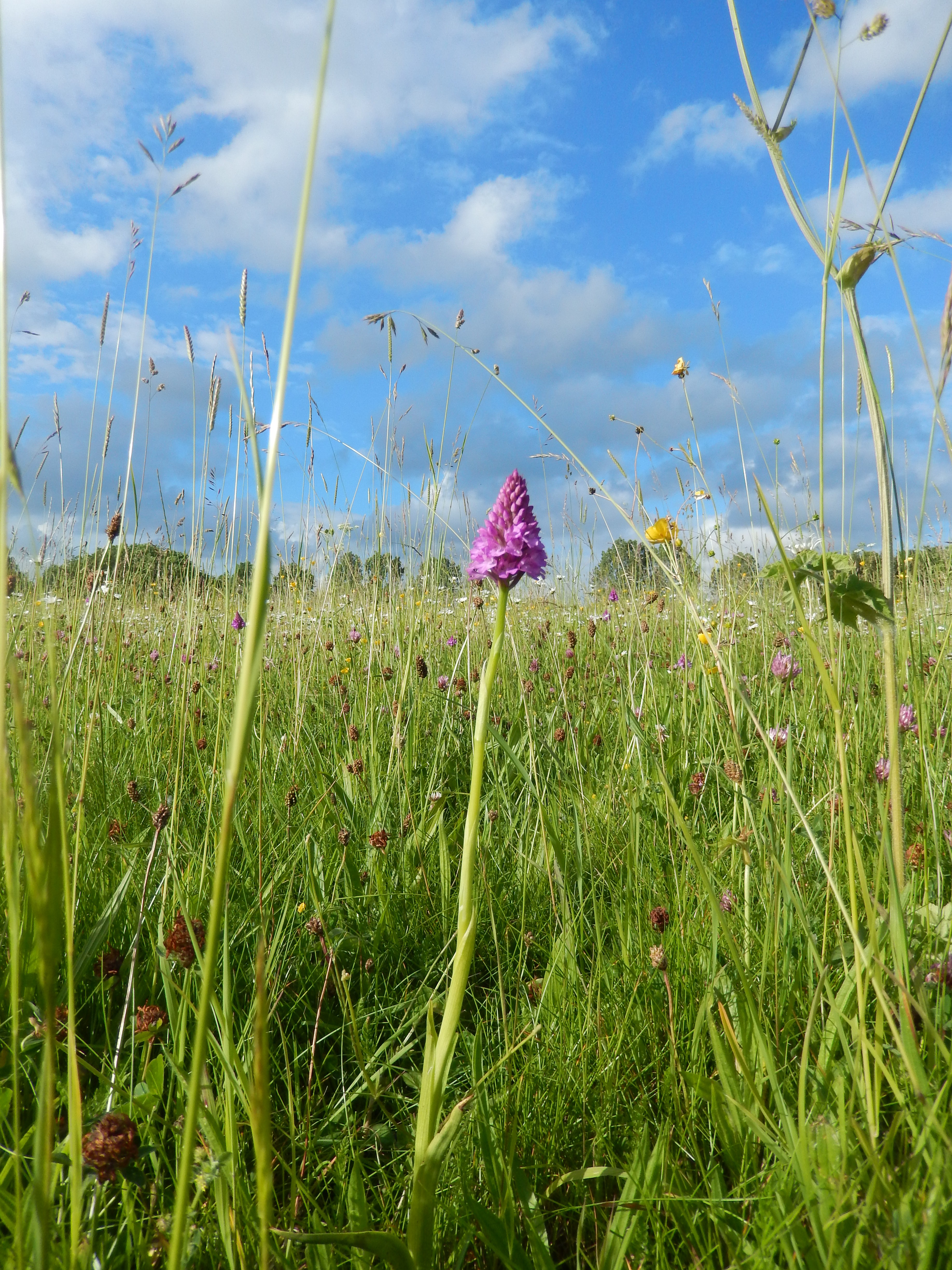
Pyramidal Orchid in Flowery Meadow
It was a pleasure to find the Pyramidal Orchid in a flowery meadow near a town: despite the dog-walkers, the increasingly uncommon flowers were clearly spreading from a small patch across the meadow, which is mown annually.
Less pleasantly, there were next to no insects pollinating the flowers: we saw one Small Tortoiseshell, a fly or two, and one (white/buff-tailed) bumblebee. It was a stark contrast to the masses of bees and beetles I’ve seen on the reserve in London. Of course, in London there is now very little use of pesticides, and basically none on an industrial scale.
This year (2014) does seem to be particularly poor for butterflies. It was an extremely warm winter and a very wet and windy spring, so I wonder if the result has not been a bad spring for insect pests … and perhaps, whether England’s farmers have not sprayed insecticide especially heavily? It’s a question that could clearly be answered by someone. If the answer is yes, then our ‘useful insects’ have suffered very heavily as a consequence.
The next day we went to Cley Hill, a western outlier of the Salisbury Plain chalk downs, sticking up above the plain below the chalk escarpment.
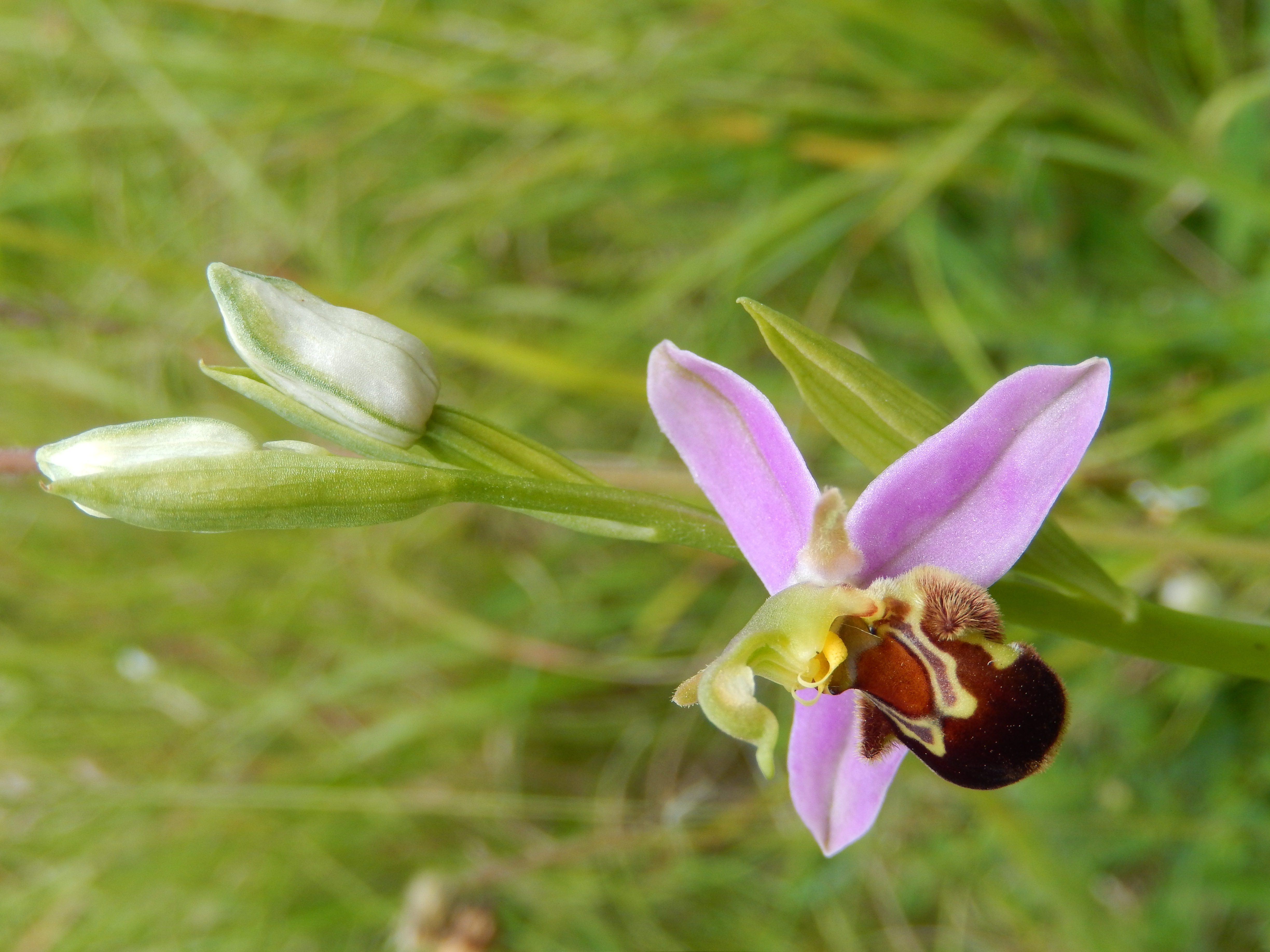
Bee Orchid
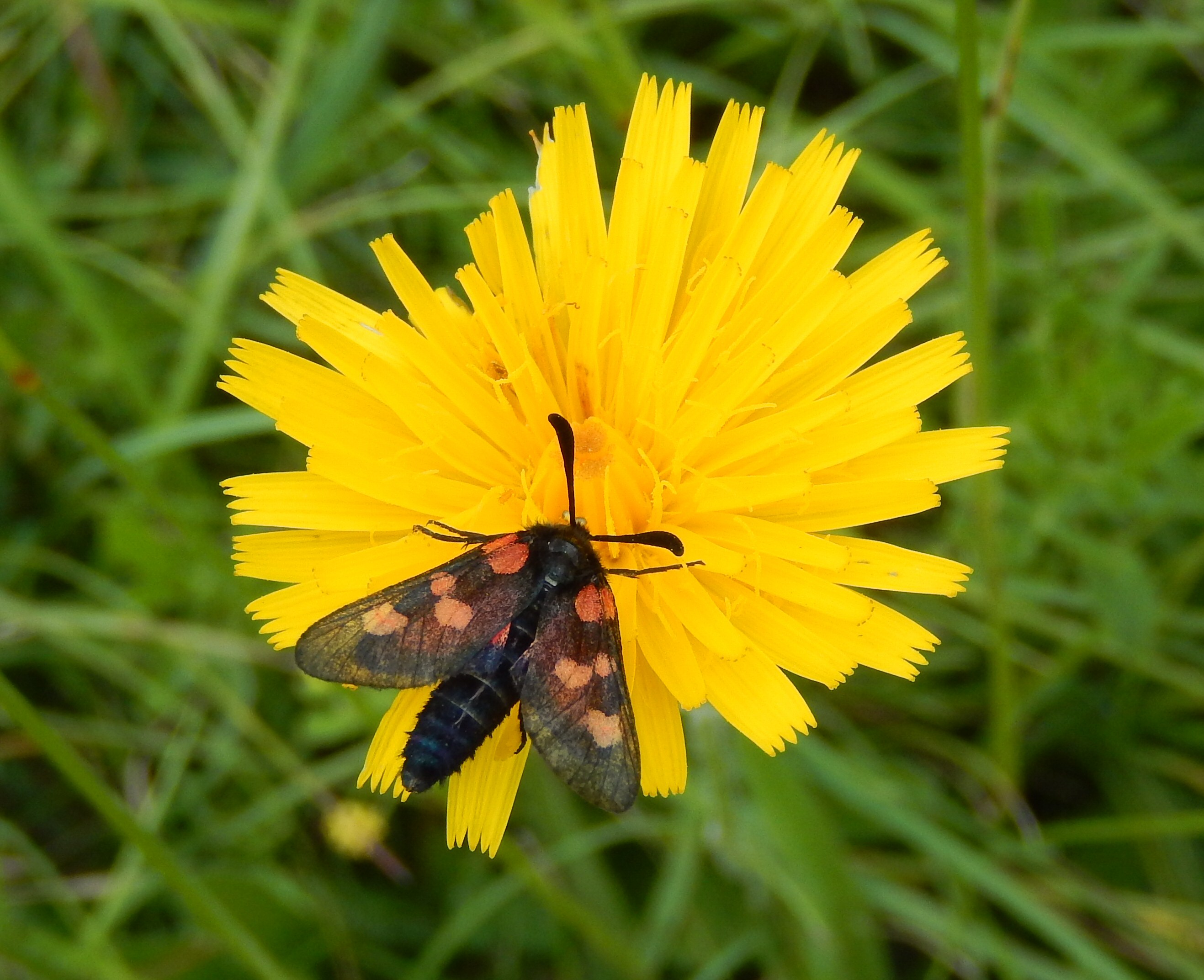
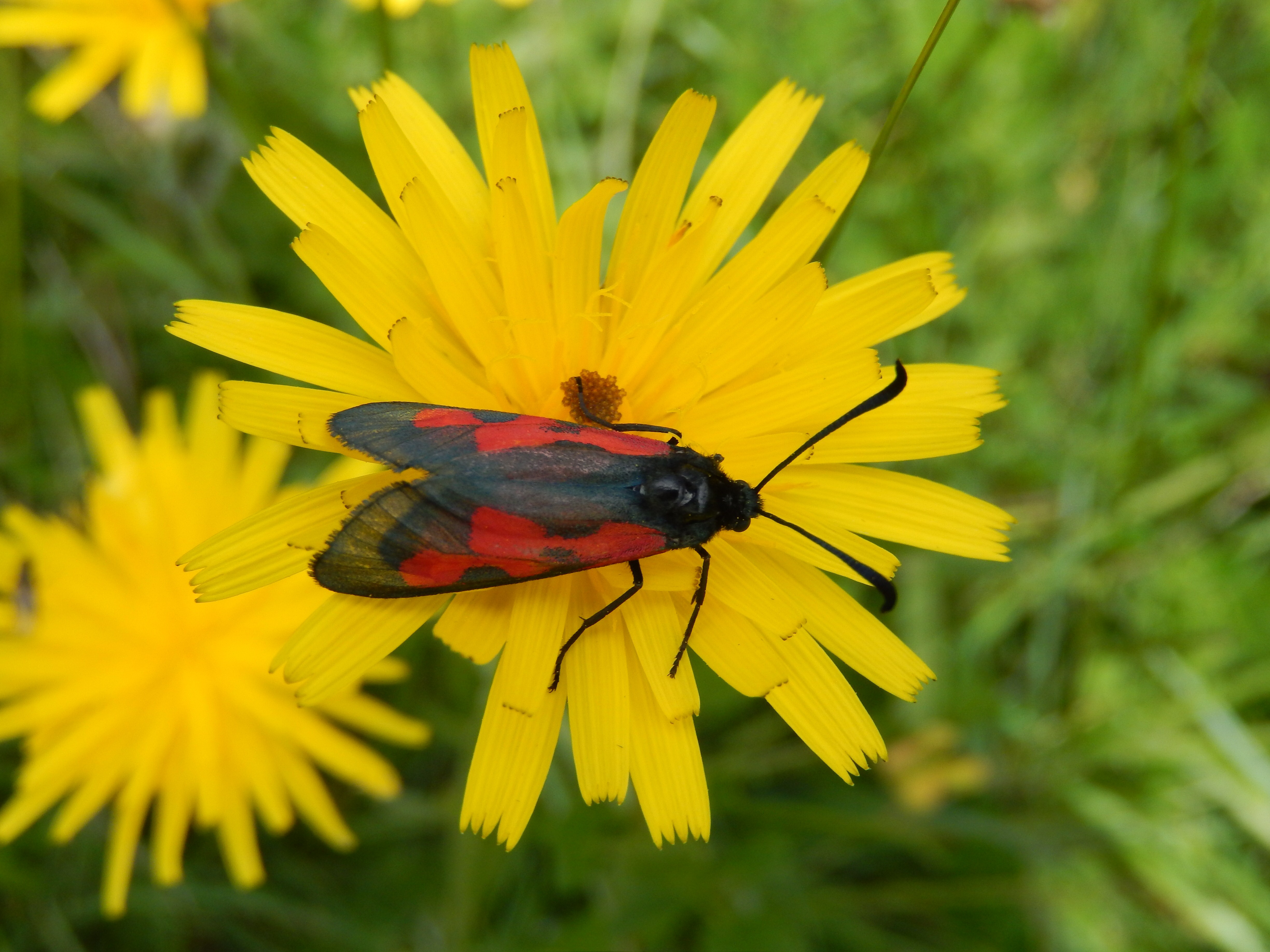
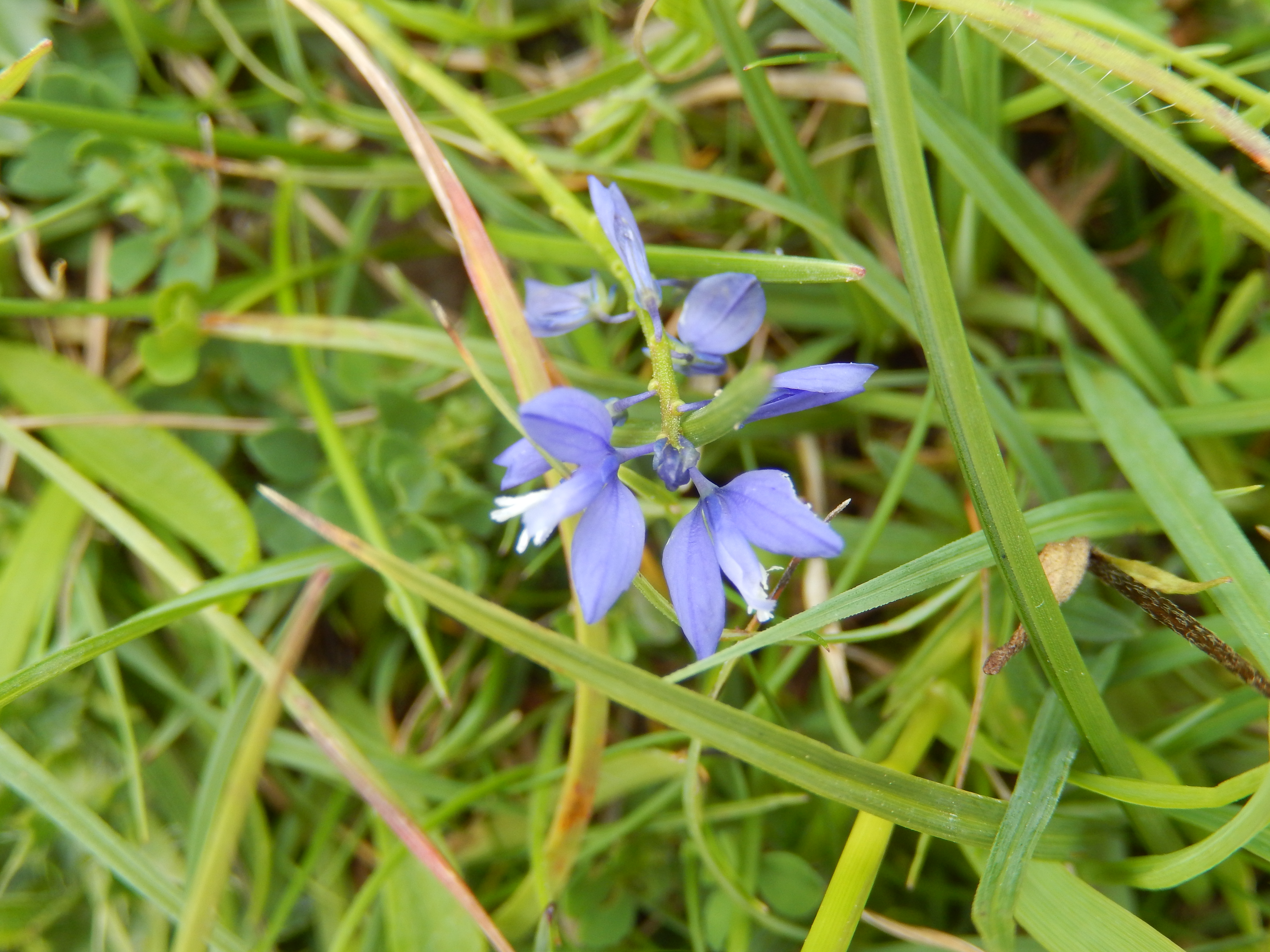
In the short grass, full of lovely flowers – Sainfoin, Milkwort, Horseshoe Vetch – were Bee Orchids, and happily both bumblebees in this special place protected by the National Trust and Burnet Moths – mostly Five-Spot Burnet, with some Transparent Burnet too, quite a treat.
Five-Spot Burnet MothTransparent Burnet Moth
On the top of the hill, above the Iron Age earthworks, we came across a group of about five Wall Brown butterflies, all very tatty and worn: perhaps they had been blown across the Channel from France on the warm southerly wind that is accompanying this anticyclone (centred to the east). Nearby were a few Brown Argus, small butterflies in the Blue family: not uncommon in France, far from common in England. Their coloration may seem odd for the Blue family, but females of quite a few species are brown, contrasting with their bright blue males, so the genes for ‘brown’ are clearly available: perhaps it takes just one or a few genetic switches to turn on brownness in both sexes rather than in just one.
In several places on the hill, often on bare chalk paths or short grass, we saw the glowing blue and purplish blue of Adonis Blue butterflies, with their chequered wing borders. So we saw some rather special butterflies, though with the definite feeling that they are only just hanging on in the area.
Milkwort, once a common plant in (cow) meadows
The hill is also host to Chalk Fragrant Orchid, Pyramidal Orchid, Spotted Orchid and more: it was lovely to see them all, though we were moved on swiftly by an anxious pair of Skylarks circling rather low overhead, trying to get back down to their nest, clearly not far from where we were sitting. All around in the thorn bushes were Tree Pipits, singing away, with some twittering Goldfinches and one Yellowhammer, my first of the year: yet another species that was once commonplace in every hedge.
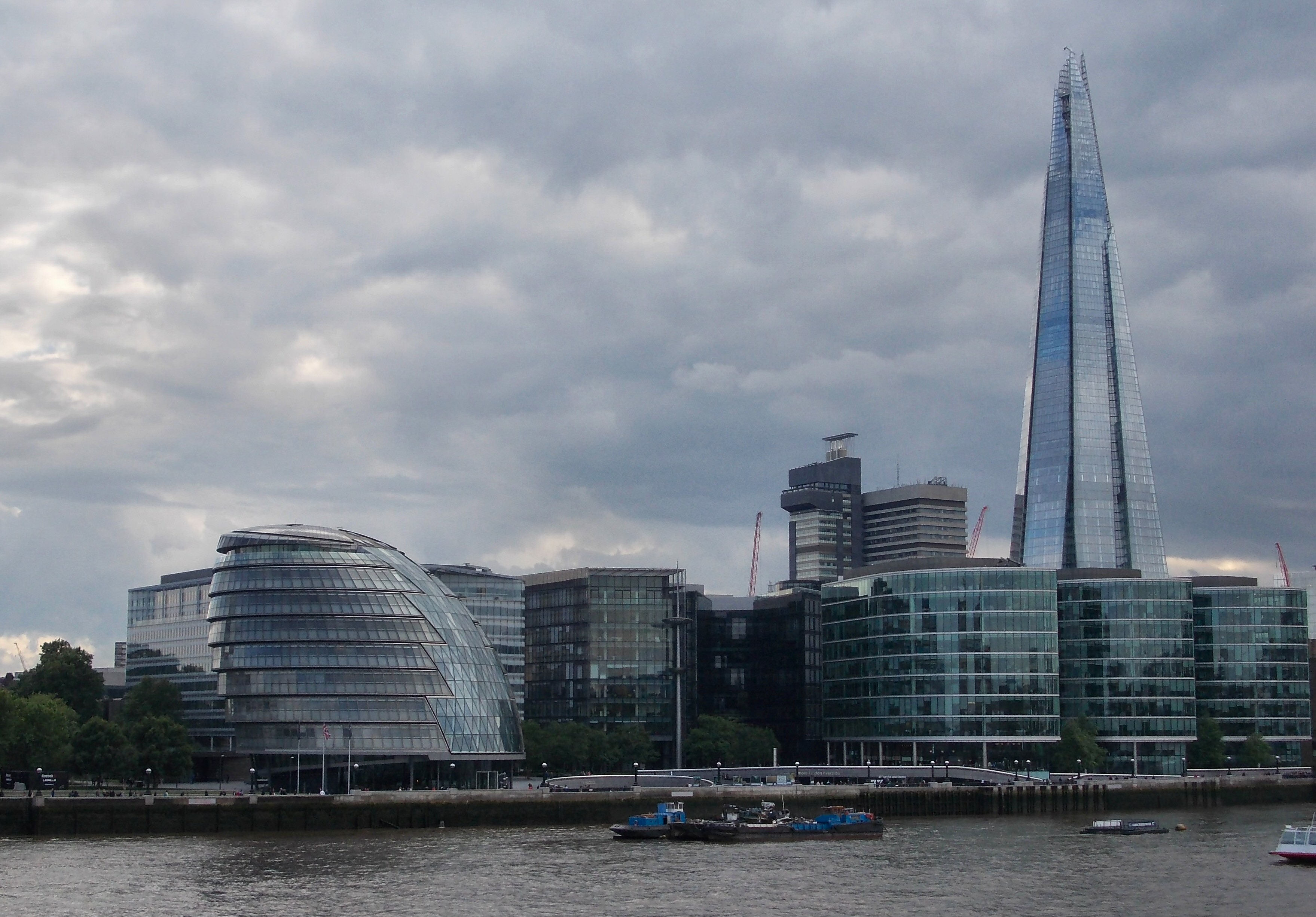
In the evening I went down to Tower Hill and walked across Tower Bridge to City Hall, where the London Orchard Project was celebrating its 5th Birthday.
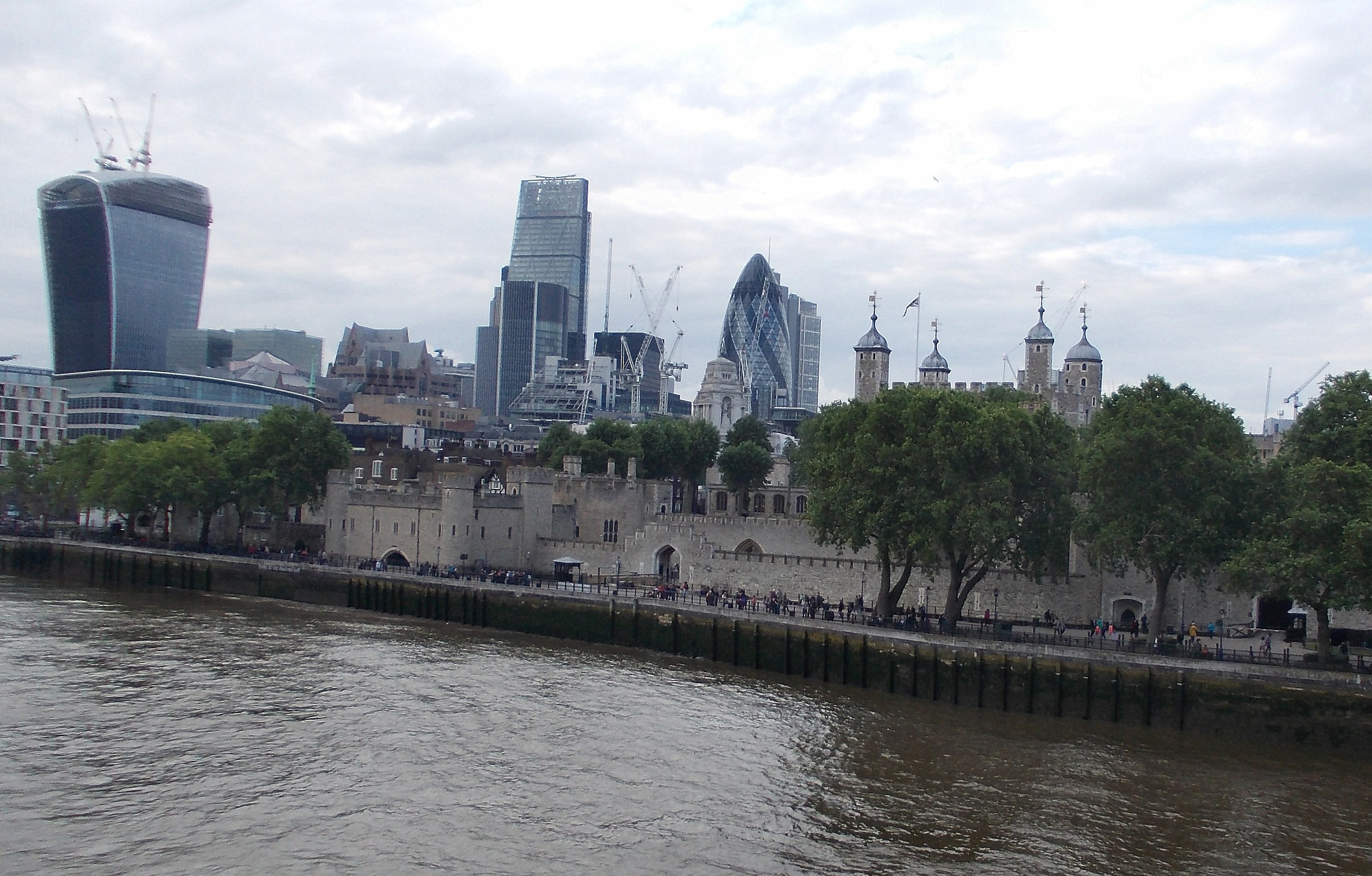
The City and The Tower of London: 1000 years of growth
The amount of new development is a shock after the relative quiet of west London, but I had a strong feeling (presumably the City Hall architect’s intention) of being right at the centre of a great and bustling city. Across the river is the quiet symmetry and antique military splendour of the Tower of London: it’s even beautiful in its stern way. But right next to it is the bulging, up-thrusting, grey glass, steel and concrete disharmony of the City, former giants like the NatWest tower and the Gherkin already dwarfed by newer demonstrations of financial might, brazenly shoving their manhood up into the sky. It’s jarring.
But then, I reflected, there are Roman walls near the Tower and at the Barbican: this city is 2000 years old. It was already ancient when the Normans came and rudely shoved the White Tower with its four-square pinnacles and Might Makes Right foreign invaders’ pennants to fly high over a thoroughly defeated, despondent and disgusted Anglo-Saxon (i.e. English) nation.
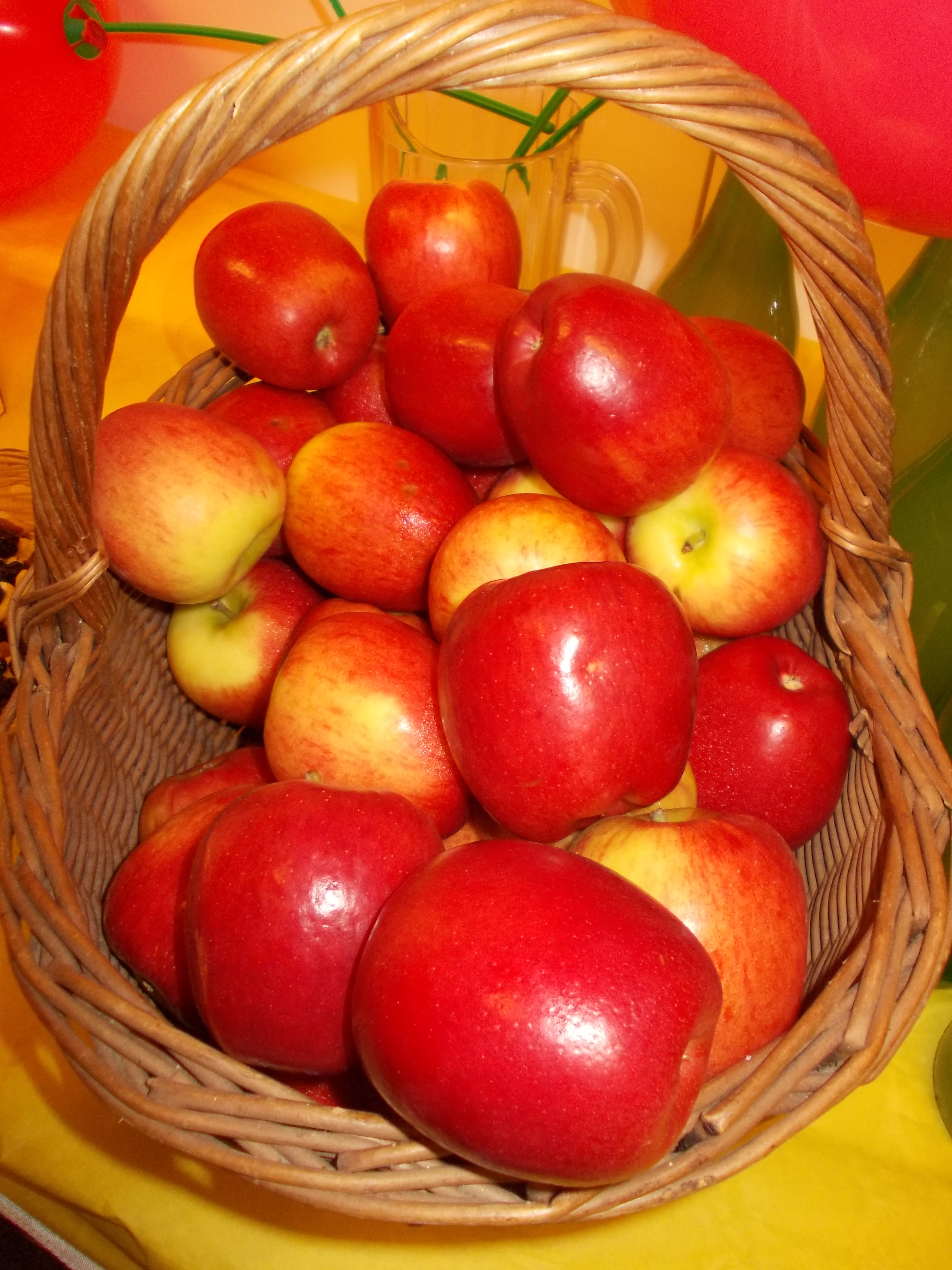
Little Red Riding Hood (symbol of Idunn, goddess of Apples and fertility) would have been proud of the baskets of bright red donated fruit (image not enhanced)
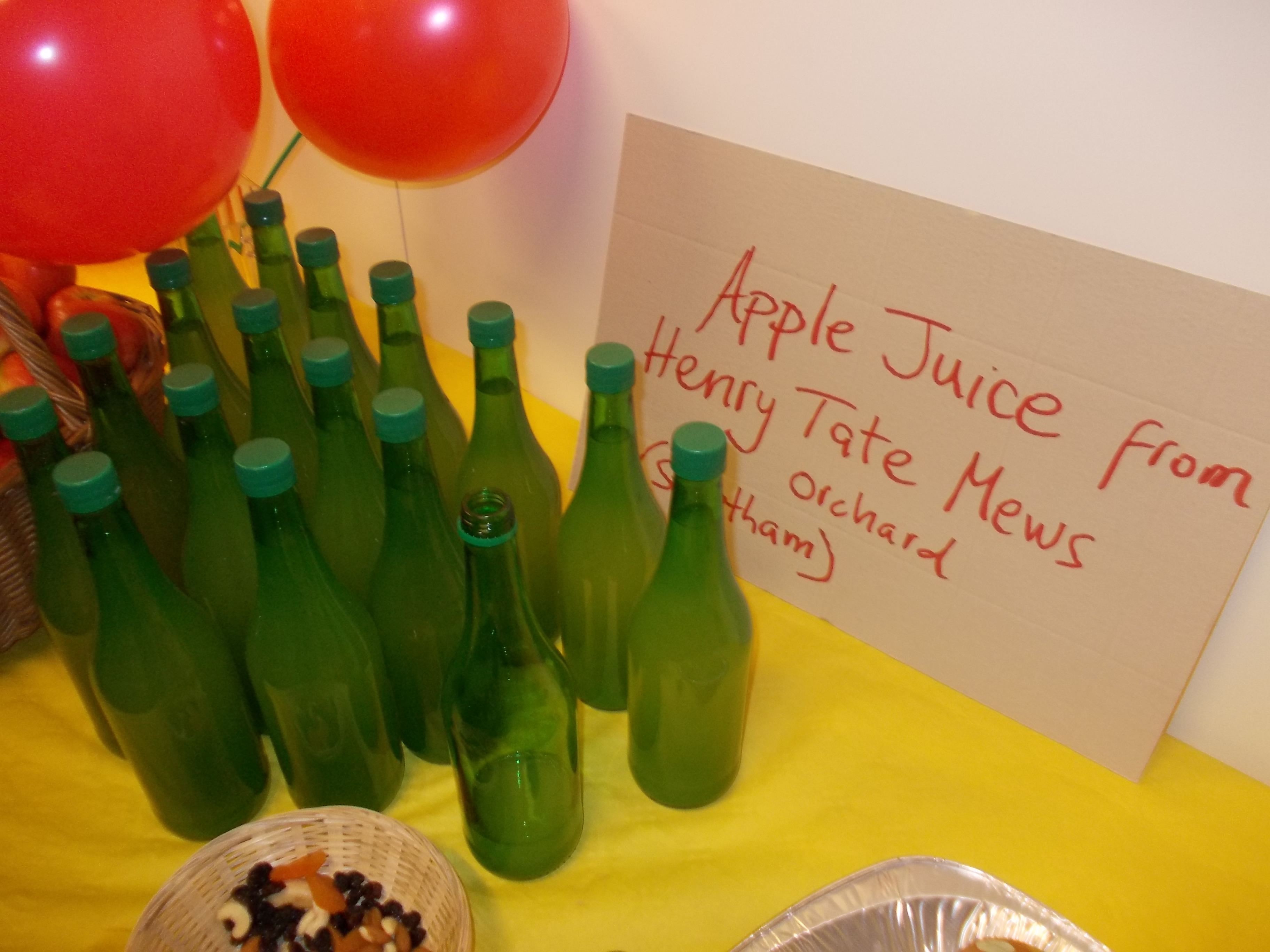
Once inside City Hall, after the brisk initiation with airport-style security (at least I didn’t have to remove shoes and belt), it was down and round the ridiculously long spiral ramp – what a grotesque waste of space compared to stairs and lifts, but how distinctive also (presumably city politics takes you round and round and never seems to get anywhere, hmm), I stumbled into a meeting room decked out with fruity bunting, maps, photographs, fruit juice, cider, apples, apple cake and bowls of dried fruit and nuts.
Some of the Project’s Apple Juice to try
I learnt that London Orchard Project had been founded by two friends, Carina and Rowena, who had just realized that our parks didn’t have to consist of nothing but inedible London Plane trees and grass. They emailed a lot of people and within four days had 120 groups who wanted to join in! Since then, 12 old overgrown orchards have been saved and restored, and an extraordinary 83 new orchards have been planted all over our city: soon there will be 100. Even after 2000 years of urban growth and development, I reflected, there is still space and energy and enthusiasm and collegiality for a hundred beautiful spaces full of healthy, vigorous, productive fruit trees.
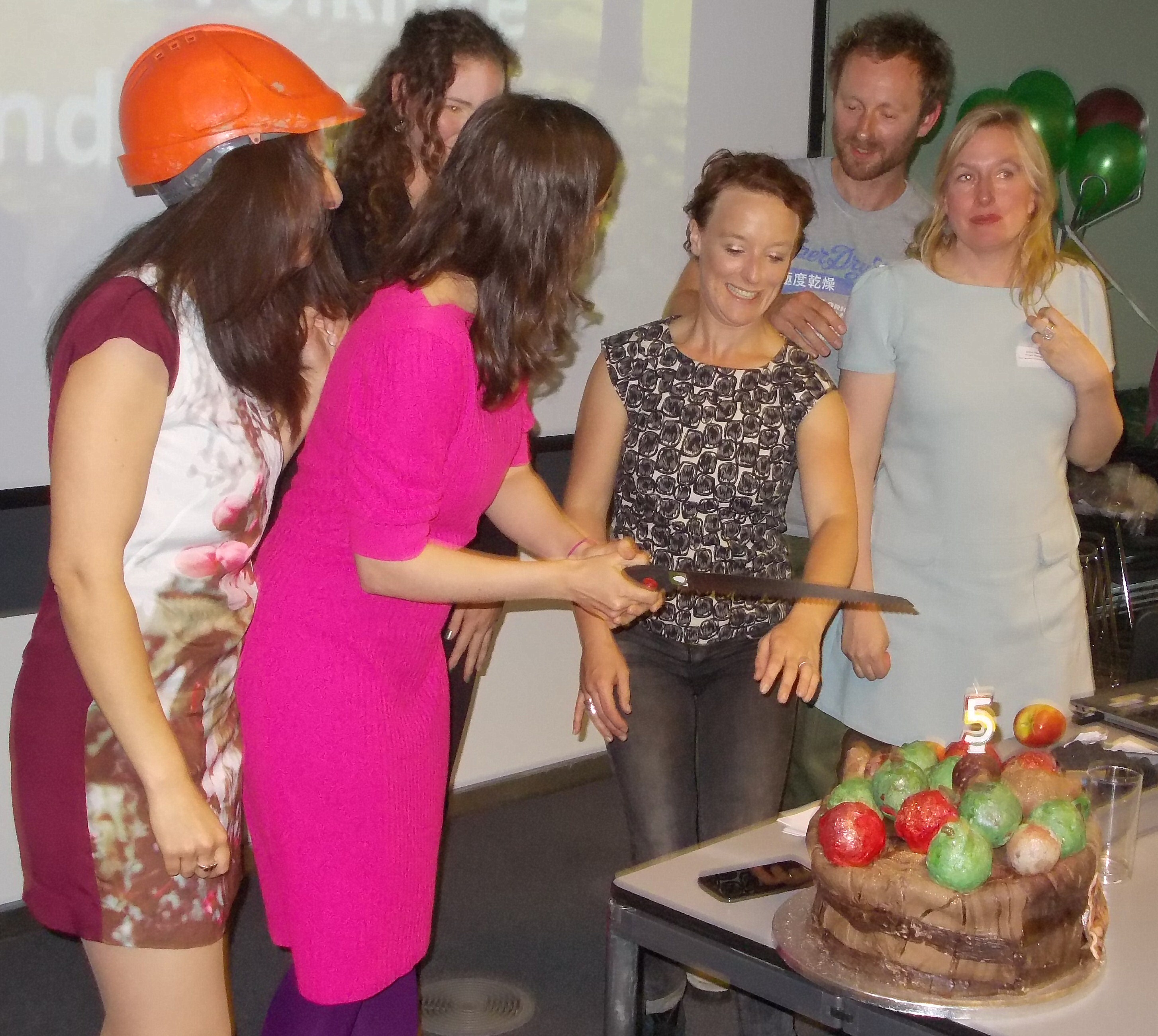
Rowena, Kath, Carina, Merrin, Lewis and Amber cutting the cake … with a fiercely serrated pruning saw
All the talks were remarkably interesting. Lewis McNeill gave practical tips for healthy fruit trees, from pruning to fertilising, and gave away root cuttings of Comfrey, a herb which grows vigorously and gathers minerals in its leaves, making it ideal as a mulch for Apple trees. London Glider cider-makers described their first few years, going from newbies to experts: unlike beer, which you make, sell, and then do the next batch, cider is made in the autumn, sold in the spring so you need a lot of storage: they do 7,000 litres a year, the limit before paying excise duty on every litre.
Amber Alferoff, a project manager (she’s on the right of the photo) spoke on the folklore of apples – all those fertility goddesses like Astarte/Ishtar, Aphrodite, Freya, Idunn and the Roman goddess Pomona (that was an easy one) have names that mean Apple, apparently, while Adam and Eve are offered the Apple by the Snake/Dragon, a combination that goes right back to ancient Babylon long before the bible, apparently.
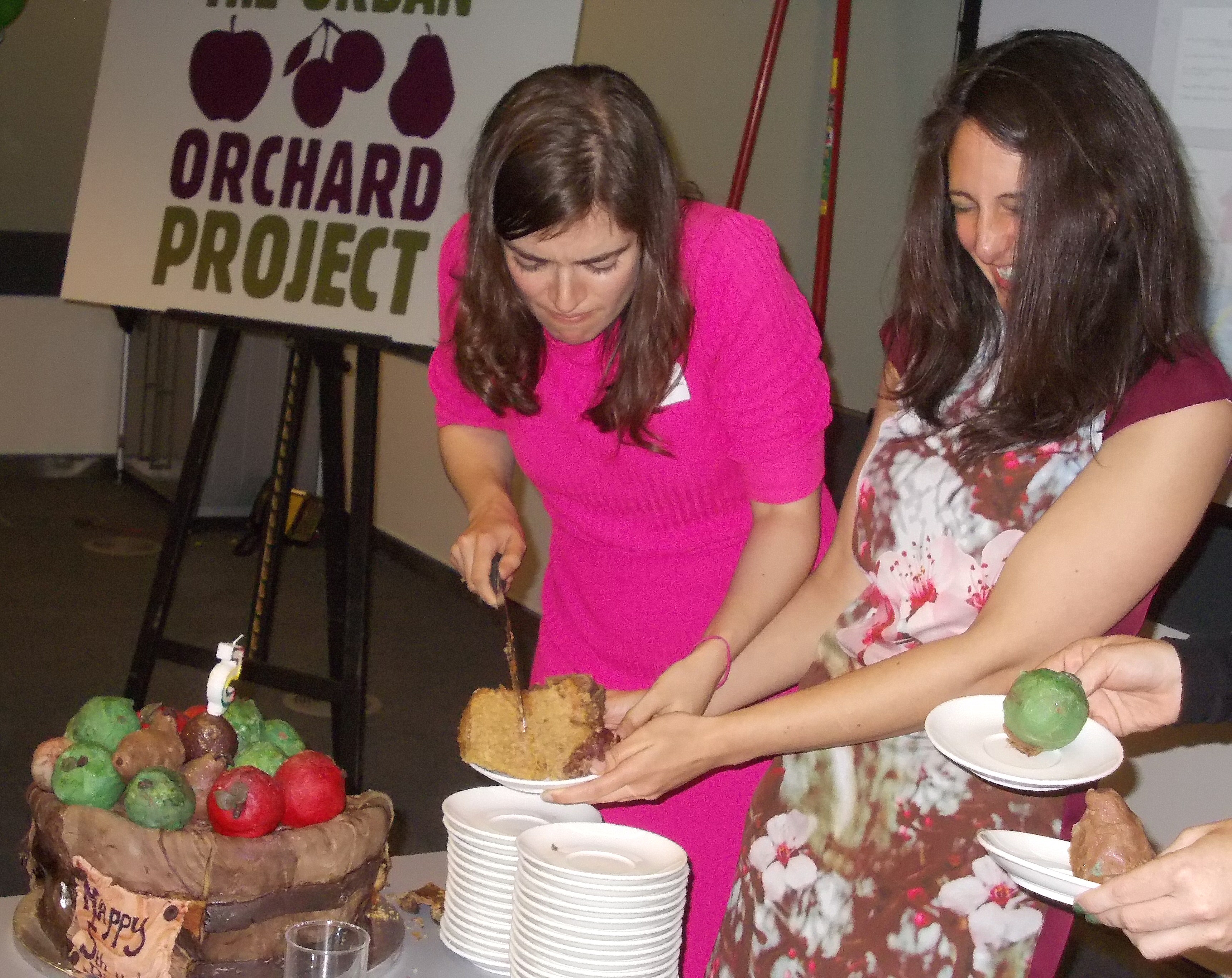
London Orchard Project founders Carina and Rowena cut the birthday cake
Carina and Rowena joined the celebrations by cutting the cake with a viciously sharp doubly-serrated 70-cm pruning saw (and the obligatory hard hat for tree work). There are 1200 volunteers; hundreds of Orchard Leaders; 50 public events; 3 tons of apples; a new apple variety, “Core Blimey”; and they even met the Queen. They worked fulltime for the project for a while but have now taken a well-deserved back seat as trustees.
In the driving seat now is Kath Rosen, Chief Executive, who spoke energetically about progress and the future, which most immediately is to start work in other cities including Manchester. That means the project has to be renamed to the Urban Orchard Project, as it’s no longer just London: growth indeed.
And Rich Sylvester, wearing quite a hat, told stories and made us sing an adapted version of ‘I’ve been a Wild Rover / For many a year’ only it was all about orchards.
But for me the most inspiring talk of the evening was given by the community team from the Orchard Estate in West Greenwich. The photographs told the story: a bleak estate of tall ugly brick-and-concrete towers surrounded by blank areas of grey concrete and dustbins. The residents never spoke to each other. Then in 2012 with the Olympics, money was on offer for a dozen projects, just a proposal was needed. They had a go and won: now there’s an outdoor gym area, popular with all ages; a large square of grass dotted with neatly mulched circles around handsome apple trees; and a veggie polytunnel and a dozen allotment plots, where neighbours come out to sit, chat and enjoy working together. The effect on wellbeing and genuine community (what an overused word that is) was immediate. Now the London Orchard Project has got them to act as tree nursery for the whole project, as they have enough land for it, and willing people too. When they said that now they were extending the orchard with more trees every year in a new area of the estate, there was cheerful and rightly appreciative applause. We learnt, too, that visits to other orchards were always enjoyable, always a time to learn more. The name “Orchard Estate” had come, by the way, from a real orchard that the concrete had destroyed, the architect soullessly naming each hideous tower after a kind of apple – Worcester Pearmain, Egremont Russet and so on. Now, full circle, a tree of each of those varieties has been planted: all but one, now uncommon, which is being sought. Life goes on, and together, if we work as a community, we really can be in harmony with nature and each other.
There is something distinctly odd about the British love of nature. I mentioned the subject at a book launch the other day, and the person I was chatting to said, between sips of the very nice white wine and a nibble of the focaccia, that he thought the British were not really in love with nature any more as a personal activity, but were just consumers, passively and vicariously absorbing what is offered up as a commodity. I said that was ‘interesting’.
The ‘in love’ view of the British perhaps blends several different stereotypes. One is the obsolete stiff upper lip, the naturalist out in some far outpost of forgotten empire, enthusiastically carrying on studying phasmids like James Wood-Mason, writing obscure papers in the Journal of the Asiatic Society of Bengal for the benefit of anyone of similar inclination.
Another is the hugely enthusiastic amateur naturalist – the keen birdwatcher, entomologist or botanist with telescope, moth-trap or vasculum always to hand, hoping to add a species or two to a county list.
Yet another is the happy gardener, always outside – rain or shine – pruning, digging, composting, planting, watering, weeding.
The stereotype that my wine-sipping acquaintance had in mind was presumably rather different: couch potatoes, relaxing with a remote in the sitting-room, allowing an hour of television gardening with Monty Don or a year in the life of some wildlife area – the Canadian Rockies or the Great Barrier Reef, the Patagonian plains or the last surviving bit of the Sundarbans, or worse, all of the above, cut together by an editorial team with a high concept of Surviving Against All the Odds or something – to wash over their minds, leaving no particular trace other than a feeling of having seen a lot of colourful flickering images.
Personally, I doubt that picture is fair, though like all stereotypes it must make some contact with reality somewhere. People are all different, and everyone needs to relax sometimes.
A truth, though, that everyone who likes some kind of experience of nature, live or through book, film, photograph or website, is that if we’re studying or watching nature without doing something to help protect it, we are ignoring a very large existential threat indeed. Assuming we manage not to destroy ourselves in a nuclear war, we are going to have to work out how to survive an ecological disaster of our own making. Its epic proportions are becoming clear: the last time anything like this happened was at the end of the Cretaceous period 66 million years ago. Whether Luis Alvarez was right that an asteroid or comet crashed into the Earth to form the Chicxulub crater, the debris thrown into the atmosphere causing something like a nuclear winter, it is certainly the case that huge numbers of species became extinct very quickly, including all the world’s large dinosaurs (yes, I know we have the birds still with us, and they’re in the dinosaur clade) along with perhaps three quarters of all other kinds of living thing.
You may perhaps feel somewhat untroubled by the idea that the world of your grandchildren might have no tigers or rhinoceroses in it; or even that there would be no areas of rainforest outside national parks – the Amazon and the forests of Sumatra and Borneo are well on the way there already.
You might be slightly less thrilled at the news that many of the world’s hotspots for variety of animals and plants will be gone completely: as South Africa becomes warmer and drier, the whole Cape region as understood by botanists will move southwards – into the ocean – and disappear forever, that incredible wealth of flowers, all those extraordinary Proteas, will remain only as a memory.
Perhaps even that isn’t too worrying, just news from a far country? Well, the sea level will rise by several metres when the Antarctic ice-cap melts, flooding coastal plains and threatening to drown many cities.
Not a problem? Global warming, whatever may have caused it, is already making deserts expand. Droughts will become year-long from California to southern Spain, Sahel to Australia. Food prices will rise drastically; wars will be fought over water and other critical resources.
Still not your problem? Farmland all across America and Europe is already denuded of crop pollinators, especially honeybees and bumblebees. Grasses like wheat and rice are not affected, but much of your food, and vital fodder crops for farm animals – from alfalfa to zucchini – is utterly dependent on pollination, and it’s in free fall.
What is all this about? How have we got into the crazy situation that half of us – some of us anyway – love the idea of nature, love to look at it (at least the pretty bits), while the rest (ok, possibly nearly everyone, whether we like nature or not) see themselves as separate from it? How separate can we be when we depend on it absolutely for the air we breathe – all the oxygen produced by green plants – and the food we eat – all our food coming from animals and plants? What are all those student notes in English literature about ‘man v nature’? We are part of nature. It isn’t even that nature is our survival blanket. We, like all other living things, are part of an ecosystem. The mosquitoes that bite you on holiday are in no doubt that you are edible. You eat chickens or carrots, beef or beans. Billions of bacteria in your gut share that food with you, consuming some, helping you absorb the rest. Eventually, bacteria will consume you, if you don’t get yourself cremated first. You are part of nature, no doubt about it.
So, how are you going to change what you do, to help keep this system working? Right now, it’s already badly broken, and getting worse each year. We haven’t got long to fix it.
You enter the wood — and you might just as well be in the Middle Ages. When I hear people speak of the Dark Ages, I remind myself how in those days the sun shone in just the same way as it does now, and the flowers glittered in woods where there was no difference from what we see today. … Inside the wood we are in the past as well as in the present.
With these thoughts, John Stewart Collis draws his book Down to Earth, now the second part of the combined volume The Worm Forgives the Plough (see my book review) to a close.
And in a way his thoughts from 1947 are still true today: nature is timeless, specially in a wood.
But in another way, the woods of 2014 are very different from those of 1947. The old practice of coppicing is all but dead: a few nature reserves struggle to practise something approaching it; enlightened landowners fell woods in patches rather than clear-felling whole landscapes, approximating the mosaic of new glades, fine old trees, brushwood, young trees and woodland edges bursting with songbirds that characterise true coppice. Often, in the old way of things, coppicing deliberately left behind a few ‘standards’ here and there, fine straight oaks or other hardwoods to grow large timbers for building ships or roof beams. Now, woods are more likely to be managed industrially for timber, or are sadly neglected with ivy on every trunk, brambles all around the forest floor.
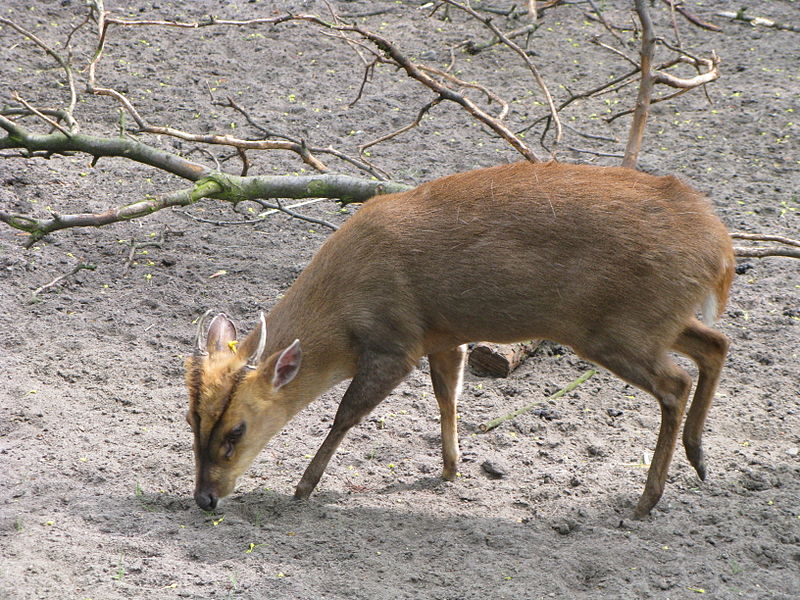
Reeves’ Muntjac, introduced from China, are now widespread across Britain and Europe
And it gets worse. Where Collis took for granted that woods in springtime saw the primrose, then the bluebell, with here and there an orchid, our wild flowers have declined markedly for reasons to do with human interference. Visitors from the cities pick nice-looking flowers, or dig them up to plant in their gardens. Accidental introductions of deer, especially the Muntjac, graze native flowers down to nothing. Many flowers listed in field guides as common are becoming hard to find outside nature reserves.
Numbers of deer in general, including our native Roe and Fallow, are increasing (and they are spreading into the suburbs) as gamekeeping declines. Since all our large native predators like bear, wolf, lynx, wolverine have long ago been hunted to extinction, there is nothing but human hunting to control deer numbers, and current levels of hunting are insufficient. Maybe George Monbiot is right: our woods need rewilding.
The Gypsy Moth, Lymantria dispar, is a notifiable pest listed by DEFRA, or at least it was when that document was published back in 1997. The insect was announced to be “a serious pest of trees and shrubs” and nurserymen and landholders were required to notify DEFRA or the PHSI HQ immediately.
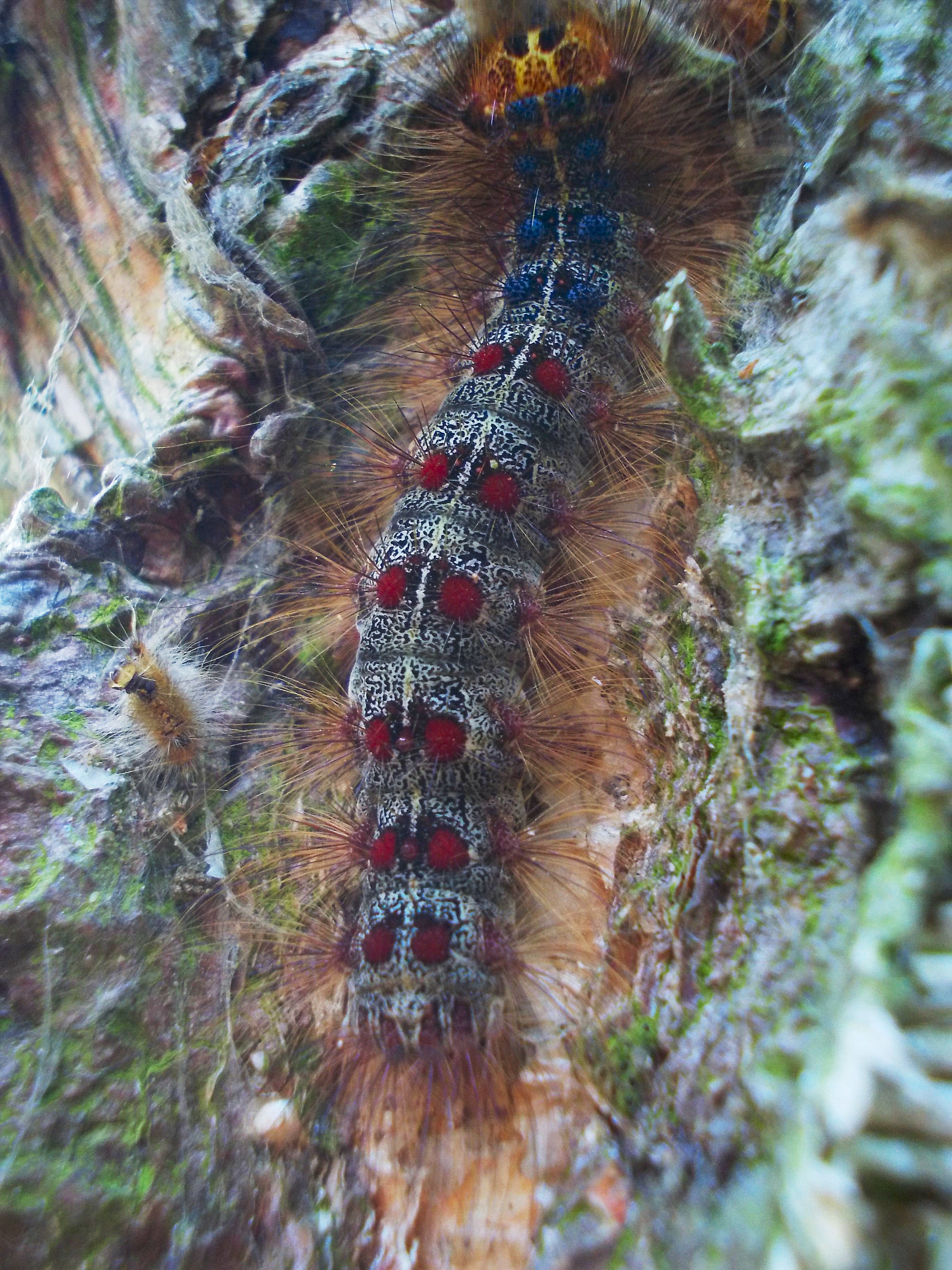
Gypsy Moth caterpillar on birch trunk: blue warts at front, red warts at back. The black-and-white pattern may also be aposematic
It has arrived in the Gunnersbury Triangle with the hairy dark caterpillar larvae with blue and red warts on their backs all over some Birch trees. The infestation is rapidly defoliating them, and causing substantial damage to some Oaks too.
Lymantria means ‘destroyer’, quite a well-named genus. The caterpillars are aposematic, their hairs and bright coloration warning off predators; the hairs are irritant, containing diterpenes, complex organic ring compounds found in wood and plant resins for defence against microbes and fungi, and retained by the caterpillars for defence against predators.
It will be interesting to see how the trees cope. Oaks can generally recover even when thoroughly defoliated; the Birches may suffer more. People can hardly use pesticides in the nature reserve, even given the means to spray whole trees safely, but biological controls are imaginable. The caterpillars are parasitised by Ichneumon flies, which may well be keeping Gypsy Moths under some sort of control in Europe. There were no controls in place to halt the spread of Gypsy Moth in America, however, where the pest was accidentally introduced in 1869 from Europe by the amateur entomologist Étienne Léopold Trouvelot. He was hoping to cross-breed them with silkworms to improve their disease resistance; he is remembered instead for starting a disastrous continent-wide caterpillar plague which still continues. Attempts with other pest species to introduce their predators or parasites have often proved unsuccessful and sometimes disastrous in their turn.
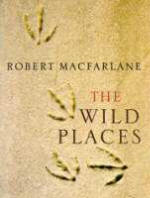
Macfarlane knew Roger Deakin (see my review of Wildwood), and was inspired by meeting him and visiting his extraordinary house. As a young, tree-climbing academic in the distinctly tame countryside of Cambridge, just sitting in the top of his favourite tree outside the city simply wasn’t enough to satisfy his craving for wildness.
The Wild Places, by Robert Macfarlane
So, for The Wild Places, Macfarlane sets out to the farthest shores of the British Isles, trying both to redraw his map of these islands – not with roads and cities, but coasts and mountains and woods and bogs, linked by ancient footpaths and holloways (roads worn down into the land by centuries of feet and cartwheels), and to define for himself what wildness really means.
In the space of fifteen carefully-crafted chapters, with titles like
Beechwood, Moor, Grave, Holloway and Saltmarsh, Macfarlane introduces us to some of his favourite places, views, treasures – in the form of found stones and shells and bits of wood, in a Deakinesque manner.
Where Jay Griffiths (see my review of Wild) is passionate, even overheated, and Deakin is calm but subtly warm, fiercely rooted in wood, Macfarlane can seem at first rather cold and intellectual: skilful with words, but oddly bloodless. It takes some chapters to start to realize the quality of The Wild Places; a desire to immerse oneself in wildness (both Deakin and Macfarlane favour swimming the wild way, Deakin notably traversing many of our wilder rivers
in his book Waterlog).
There is a plan to the book: around the British Isles, upside down; around the different kinds of wild place – high, low, wet, dry, hard, soft, empty, populated. The last is plainly a surprise to Macfarlane, who travels from an initial rather romantic conception of the places unaffected by man (as if), to places with strong energies of their own, and the people who naturally go with them. There is a bit of dialectic about all this – a thousand student essays on Man vs Nature, perhaps – but it becomes clear that Macfarlane is coming down to earth, and warmth creeps into his writing.
Macfarlane is at his best describing the wonderful diversity of life in the Burren: a rainforest in miniature, in the deep narrow grykes between the clints, the hard, dry exposed slabs of limestone pavement: an endangered habitat if ever there was one. And his love for Coruisk, beyond The Bad Step in the Cuillin Hills of the Isle of Skye, shines out despite any clever word-schemes or devices.