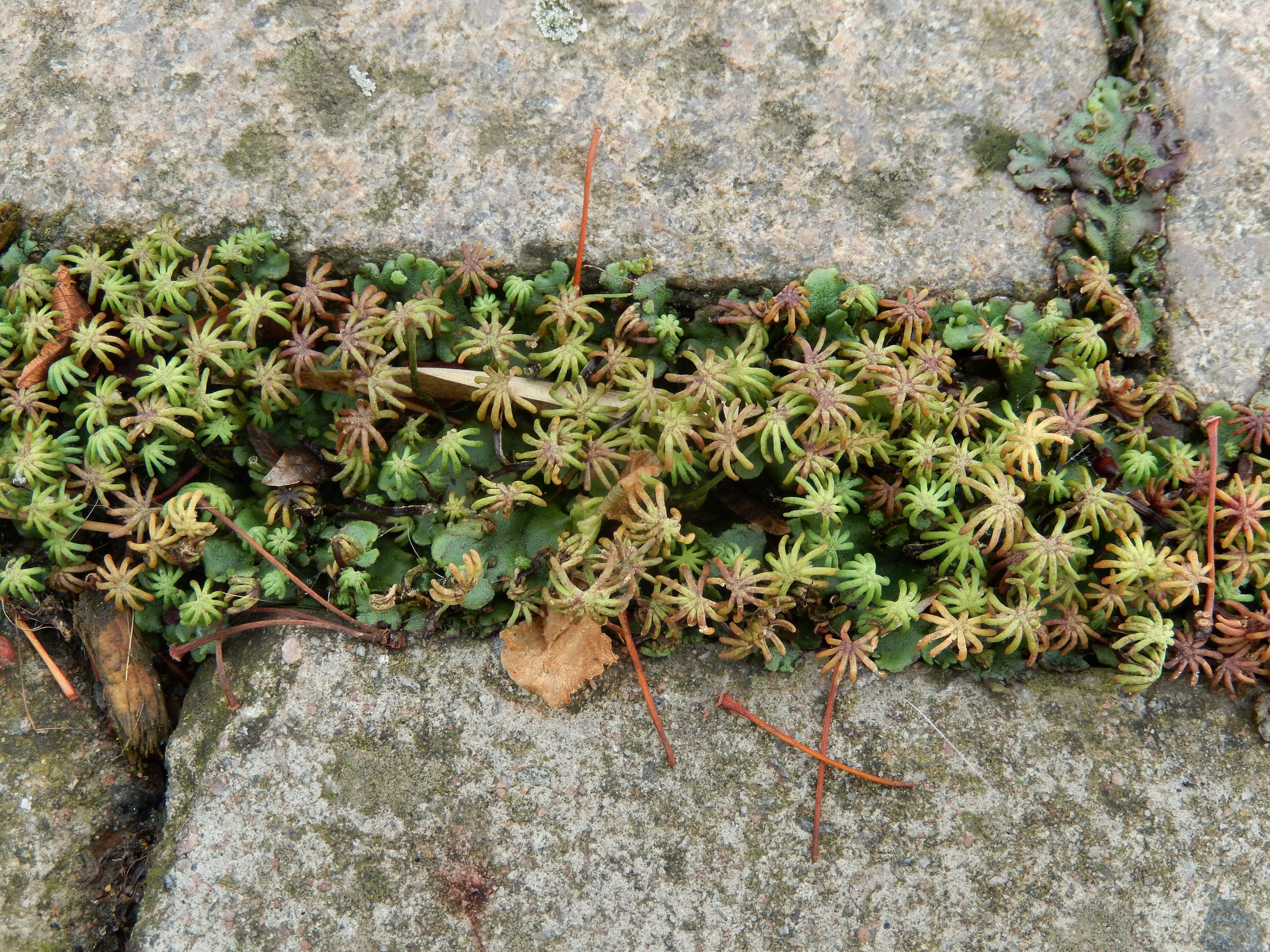
Well, it’s been pouring. The English Summer app is running, sort of, only the running is as in “running water”. The pavements in my street are wet enough to support flourishing colonies of the greenhouse liverwort Marchantia polymorpha. It is named polymorpha as it has many (poly-) forms (morph-). Two of these are rather splendidly visible in the photo.
Firstly, the female plants have decorative little umbrellas with star-shaped tops, which are gametophores which carry the female gametes, the ova.The flat green thallus is lobed like a liver, which by the mediaeval doctrine of signatures was supposed to be God’s way of indicating to the herbalist that this was a useful medicine for the liver … no worse than the modern crackpot ideas that Ben Goldacre ridicules in Bad Science, I guess.
Secondly, sticking up from the top of the thallus (try the top right of the photo) are little circular cups containing gemmae, small discus-shaped blobs of tissue. When a raindrop (yeah) splashes into the gemma cup, the gemmae ricochet out and land a little distance away, ready to grow, asexually, into new liverworts.They do this so well that stream banks are often carpeted with the little plants; and so are greenhouse pots.
Male plants (not shown here) have circular gametophores instead of the female star-shaped ones. Quite a lot of fun and curiosity from a small corner of pavement, really. In a sufficiently wet year, of course.
Today I set out between the showers to survey the Swifts, if any, near Chiswick Mall. Equipped with a map and instructions, I chose six viewpoints at road junctions, and cycled between them, keeping a sharp eye out. By St Nicholas’ Church, three House Martins wheeled overhead, but no Swifts.
Up the Mall, near Chiswick Lane South, one Swift hawked high over the river, as did a pair of House Martins, quite an encouraging sight:. There were six nests in good condition on Field House, and within a minute I saw two Martins fly in and out of a nest.
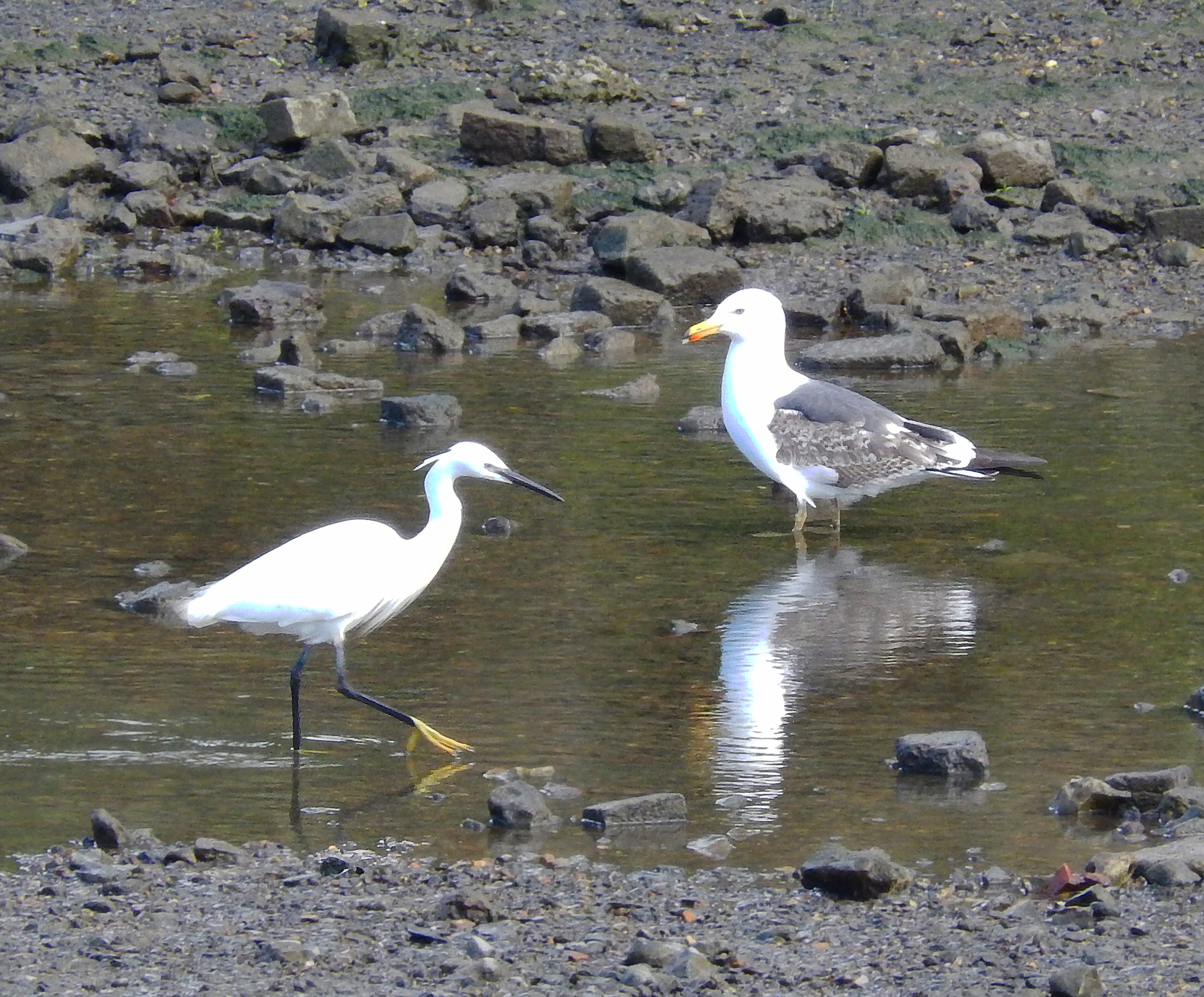
Down the beach in front of Chiswick Eyot, a Little Egret trotted up and down in the water, showing off its elegant figure and yellow feet, and stabbing rapidly at invisibly tiny fish.
Nil to report at Eyot Gardens, despite the handsome tall terrace of red brick houses that once held many House Martin nests. No malice had been shown the colony: probably the loss is due to the dangers of the Sahel (and the guns of the Mediterranean).
Round the corner in British Grove, I was surprised and delighted to see two Swifts overhead – quite high, twice the height of the buildings, so no indication of a nearby nest, but still nice to see them.
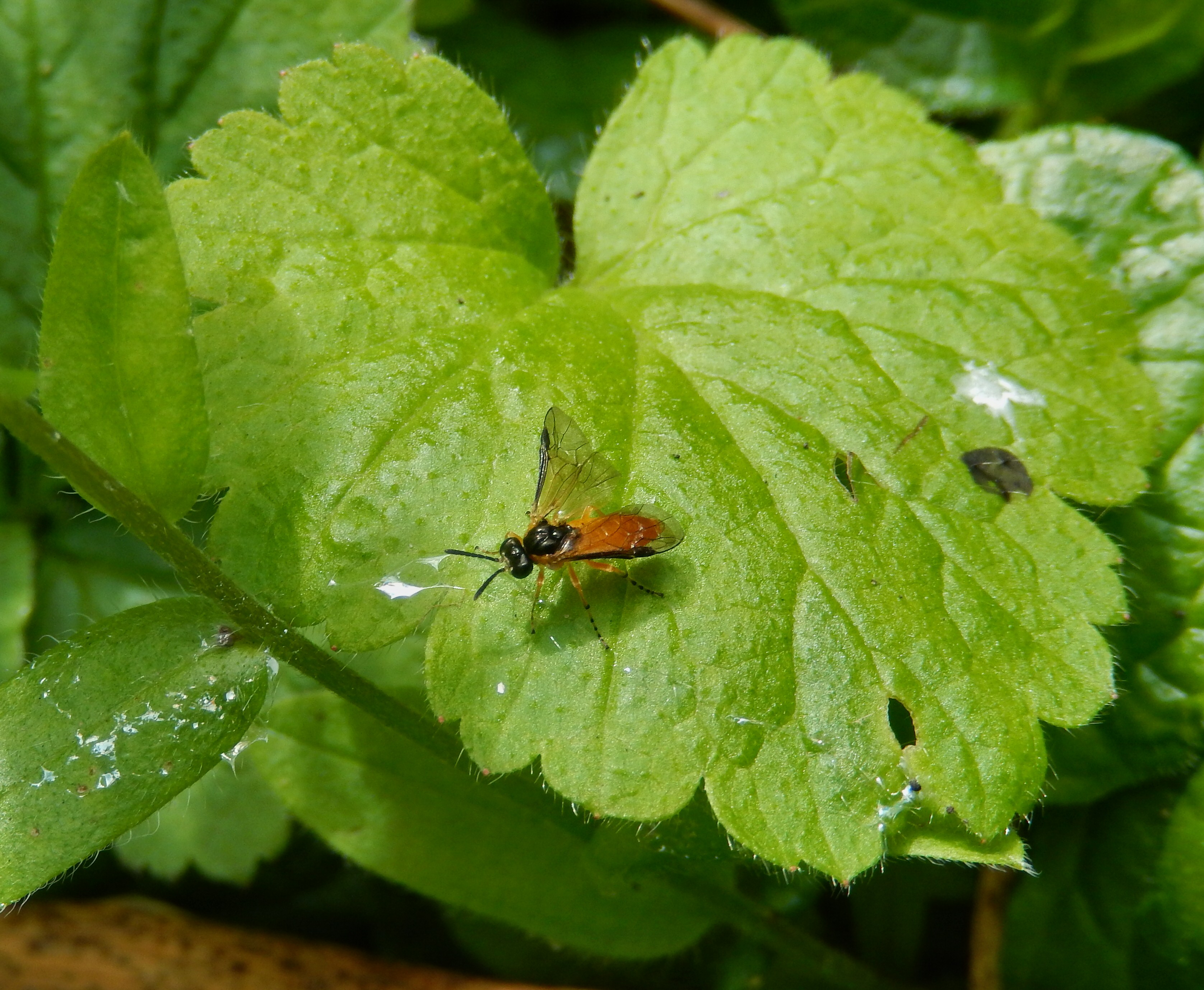
Newly-emerged Sawfly stretching its still-curled wings
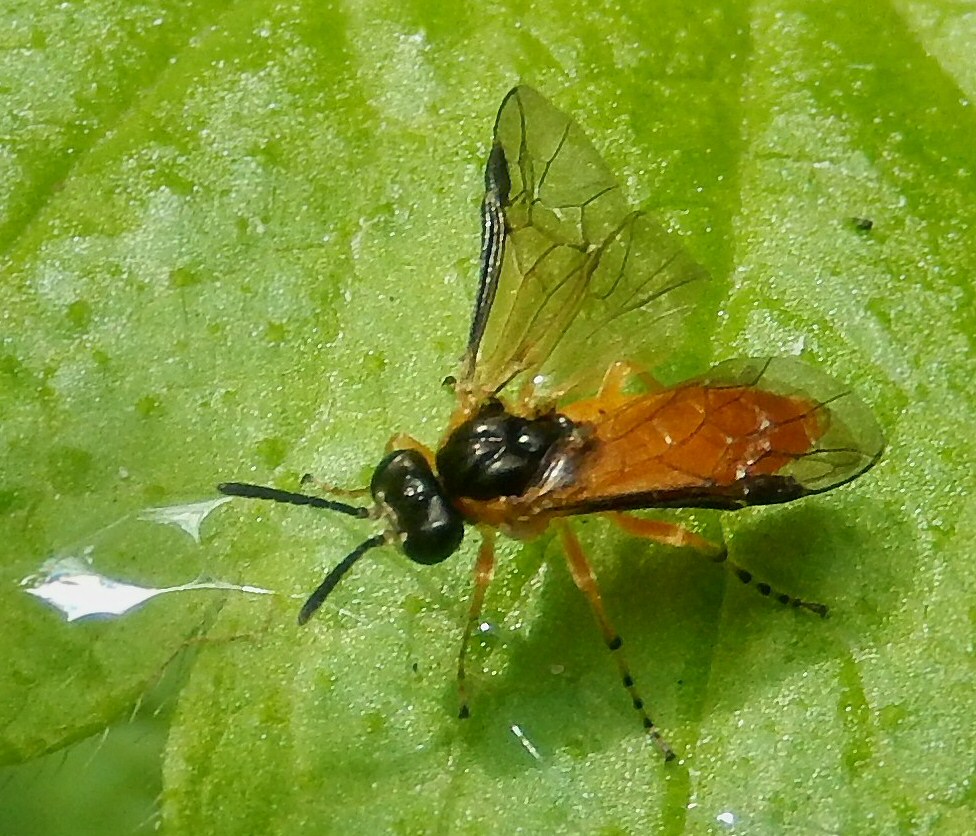
A miniature drama unfurled in my garden this morning, little streaks of orange and black sparkling in the sun as they chose places to land and sun themselves. They seemed to be newly-emerged, as they immediately stretched out their wings on landing: and if you look closely, you can see that the wings are not fully deployed, but are still soft and need to be puffed out quickly before they harden. If so, it’s remarkable that these little flies can take to the air in that condition.
Emmanuelle Béart in La Belle Noiseuse
La Belle Noiseuse, the beautiful nuisance, roughly. Not the female sculptor in Jacques Rivette‘s 1991 film, starring Emmanuelle Béart, but a small sawfly. It’s a glorious little insect, shining in the sunlight, its deep orange-ochre abdomen contrasting with its black thorax and head, its legs elegantly banded black on orange, giving it a slightly waspish look in flight. (Indeed, it is presumably a Batesian mimic of wasps, benefiting by looking as if it might sting.)
Newly-emerged Sawfly detail
But its nuisance value does not lie in stinging, but in its caterpillar-like larvae, which devour the leaves of gooseberries and can defoliate whole bushes.
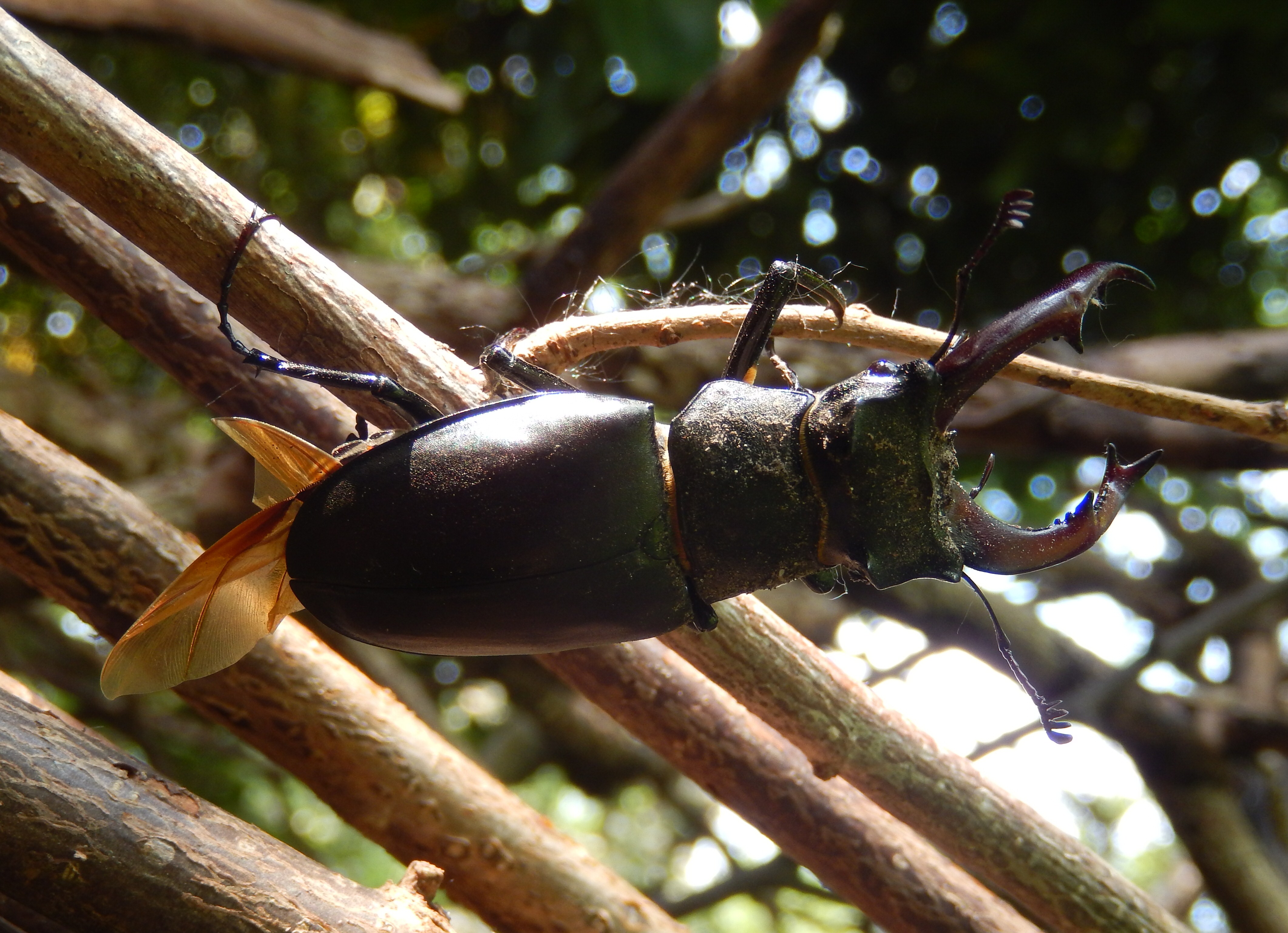
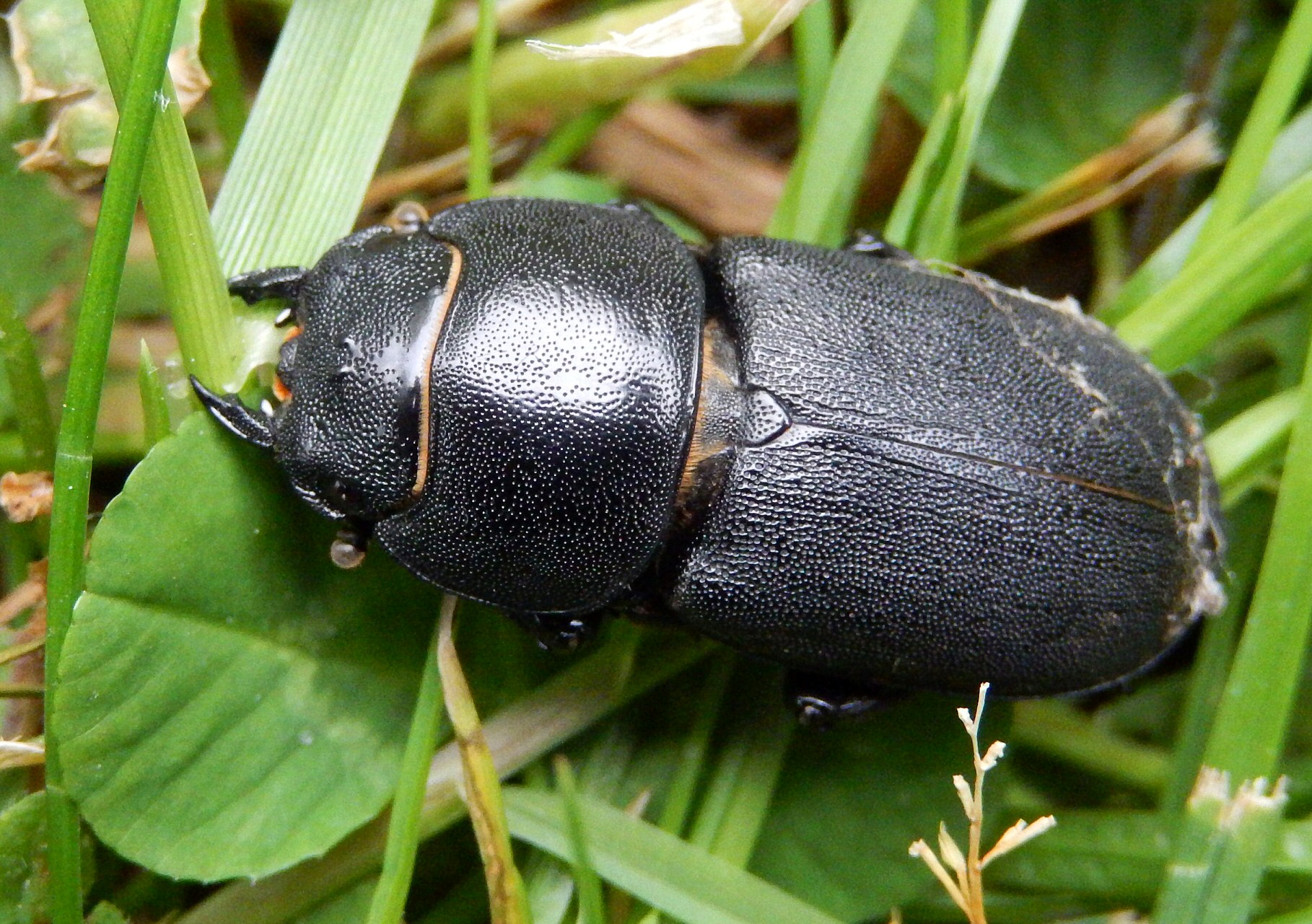
Stag Beetle, Lucanus cervus, just landed, wings not fully folded
I was just walking around the triangle, talking to one of the Garden Design students about its natural history, when a mouse-sized animal scurried across the top of a post that we had hammered in to form a dead-hedge above the boundary stones. In my binoculars, it was at once clear what it was, a Stag Beetle. As I pulled out my camera, it spread its wings impressively, and flew a few feet across to the woven top of the dead-hedge, folding its wings but leaving the ends still sticking out of its wing-cases for a while.
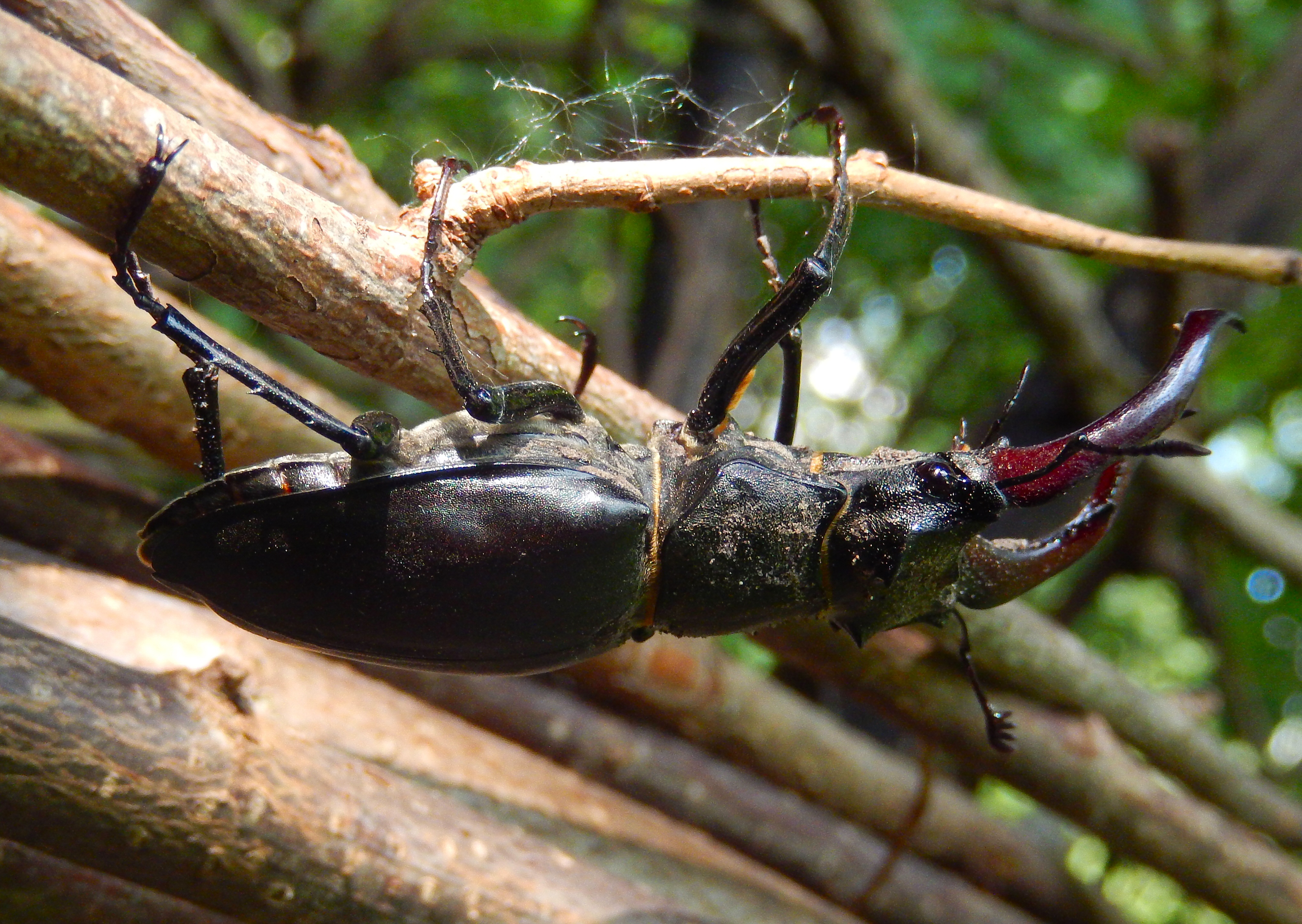
Stag Beetle, side view
So, all that work on loggeries may have paid off. Or perhaps it didn’t: behind the dead-hedge was simply a pile of brash and logs, abandoned for several years. Anyway, we’re very pleased to see a handsome adult male out in the sunshine.
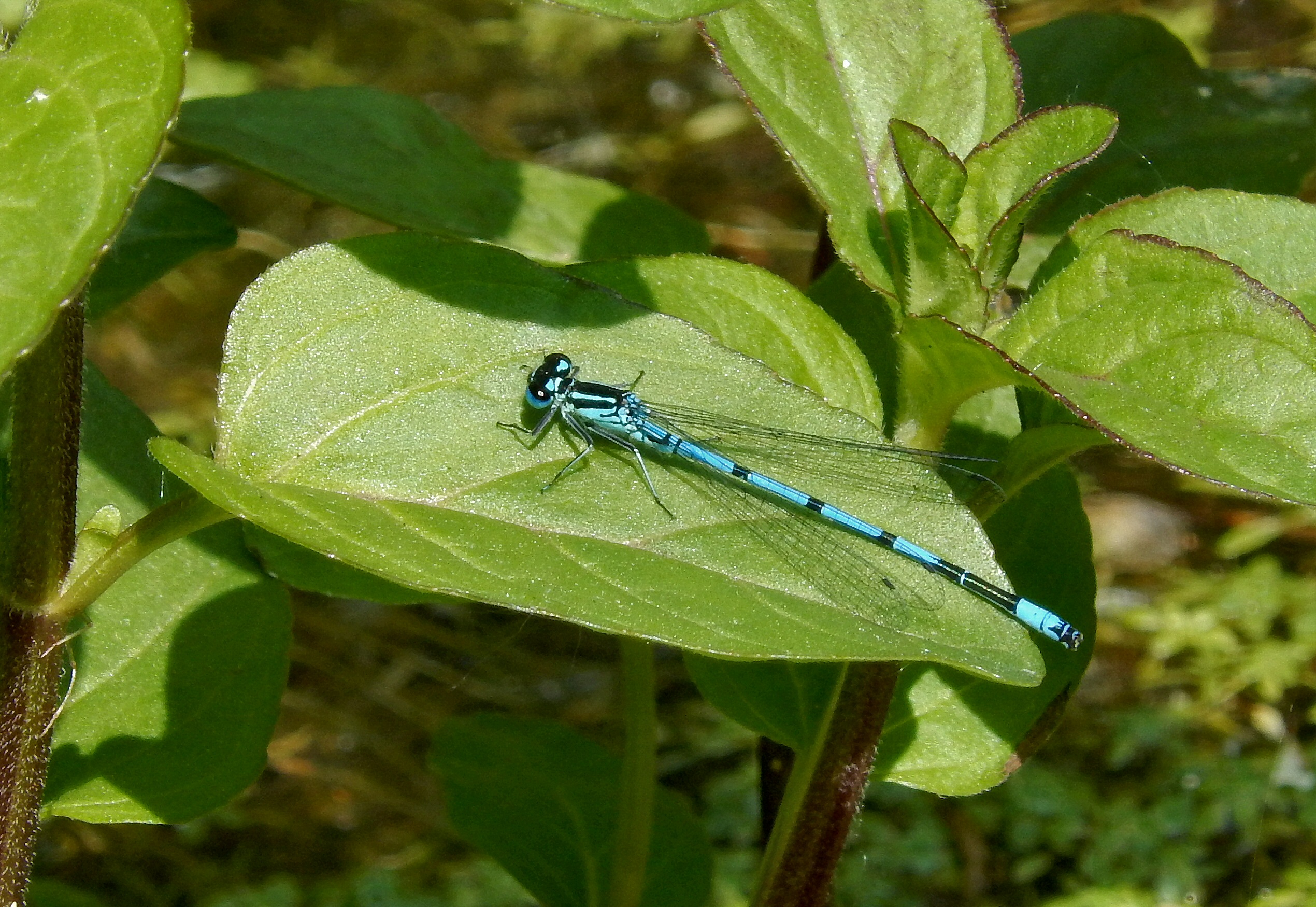
Azure Damselfly recent hatch
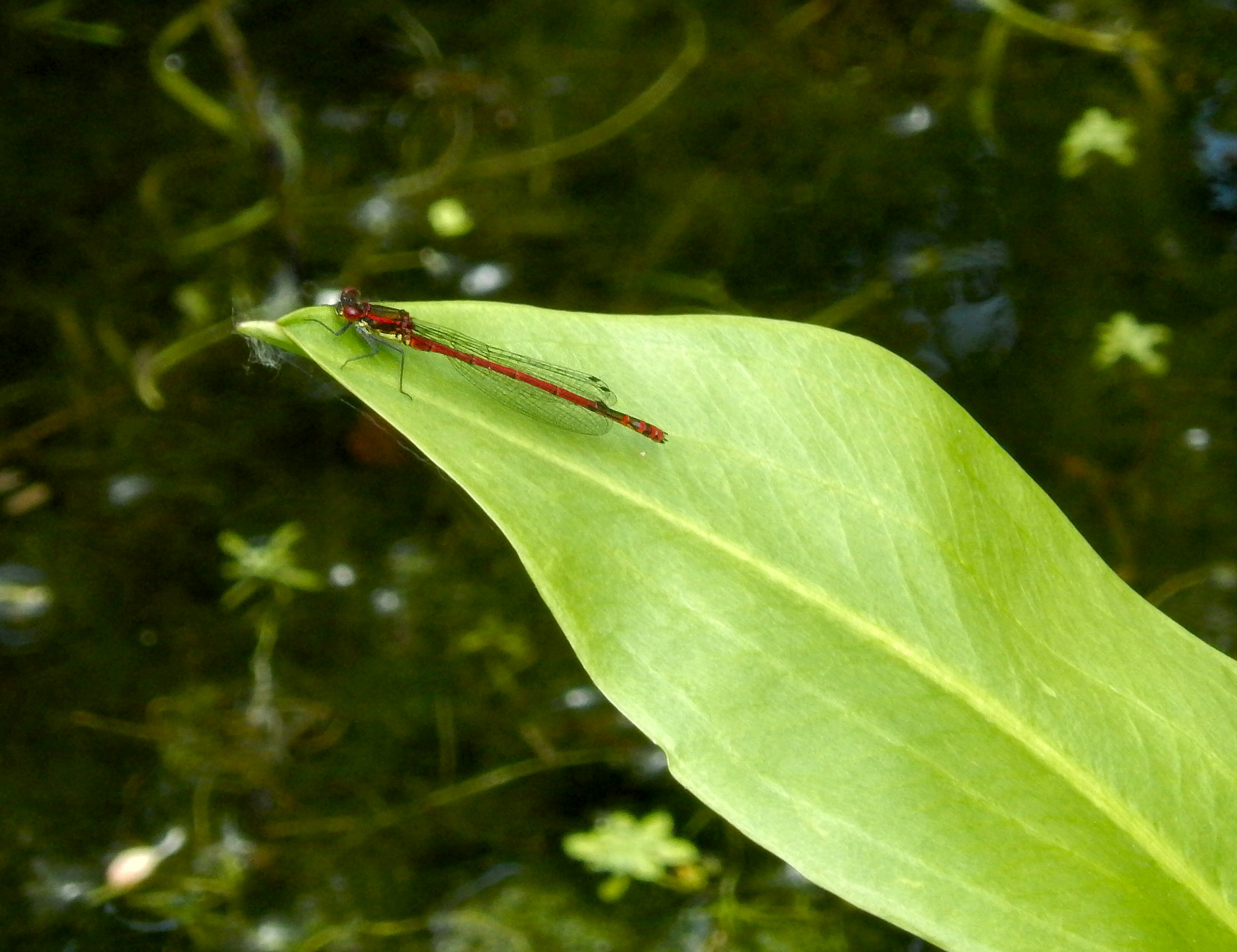
The triangle’s first batch of Azure Damselflies, surely within a day of hatching, perched on leaves of emergent water-plants, or flew around in cop, laying eggs already. One or two Large Red Damselflies sunned themselves also.
Large Red Damselfly
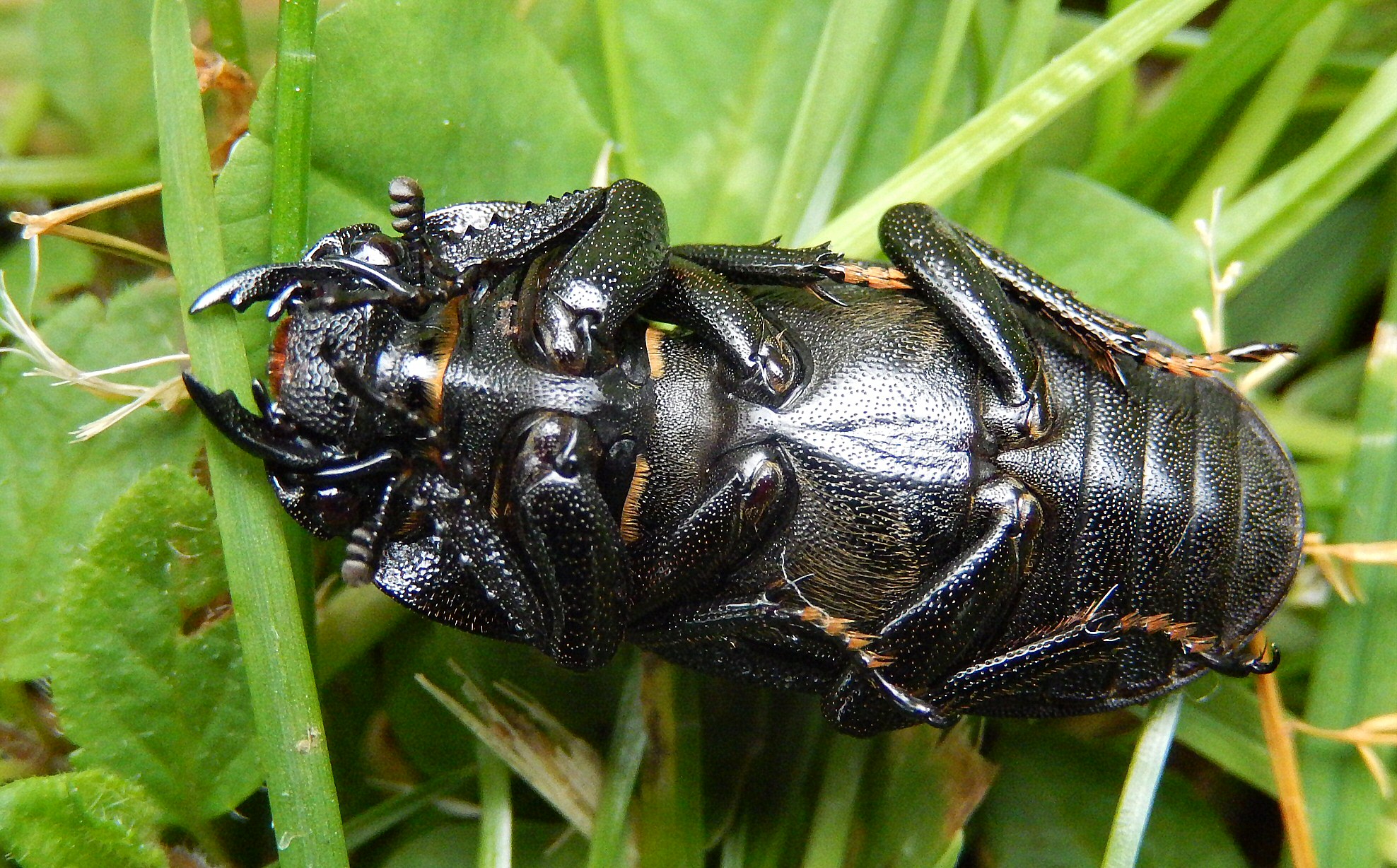
P.S. A week later, on 4 June, a Lesser Stag Beetle crawled across the lawn in my garden. I guess it emerged from the dead wood stacked in odd corners for that very purpose. It’s a lot smaller than the Stag.
Lesser Stag Beetle in gardenLesser Stag Beetle, playing dead
I picked it up to ensure I got a photo, and was rewarded with a fine display of thanatosis, shamming dead.
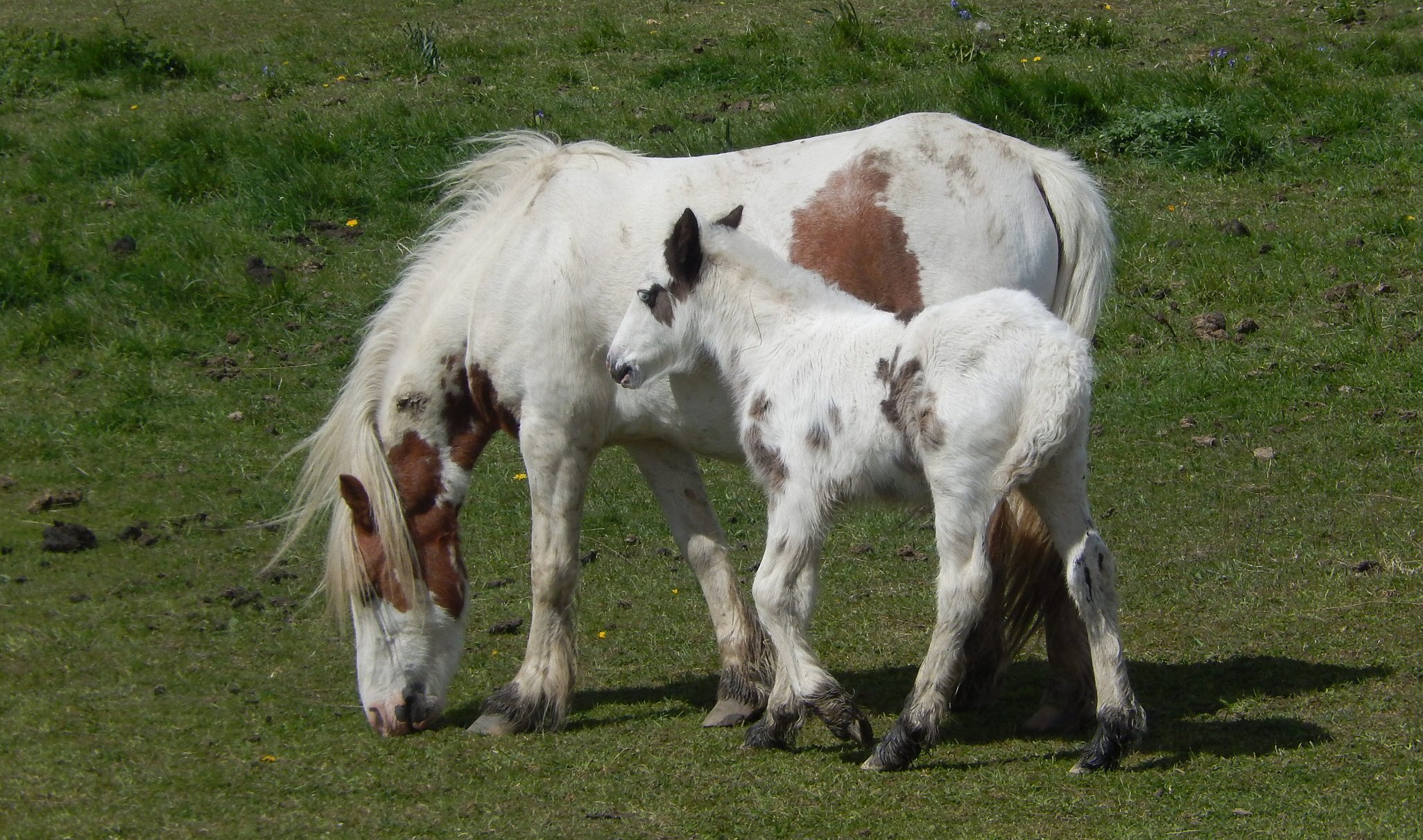
OK, it’s official, spring has arrived. It may be freezing in the North wind, snow may be forecast, but … this year’s foals look lovely, relaxing with their mothers in the sunshine.
Overhead, the first three Swifts of the year wheeled against the blue sky; a couple of Buzzards drifted past, one mobbed by a pair of Carrion Crows; a Kestrel hovered, moved on, hovered again.
Down below, Wraysbury’s Lakes are empty of ducks, the winter visitors long returned up to the far North. The bushes, however, are rapidly filling up with warblers. Chiffchaffs, Blackcaps, and for the first time this year, masses of Whitethroats (there must have been at least a dozen, wheezing out their scratchy little songs) displayed atop still bare thorn-bushes, one male even venturing a little song flight. Several Sedge Warblers chirruped, whistled and churred their complicated but not very harmonious song — avant-garde jazz with Ute Lemper, perhaps — and to my great pleasure a Garden Warbler gave out its marvellously rich, full, even, sustained warble from a dense Hawthorn. So it was a five warbler walk.
The prettiest bird of the day, however, was a male Linnet. After months of being drab and scruffy, he was in full breeding plumage, his head gray, his back brown, his tail crisply forked, and the band across his breast redder than a Robin’s orange, really startlingly red. Most of the time I think Lars Svensson’s marvellously detailed Collins Bird Guide is exaggerating in those too-beautiful colour plates by Killian Mullarney and Dan Zetterström — but its painting of a breeding male Linnet is exactly true. Red. So there.
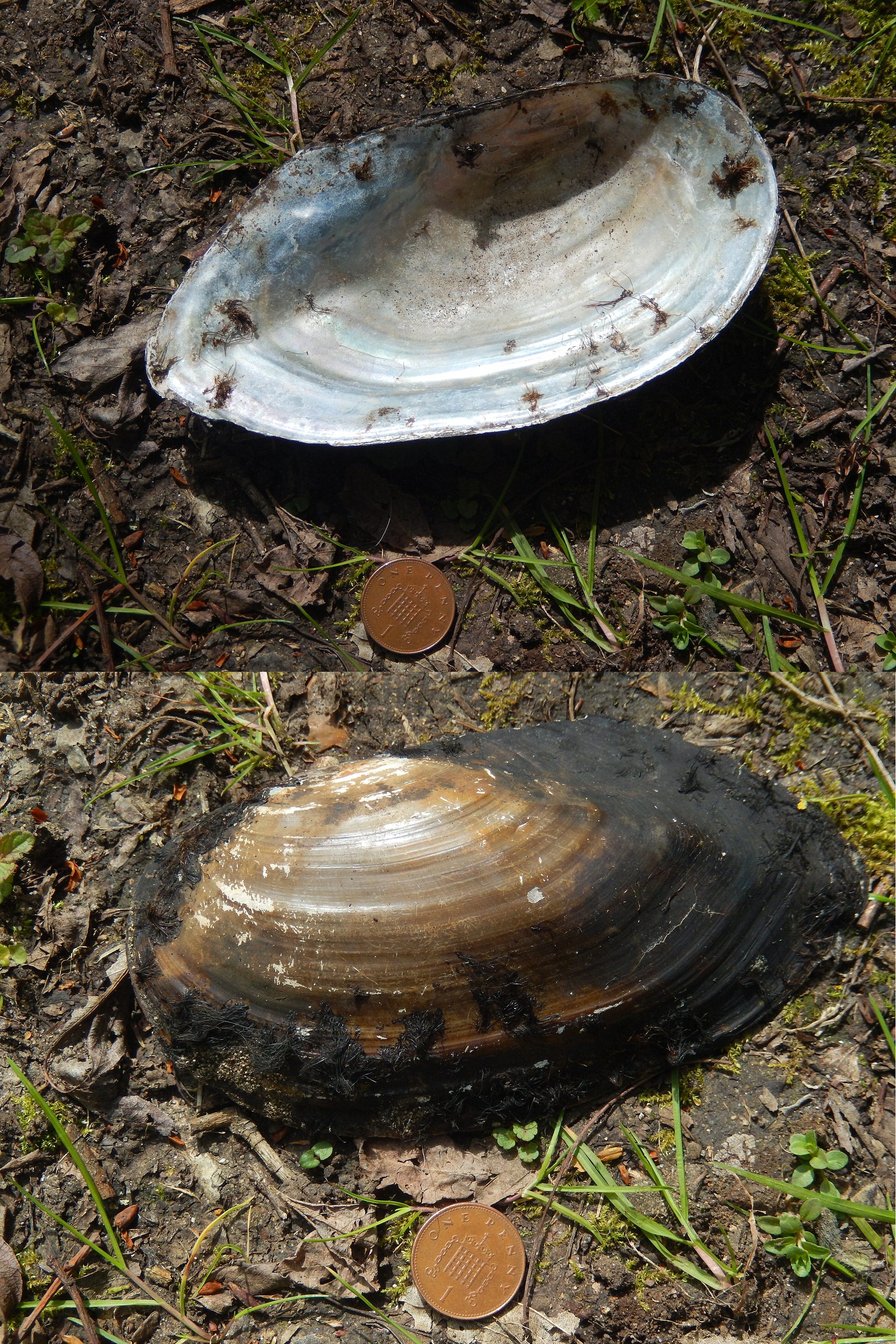
Freshwater Clam at Wraysbury
While off the beaten track listening to the warblers, I found this 13cm long Freshwater Clam shell. It was considerably thinner than a marine clam, and handsomely greenish-brown. I had no idea there were such large ones here right by London. It looks very much like the Swan Mussel, Anodonta cygnea, given its size, and indicates that the water “is in tip top condition”. The Natural History Museum has seen a specimen 19cm long.
Well, it isn’t every day one visits 3 nature reserves, but today I had a look at Hillingdon NHS’s Harefield Place LNR, London Wildlife Trust’s Frays Farm Meadows SSSI, and Denham Lock Wood to boot.
These are by London standards remarkably secluded and inaccessible, which is to say you need to know where to park and which way to walk, as there’s basically no indication on the ground until you arrive, and even the LWT website is misleading.
Whatever the reason, it’s a delight on a fine spring day to find woods alive with Chiffchaffs and Blackcaps, a pair of Greater Spotted Woodpeckers calling and chittering with excitement directly overhead (and visible in the still nearly-leafless trees), the Blackthorn in delicate white clouds of new blossom, and a Roe Deer skipping away across the meadow, stotting slightly and flashing its “I’ve seen you, I’m running away, and I’m faster than you so don’t bother” white rump-patch. It’s what zoologists call an honest signal, something that benefits both predator and prey. The predator is saved a wasted chase, and the prey gets away without hassle to live another day.
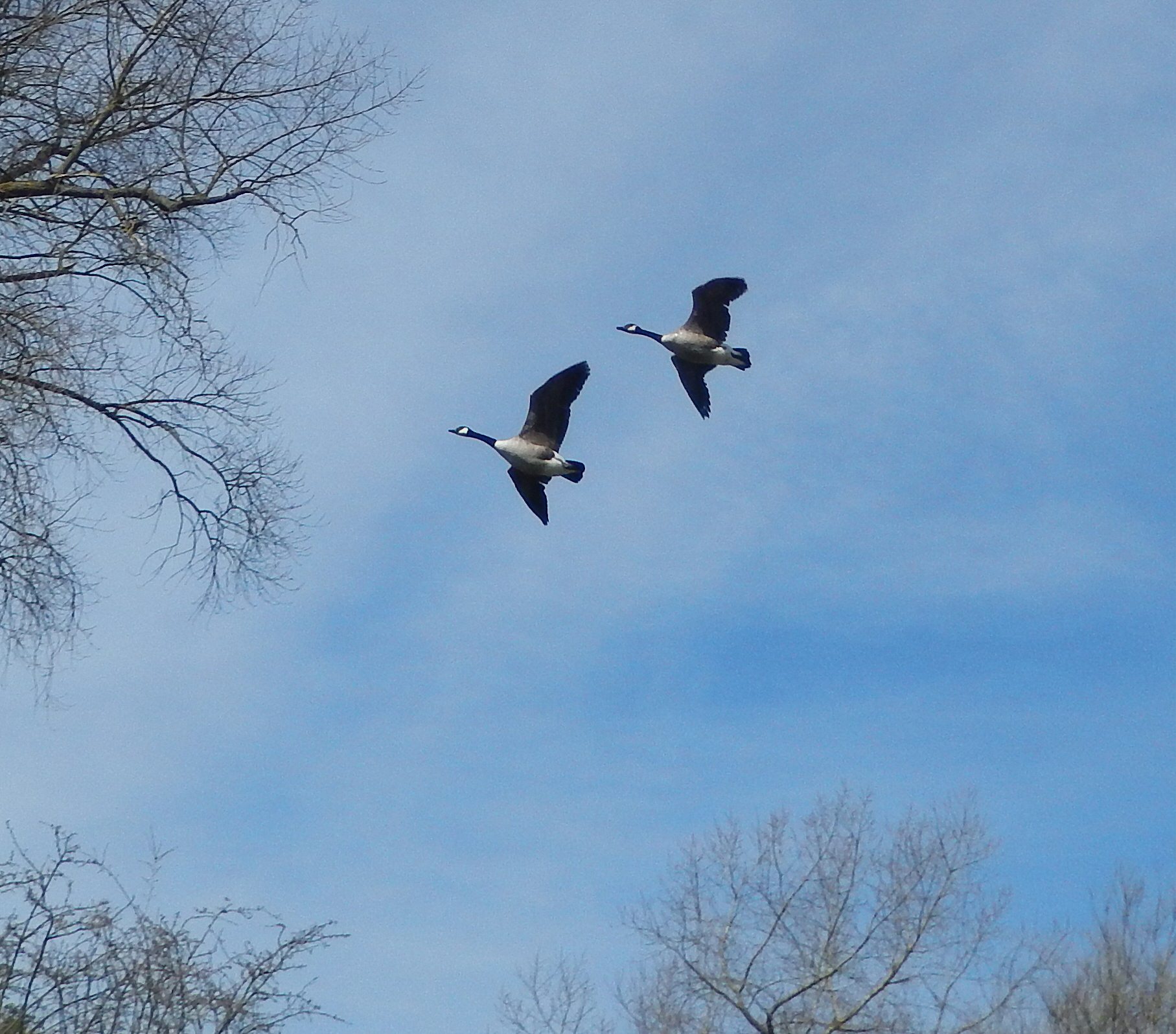
Canada Geese overhead
I walked in on the Golf Course path, a pleasant trek down the hill, past the lakes and along the muddy track through the willow woods. There are only our resident wildfowl at this time of year – Canada Geese, Egyptian Geese, Coot, Moorhen, Mallard, Tufted Duck, Mute Swan, Great Crested Grebe: presumably all breeding right here.
The track was studded with deer slots, and it was nice to have my “Roe Deer” slot identification confirmed with a broad-daylight sighting. Out of the woods, it grew hot, and I discarded coat and pullover.
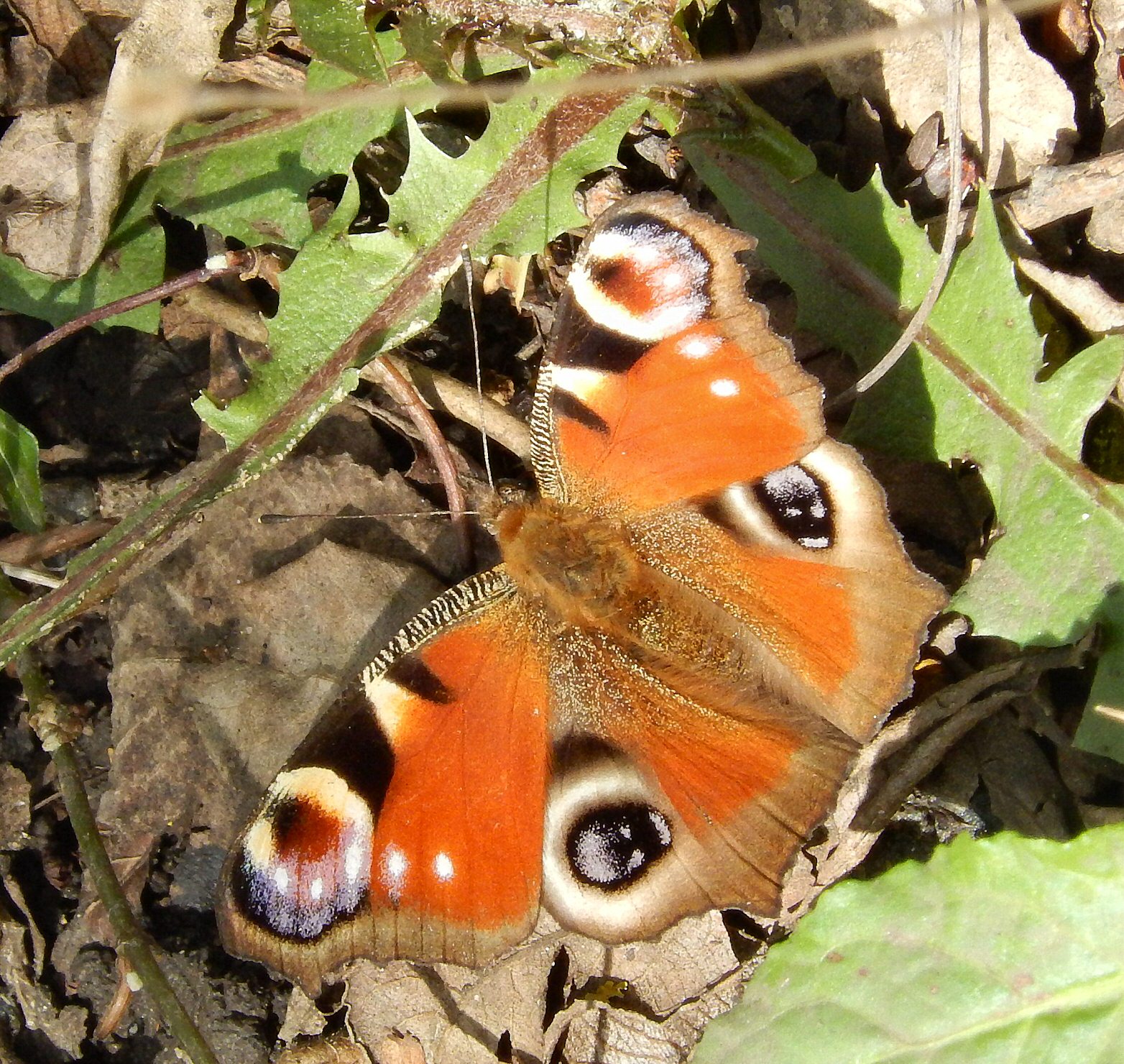
An early Peacock butterfly
A few butterflies flitted about – Brimstone near the brambles, a Meadow Brown or two, several Peacock.
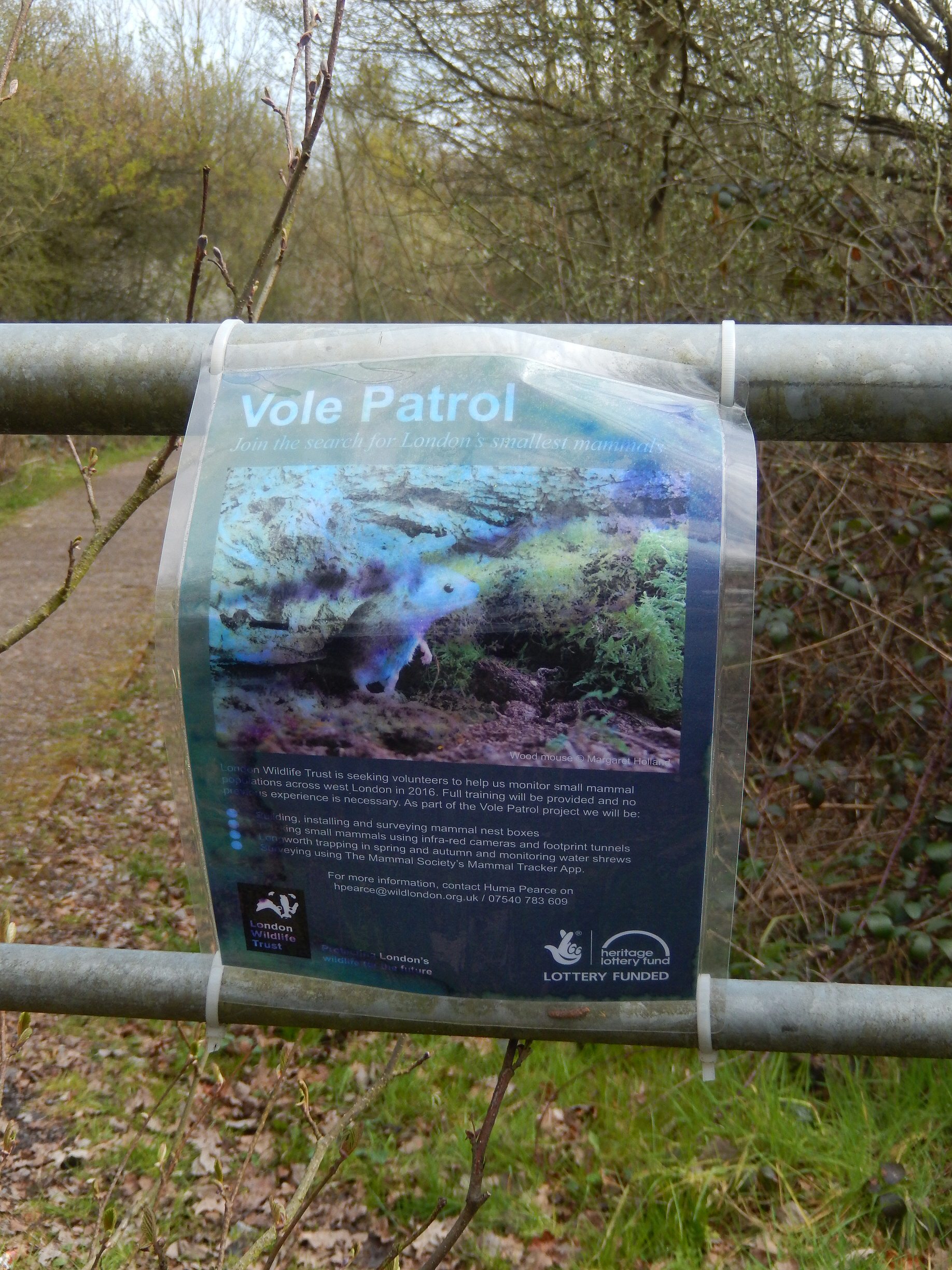
and a Vole Patrol poster
I met another LWT volunteer, Daniel, who it turned out was not only checking the local boardwalks, but had got up at 5:30 am to do the Vole Patrol on his local patch here! I said I volunteered at Gunnersbury Triangle, and he said he knew who I was, he read my blog (Hi Daniel!). We talked of Kingfishers and conservation and being bitten by small mammals. He asked me which group I particularly liked, birds, butterflies? I said dragonflies, but it was a bit early for them. Sure enough, a minute later, a damselfly flew past! I got my binoculars on to it but had no chance to identify it to species (Large Red is our earliest, but I saw no colour). Still, a distinct surprise so early in the year. Perhaps they are hatching earlier with the warmer climate.
On the way out, I passed a Vole Patrol poster. Huma, the small mammal expert in charge of the project, really can’t be getting a lot of sleep travelling all over West London like this and trapping every day.
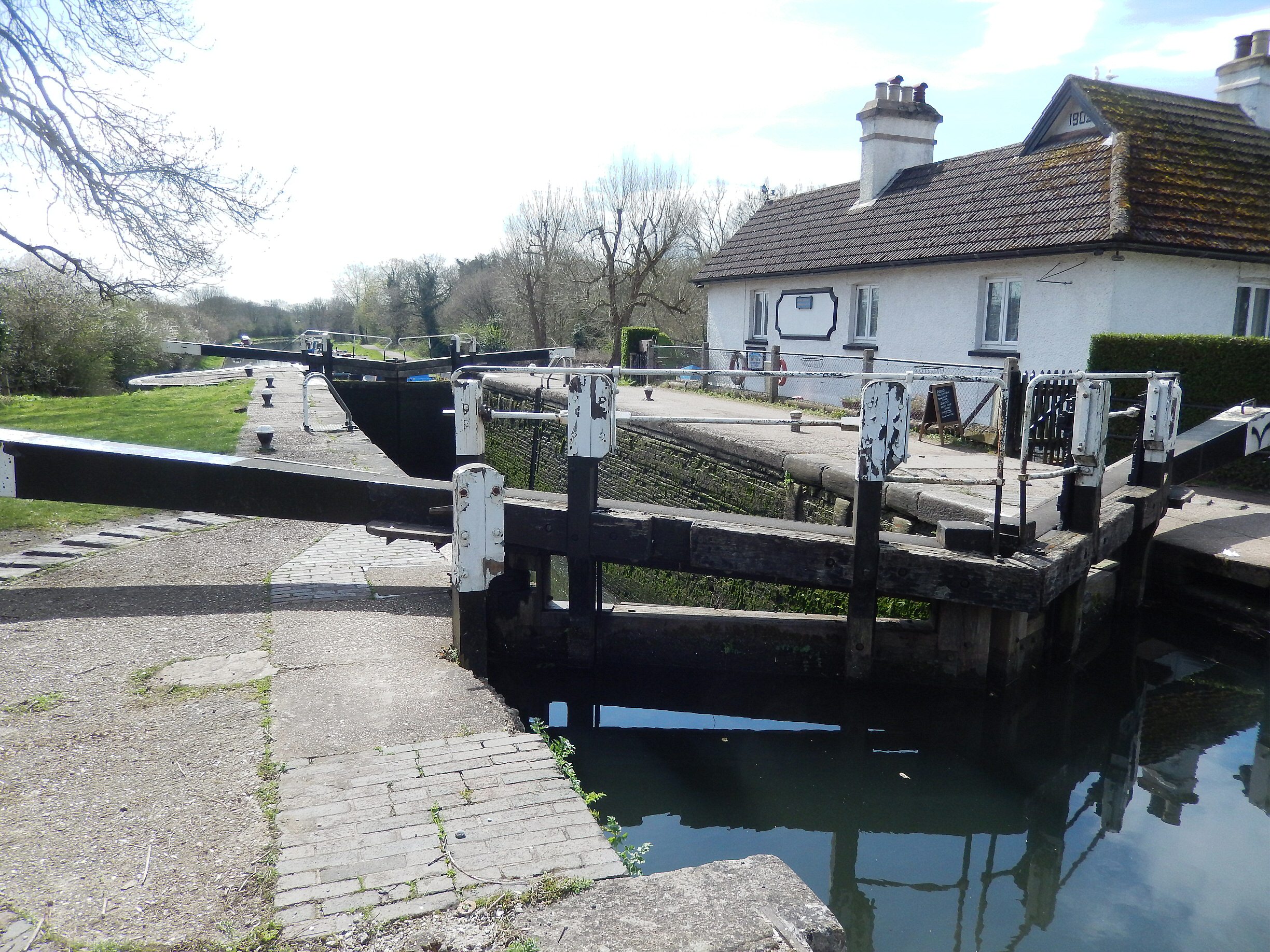
I walked across to Denham Lock, an attractively rustic spot with a line of narrowboats, traditional wooden lock gates and a delightful lock-keeper’s cottage complete with teashop.
Denham Lock
A pair of Grey Wagtails flew about as if they owned the place, landing in the trees beside the canal, a few steps from where I took the photo. They must be breeding here too.
“Cast ne’er a clout till May be out”, runs an old proverb. I guess it means, don’t trust the appearance of spring and sunshine in March or April: I recall two other spring proverbs, “March winds, April showers”, and “One Swallow doesn’t make a Summer”. In other words, spring arrives in fits and starts.
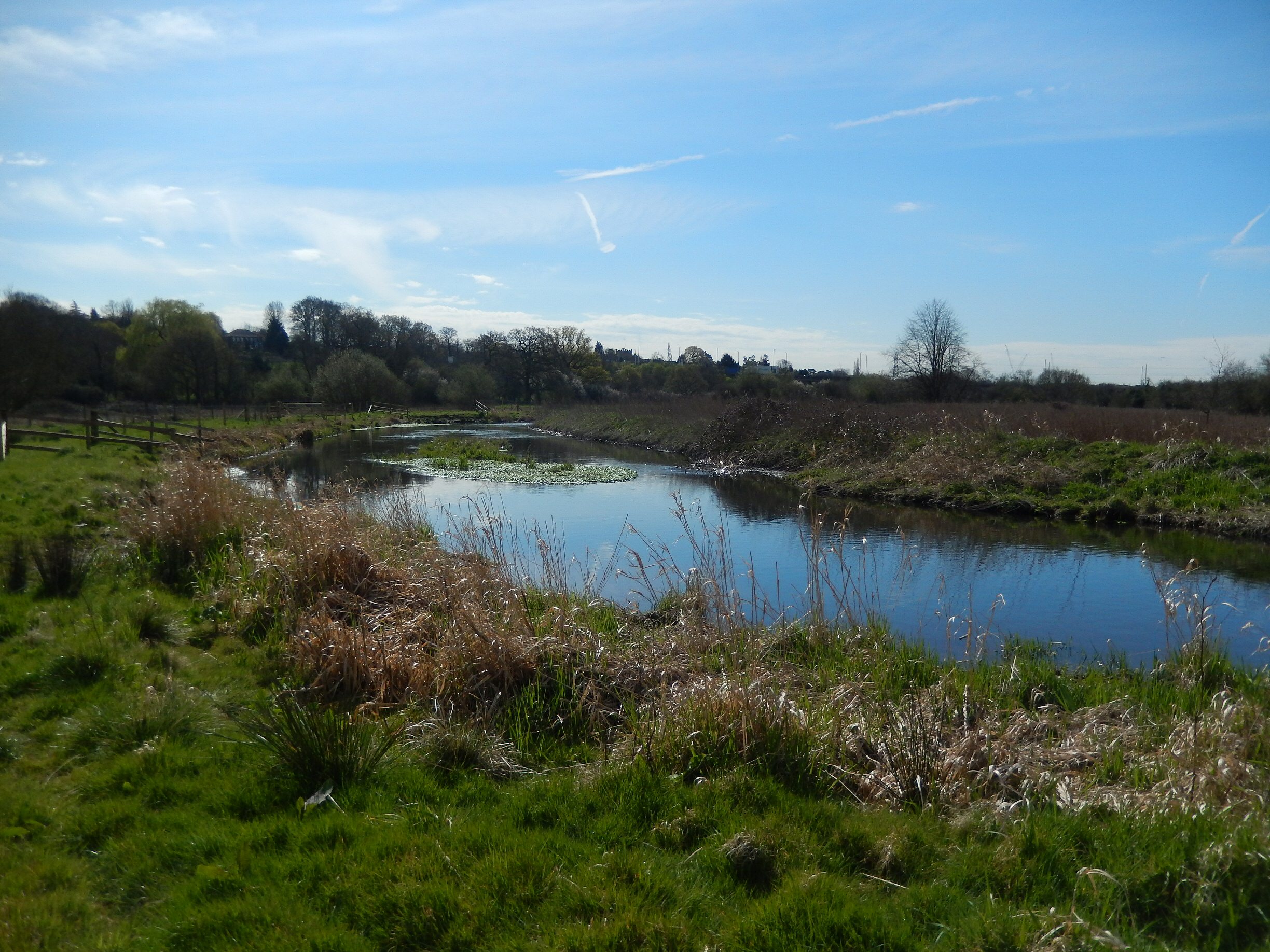
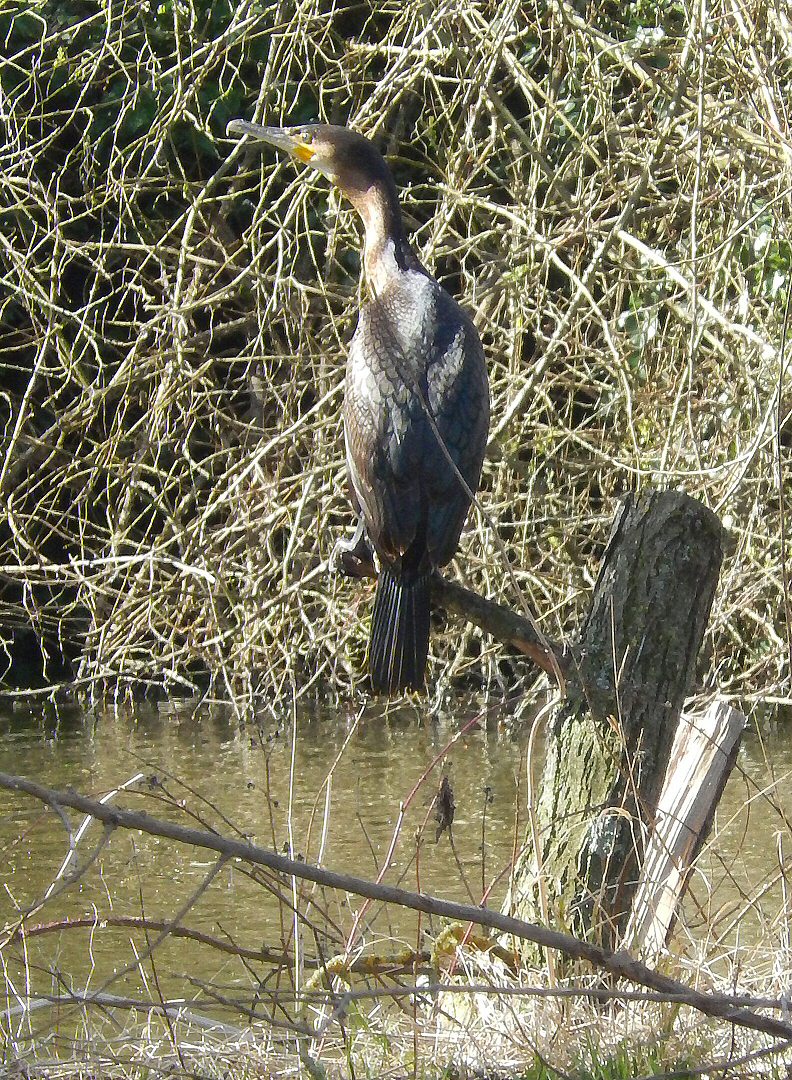
Well, it felt almost like spring at Wraysbury Lakes, with bursts of bright sunshine. A rather bold Cormorant investigated the fish in the river from a low perch. Many Willows have fallen and been cut down: they grow very rapidly, soon become hollow or outgrow their roots in the soft ground, and snap in a storm or topple — across the path, or into the water.
A Cetti’s Warbler gave me a single burst of its loud song from a waterside bush: as usual it was invisible.
Three or four Chiffchaffs chorused uncertainly. There were no other warblers to be heard. Perhaps I’ll get a Six Warbler Walk in a few weeks’ time. The early songsters remain the Song Thrush, the Great Tit and of course that 12-month, 24-hour standby, the Robin.
A Magpie chattered on the woodland edge of Horse Hill: a big brown Buzzard flapped slowly away from the annoyance to perch in a tree.
It was a delight to walk in Kew Gardens in spring sunshine. The thousands of daffodils shone golden on the mound of the Temple of Aeolus; thousands of blue Scillas coloured the grass, and a mass of Grape Hyacinths (Muscari) puzzled visitors as it grew under a hundred different labels of herbs not yet emerged from their winter rest!
Overhead, a Nuthatch ran about the branches like an arboreal mouse, calling loudly (but with single whistling calls, not its triple see-see-see). A pair of Marsh Tits, presumably on migration, called Pitchu! Pitchu! to each other, readily visible in the still-bare trees. Hundreds of small children clustered eagerly around the Easter Egg hunt stands.
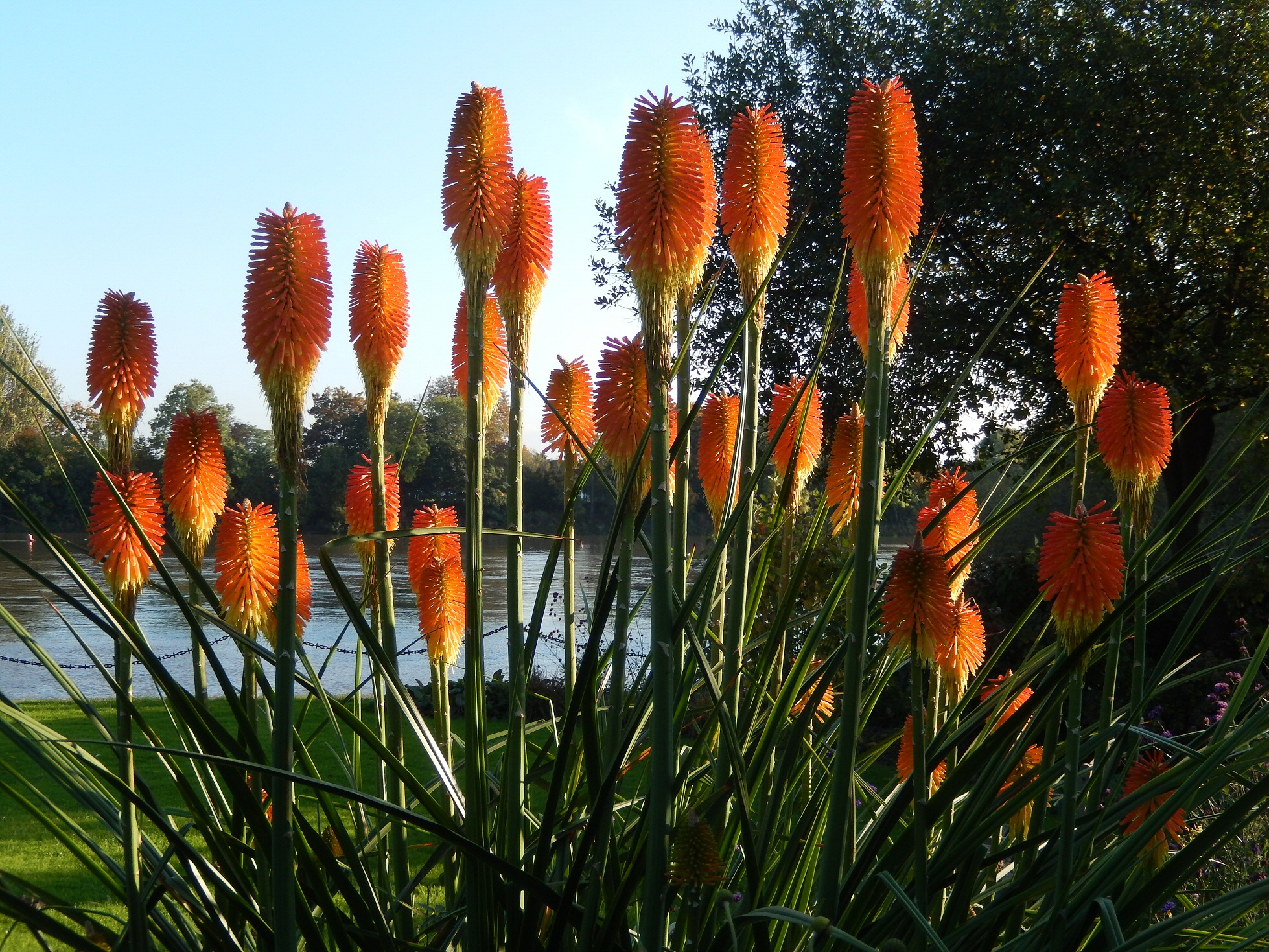
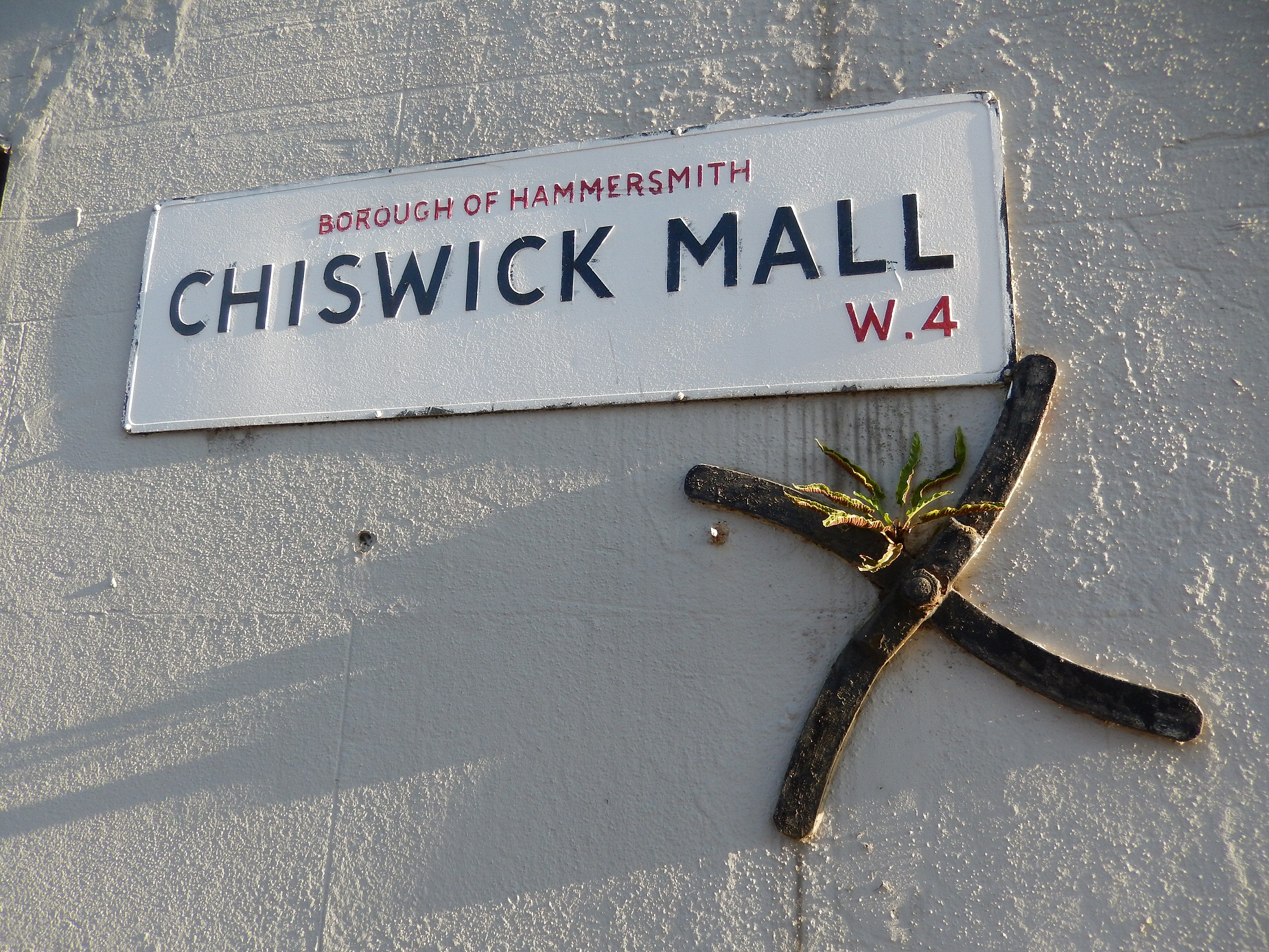
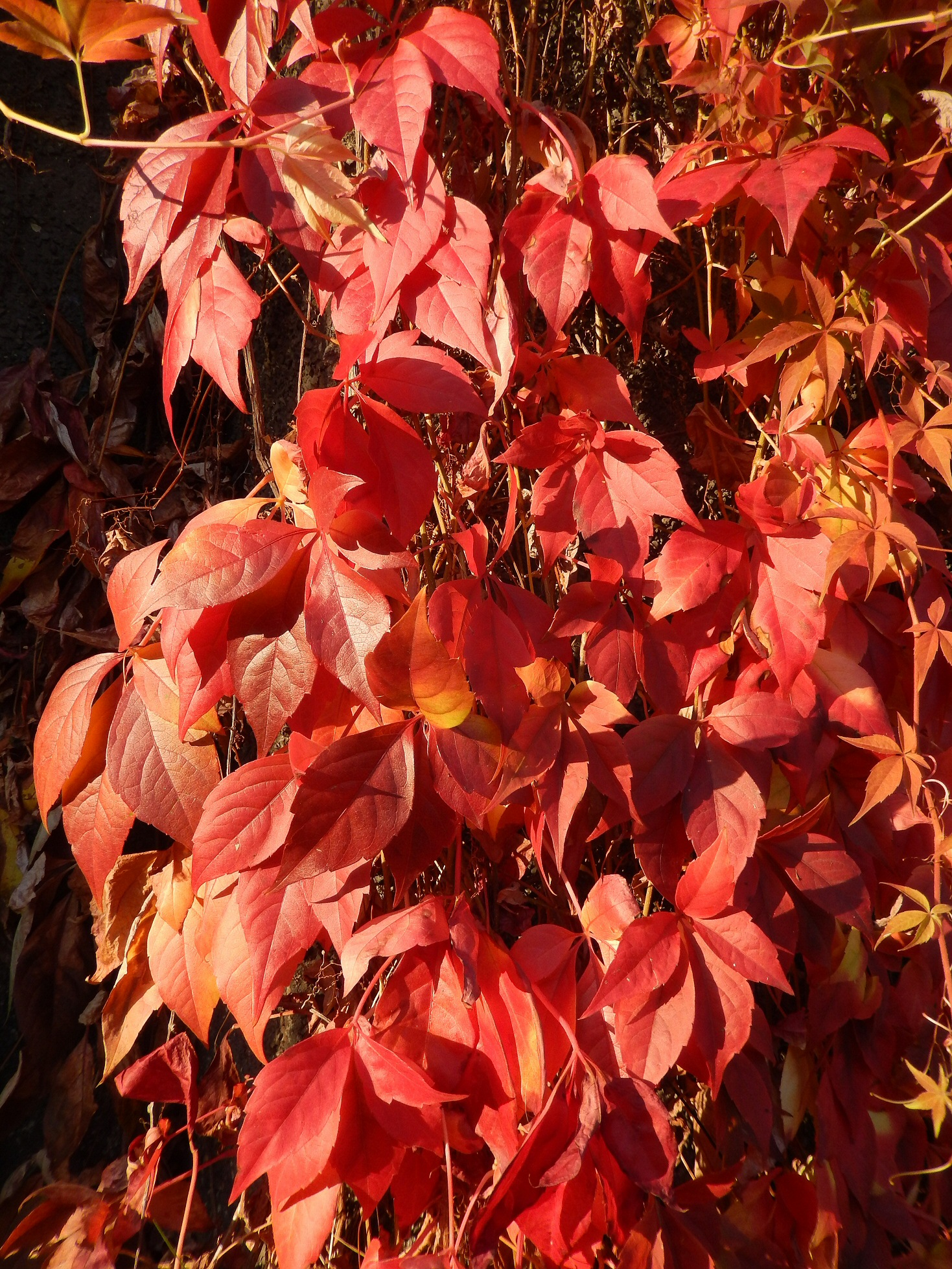
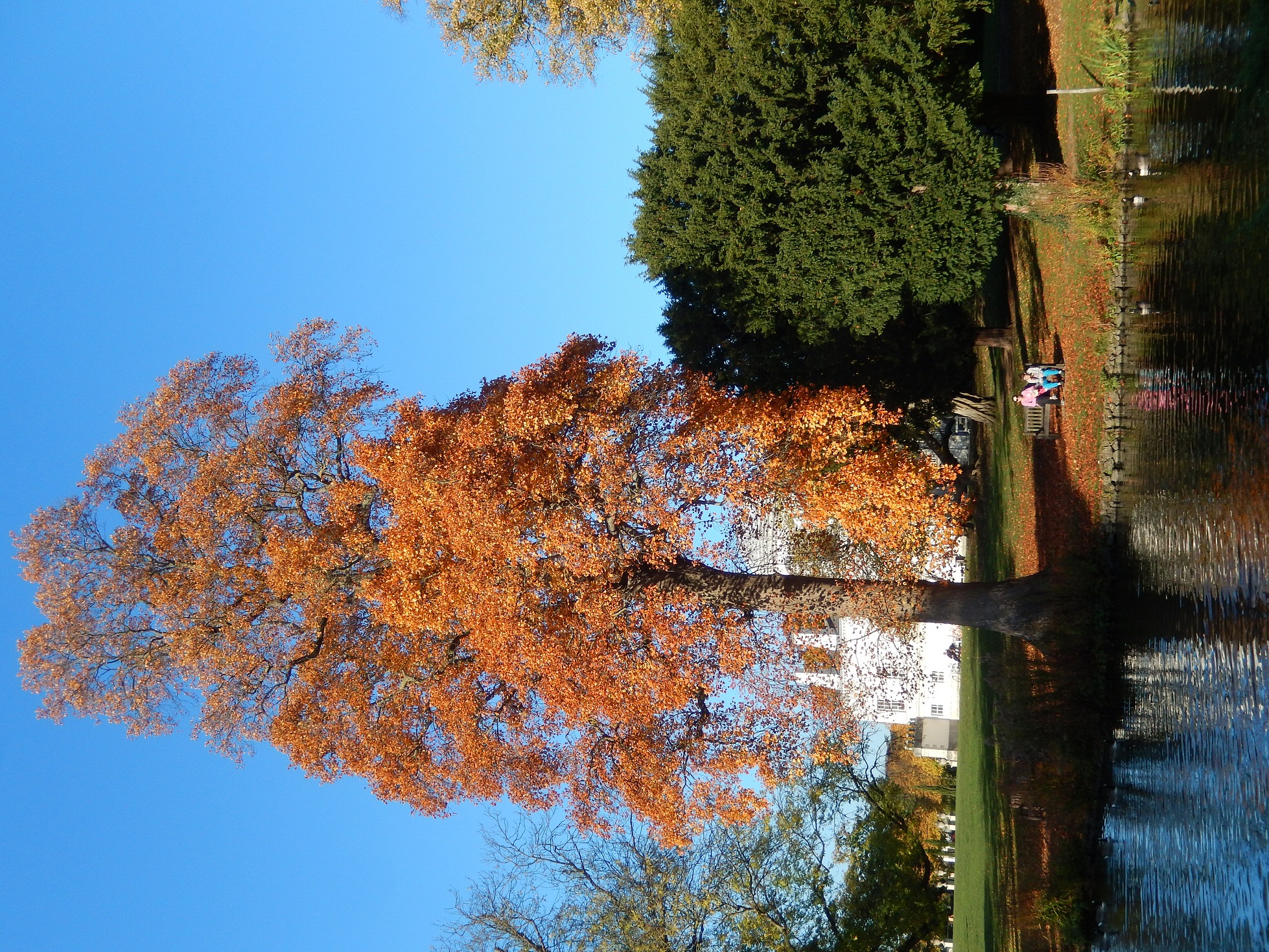
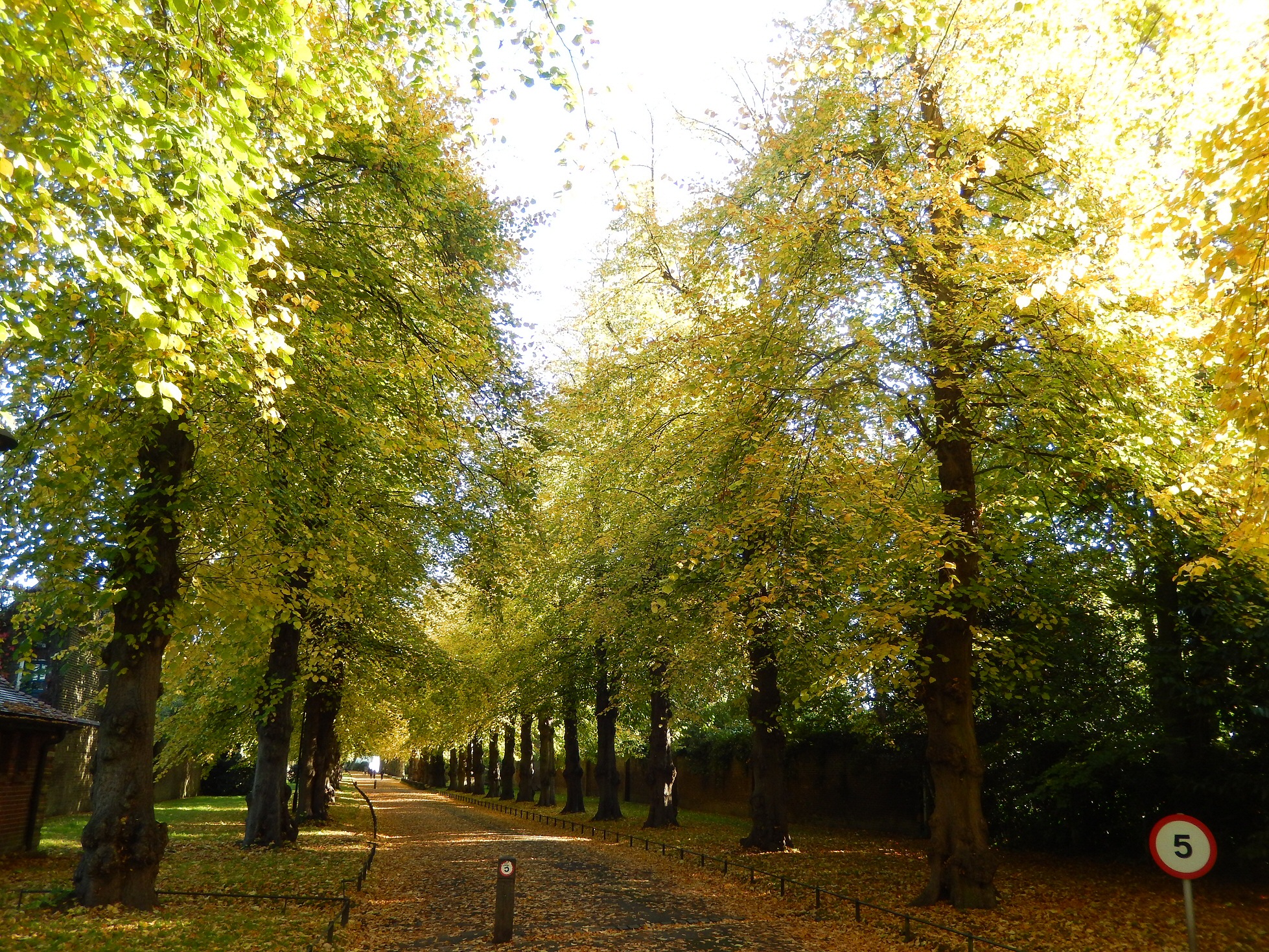
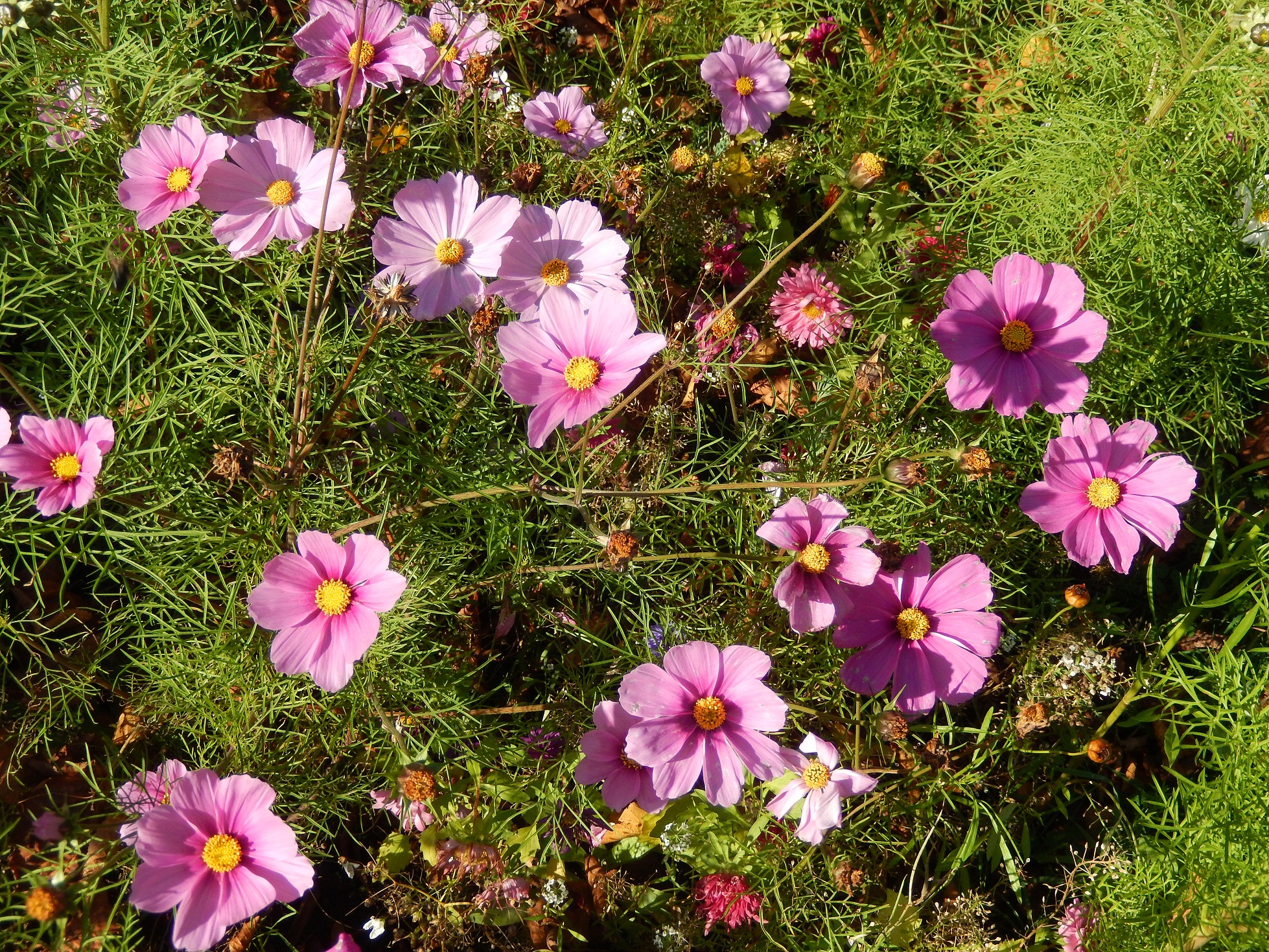
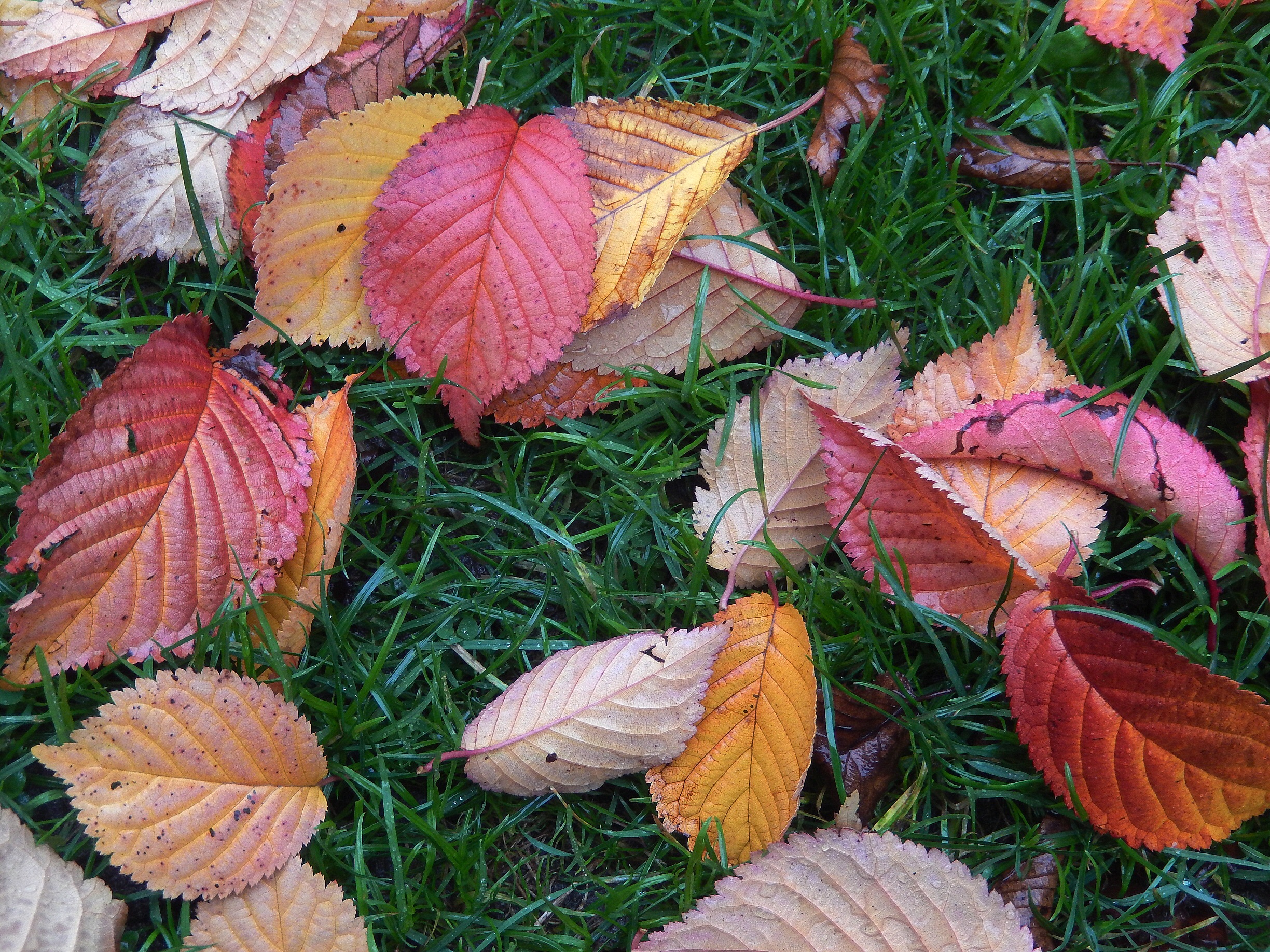
Red Hot Pokers on Chiswick MallA Study in White: Harts Tongue Fern, Chiswick MallVirginia CreeperTulip Tree (Liriodendron) Autumn Colours Chiswick HouseGolden Autumn: Lime Avenue in Chiswick ParkCosmos in full bloom, 26 OctoberFallen cherry leaves, 30 October
The English seem unemotional … except for their passion for nature