Category Archives: Natural History

Free Public Event: Book Launch at Gunnersbury Triangle 17 May 2015

LWT reading by the author 17 May 2015

London Wildlife Trust have kindly put on a book launch event for my new book The English Love Affair with Nature. The event is free and open to all; though small children may prefer to eat the cakes and go pond-dipping, which will be available on the reserve! Attractions will include me, reading from the book; a chance to buy a signed copy, if that’s your sort of thing; nice things to eat and drink; and the beauty of a nature reserve in May, complete with birds, butterflies, bees, bugs, flowers and trees in new leaf, not to mention mini-beasts, newts and everything that wriggles in pond water! I hope to see you there.

Making Wooden Pegs (whatever next) … and a Congregation of Newts

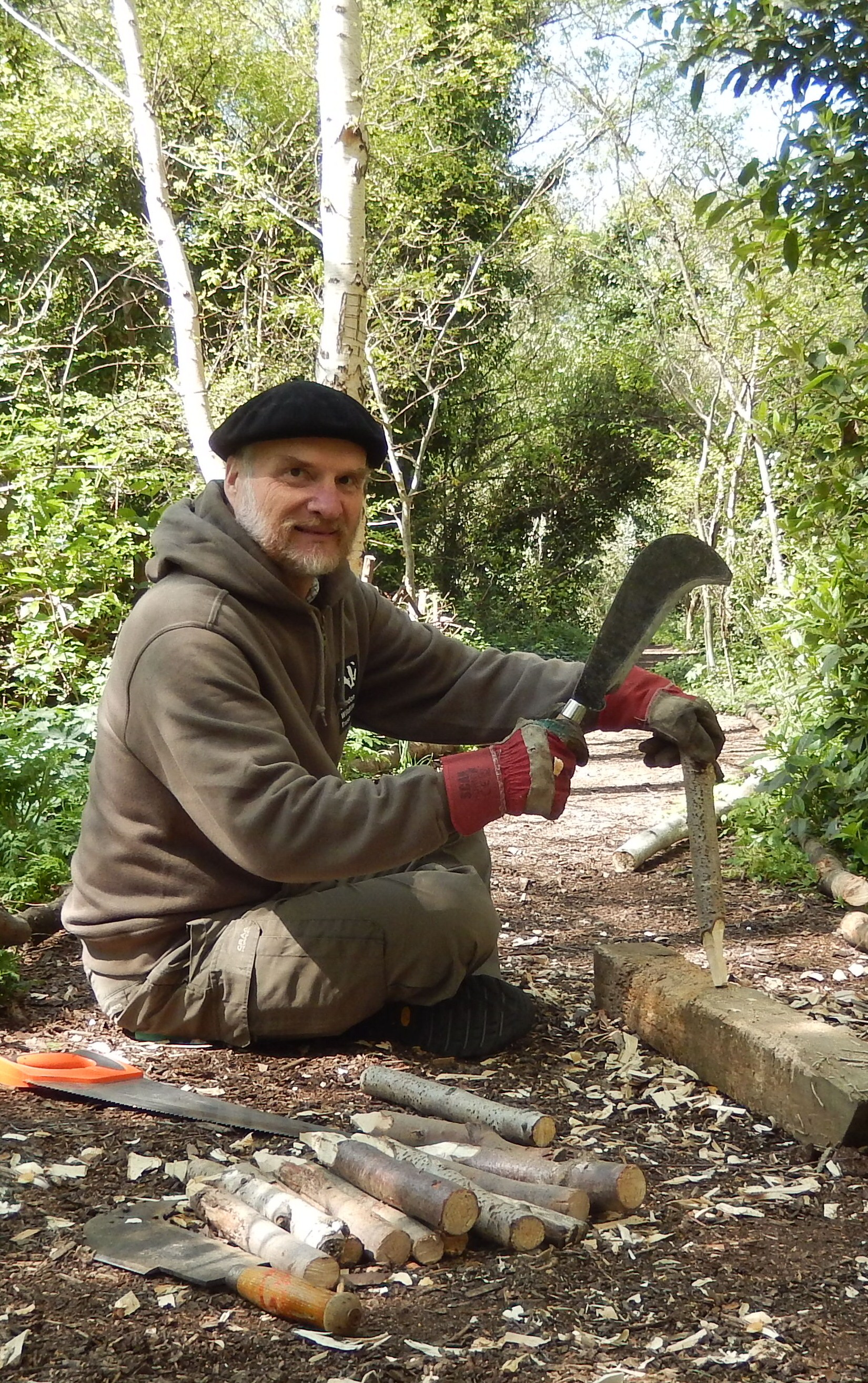
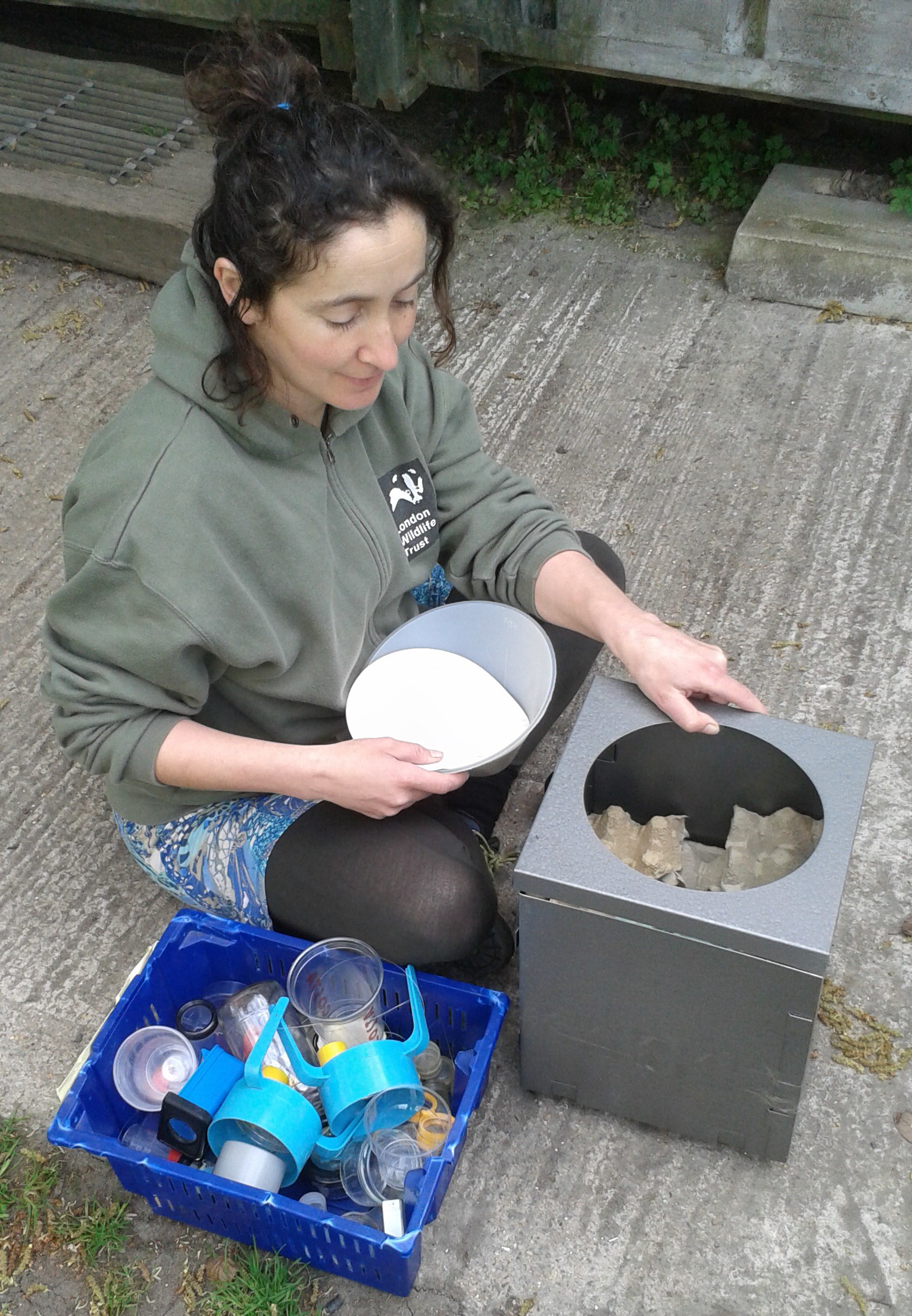
Making Pegs (with a billhook)

Well, I’d read John Stewart Collis’ marvellous The Worm Forgives the Plough, and his description of the bill-hook as a marvellous tool, but it’s one thing to read about something and quite another to do it with a purpose.

Today, we were tasked with making edges for a stretch of path in the reserve. You can see some lengths of birch trunk lying along the path edge below my left hand. These of course had to be pegged to keep them in place, and then wired and stapled to discourage casual vandalism. The only source of wooden pegs was … more sticks. I set to work with the bill-hook, and indeed the tool is finely adapted to its job. Well-balanced, just heavy enough, and sharp, it slices through wood with a satisfying soft chopping sound. Even so, care and skill are needed, and the job takes a bit of time.

Congregation of Newts

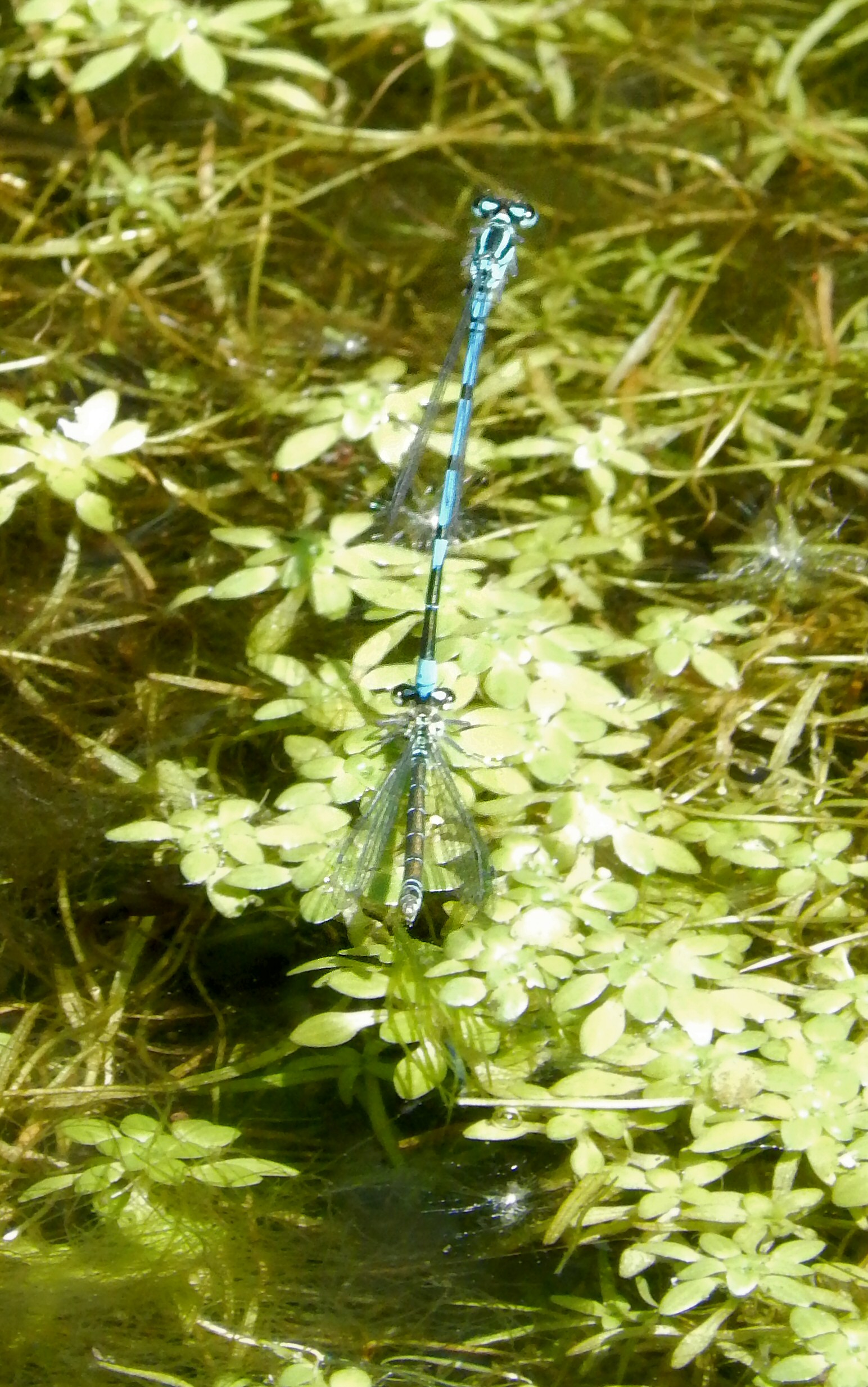
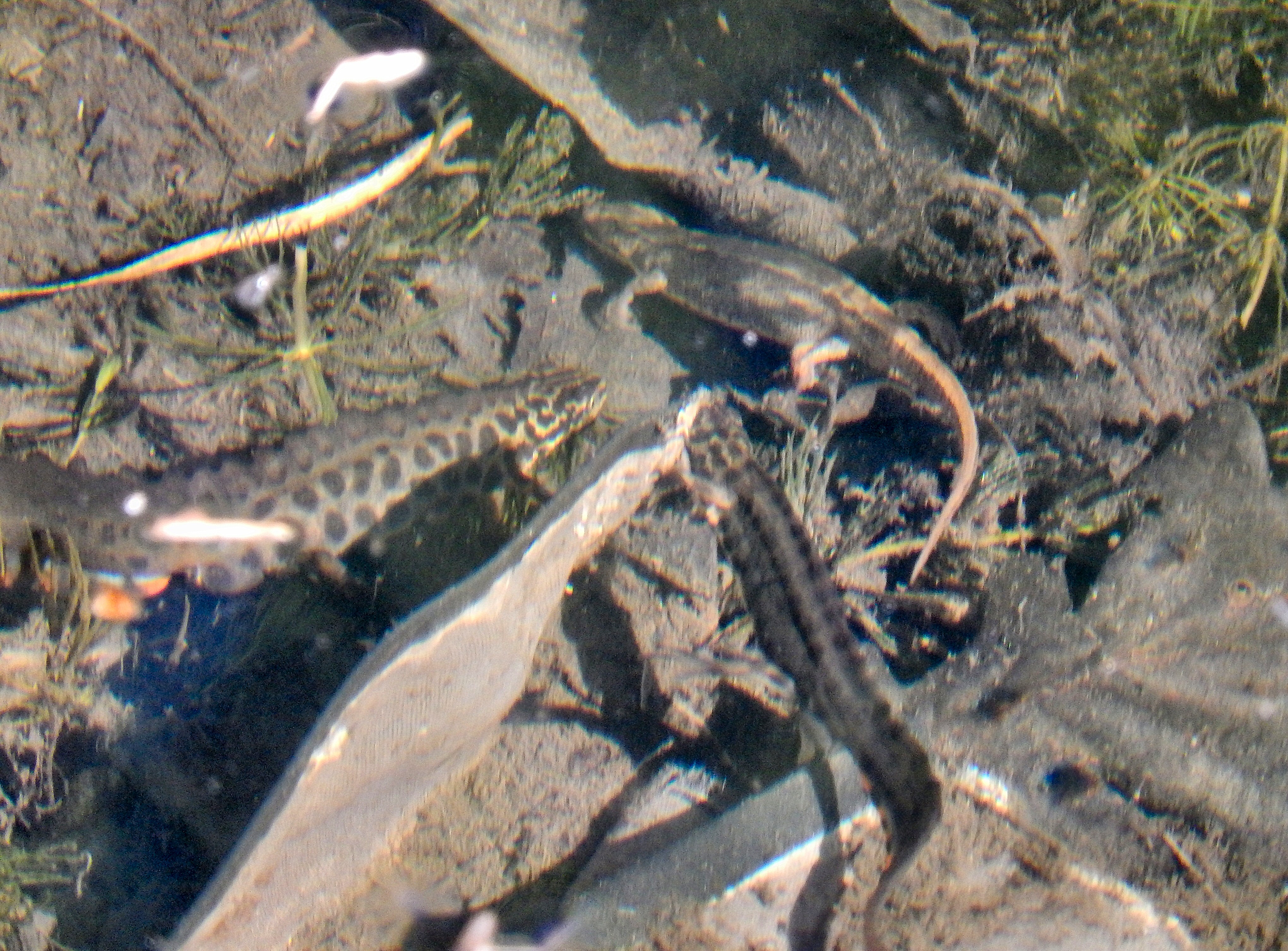
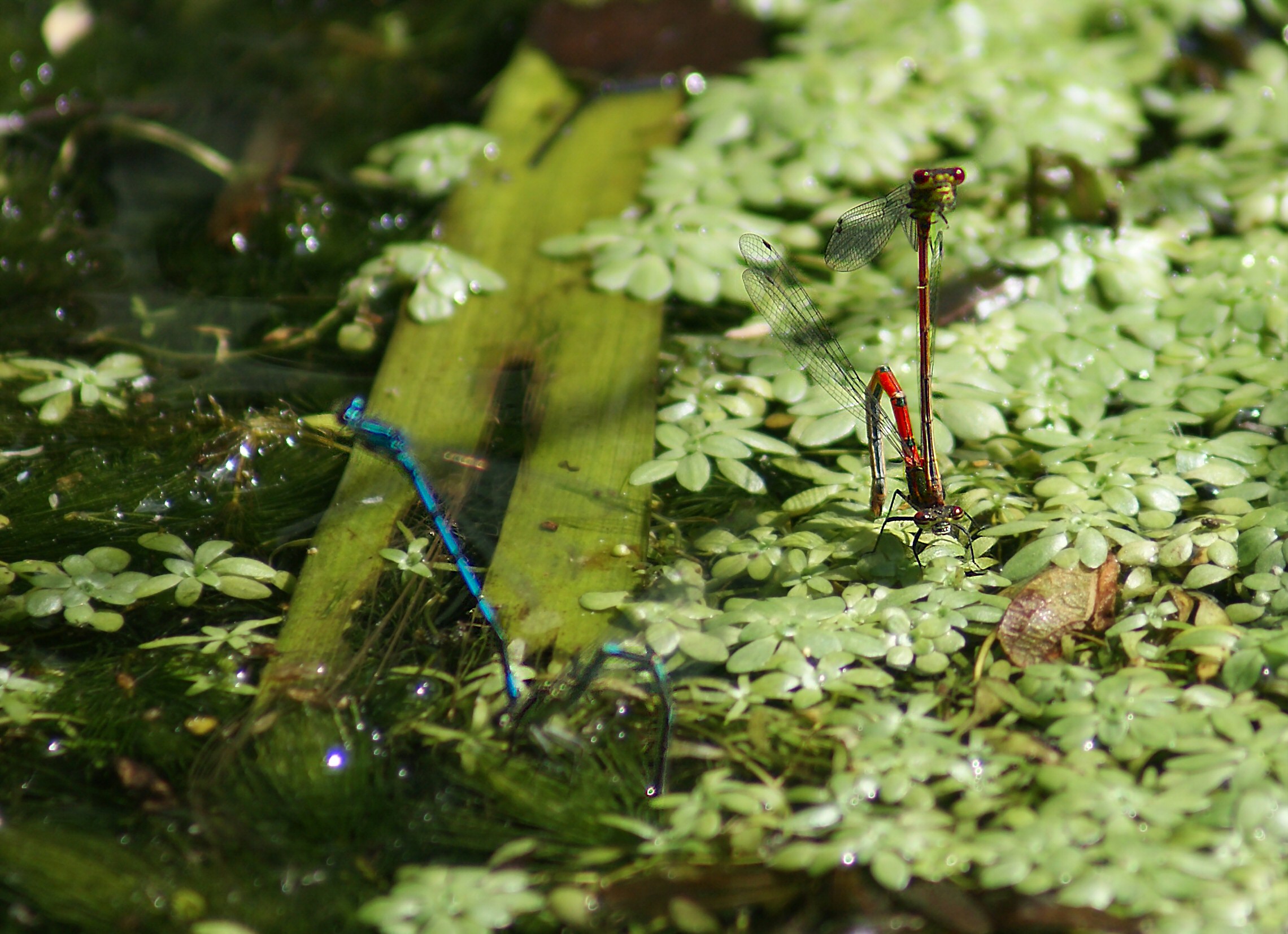
When I had made all the pegs anyone needed, I went for a little nature walk. Down by the pond a now-scarce visitor was singing in the birch trees: a Greenfinch. In the pond, several smooth newts were flicking and darting about. The sun was glinting off the water, as you can see, but it seems two magnificently spotty males were courting a drabber female at the top.

Snail Egg Pattern

Snail Eggs in Pond
Snail Eggs in Pond

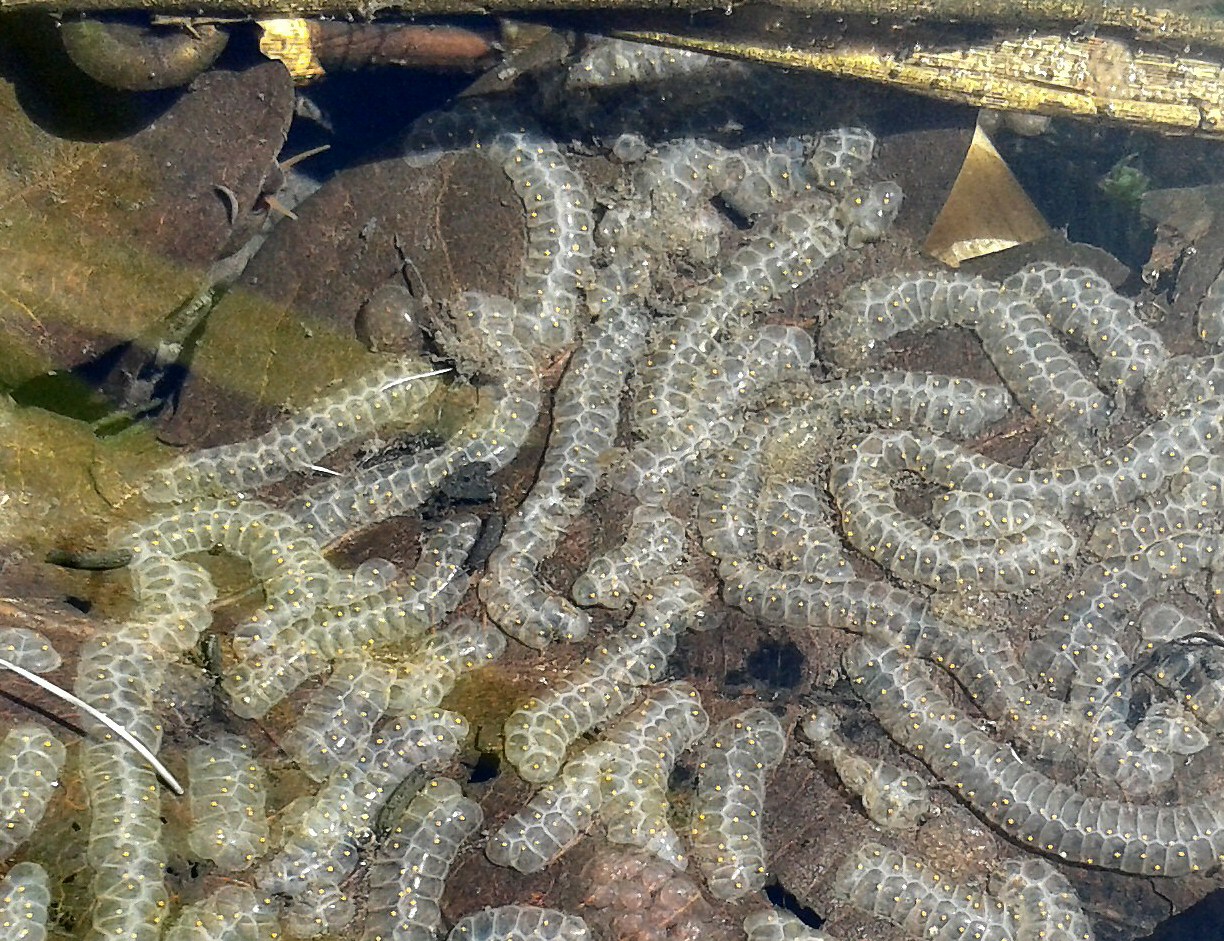
Walking past the main pond, my eye was caught by a striking pattern reminiscent of a brain coral. Lying down on the boardwalk to get the diminutive lens of my phone camera as close to the pond surface as possible, the squiggles resolved themselves into long patterns of jelly divided mostly into hexagonal areolae like miniature cells in a honeycomb, each with a white boundary and a tiny yellow egg at its centre.

At the top left of the photo is a large Ramshorn Snail: several others were nearby, so they are the likely culprits. Generally pond snail egg masses (as laid by the large pointy-spiral pond snail Limnaea) are small, undistinguished jelly-blobs, so these large, impressive structures were a surprise.

Moths and Warblers at Gunnersbury Triangle

Early Grey Moth
Early Grey Moth

The dawn chorus at the reserve revealed two singing Blackcaps: one was alternately feeding on newly-emerged Cherry buds, presumably eating insect larvae, and giving short bursts of song or subsong. In a few days’ time the leaves will make such easy observation much less likely. There were two singing Chiffchaffs, one of them in full view in a Birch just coming into leaf above the main pond; and a Willow Warbler which I first heard yesterday near the picnic meadow.

Identifying a Pug Moth

A party of newly-fledged Great Tits blundered about the bushes on the steps by the main pond, and a Wren gave me a fine view at the ‘mangrove swamp’, which is fast drying up. The newly-dug extension to the seasonal pond has filled with water and is in fact deeper than the rest of the pond, probably a useful variation in depth.

Inspecting the Moth Trap at Gunnersbury Triangle

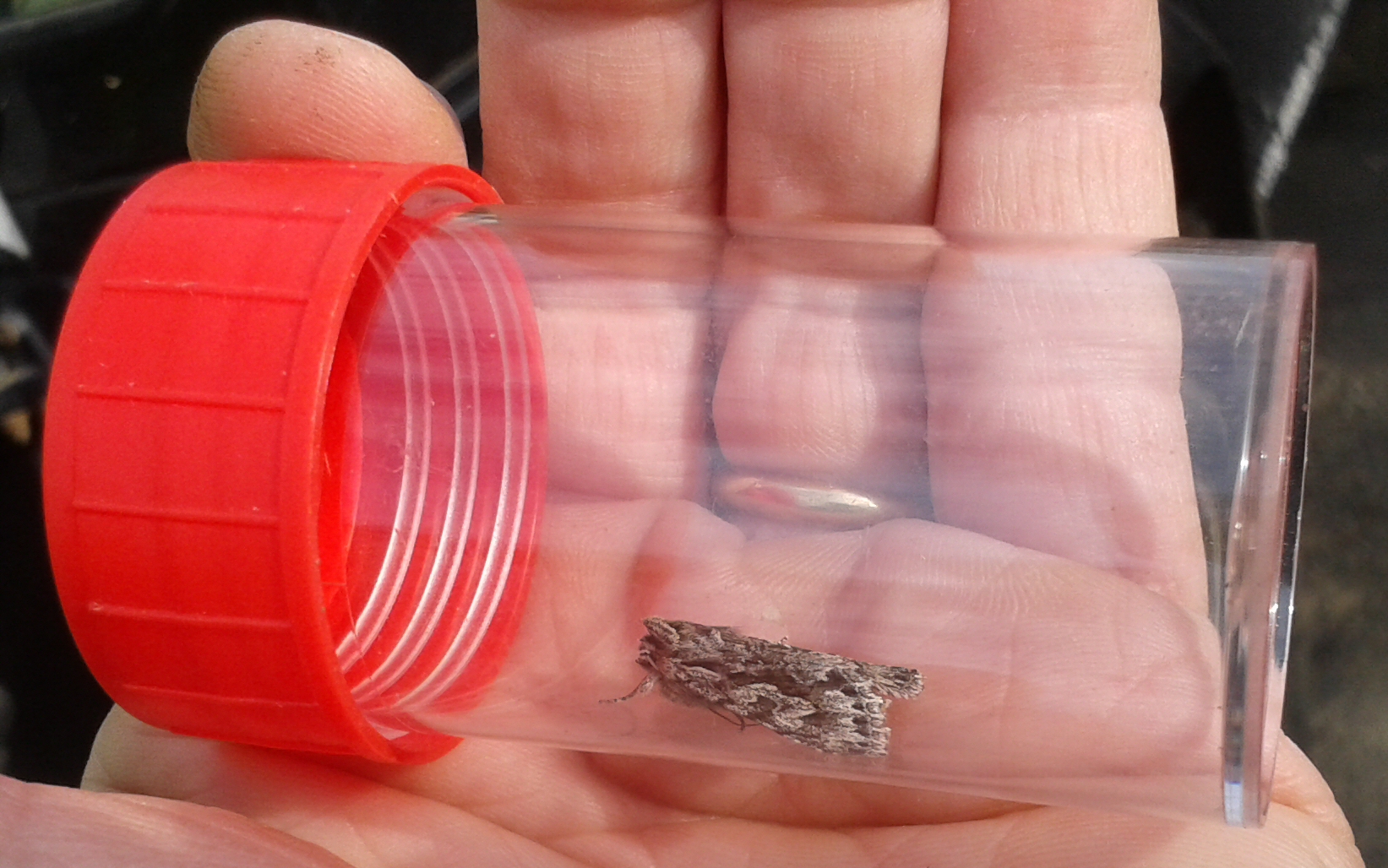
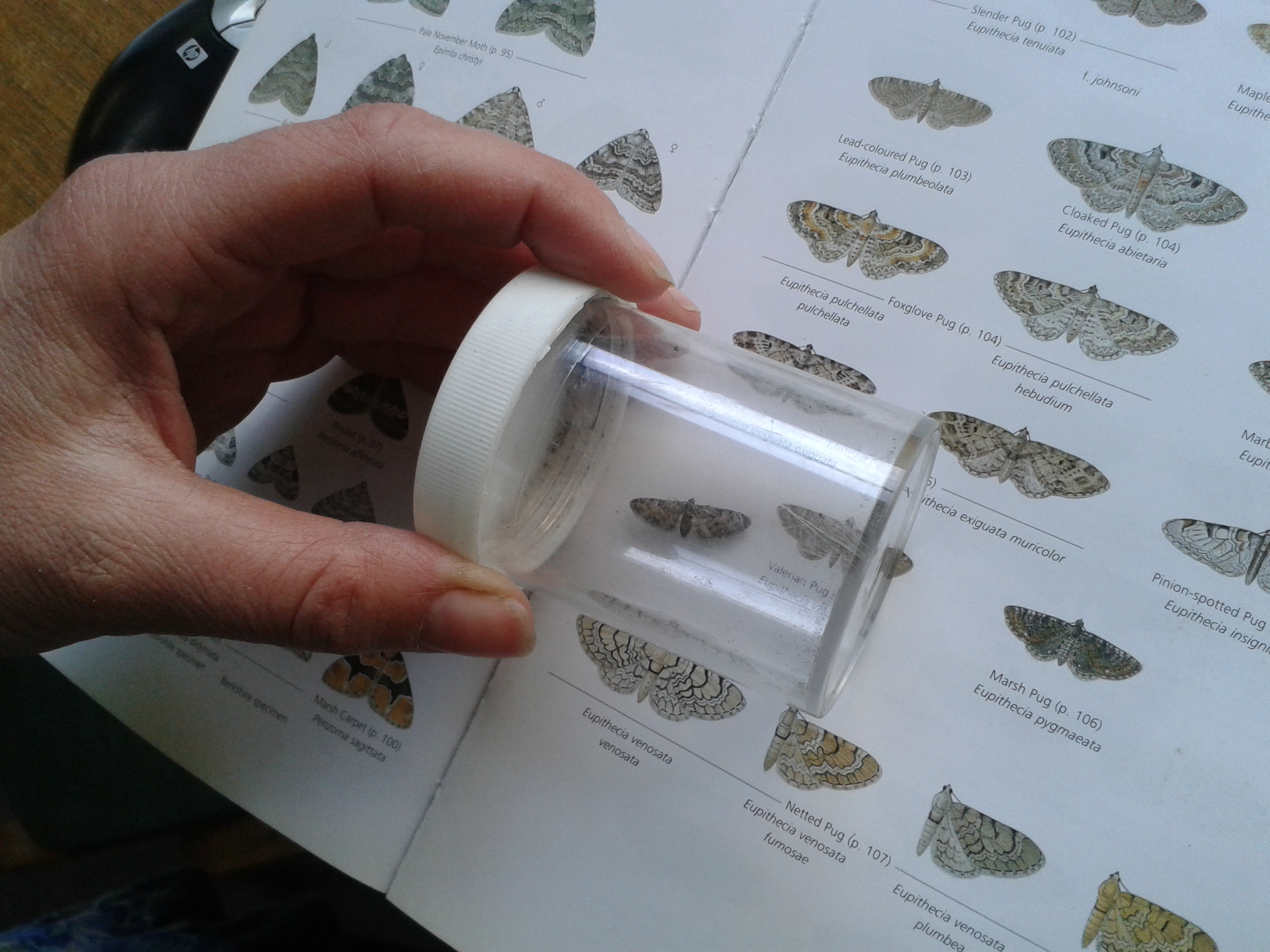
Up at the hut, the moth trap was being opened after a night’s work. Inside were some Pug moths, probably Brindled Pugs, and a much larger Noctuid moth, an Early Grey.

Also seen were Jay, Magpie, Carrion Crow, Wood Pigeon, singing Dunnock, Blackbird, Robin, Mallard. A Wren was carrying food to its nest near the ramp.

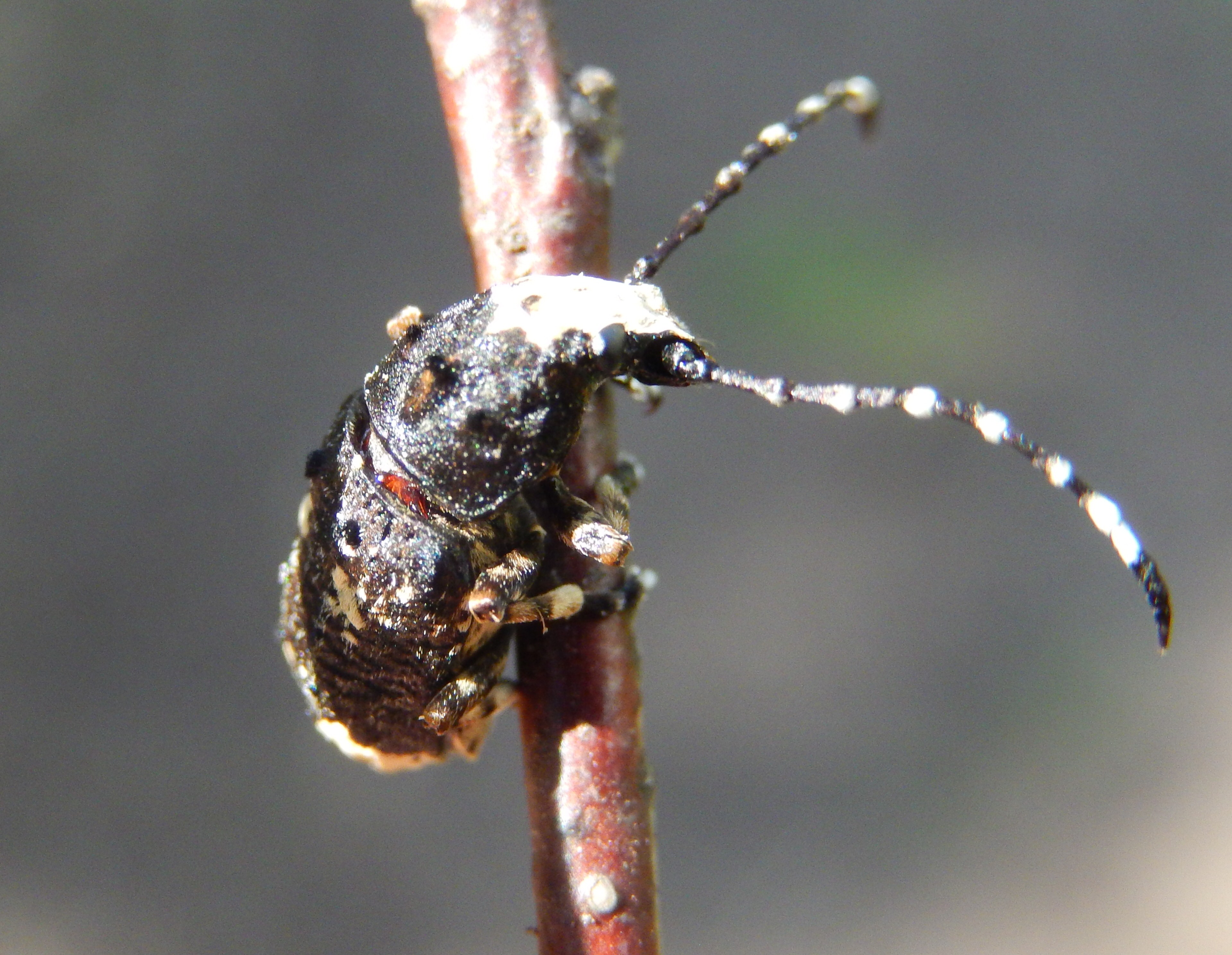
Anthribid beetle, Platystomos albinus, male

Anthribid beetle Platystomos albinus male

Well, a rarity: this fine beetle, Platystomos albinus, is an Anthribid, a member of a family somewhere between the wood-boring Longhorns and the pointy-nosed Weevils. It has plenty of odd features, not least that it is camouflaged as a bird-dropping. It is “nationally scarce (Nb)” and an “Index of Continuity Species”. This is a male – it’s easy to tell as the species is sexually dimorphic: the males have enormous long antennae nearly the length of the body; the females have antennae about as long as head and thorax together.  And this specimen seems (?) to be bleeding from the back of the thorax, possibly an instance of reflex bleeding (autohaemorrhaging) to warn off predators: perhaps the blood is toxic or irritant as it is in several families of beetle.  The larvae live in dead standing wood; the adults in fungus-infested Beech or Alder – we have a very few Beech here, and no Alder, and the insect was nowhere near either species.

Sussex Coastal Geography in the Spring

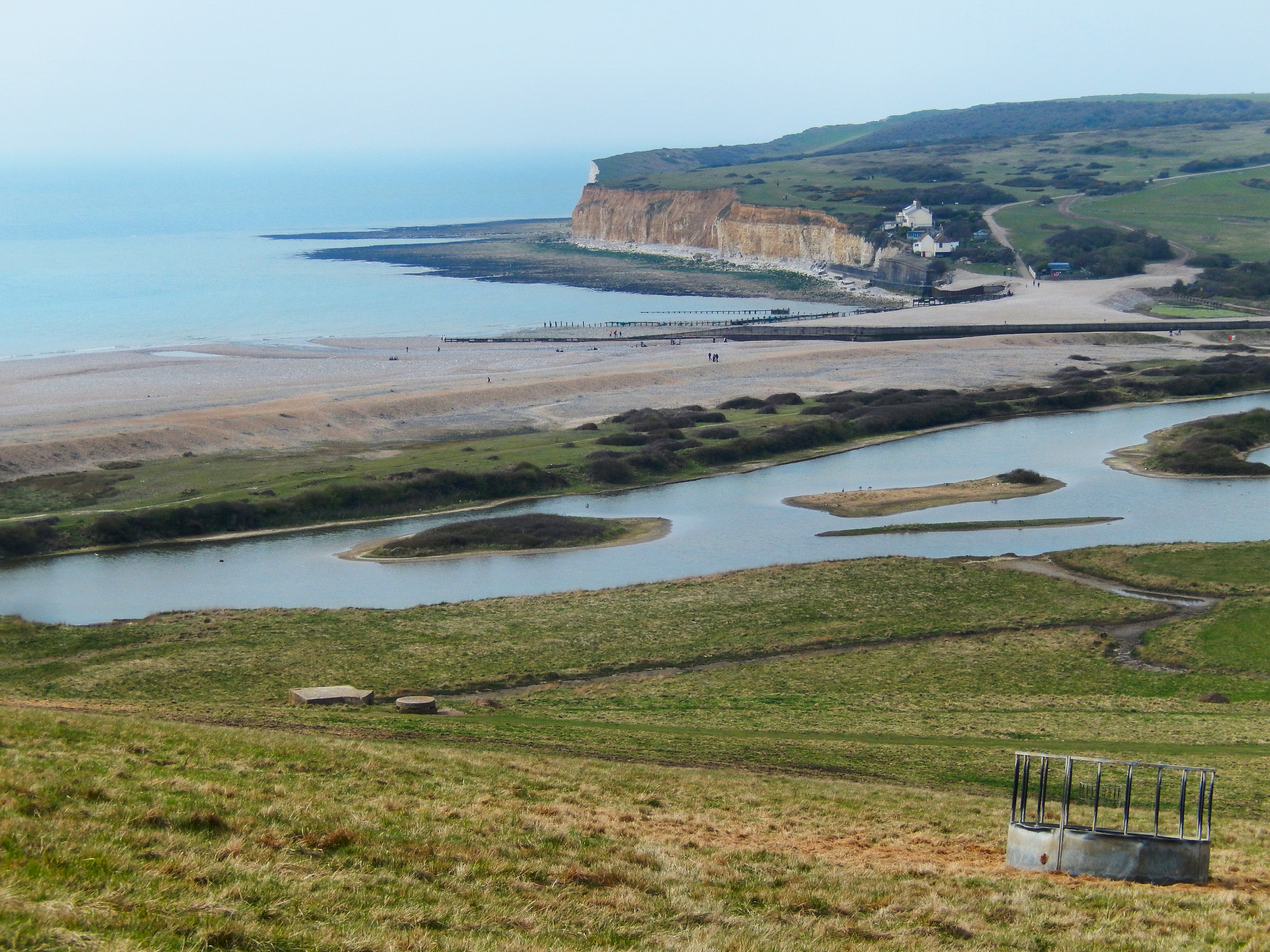
Cuckmere Haven with bar, lagoon, and wave-cut platform

Down in Sussex for a few days, we walked the Seven Sisters from Cuckmere Haven to the Birling Gap.

We had a taste of the scale of human interference with the world’s climate in the shape of a thick haze of pollution trapped by an anticyclone: on the Weald approaching Lewes, we could see the thick haze below the level of the South Downs, and taste the acridity on our tongues. On the coast itself, it was less noticeable in the sea breeze, but the visibility was much reduced with the Newhaven-Dieppe ferry quickly fading into the murk. The BBC warned of high local pollution (worst near Hastings) and an expert advised against strenuous exercise.

The photo of Cuckmere Haven had to be enhanced as it actually looked all washed out in the haze. The geography is interesting: the Cuckmere River emerges (as a dark horizontal line) through what looks from this viewpoint like a continuous shingle bar across the mouth of the valley. The ‘lagoon’ on the landward side of the shingle is part of a former meander of the river, now cut off as if it were an oxbow lake; the current watercourse is canalized with artificial embankments. In the background are vertical sea-cliffs of chalk, with softer (brown) sands above, eroding at a shallower angle. At the base of the cliffs is a white line of fallen chalk rubble, and a dark horizontal surface, a wave-cut platform of chalk (with dark seaweed). In the foreground is the slope of chalk grassland and (left centre) two wartime concrete pillboxes defending the haven.

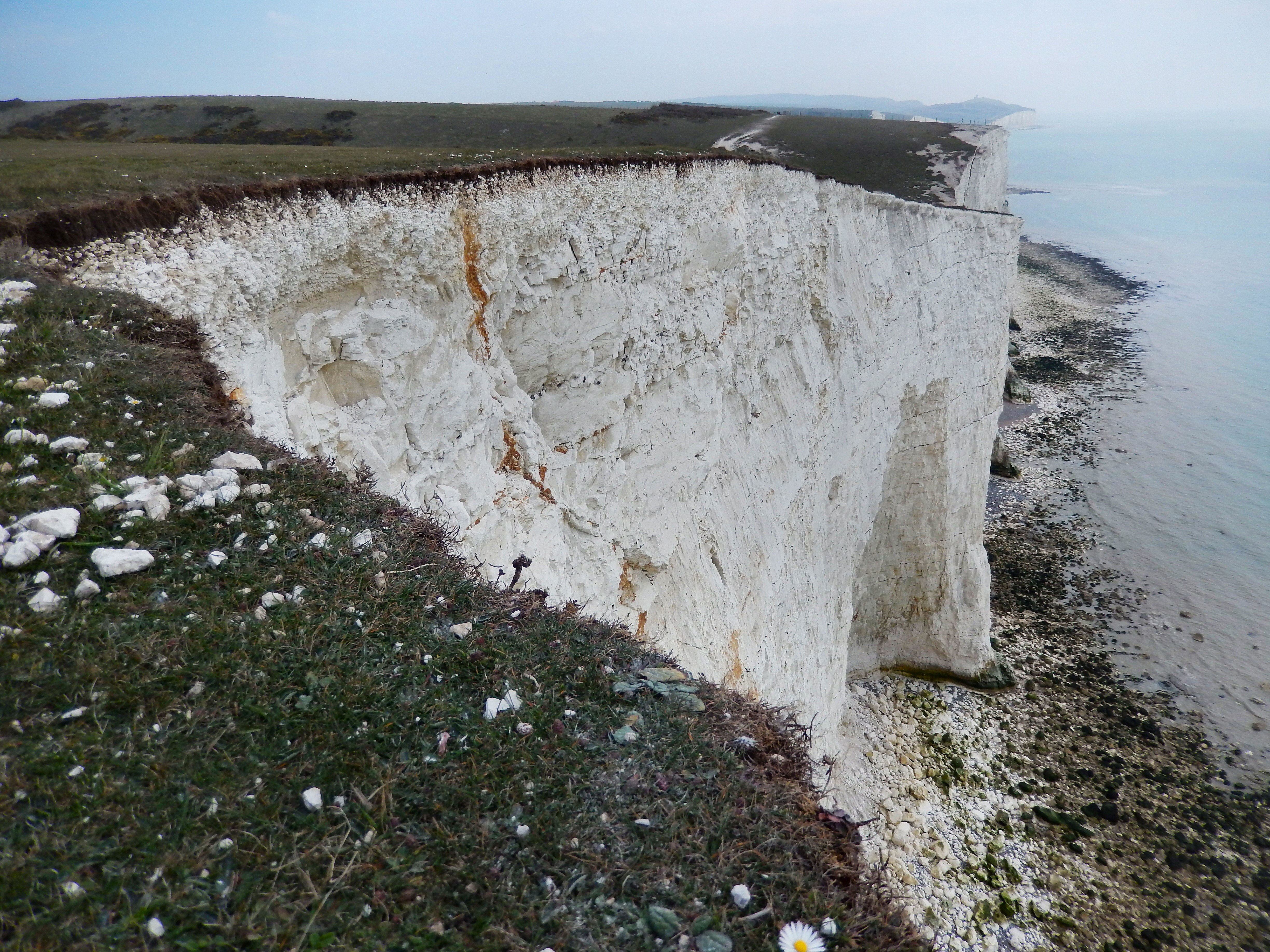
Seven Sisters - coastal cliff erosion
Seven Sisters – coastal cliff erosion

Gingerly approaching the cliff edge at a crawl, I took this photo, showing a large cave in the chalk: the waves fracture and undercut the cliff at high tide, causing progressive and often sudden cliff falls. The coastline recedes by about 70cm per year, but this bland average conceals a very different reality: the cliff edge barely changes from one year to another, until in some specially violent winter storm, perhaps three to five metres of chalk grassland and hundreds of thousands of tons of chalk suddenly collapse all at once into a gigantic white heap on the beach. The cave in the photo has created an overhang of more than 10 metres; it will certainly collapse one day in the next few years.

The walk was constantly accompanied by the song-flights of Skylarks, and their darting duels low over the grass. A few Ravens flew about the cliffs, and many Jackdaws; a pair of Carrion Crows mobbed a Raven; a few Magpies brought the number of members of the Crow tribe up to four.  Near Birling, Chiffchaffs crept about an orchard, and Blackcaps dived into gorse bushes. Hundreds of Brent Geese flew Eastwards in V-shaped skeins or long lines half a wingspan above the waves. Four or five Little Egrets darted about the Cuckmere Haven lagoon, spearing small fish: a century ago they were hunted to local extinction for their plumes, used for elegant ladies’ hats. The RSPB was founded partly as the “Fin, Fur and Feather League”, a women’s campaign against the cruel and pointless use of animals in fashion that became a major force in bird conservation. In the last thirty years or so they have quietly returned to the south coast and are increasing in numbers.

Angle Shades Emerging (it’s springtime)

It’s spring! Well, a Blackcap sang its cheerful spring song to me yesterday, in my garden, how about that, after flying all the way from Africa. Today, a Chiffchaff sang (and briefly appeared) in the nature reserve while I was working down at the frog pond.

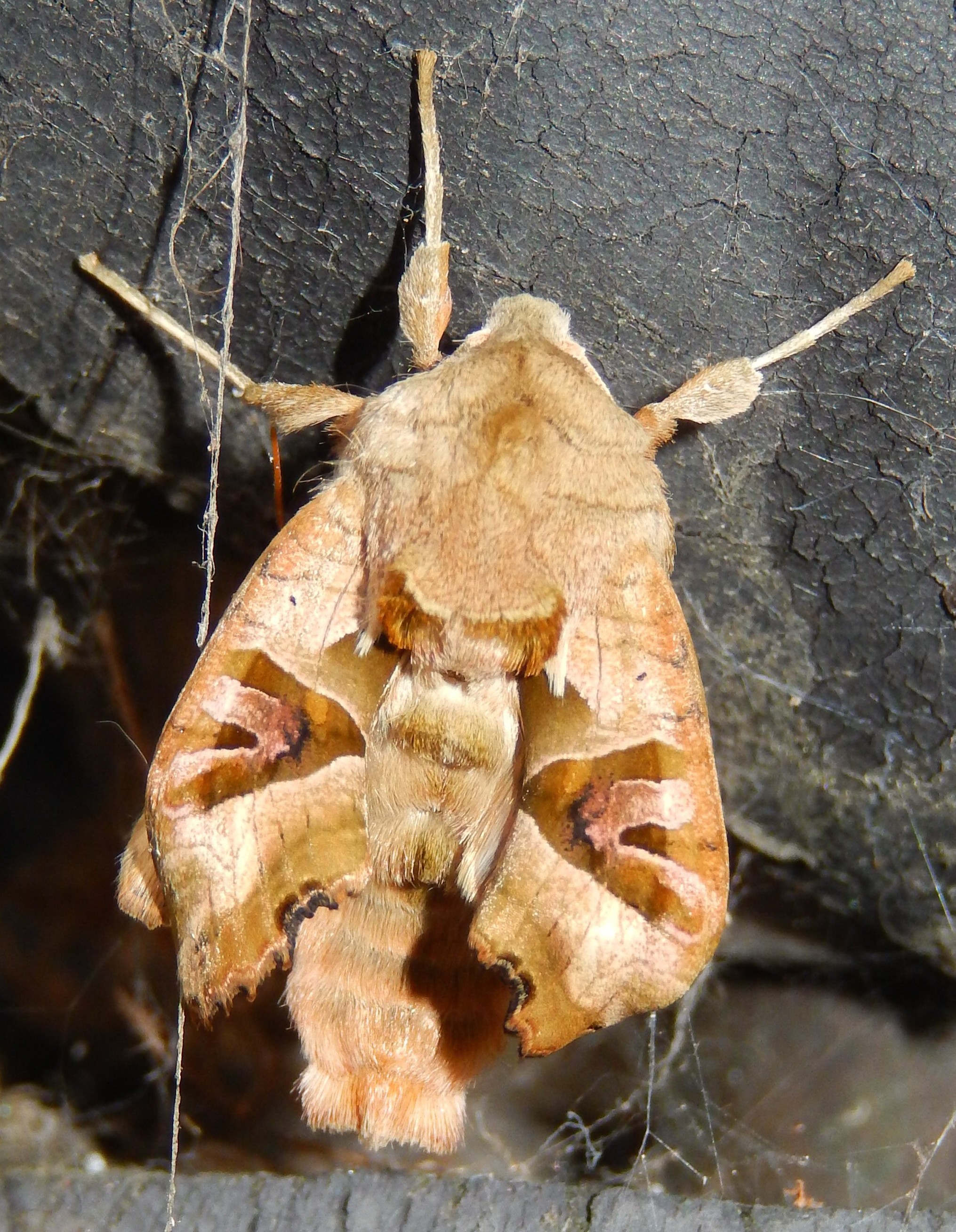
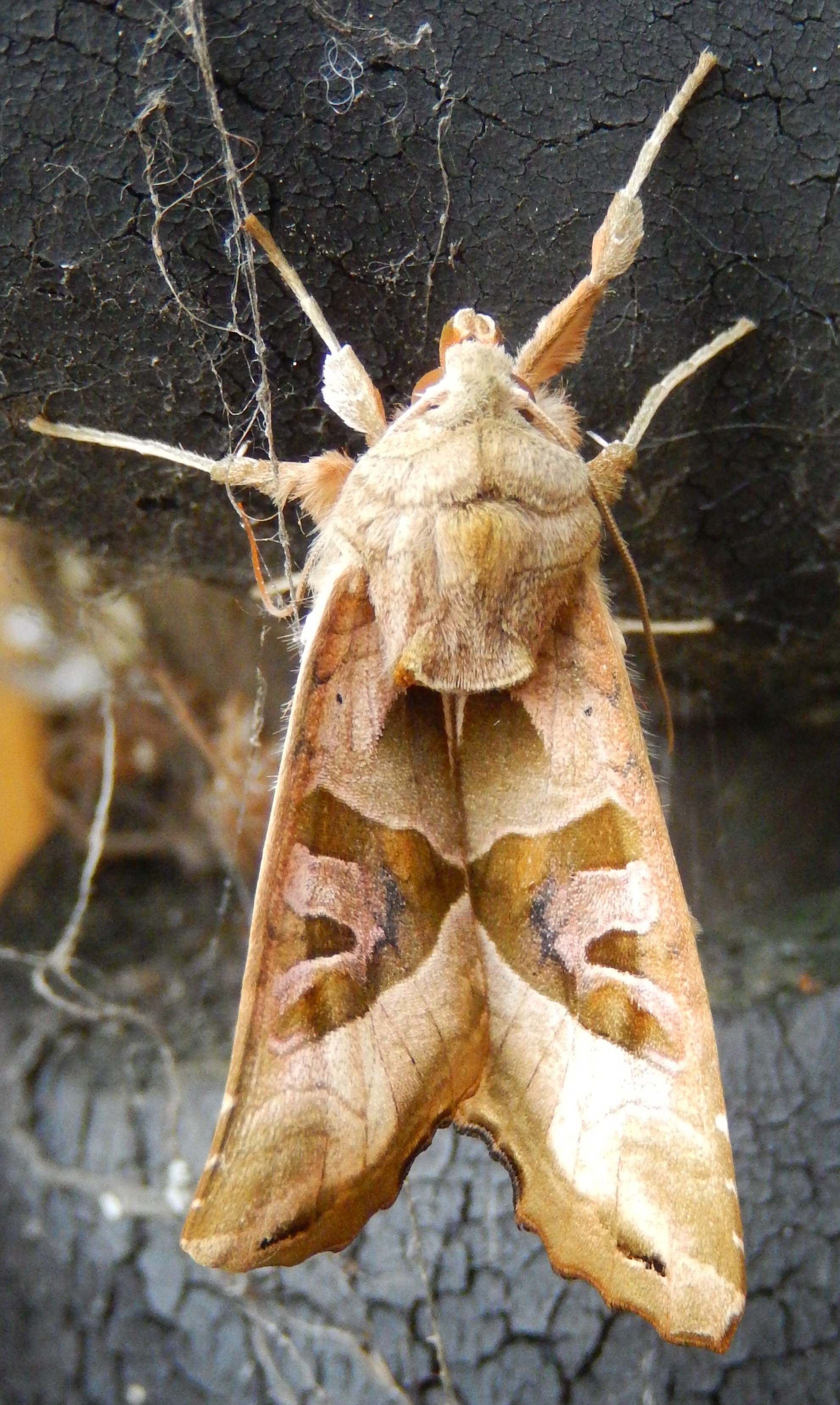
And back at home, as I was watering the garden, I saw this Angle Shades moth (Phlogophora meticulosa, a Noctuid) in its final ecdysis, inflating its wings from their crumpled state inside the overwintering pupa. It was on the pipe insulation of the garden tap.

Angle Shades, wings about to inflate
Angle Shades, wings nearly inflated


Presumably the moth’s body clock said “It’s spring”. Amazing to watch.

Signs of Spring, and Muntjac, at Wraysbury Lakes

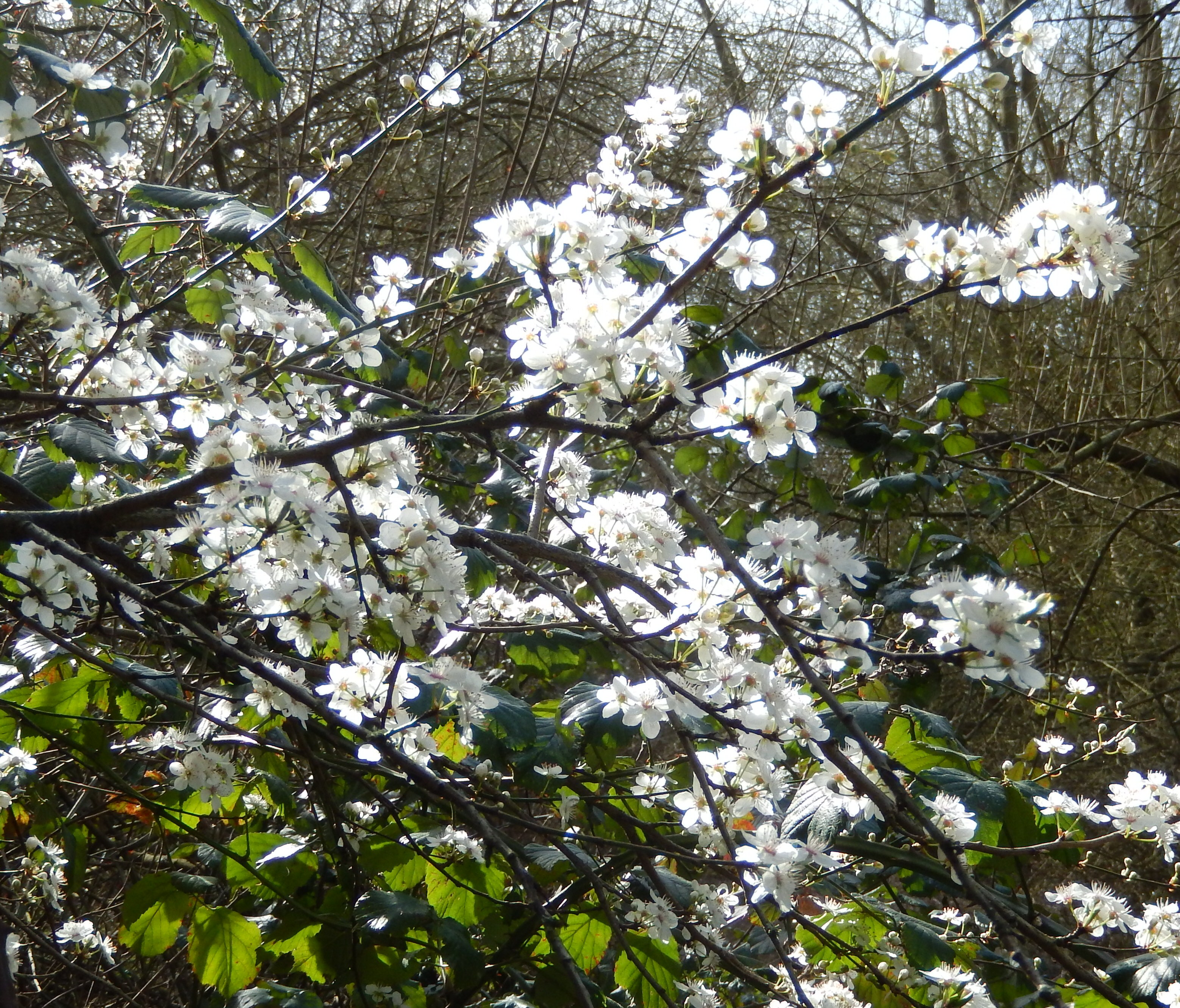
Spring blossom - Wild Pear the first to bloom
Spring blossom – Wild Pear the first to bloom

Suddenly it feels like spring. The migrant warblers haven’t arrived, though a resident Cetti’s gave me a fine burst of its loud simple song; and the winter ducks haven’t all gone back up North, a few Goldeneye and Goosander still fishing the lake; but it was almost warm in the bright sunshine, and the wild pear tree in the woods positively sparkled with fresh new blossom.

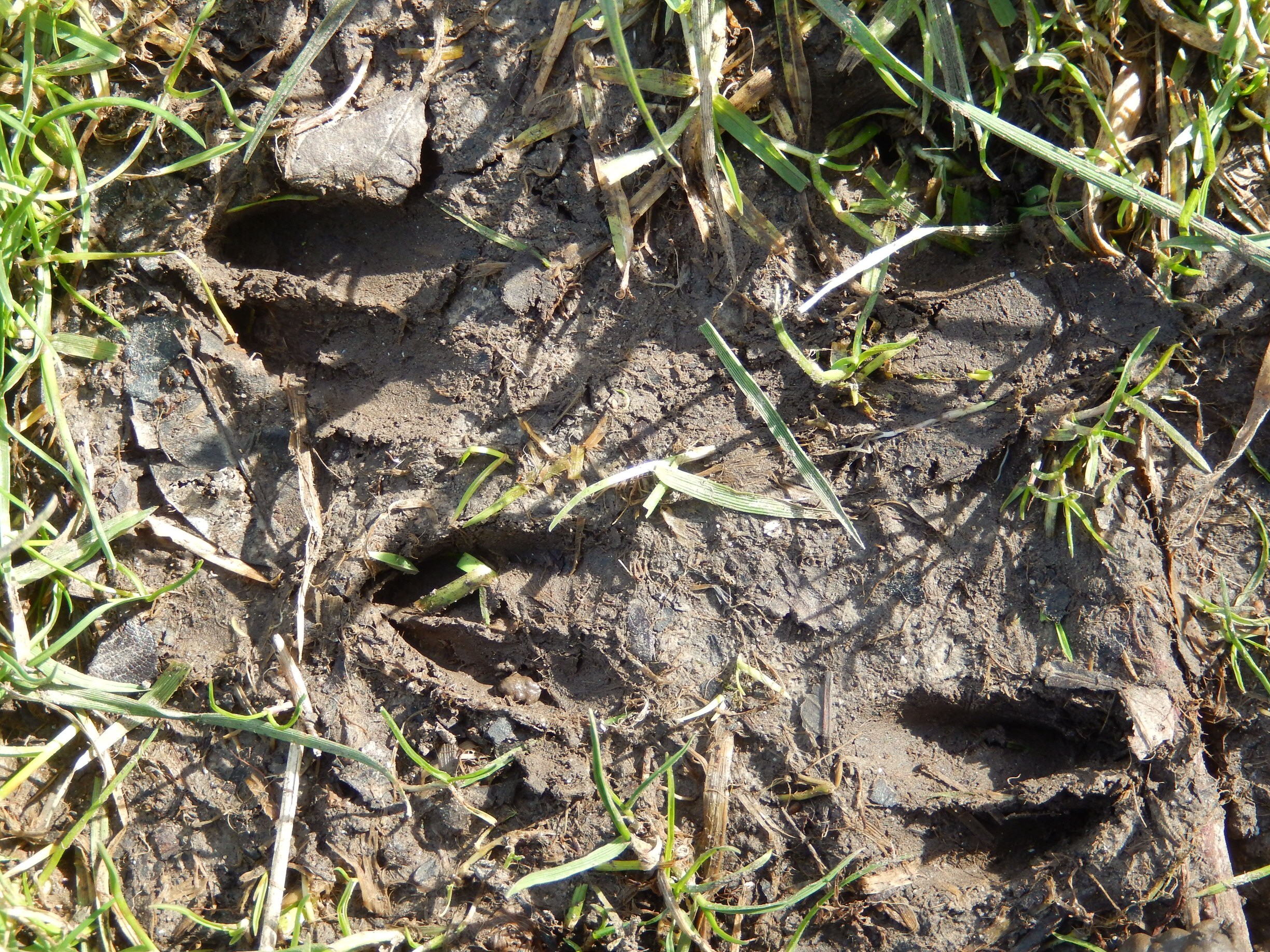
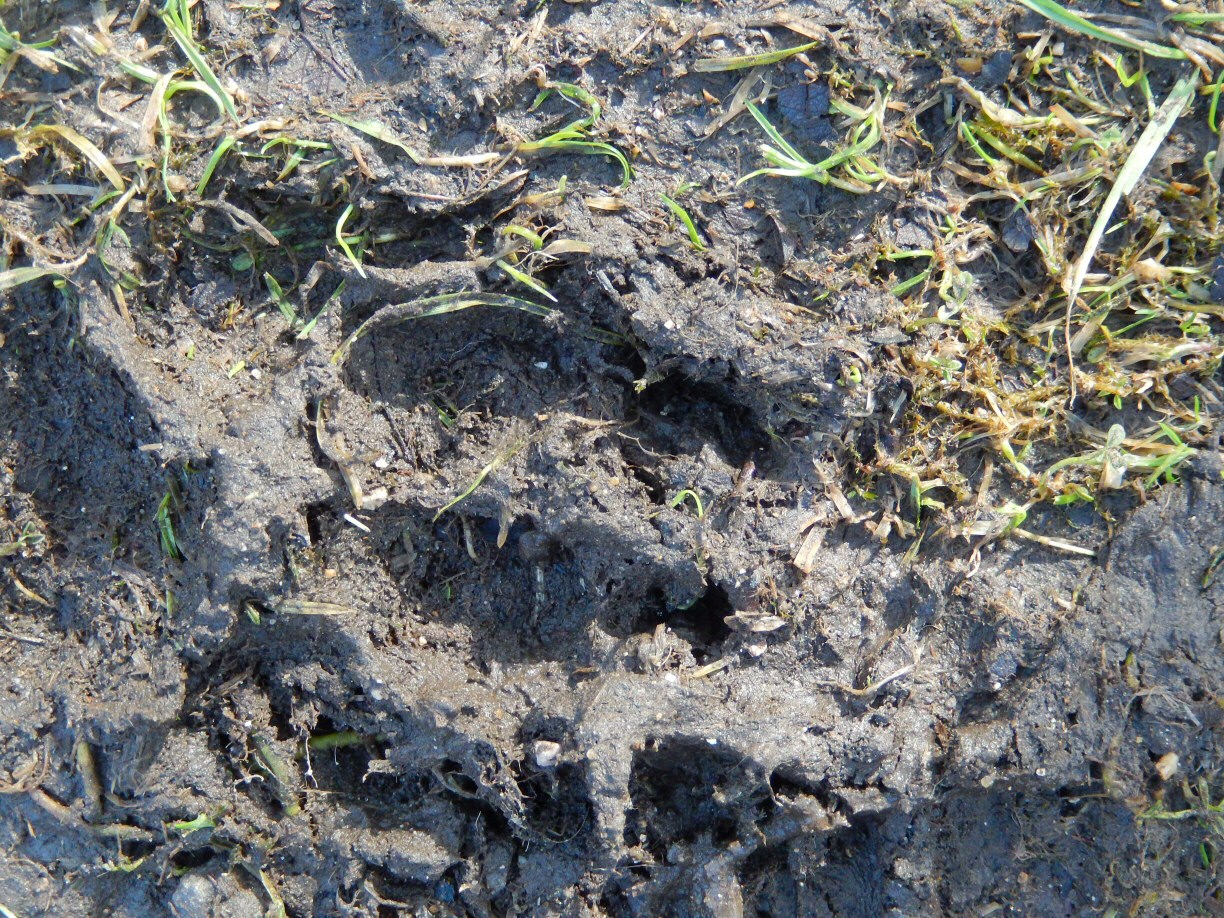
Tiny footprints: Muntjac slots

There were animal tracks too: tiny footprints of Muntjac.

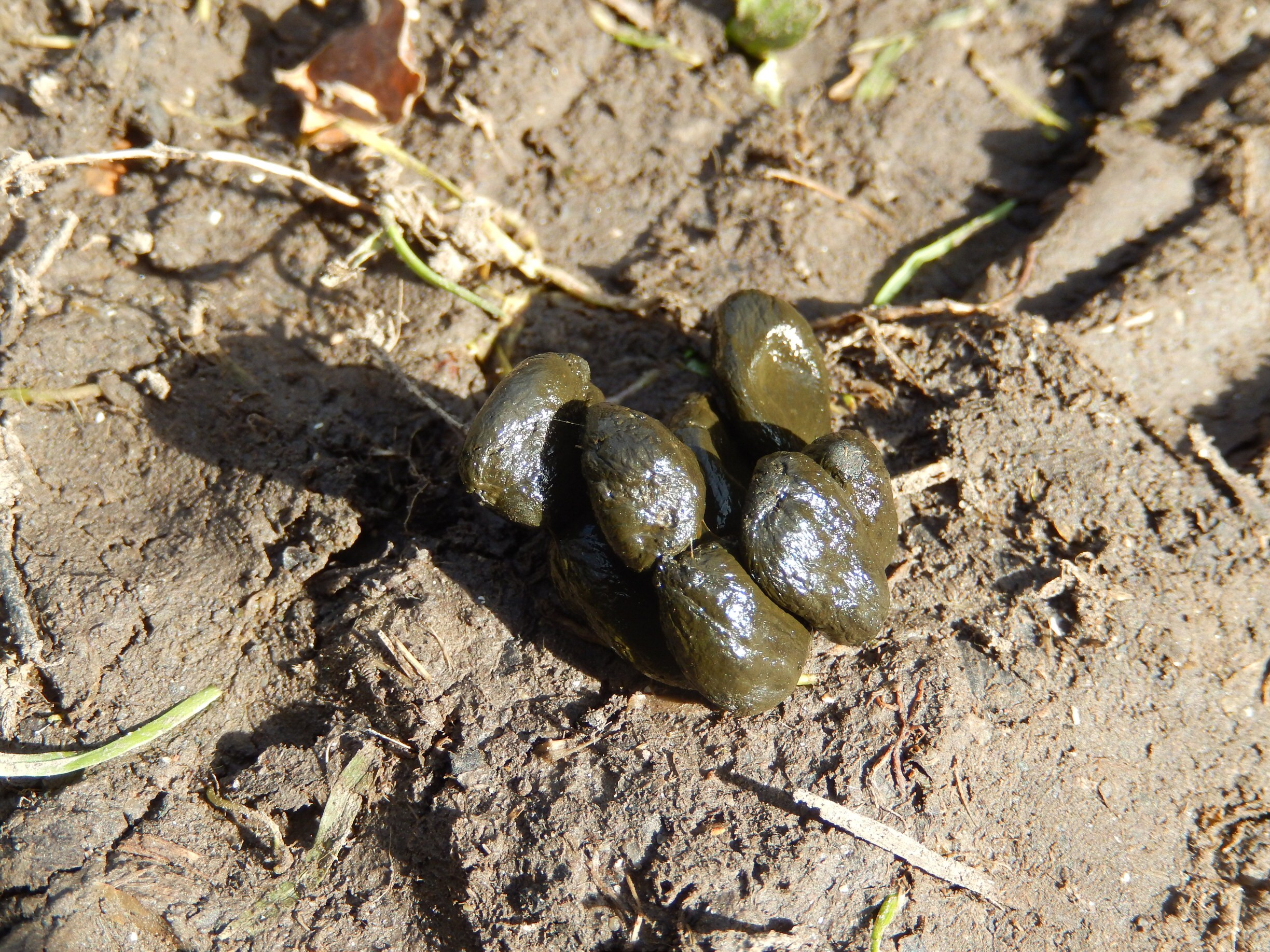
A little further, a fresh pile of tiny scat, Muntjac for sure.

Tiny scat: Muntjac
Tiny scat: Muntjac


A Sparrowhawk dashed low over the willows, and disappeared as swiftly as it had arrived.

On the path, the much larger slots of Roe deer; and a Rabbit hopped quietly aside.

Larger tracks: Roe deer

The last of the winter thrushes – a flock of Fieldfares – called their chattering chack-chack from the tall boundary hedge of trees. A flock of gently twittering Goldfinches, too, served as a reminder of a winter only just passing.

Not every day I’m seen wheeling a bench about a nature reserve

Wheeling a bench ...
Wheeling a bench …

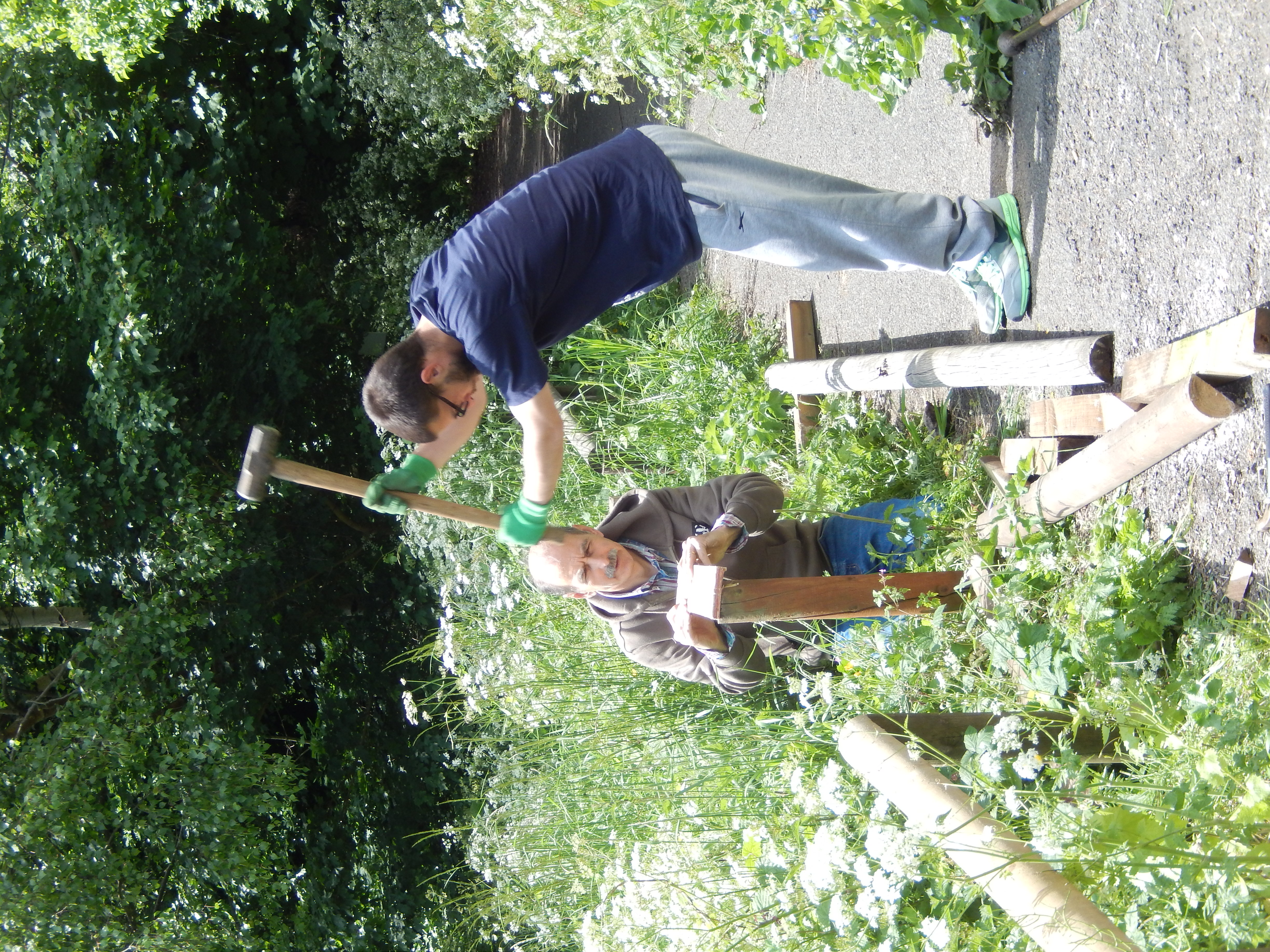
Well, it’s not every day one wheels a robust two-legged bench about a nature reserve. The team of three however managed to think of a way of balancing the bench on a wheelbarrow using a bit of four-by-two to prop up the legs, and thus poised it turned out to be quite easy to trundle along, carefully dodging trees and bushes along the way.

The holes were just the right depth, so all we had to do was drop in the bench, level it, pour in some water and add rapid-setting post concrete. The bit we had left turned out not to be enough, so after struggling in vain with additional pebbles, we propped it up and those with bicycles went round to the hardware store to fetch some more concrete.  Second time proved lucky, the ‘crete set like custard without enough milk added, and very soon we were shovelling the spoil into the holes and stamping it down.

New bench on the mound

Owl Box for Gunnersbury Triangle

Tawny Owl Nestbox
Tawny Owl Nestbox

It was a very rainy workday, and with only two of us around we wondered what to do. It was time for an indoor project that we’d been putting off … make an owl box. Tawny Owls might seem surprising citydwellers, but they are around in the leafier suburbs and larger parks.

We looked at the RSPB website for instructions, calculated the measurements of all six faces of the box on a sheet of paper, and studied the bits of plywood we had available. Just whiz along with the circular saw, screw it all together and we’ll be done.

It took a little longer. To cut the wood, we needed to be outside. Where it was raining. The wood got wet and it was hopeless trying to draw lines in pencil or biro. Felt pen worked, sort of, but gave us thicker smudgier lines. We drew, went outside, held and sawed, dusted down, came inside, made another cup of tea, drew again, went outside.

Finally we had a forlorn pile of long, dirty, improbably shaped bits. They seemed nothing like a nestbox. Let’s finish it next time, said Netty, sounding a lot less keen than she had at the start. Let’s get it done, I said. It’ll not take long now. We were a bit cold. We screwed the front to the sides, which were the thickest parts. Suddenly it had a shape. We took the extraordinarily long back and screwed it to the sides. A box. A very long box. We pushed the base into the hole. It wobbled. We pushed it down the very long hole with an umbrella and got some screws in. It was all done save the lid, which needed waterproofing with some roofing felt, and attaching with a rubbery damp-course hinge.

The next time was dry, and we took the box outside. It seemed enormous, and Netty had fixed on a long bit of dead branch as an owl-perch, but it went in a wheelbarrow and we set off with drill, ropes, and a ladder to the chosen Oak, a tall straight tree off the beaten track.

We managed to get a rope over a branch and haul the box up. Only, how to fix it and get the rope down again? We let it down, threw a thin plastic rope over the branch as well, hauled the box up, tied the thin rope onto the top of the box, and stood back. The box was up, but definitely dangling. We could easily fix some screws into the stub at the base of the box, but how to do the same for the stub at the top? We moved the ladder around the tree to find a way to reach. With the ladder in the easiest place, the box was directly above our heads. We tried it every which way, we couldn’t reach. We put the ladder back where it was. With two of us holding the ladder and one on the top rung, it was just possible. Trying to tie knots or fix a screw with one hand … is quite tricky. We were very pleased when it was done. We’ll be delighted if a family of owls takes up residence. Or even some jackdaws.

Netty fixing enormous Owl Box