In the evening, the full moon rose between the housetops, a huge, orange-yellow circle, slightly squashed into an ellipse by refraction through the atmosphere. A thin wisp of cloud in the otherwise clear sky gave her yellow glow a ghostly appearance. The moon’s dusty ‘seas’ glowed grey-brown, distinct in outline.
The night was warm. I rose, sticky with sweat, washed, drank, tried to sleep.
A vixen barked, once, twice, faded. I dozed, tried to dream.
The vixen returned, gave her brief yelping bark, louder, nearer, coming closer. I parted the curtain. She was running from left to right along the middle of the road, tail down, nose to ground, shoulders lower than rump, legs moving swiftly in a short trotting gait, grey-brown in the sickly yellow streetlights.
Behind her, on the far pavement, a ghostly shape similar to hers appeared and disappeared, seeming to flicker in the light, vanishing behind the parked cars, more a movement than a shape, her yearling cub, under the vixen moon.
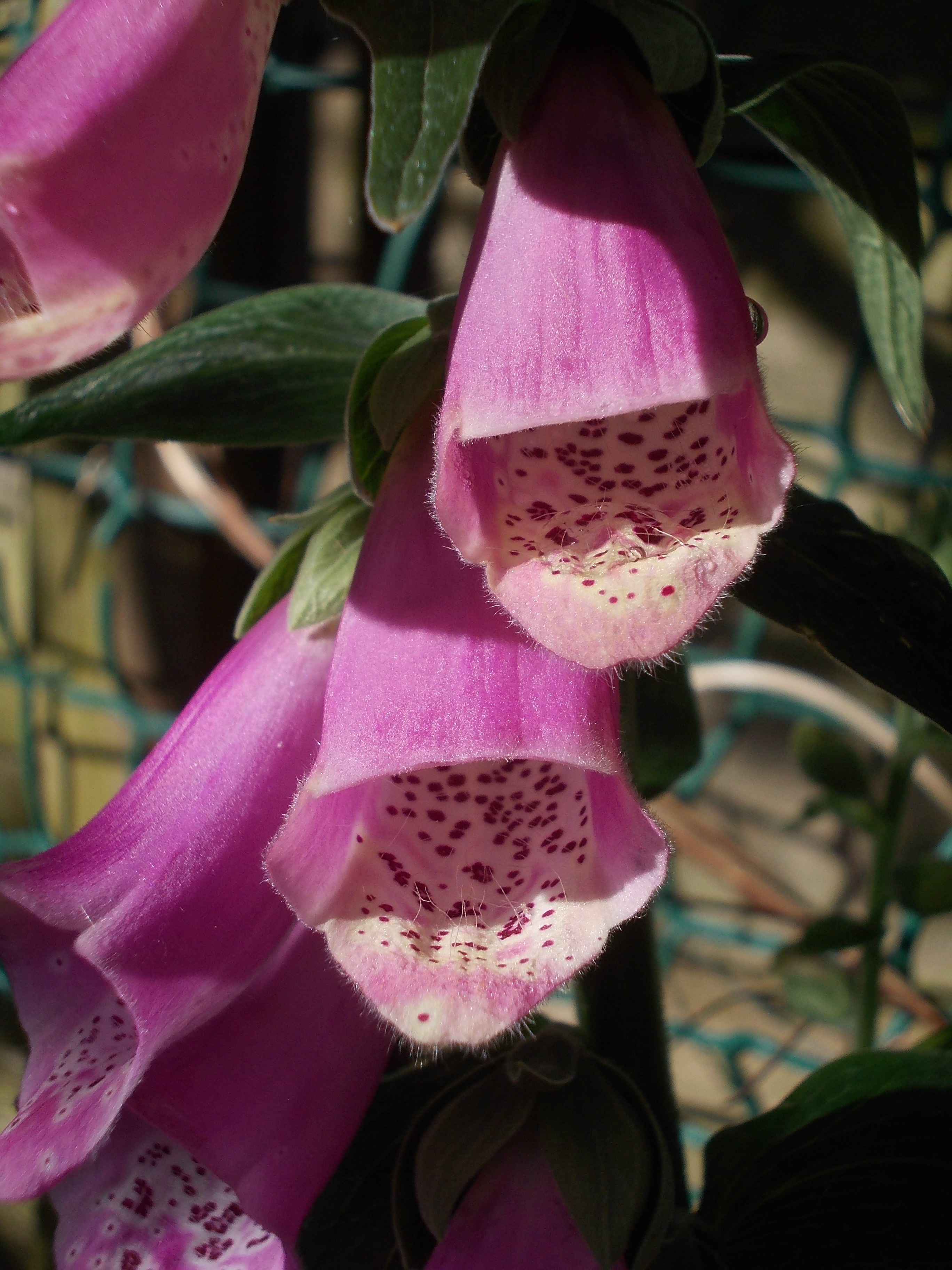
Foxgloves, growing in a shady corner of the garden
My foxgloves are beautifully in flower. They began around the 11th of May and are now in full bloom. Most are dressed in traditional purple with the insides of the “gloves” spotted deep purple in white areas, as if the pigment had been dragged together into clumps. Some are in unspotted white: creamy when closed, dazzling greenish-white in full bloom. This is seemingly a naturally-occurring variation, with perhaps a single mutation preventing pigment development.
Nothing extraordinary there? The clue is the date. Back in the 1940s in Dorset, John Stuart Collis calmly states that Foxgloves come out in August.
The odd science of Phenology tracks the dates when natural events occur in different years, thereby building up an accurate picture of changes in many species. The idea is seen in one of the classics of natural history, Gilbert White’s Natural History of Selborne (1789), which includes observations of the first Swallow to arrive, and so forth, and in some editions actual tables of phenological observations. These are described as “A comparative view of the Naturalist’s Calendar as kept at Selborne in Hampshire by the late Rev. Gilbert White MA and at Catsfield near Battle in Sussex by William Markwick Esq FLS from the year 1768 to the year 1793.” For the record, White notes Foxglove from May 30 to June 22; Markwick notes the same species from May 23 to June 15.
So in this case the anomalous datum looks more like Collis’s than mine. Still, flowering does seem to be earlier; explanations could include that London is warmer than the countryside, that plant varieties may differ, and climate change.
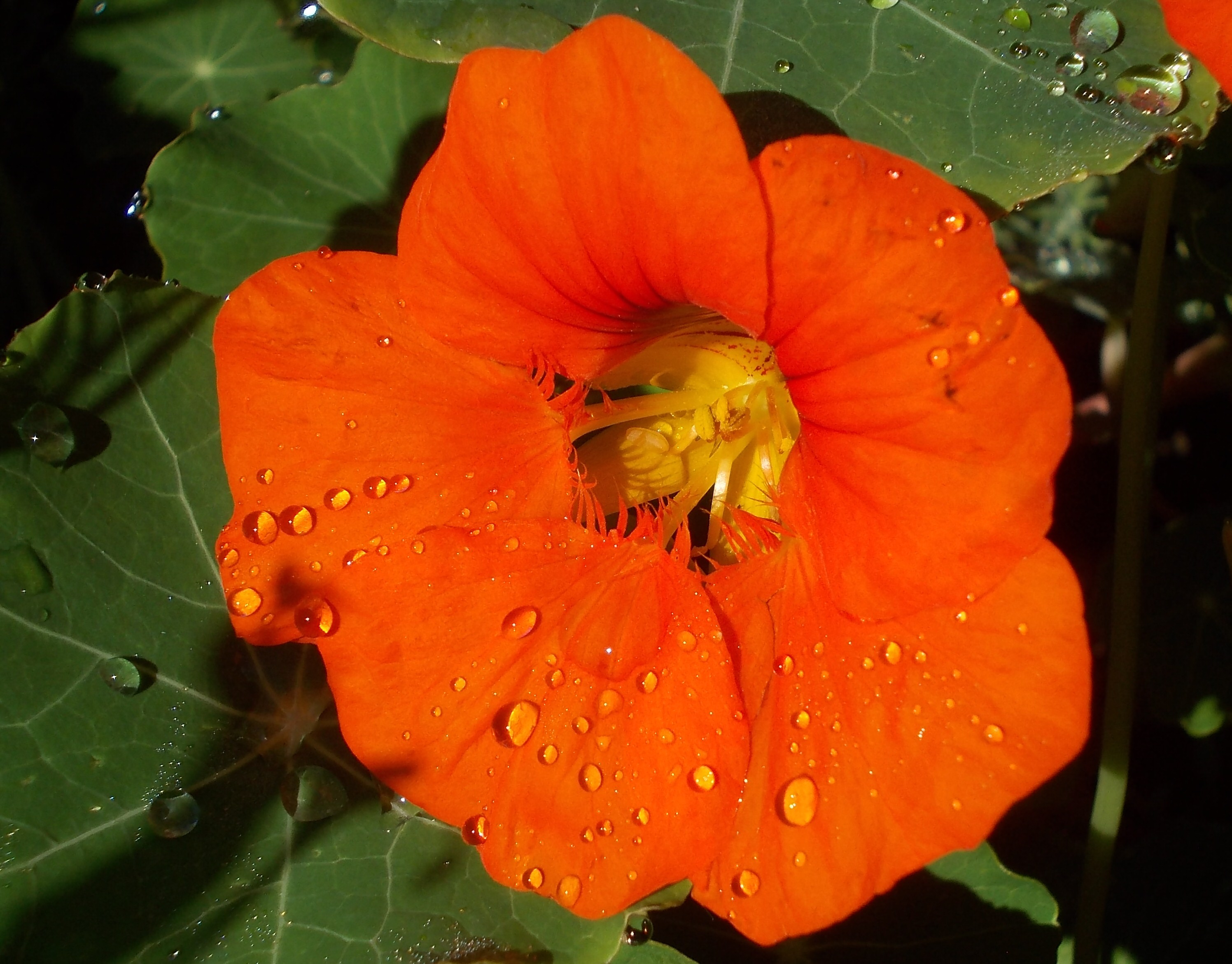
Mind you, even Gilbert White would have had a hard time recording the phenology of the Nasturtium this year. Without a winter frost, which usually kills them in December, the plants survived all through the winter, and have remained in flower essentially continuously. “1 January—31 December”, I suppose.
Nasturtium, all natural. The colour is as the camera saw it, and the water droplets are rain or dew, where nature left them.
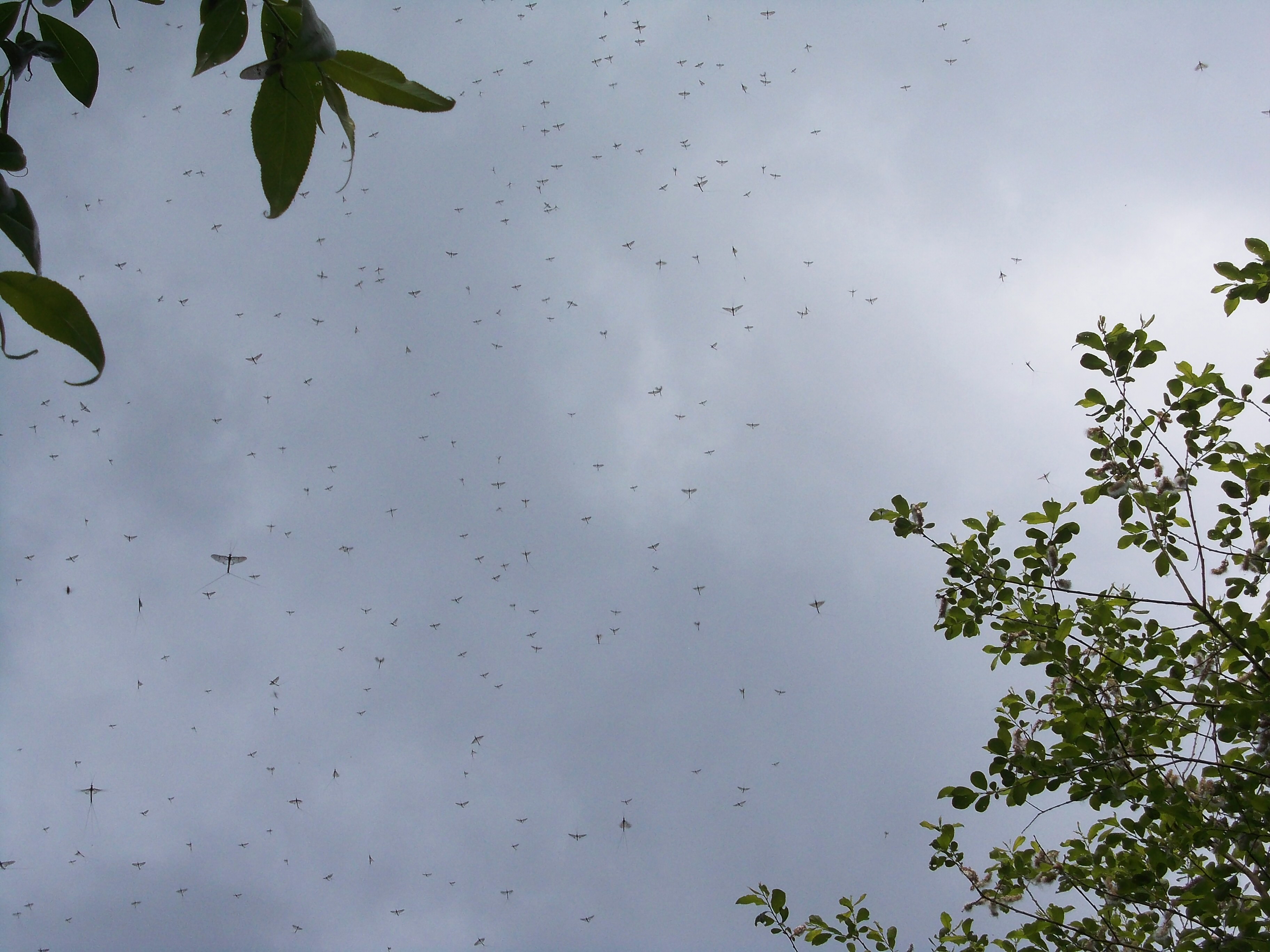
May is the fastest time of Nature’s year. What a difference a few days make! Last time at Wraysbury, a few sluggish mayflies sitting around as if waiting for something to happen in a one horse town.
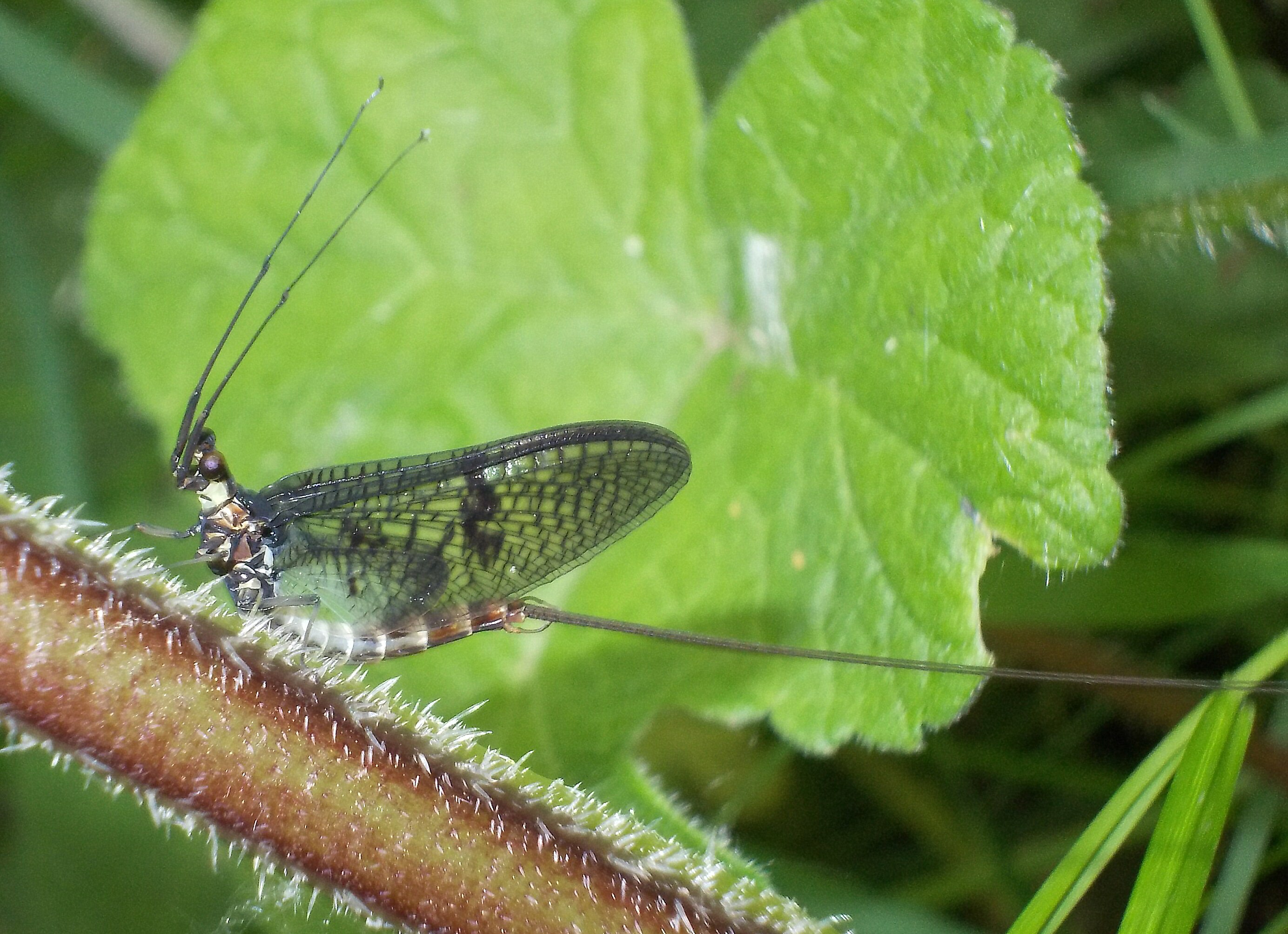
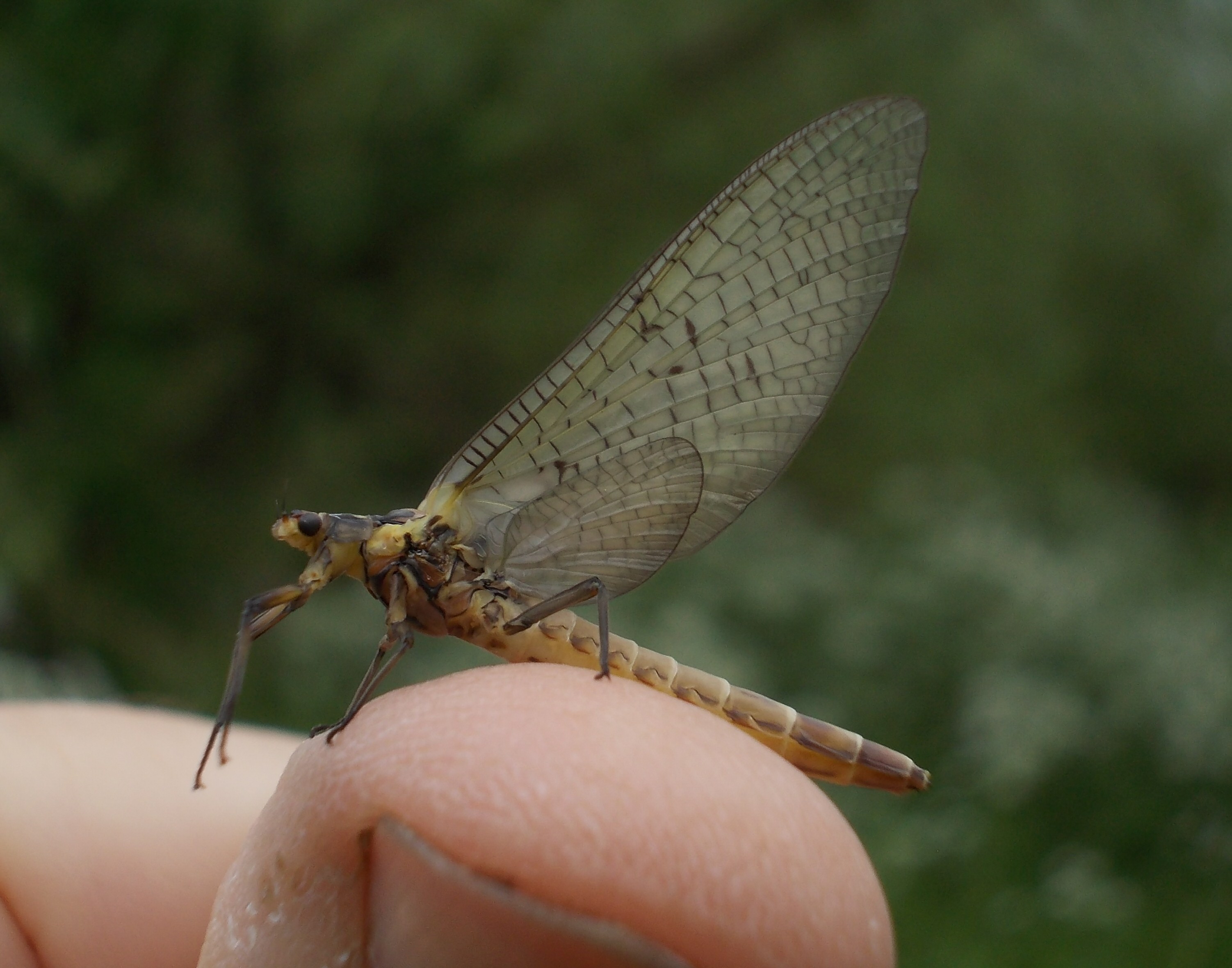
Well, today it’s happening. In places, the sky is filled with rising mayflies: a few mating, most alone. Here and there, some repeatedly dance up, and a few seconds later, down; but most just climb, and fly about, seeming frail on their large wings, their triple tail streamers hanging below them: it’s worth zooming in on the picture. Even better, here’s a short video clip. The soundtrack combines an airliner taking off and a Blackcap singing.
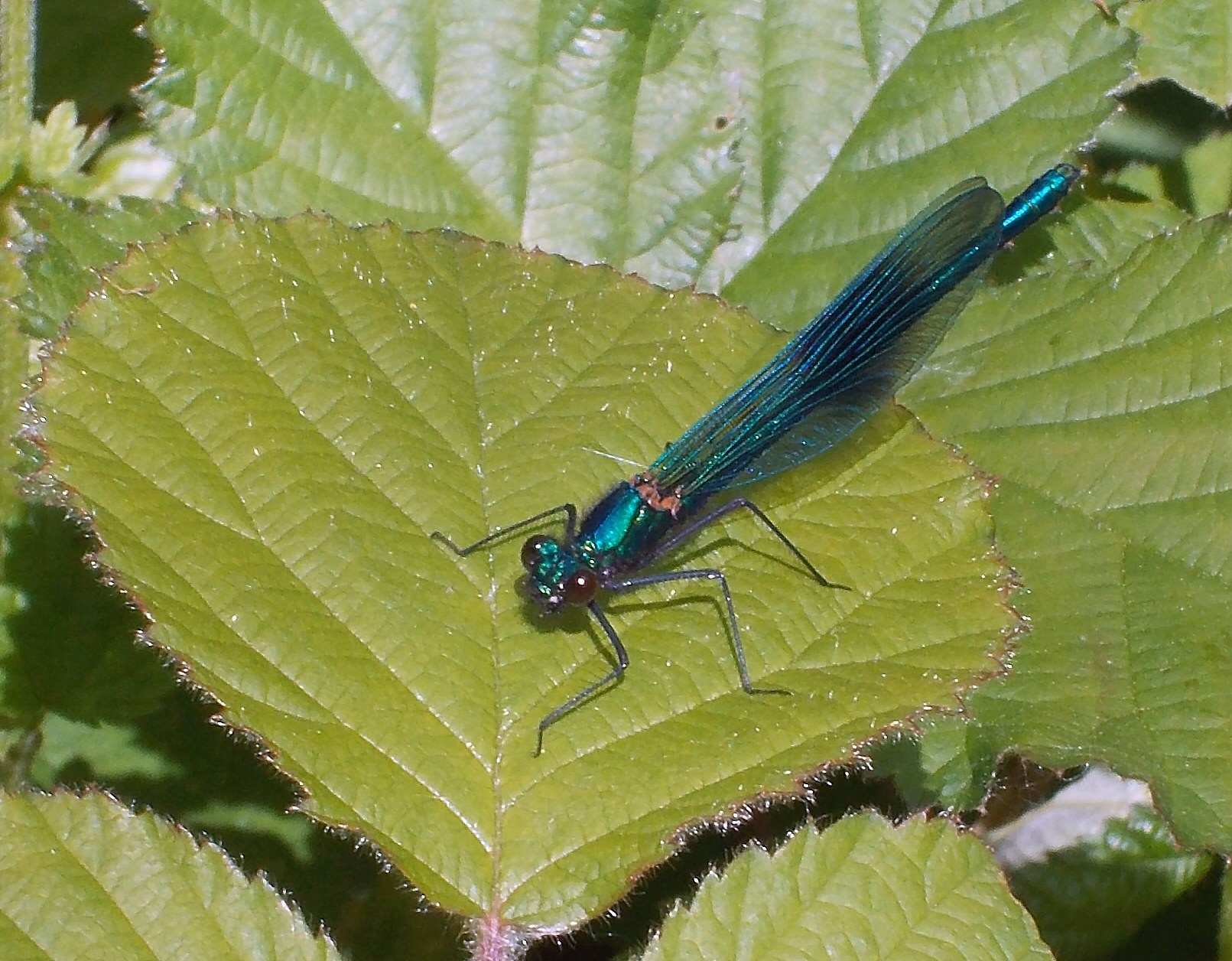
Male Banded Demoiselle on Bramble
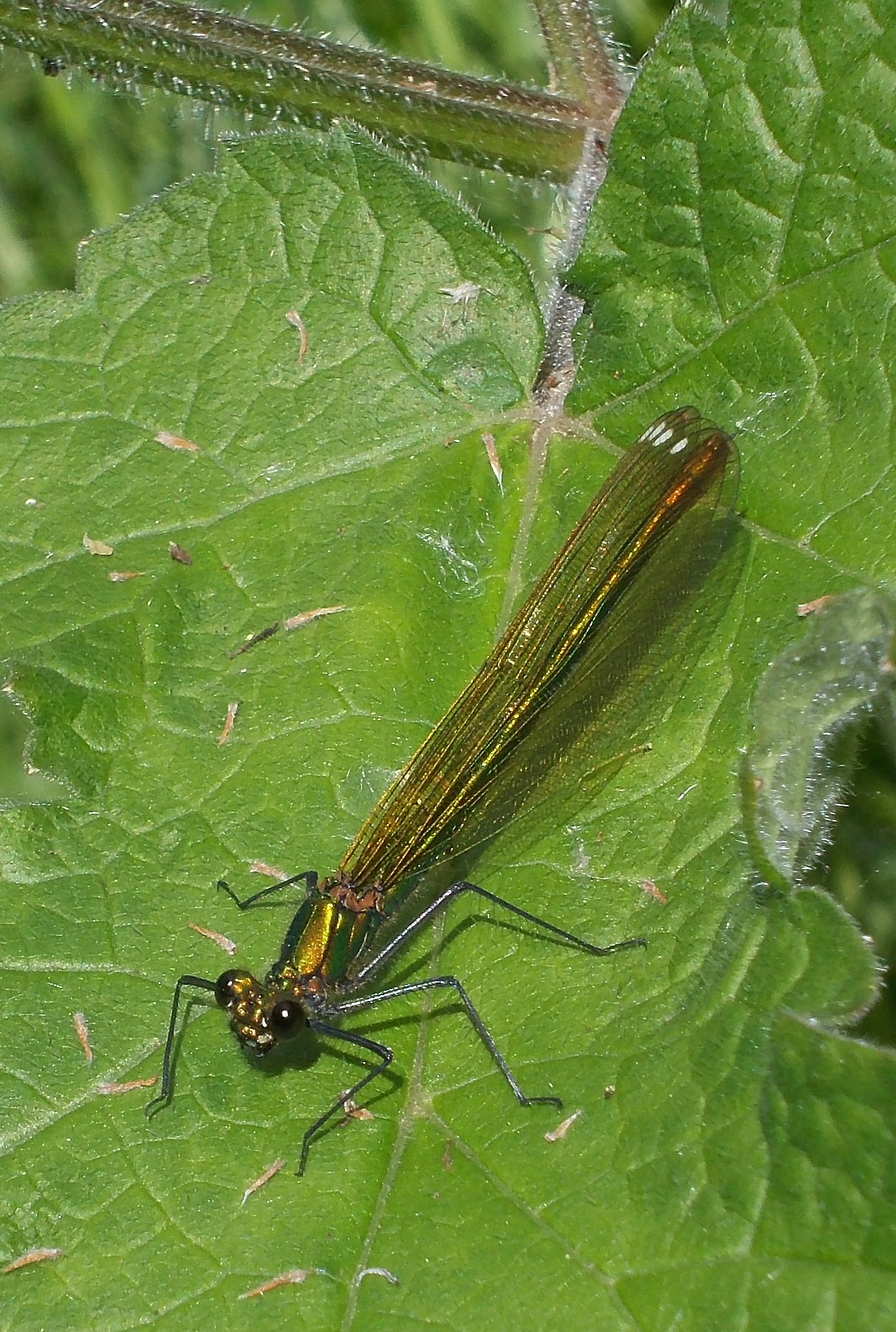
One of the glories of summer by water is the brilliant turquoise and green iridescence of the male Banded Demoiselle – the so-called band is actually the appearance of flickering of the wings, the dark spot on each of the four wings giving a hard-to-describe semblance of a sparkling blue jewel in flight, with bands of colour too fast and changeable for the eye to understand. But he’s pretty fine at rest, too.
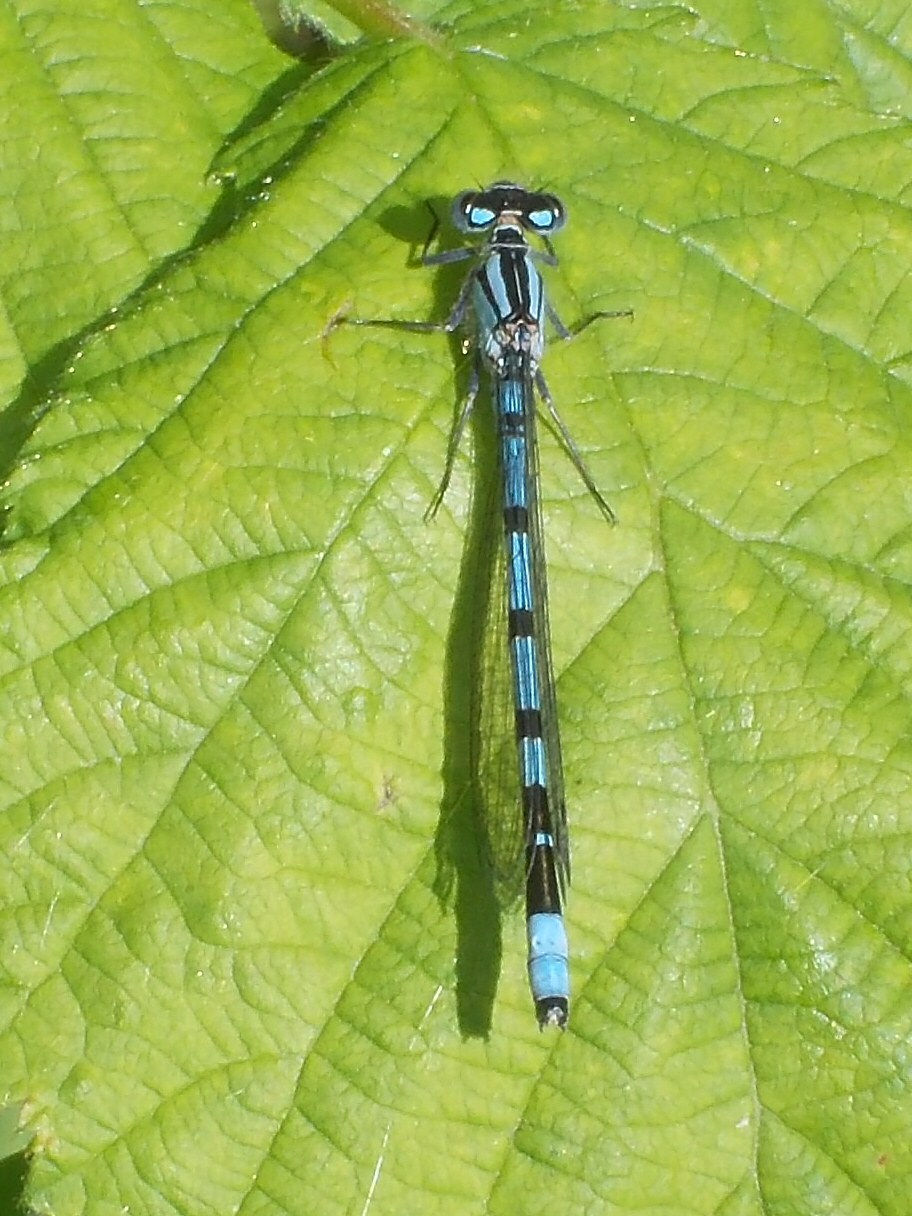
Male Common Blue Damselfly
Common Blue, Bluetail, and Red-eyed Damselflies have all now emerged, the Red-eyed being the scarcest of the three, seemingly.
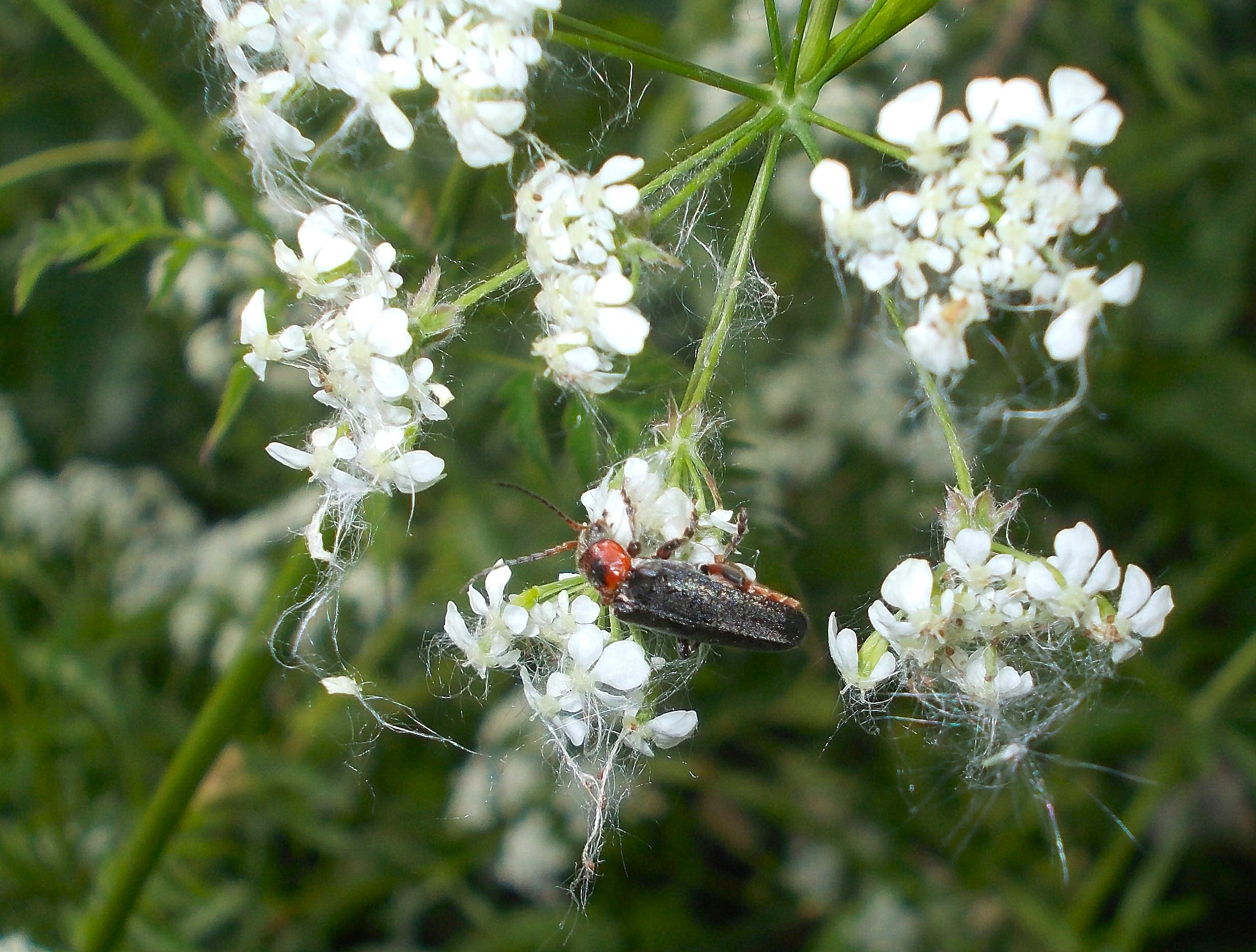
Soldier Beetle, Cantharis rustica on Cow Parsley
On the Cow Parsley were, as well as the damsels, two cantharid Soldier Beetles, Cantharis rustica or a close relative. Another enormous cloud of rising mayflies, and suddenly behind them a pair of Hobbies, hawking for insects – whether damselflies or even mayflies is impossible to tell. One comes close, wheels away on scything wings as it sees me.
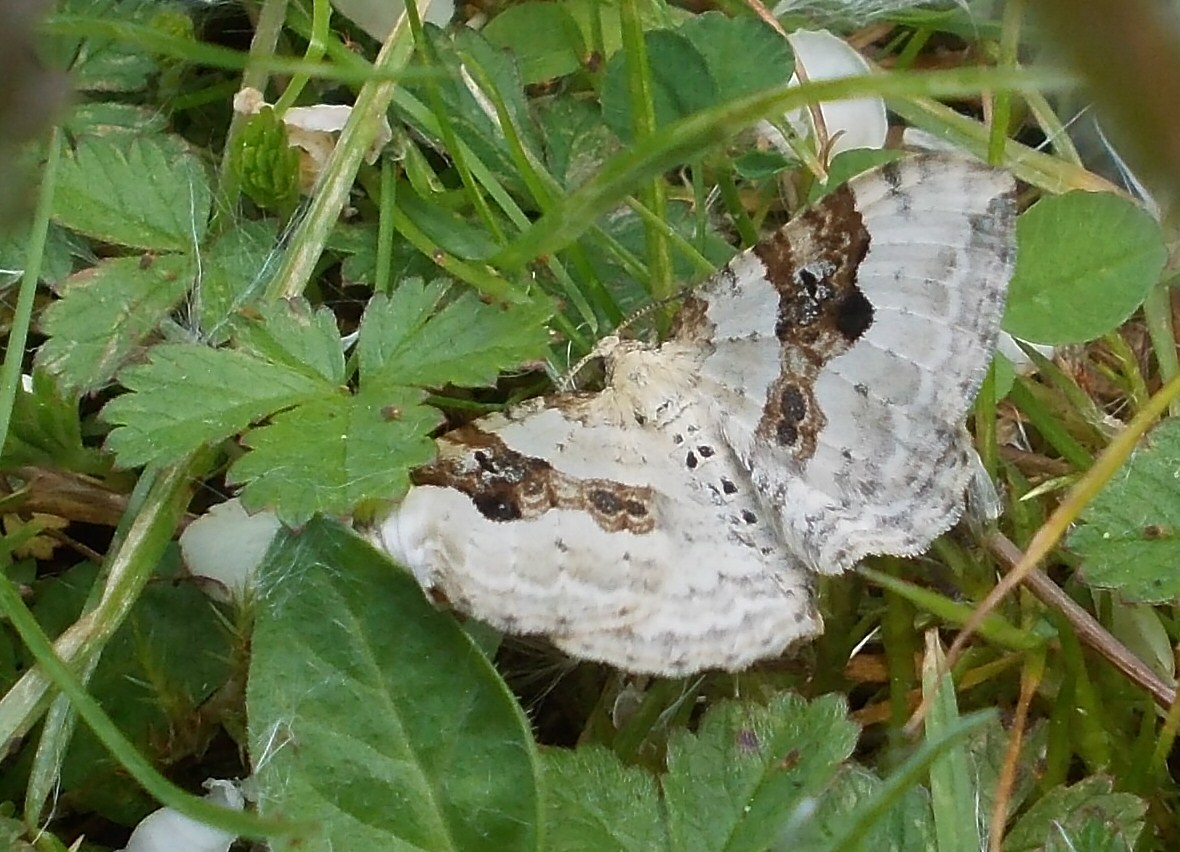
Silver-Ground Carpet Moth Xanthorhoe montanata
A Silver-Ground Carpet Moth, Xanthorhoe montanata, flutters weakly past me among the Hawthorn bushes and flops onto the grass. Garden Warblers sing, a Whitethroat rasps in its songflight. A Treecreeper sings its little ditty sweetly from near the river.
On the hill, three Greylag and two Egyptian Geese form a peaceful flock. Stock Doves and a mixed flock of Crows and Jackdaws rise from the grass. A Song Thrush gives a marvellous solo recital near the road.
“We’ve had a creationist … babbling away in the comments. He’s not very bright and he’s longwinded, always a disastrous combination, and he tends to echo tedious creationist tropes that have been demolished many times before. But hey, I’m indefatigable, I can hammer at these things all day long.”
Thus speaks Pharyngula (P. Z. Myers), most indefatigable of science (or should that be, anti-nonscience) bloggers. He’s been at it since 2002, and in that time he’s written about a huge range of topics.
On the way, he’s acquired a nonscience enemy who’s closely enough stuck to him (opposites attract) to have an antiblog of the same name. It’s almost a fanpop website, complete with photo portraits, CV, and a section called ‘What the heck is a pharyngula?’ which actually answers its own question. It’s a stage in the embryonic development of vertebrates, following the more familiar blastula, gastrula and neurula stages (pay attention at the back there).
He has even, by dint of writing accurately and entertainingly, and by speaking truth to twaddle, acquired his own Wikipedia article, quite a feat since generally self-published blogs are considered inherently “non-notable” by that august establishment. My spellchecker just suggested “Windpipe” for Wikipedia, not a bad try. Anyway, Windpipe tells me he won the 2005 Koufax (who?) Award for Best Expert Blog, and he certainly deserves it.
But too much of Pharyngula’s time, and the world’s, is taken up with kicking “Bad science” – he also has categories for “Bad Science”, Creationism, Godlessness, Denialism, Kooks, and Weirdness, and I expect I missed a few more. It’s a lot of energy.
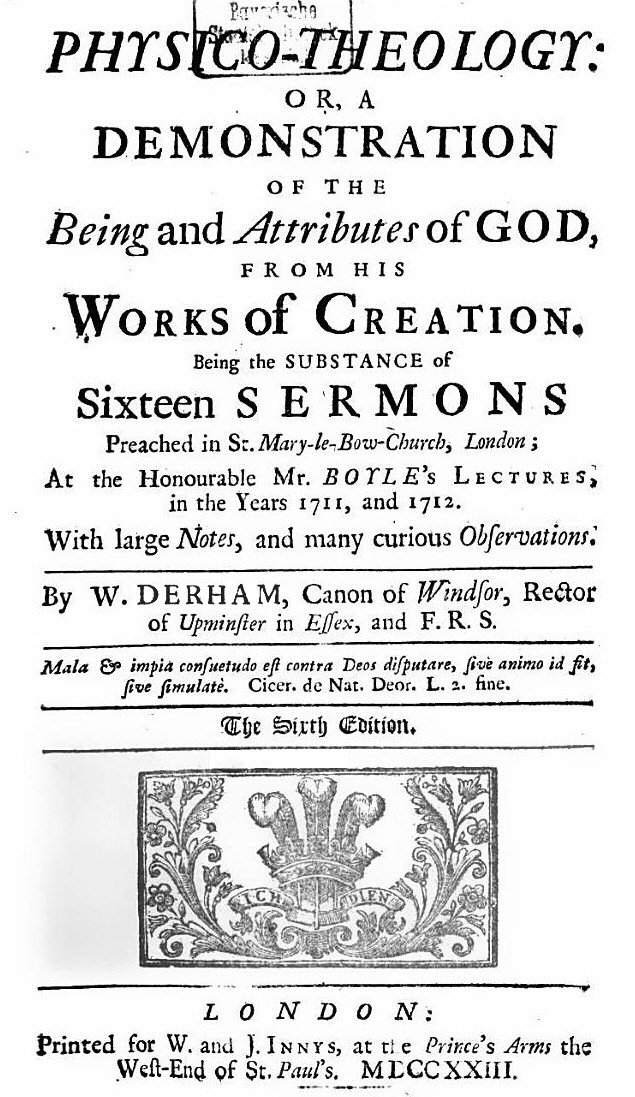
I’ll write about the history of it another time – the Argument from Design thing has been going on since at least 1713, when the Revd. William Derham published his Physico-Theology.
William Derham’s Physico-Theology, first published 1713 (this edition 1723)
The curious thing about physico-theology, natural theology, intelligent design, Paleyism or what have you is that it is a circular argument. There’s assumed to be a Creator. The Creator is assumed to be good. Things in nature are seen to be well-adapted, e.g. the wings of birds are well adapted to enable them to fly. Since birds have been created, the Creator must be good, and must exist. Errm, something not quite right in this argument… it’s logically hopeless to assume what you’re trying to prove, regardless of any external facts. Assuming for sake of argument that there is a good Creator, the existence of birds with well-adapted wings says precisely nothing about that Creator. The birds might always have existed, or might have been created in a Manichean universe by an evil being, or might have evolved all by themselves, there’s no telling just from the excellence of adaptation of the wings on the bird.
Curiously, “the survival of the fittest” looks at first sight like a circular argument, and intelligent writers like John Stewart Collis have fallen into the trap of thinking that’s what it is. But it isn’t. Darwin didn’t say that the ones that survive, survive, so species evolved — the first part says nothing, and evolution doesn’t follow. Darwin did say that the ones that don’t survive, don’t have children. It’s a what-happens-in-the-next-generations argument, and that breaks the circularity. Or to look at it from the present back to the past, back all the way to the origins of life on Earth, each thing living now is descended from parents and ancestors which survived long enough to reproduce, while countless others failed to do so. Some were simply unlucky: in Darwin’s words, nature is prodigal: tremendously wasteful. Others were just slightly less well-adapted, just slightly less likely to survive long enough to reproduce, and did not so survive. The result: in each generation, the offspring carry the genes of the just slightly better adapted. Darwin was right, it is a prodigiously wasteful mechanism. A more wasteful approach could not be devised — you generate a tremendous variety, and in each generation you throw almost all of it away. Out of thousands of eggs in frogspawn, only a few will become adult frogs; out of tens of millions of eggs of the Atlantic cod, only a few will become adult fish that breed. “Only the fittest survive”: not exactly. Many perfectly fit fish are unlucky. But the fit ones are on average luckier than the rest. It’s a slippery argument, though not really complicated, and it has to be stated carefully. But it has proven to be a pons asinorum for far too many.
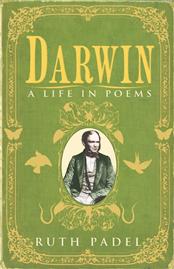
Right, I don’t review poetry books, and I don’t read them that often either, though I have my favourites. But this one is extraordinary. I very nearly read it in one sitting, as Claire Tomalin claims she did on the back cover, but I had to make do with two sittings instead. Gushing newspaper critics often say they couldn’t put a book down. In the case of Padel’s Darwin, it was almost true for me.
Padel is Charles Darwin’s great-great-granddaughter. She heard her grandmother (and Darwin’s biographer) Nora Barlow, aged 95, reminiscing about her grandfather. Reading this book, I was in no doubt that Padel, too, could easily have written a prose biography of her ancestor. But I’m very glad she didn’t. What she has achieved in Darwin, A Life in Poems is a miracle of conciseness. We say a picture is worth a thousand words: a good poem, more so. With a poet’s and a granddaughter’s sensibility, Padel builds up, step by step, poem by poem, a glittering portrait of the great man. Each moment is encapsulated, seemingly without effort, certainly without a wasted word, in a short poem.
I read the first one or two, and felt — they were quite good, and I might soon stop for a cup of tea. I read the next few and the little marginal notes attentively, and started to feel these were rather enjoyable, easy to take in, giving quite a nice picture of the young Darwin in Shrewsbury. I began to reflect on the choice of imagery, how collecting allowed him “to assert control over what’s unbearable.” Unbearable. Collection was about pain? I read a few more. Barmouth: “A child on a beach, alone.” Five lines of the eleven in the poem were a single extended quote from Darwin’s own notes, laid out as verse. Ingenious. Did they scan? Yes, they seemed to have a kind of metre. How subtle were her rhythms? An hour later I was still reading.
Rhythm, metre, the feel of the words; the choice of topics; the use of materials; the different shapes of the various poems. Many are short, in three-line stanzas: “The forms are themselves. They do not change with the changing light / but unfurl in the mind. They swirl and settle new / in the kaleidoscope in his head” — it could be the start of something quite abstract, something about a drug addict or … a visionary. That poem is “The Tiger in Kensington Gardens”, Darwin’s thought wandering to imagining “if a tiger stalked across the plain behind / how feeling would be ignited”. It is light as thistledown, compact, dreamy.
One or two poems are longer: Alfred Russel Wallace’s “Journey up the Sadong River” — Padel travelled extensively in the East, wrote a nature book, Tigers in Red Weather — has four-line stanzas, more of a plodding rhythm, an earnest self-taught Victorian: it is with a shock I realize the first 27½ lines are a direct quote from Wallace! What a marvellous, virtuoso trick: what confidence as a poet, what insight to feel and to share Wallace’s prose for what it is, at its best: exciting poetry.
And the pieces fit together to make the puzzle: the wood comes into focus from the individual trees: Darwin the man emerges from the hundred-odd poems. How did she do that? I suppose a prose writer can occasionally get away with a flabby analogy, a woolly opinion, a soggy simile. A poet cannot: certainly not a modern poet, writing short pieces: each must work, or fail utterly.
I have read a few ‘natural history poems’, some simply bad, some cheerfully zoological, like Walter Garstang’s The Ballad of the Veliger (The Veliger’s a lively tar, the liveliest afloat… ), some, like Ted Hughes’s animals, enjoyably insightful. But I’ve never before experienced the life of a naturalist, perhaps the greatest one at that, in a whole book of poems, and it works wonderfully. Darwin, A Life in Poems is quite simply a triumph.
The sun is shining … in between the showers. Mayflies are resting all over the plants near the river. May blossom makes a bright show on every hawthorn bush. Yes, it’s May down at Wraysbury Lakes. The energetic breeze gives a cool feel, but out of the wind it’s very pleasant. Enjoying the brisk airflow are at least four Common Terns over the lakes and overhead; a few Swallows; and a small number of Swifts, newly arrived in the last few days, racing down to the water surface to catch flies — not the mayflies, which are active mainly at night. The warblers which are definitely about are hard to hear for the wind in the trees, but I caught snatches of Chiffchaff, Blackcap, many Whitethroats, plenty of Garden Warbler, a Willow Warbler, three Song Thrushes and a Blackbird, not to mention Robins and Wrens. A Cormorant lumbered past, climbing with effort, its jizz very much like that of the Boeing 747s lumbering heavily into the air.
Mayfly look, but no tails. Hmm
There are some pale mayflies, with neither antennae nor the 3 tails: maybe these have broken off in the vegetation.
Beautifully iridescent green-bronze: a female Banded Demoiselle
Also new today are quantities of damselflies: there are many brilliant iridescent blue male Banded Demoiselles, with their beautifully clear green-bronze females. This one seemed definitely to be watching me attentively. Two small blue species have also emerged, Blue-Tailed Damselfly and Common Blue Damselfly.
Over the lake, a long-winged falcon swooped at speed: I wondered for a moment if I had a Cuckoo, but the moustache and white face markings showed it was a Hobby, arrived from Africa in pursuit of the Swifts, and perhaps hunting damselflies as easier prey in this place. The low number of Swifts is worrying; they have been declining for years, as building renovation removes their old nest-holes, and increased human population pressure in Africa threatens them there too.
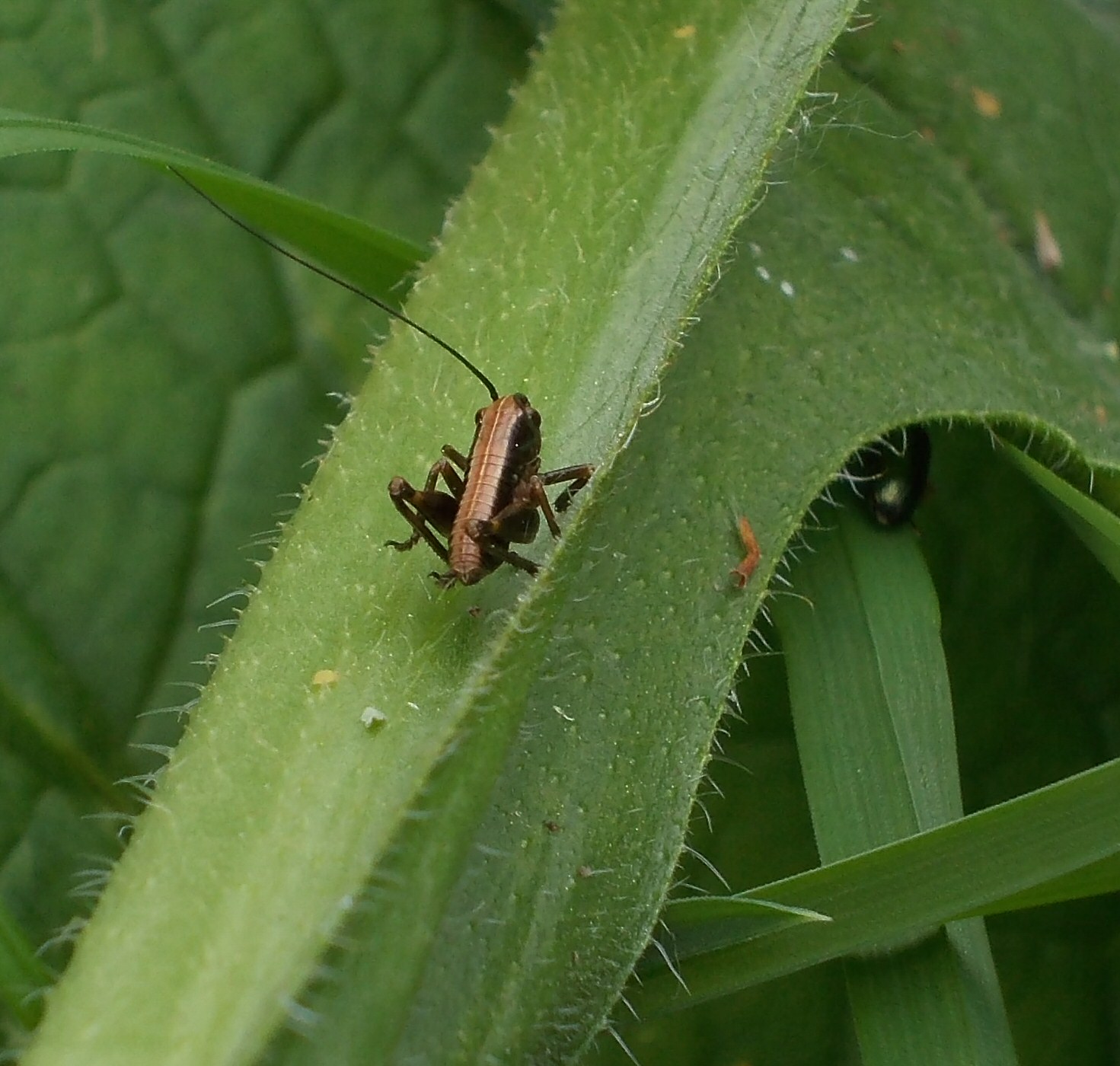
A small Grasshopper on Comfrey
This small grasshopper, missing an antenna, is my first of the year.
Further along, the bare damp area that often has teasels is bright yellow with clumps of a yellow Brassica that has clasping leaves like wild turnip (or cultivated swede). There’s a definite cabbagey smell. A Whitethroat, caught out in the open, makes a dash for a bush.
I made a mental note a while ago only to review books that I really loved: books that were special, that I’d go back to, that I’d wholeheartedly recommend to close friends. Life is too short to review books that were merely so-so, acceptable, somewhat informative, useful as background. I read (parts of) many of those, “researching” subjects and places, and for the most part once I’ve done what I wanted the book goes on a shelf and stays there.
Books that stick in the mind, that quietly speak to me long after I last dipped into them, are a small proportion. It is only too easy to buy something that looks inviting, only to find after a chapter or two that it’s a bit overblown, poorly argued, limply presented. Books that are specially trumpeted are particularly at risk here. Amazon reviews tend, on average and given sufficient quantity, to be truthful: of course authors ask friends to review their books (we all do it) so you need a good sample to get a genuine impression from readers, and, caveat emptor, you should read between the lines to see if the reviewer is real and appreciating the book in the same way as you.
I mention all this because I took a look at my most recent shelf of books with an eye to writing a review. The internal dialogue went something like this. “Um. No. Gulp, not that. Reviewed that already. no. No. no. Ah.. no, did that back in 2007. No, no, no, no, no. Erm, not much here. Hold on, did I ever do Notes from Walnut Tree Farm? Time I did.”
Roger Deakin wrote two marvellous books, Wildwoodand Waterlog. It isn’t accidental that they both have something to do with wood in their names: Deakin was very close to wood, and had carpenters and men named Wood in his family. He then died suddenly, leaving 45 notebooks full of daily observations of all kinds, written in the last six years of his life. Alison Hastie and Terence Blacker took on the task of selecting extracts and arranging them into a composite year.
Walnut Tree Farm was Deakin’s house in the Suffolk countryside. It was timber-framed, in other words made of local wood. He bought it in ruinous condition, and rebuilt it himself: a mediaeval house, with a moat that he liked to swim in. Every corner of his life was of a piece, intensely personal, fully and passionately experienced. His writing is cut from the same sturdy oak.
Fire: nothing gives me more comfort or more anxiety than fire.
Look up Cobbett on the laying of fires — talk about bread ovens and faggotts of furze for bread-making.
The fireplace has been subsumed by the TV, pushed out of the nest as by a cuckoo. People now contemplate the TV, not the fire.
What is it about Deakin’s notes that is so compelling? Reading him on fire just now, I can hear the crackle of logs in the grate, smell the woodsmoke, feel the pleasure as the flames flicker red and yellow. I would call him a sensuous writer, at the risk of being misunderstood: he does not write purple prose. He feels life directly and communicates his sensory experience in clear, straightforward words, the opposite of rambling, yet he conveys the impression of relaxed thought, of coming upon interesting things and reflecting on their possibilities. Reading him feels very private: it’s like being in his mind, a privileged position.
Deakin takes us — me, you —to Suffolk; to walk in the woods, to reflect on a dead, trapped fox, to watch the carp in his front pond, to listen to a willow warbler which “sings in the spinney by the old goat sheds”, to join him scything his lawn by hand, cooking on a “little cast-iron stove” from Morocco, having “singing lessons with Mrs Gillard, who put her hands on my stomach as I sang”. It’s extraordinarily varied, authentic in every corner, always warm, always intelligent.
There is nothing else like Notes from Walnut Tree Farm: fresh, insightful, funny, stimulating, informative, peaceful, full of life and nature. Please read it.
Further to the World on a Blackcurrant Leaf, today the Ichneumons and the Harlequins were joined by two more conspicuous flying visitors, some green Shield Bugs (true bugs, Hemiptera) and some swift yellow-abdomened Sawflies, most probably Gooseberry Sawfly. Both of these are held in definite disfavour by many gardeners, the bugs for sucking plant juices and possibly weakening plants or spreading disease, and the sawflies for making caterpillars which in a bad year can totally defoliate gooseberry bushes — it only happened to me once, and it was quite a shock: from seeing the first little green caterpillars to leafless plants only took a week or so.
Since then I have carefully checked the gooseberry every few days for signs of sawfly damage (and actual caterpillars). If there are just a few, I remove the affected leaves and squash any caterpillars I find; this usually does the trick. If there are many, which has only happened once or twice, I consider spraying, choosing a time without wind, after sunset so the bees aren’t flying, and work close to the bush to keep the stuff local. The approach seems to work well for bees and berries.
As for the bugs, well, I rather like their handsome appearance and their confident swagger. There always seem to be enough currants so I don’t mind if the yield is down a bit on what it might have been.
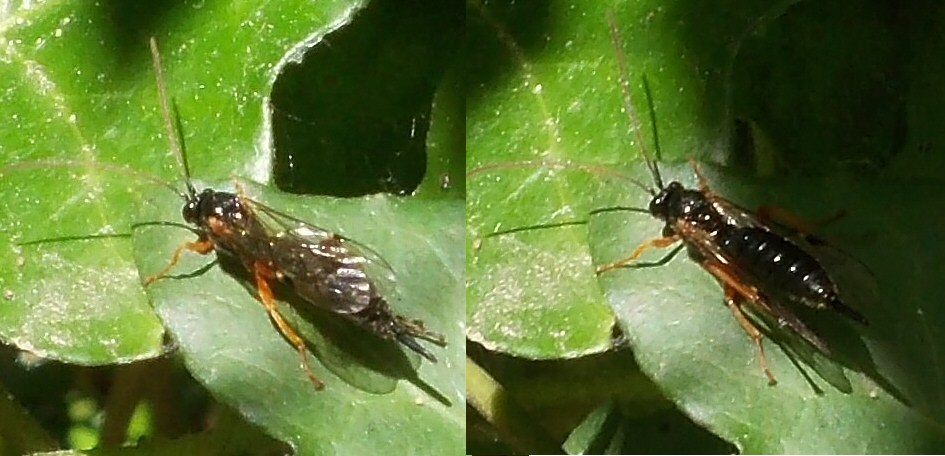
While doing the Butterfly Transect at the Gunnersbury Triangle, I came across a fairly large Wood Wasp (in the sawfly family), about 25mm long. It was a bit tricky getting a photo, as these insects are distinctly skittish – they race about in the shadows, occasionally perching on a leaf’s upper surface. The breeze was wafting the branches gently, so patches of sunlight came and went. I shot several images with the miniature camera – it has two big advantages over my full-size SLR: one, it has a very short focal length, so it has a better depth of field than an expensive macro lens; two, it’s small and cheap, so I habitually carry it with me in my rucksack.
Wood Wasp, cf Sirex, on Ivy
The two images here show (left) the resting position with the wings over the body, the long antennae, the alarming-looking ovipositor, and the orange-brown legs; and (right) the plump black abdomen with white spots. Perhaps the two images show that it’s rather hard to get a single image which is suitable for identification. This one looks like a Sirex so perhaps that’s what it is. The eggs are drilled into wood.
The butterfly transect yielded the first definite Green-Veined Whites, i.e. I was able to get close enough to be sure; until now they’ve all been “Small/Green-veined” worse luck. There were some Speckled Woods and an Orange Tip, too; a Brimstone turned up after I’d put the clipboard away.
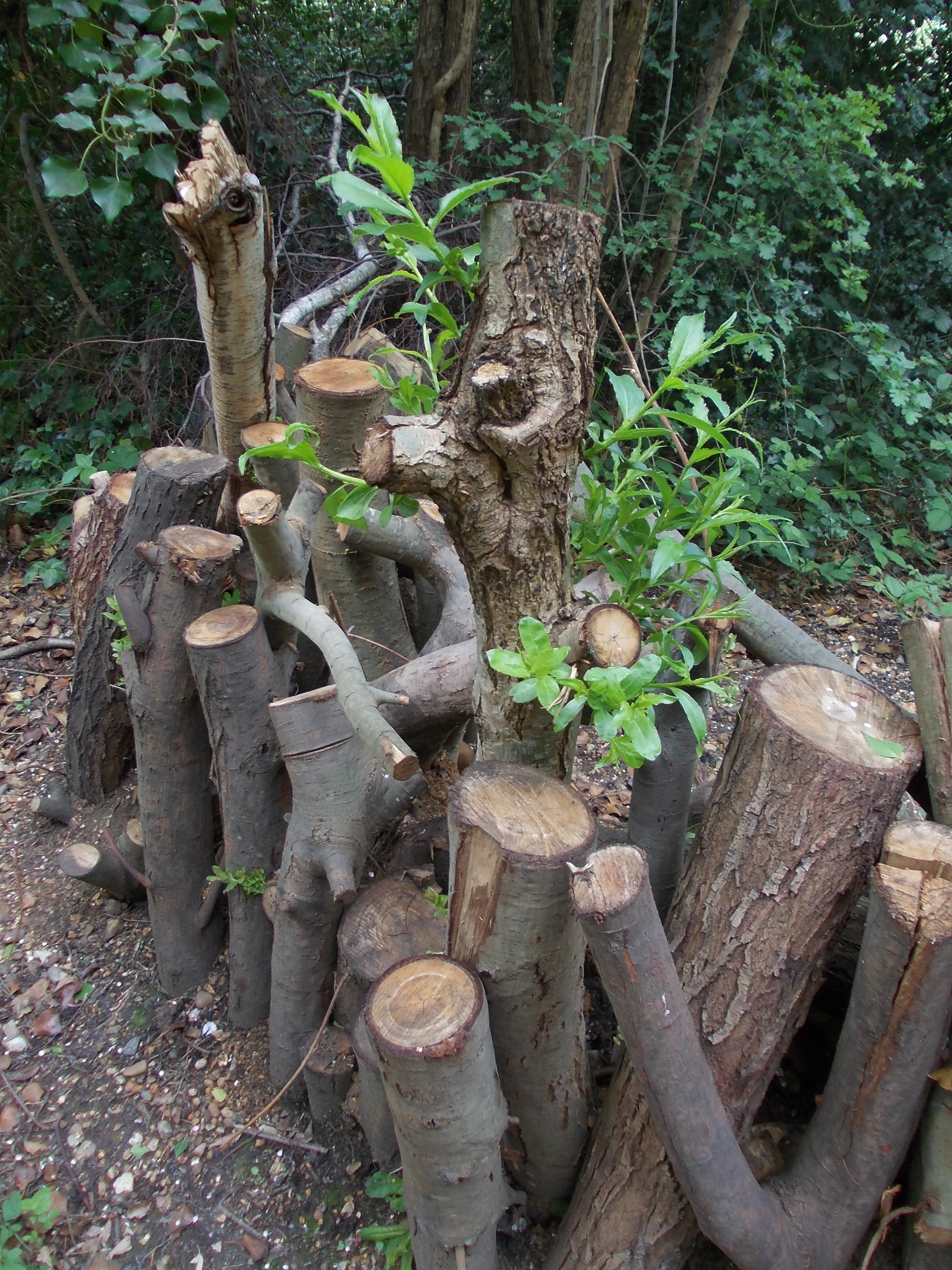
Sprouting Loggery
But the most curious observation of the day was this sprouting loggery. We ‘planted’ (more literally than we knew) the sawn Willow logs in the winter. They seem very happy in their new setting and are growing vigorously. It will be interesting to see how they get on.
One of the unceasing delights of nature is the feeling, some days more clearly justified than on others, of coming into contact with Darwin’s ‘endless forms most beautiful‘. A marvellous botanic garden – it has to be a large one, like Kew – takes one perhaps more directly into that space of wonder and delight than anything else, if it is laid out taxonomically to show the variation and diversity within one group after another.
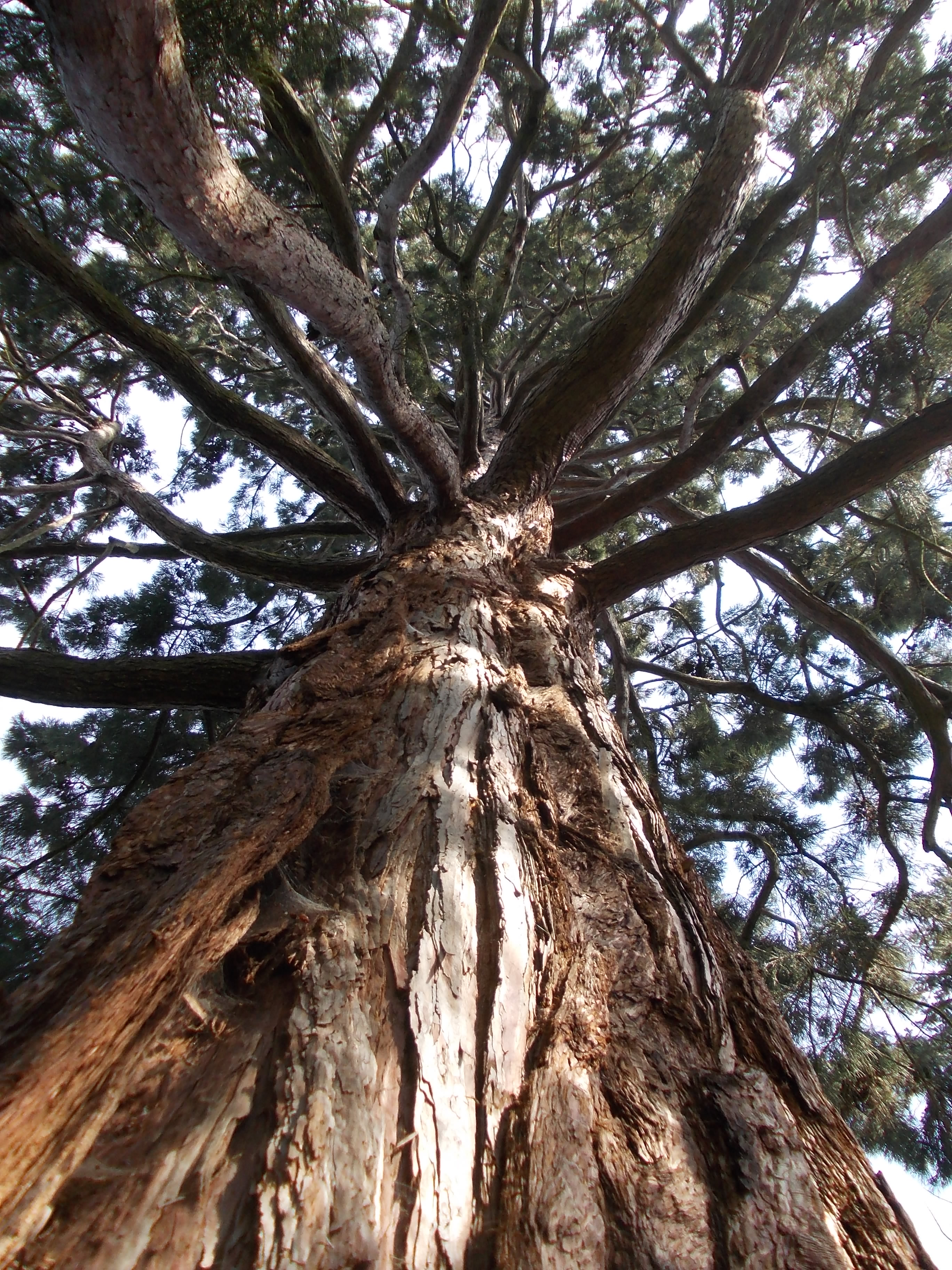
Today we wandered happily among the Conifer section of Kew Gardens, gazing straight up into the patches of sky between the radiating branches of the Giant Sequoia, feeling the soft fibrous red bark and wondering why everything is larger in America.
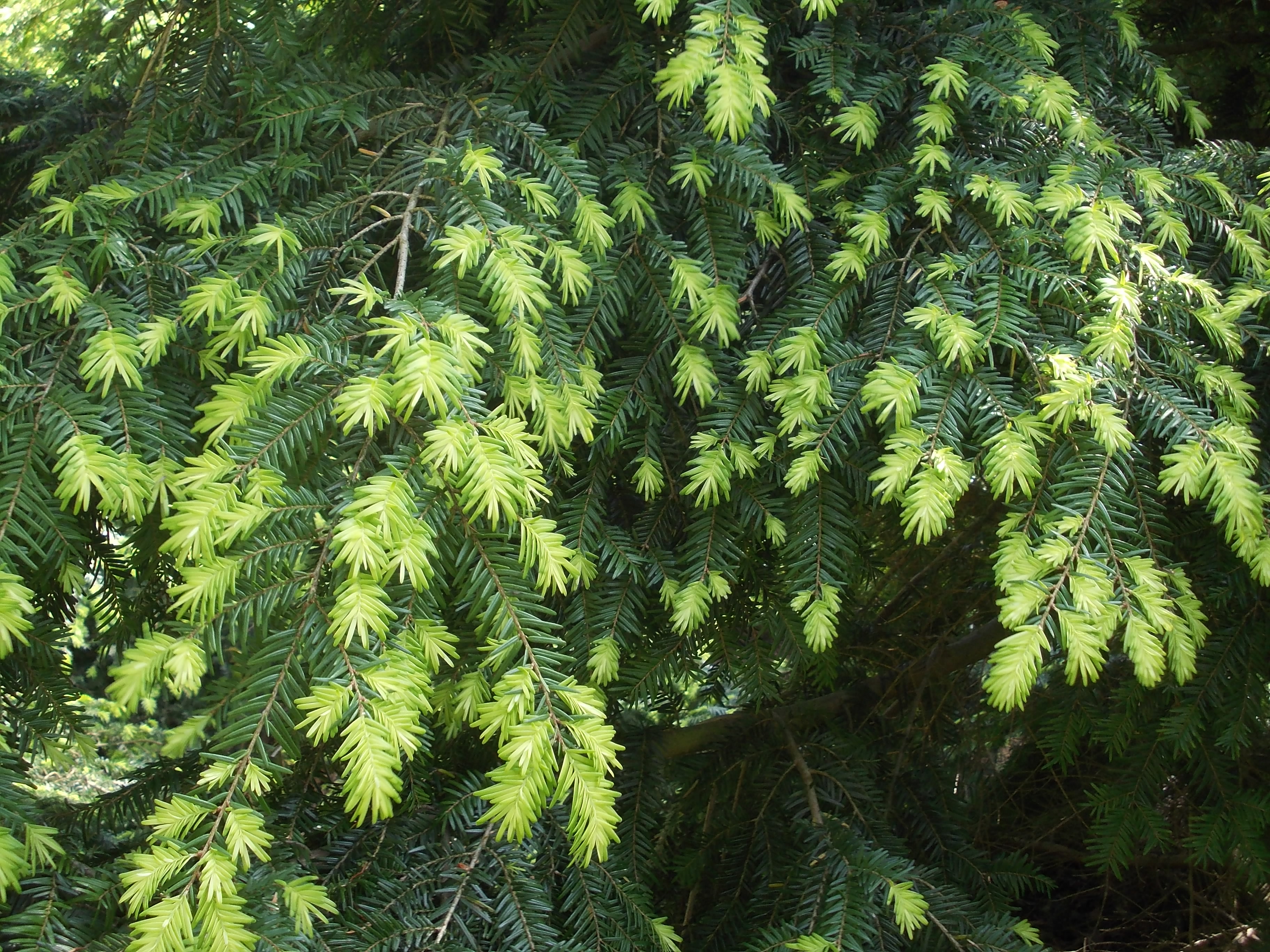
The pattern of new spring growth in Chinese Hemlock, Tsuga chinensis
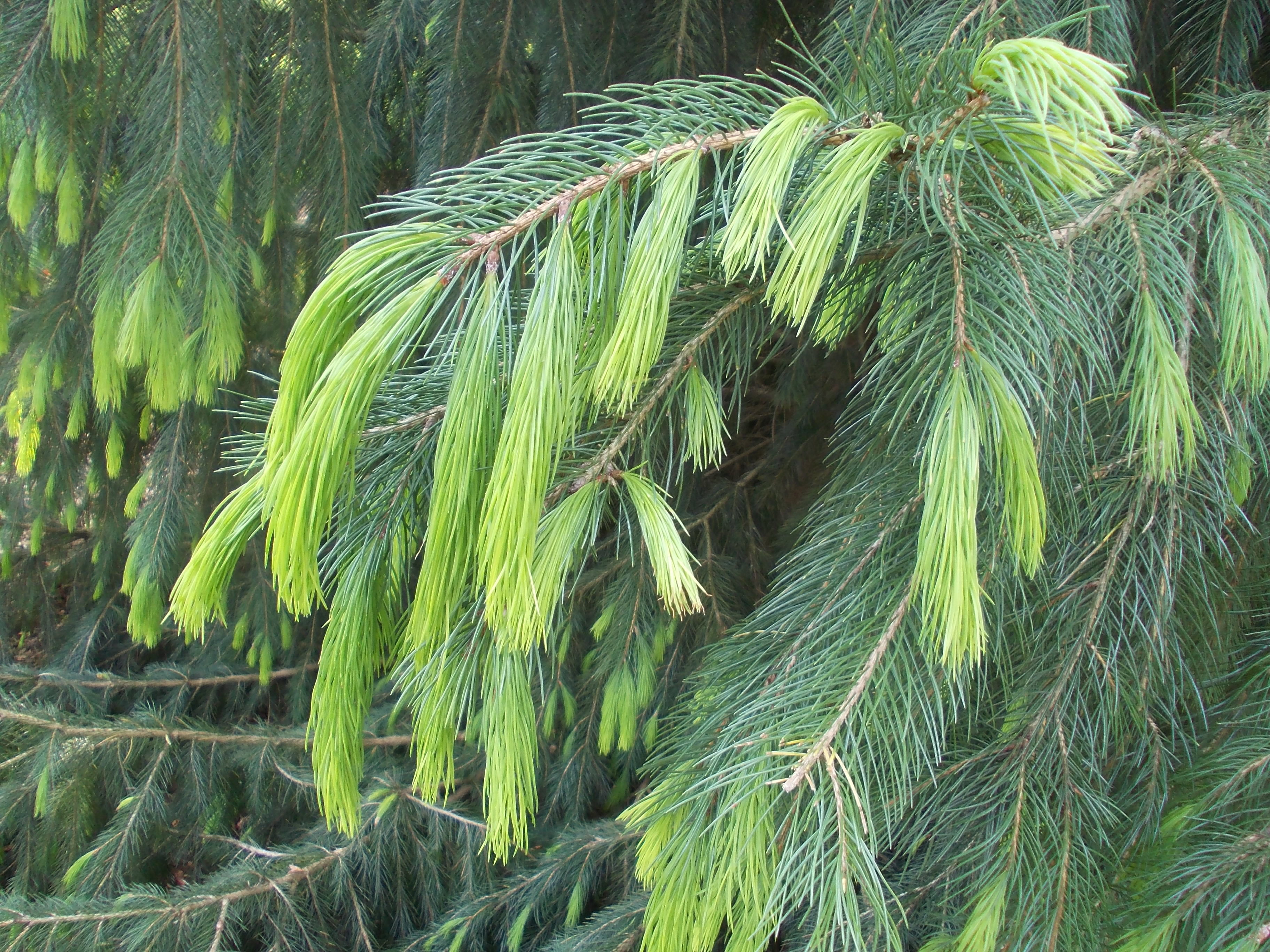
Then on to the Hemlocks and Spruces, delighting in the pattern of bright new bunches of needles scattered in diverse patterns among the older, darker growth: of course the new leaves are always at growing tips, so the patterns reveal the habit of growth of each species.
Quite a different pattern in Himalayan Spruce, Picea smithiana
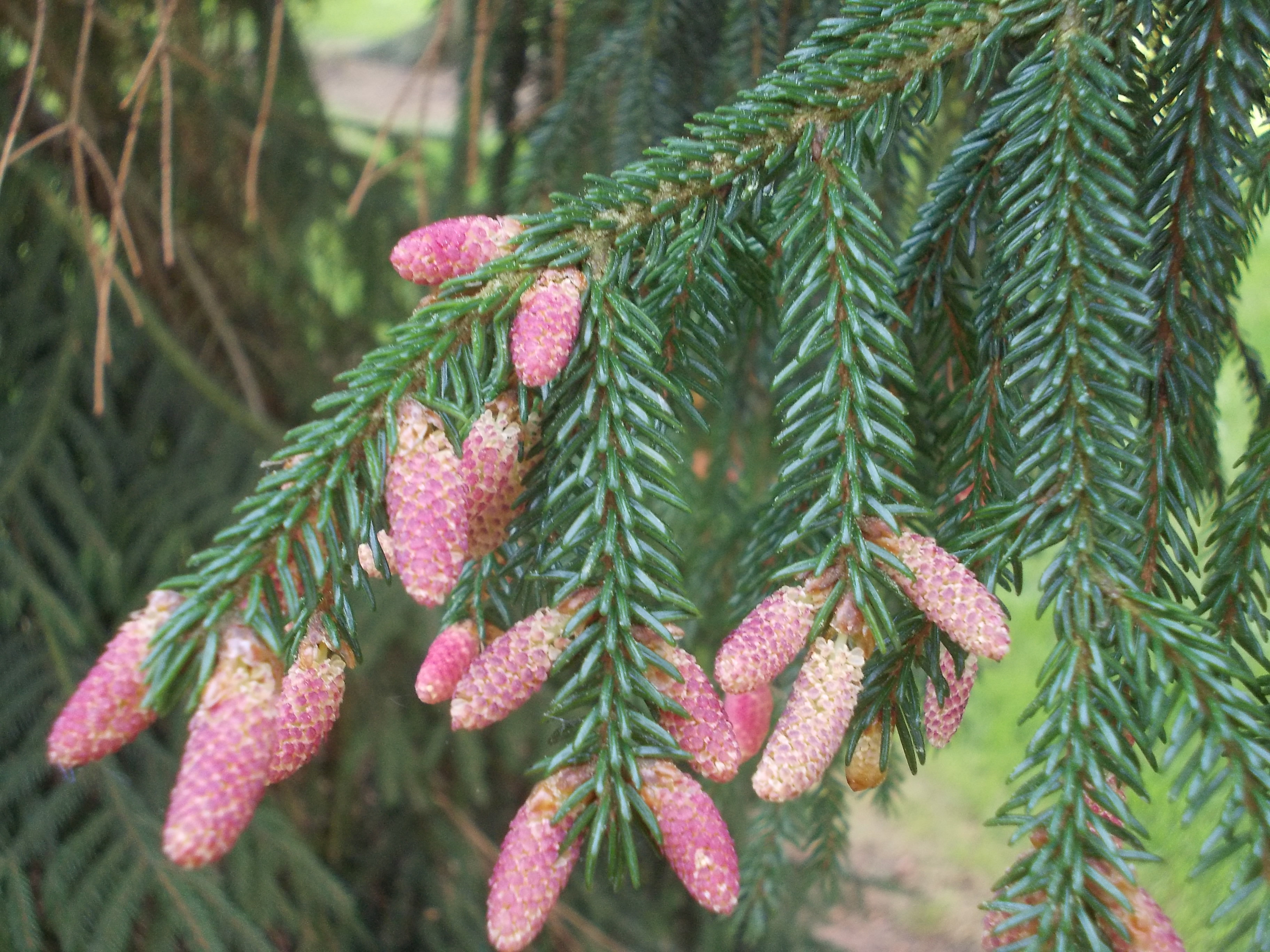
Many of the spruces are adorned with new male cones; those of Picea orientalis ‘aurea’ are a surprisingly pretty pink.
Male Cones of Picea orientalis ‘aurea’
The male cones of the Bishop’s Pine, Pinus muricata, from California are, on the other hand, grouped into pineapple-like spirals and surrounded by the Pine genus’s characteristic pairs of long slender needles, forming a fine rosette.
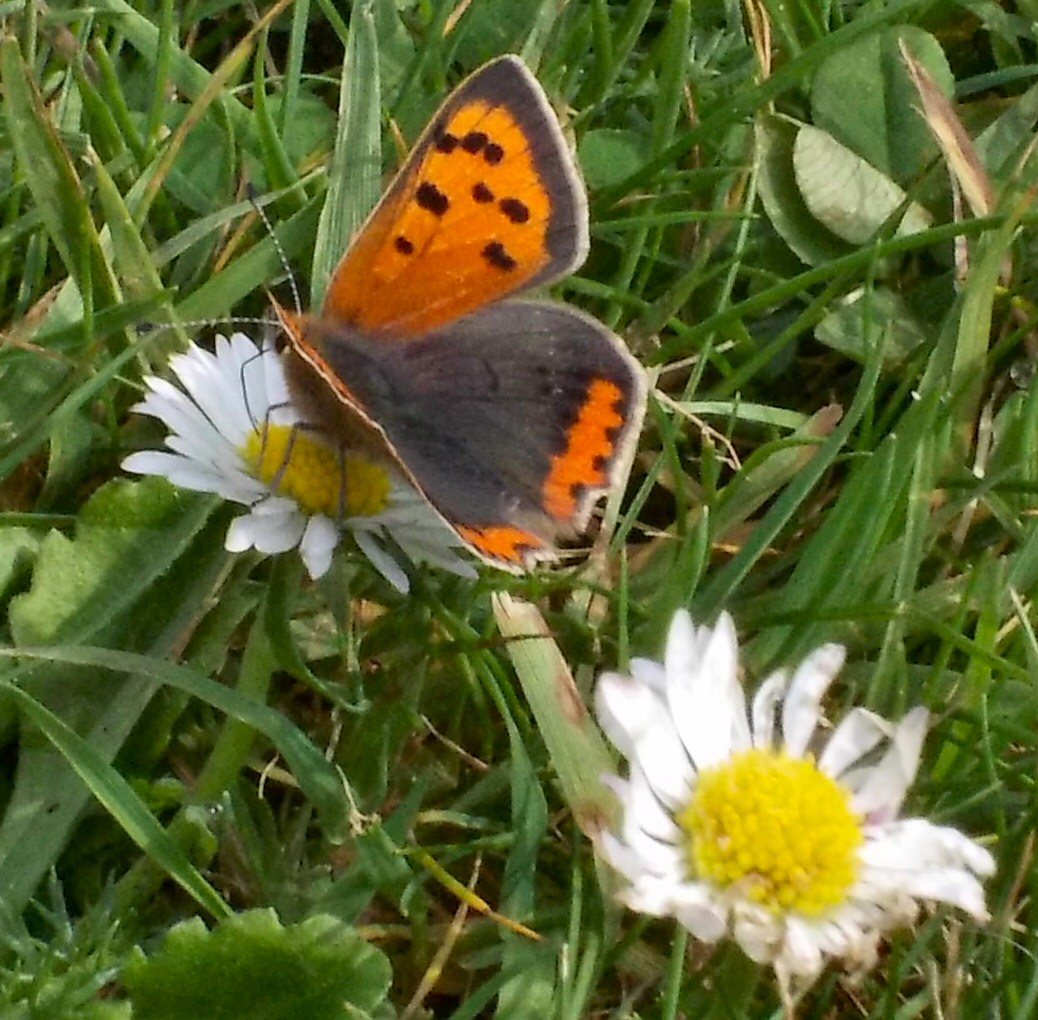
Down at the end of the gardens, Queen Charlotte’s cottage ornée (just for picnics, never inhabited; the royal party could walk down the mile and a half from the red-brick Kew Palace, or came (often) by carriage to play a la Marie Antoinette at having a little cottage in the woods. The 37 acres of bluebell woods around the cottage form a nature reserve, complete with real badgers, inside the gardens. As well as the Bluebells, Alkanet and Ramsons made the woodland floor lovely, while around the margins skipped Orange Tips, Brimstones, Peacock butterflies and Small Coppers. Fit for a Queen.
Small Copper on daisy
The English seem unemotional … except for their passion for nature