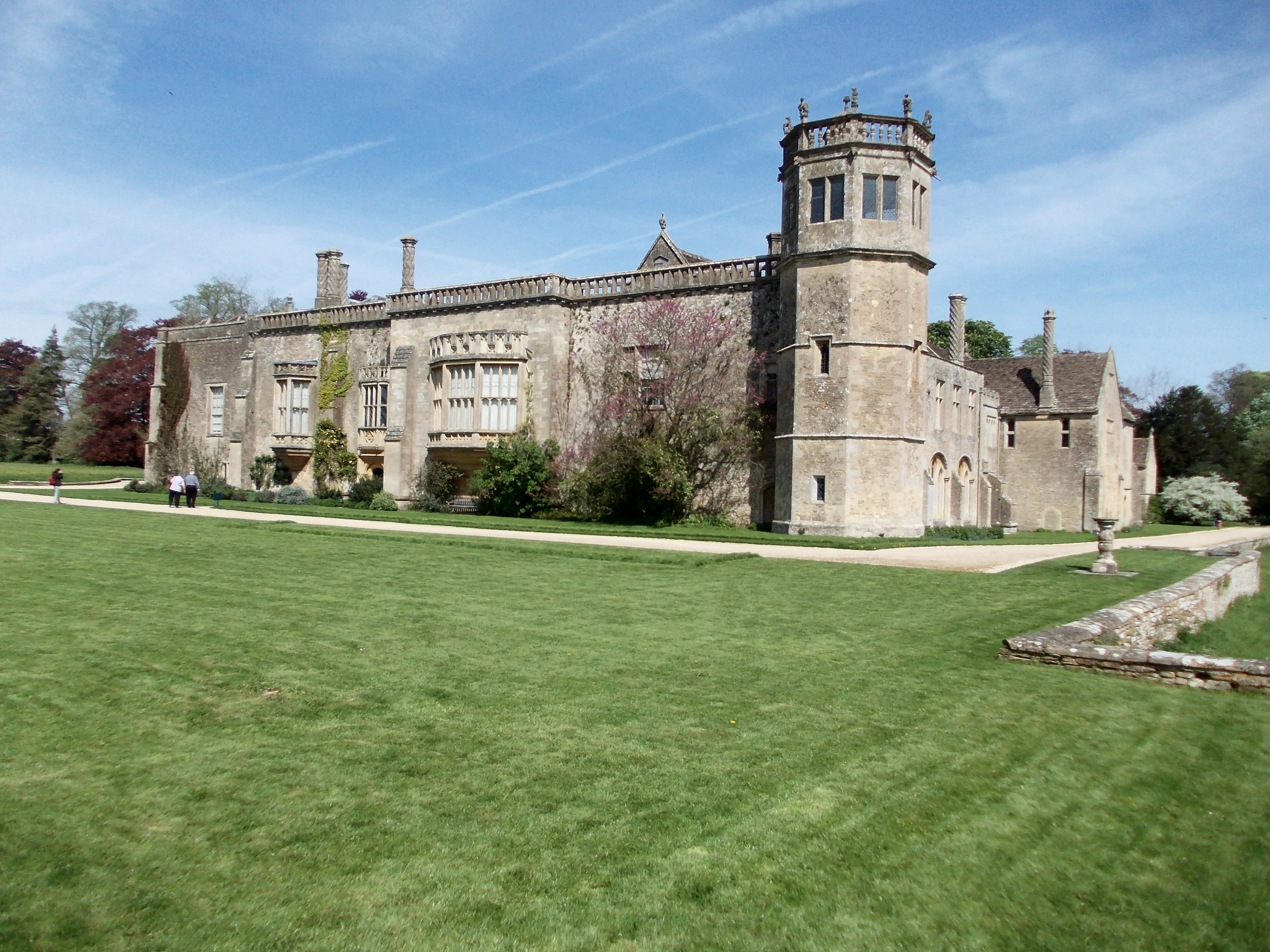
Lacock Abbey: it sounds innocuous enough. Suffice it to say that it is one of the very few mediaeval abbeys whose buildings survived the Dissolution of the Monasteries by Henry VIII. Many of our great abbeys were closed, stripped of all their portable assets, and allowed to fall down – Fountains, Rievaulx, Tintern among them. Lacock was slightly luckier: its Augustinian Canonesses – nuns to you and me – were sent away, the buildings sold by the king (not his to sell, really, but nobody felt like telling him so) to William Sharington, who knocked down the church (it would have been on the green lawn in front of the house), used it to build himself a brewery and other practical outbuildings, and converted the abbey itself into a comfortable house. One of his descendents, Olive, inherited the property and married a Talbot. Fox Talbot, centuries later, was lucky enough to have the time and space to play about, and one thing he played about with was photography.
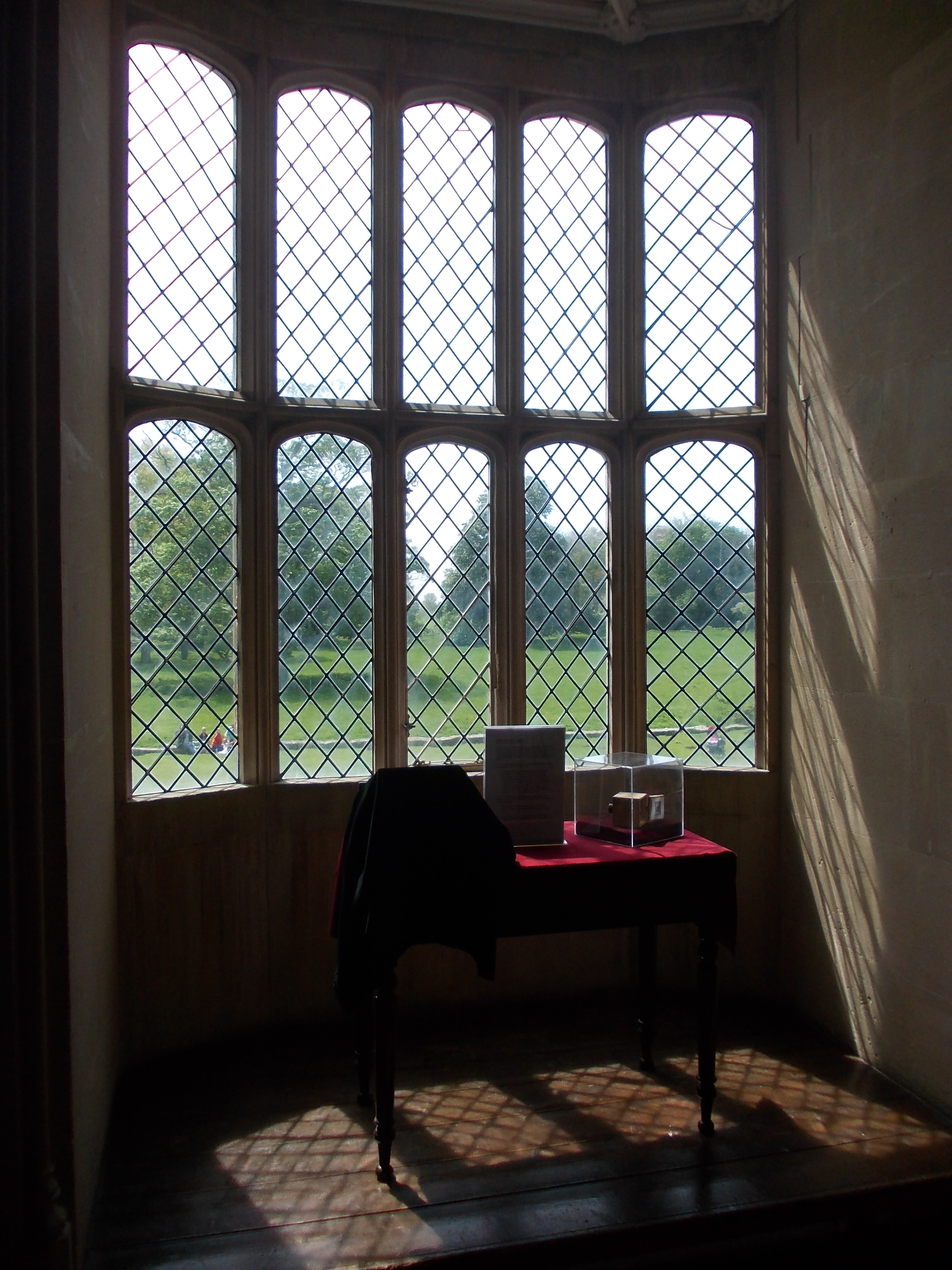
Fox Talbot’s window at Lacock, subject of his first photograph
His first, famous, photograph was a postage-stamp-sized negative and positive of this window, looking out the front of the erstwhile Abbey. Many of his (not much) later photographs were of natural subjects, not least of the patterns of veins in leaves. In other words, as soon as people had the technology to photograph nature in detail, they did so, from the first man. Fox Talbot thus qualifies as ‘obsessed by nature’ (.com).
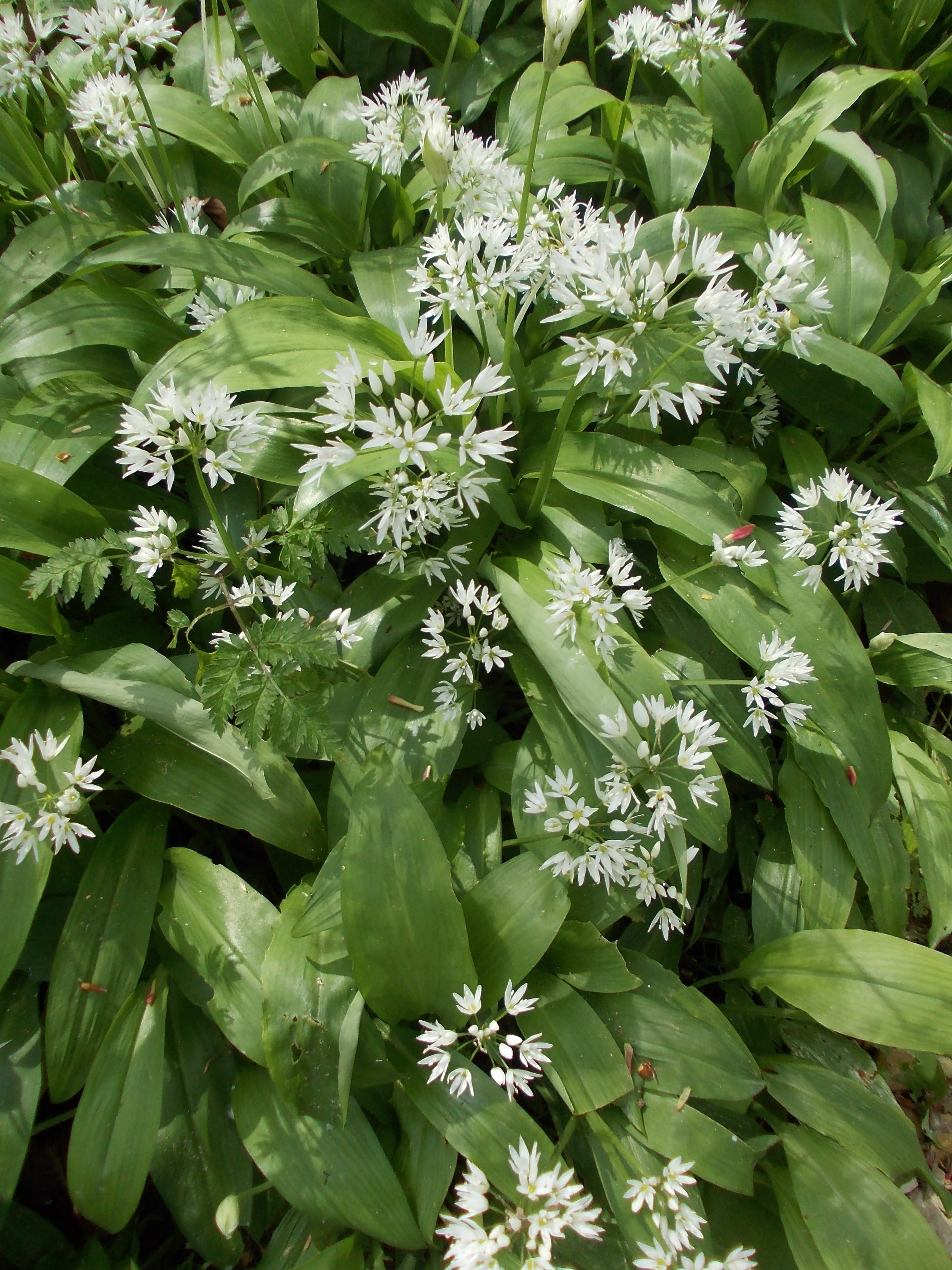
Ramsons
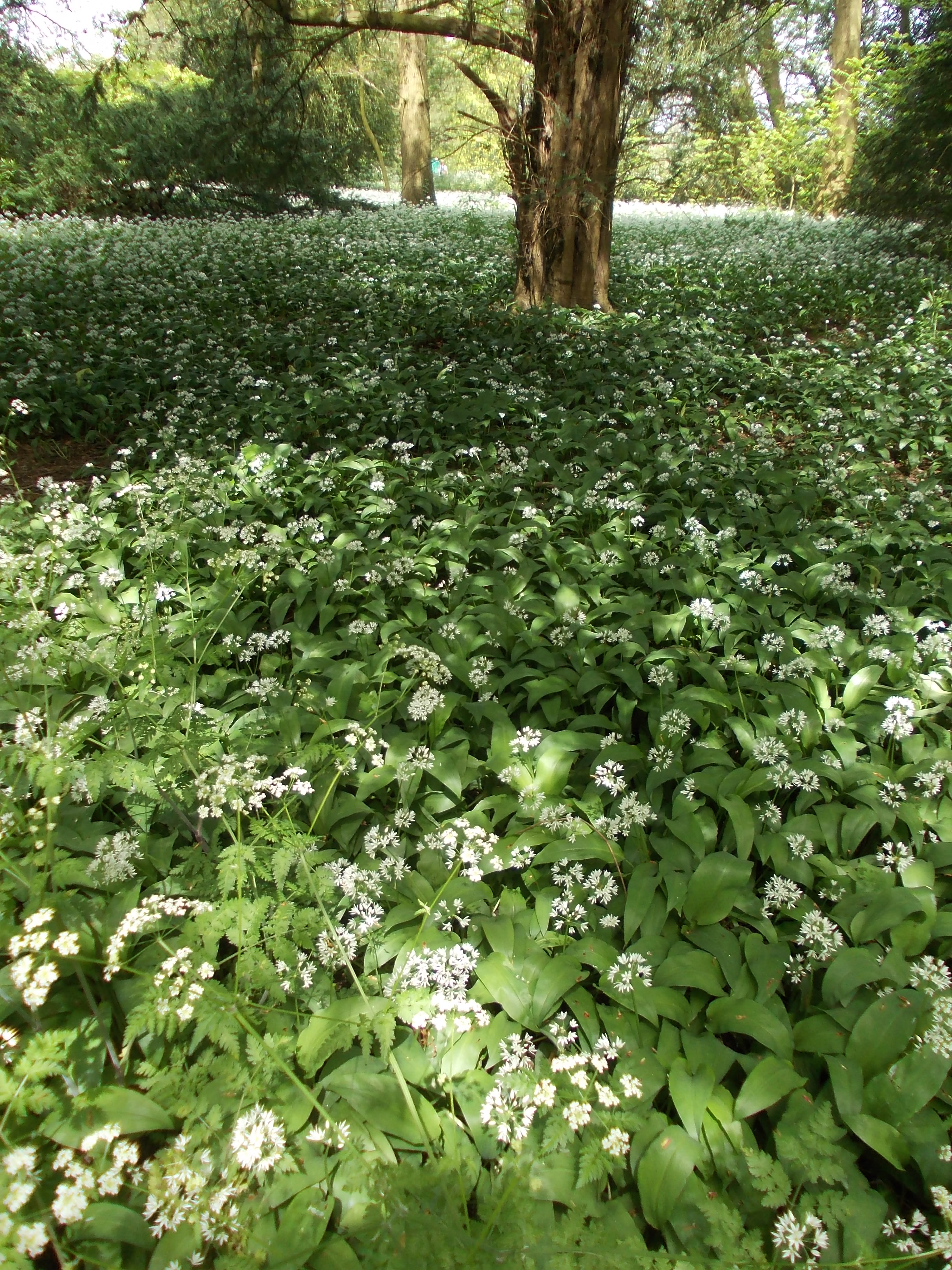
In the beautiful grounds, under graceful beech trees is a springtime carpet of Ramsons, sometimes called ‘wild garlic’. It’s not exactly garlic but it is an Allium, and while the bulbs are much too far down to be worth trying to dig up (and it’s illegal anyway unless they’re on your land), the leaves are delicious. You just cook them like Spinach and add a little oil or butter; they are soft with just a hint of onion-family taste about them.
A Woodland Carpet of Ramsons at Lacock
Outside the Abbey’s grounds is the hurly-burly of a touristy village. The first Swifts of the year wheeled around the church tower; Jackdaws nested in the belfry. Down by the ford with its little pack bridge, a Treecreeper zipped across the road and climbed up a small tree in the hedge.
Apologies to William Blake and the world in a grain of sand and all that.
Today, being a May Bank Holiday Weekend, it is very sunny and bright but the temperature has plummeted. I went shopping with my bicycle — wearing a thick fleece under a windproof jacket, and a ‘silk’ balaclava under my cycle helmet. So much for ‘Cast Ne’er a Clout / Till May be Out’. (I’ve never been sure whether ‘out’ means ‘May has come out’, i.e. it has begun, or ‘May has gone out’, i.e. it has ended. Whichever, it’s remarkably cold.)
After all the nature reserve visits lately, it’s time to look for wildlife closer to home. The blue tits have a lot of hungry little mouths to feed in the nest box above the kitchen door, and the adults flit in and out every minute or two. Sometimes one parent is still feeding when the other returns, whereupon the returner goes and perches in the Apple tree, calling softly, until the feeder flies out. There must be at least 40 feeding trips per hour, and it could easily be more. Remember that next time you’re wondering how much trouble kids are.
Ichneumon Fly on Currant leaf
The Blackcurrants are in full leaf now, and suddenly today each leaf seems to have an insect crawling over or displaying upon its upper surface. Some are certainly brief visits: smallish Ichneumon flies, about 10mm long and very slender, walk or run hastily about, on the lookout for caterpillars to parasitise with their eggs, a way of life disgustingly cruel enough to put Charles Darwin off religion for ever – leaving all the intellectual arguments aside, he simply found it sickening to imagine a loving creator doing anything so cruel. It’s interesting for such a careful scientist, able to spend 20 years marshalling arguments and evidence, that on a personal level, it was a visceral reaction that settled matters.
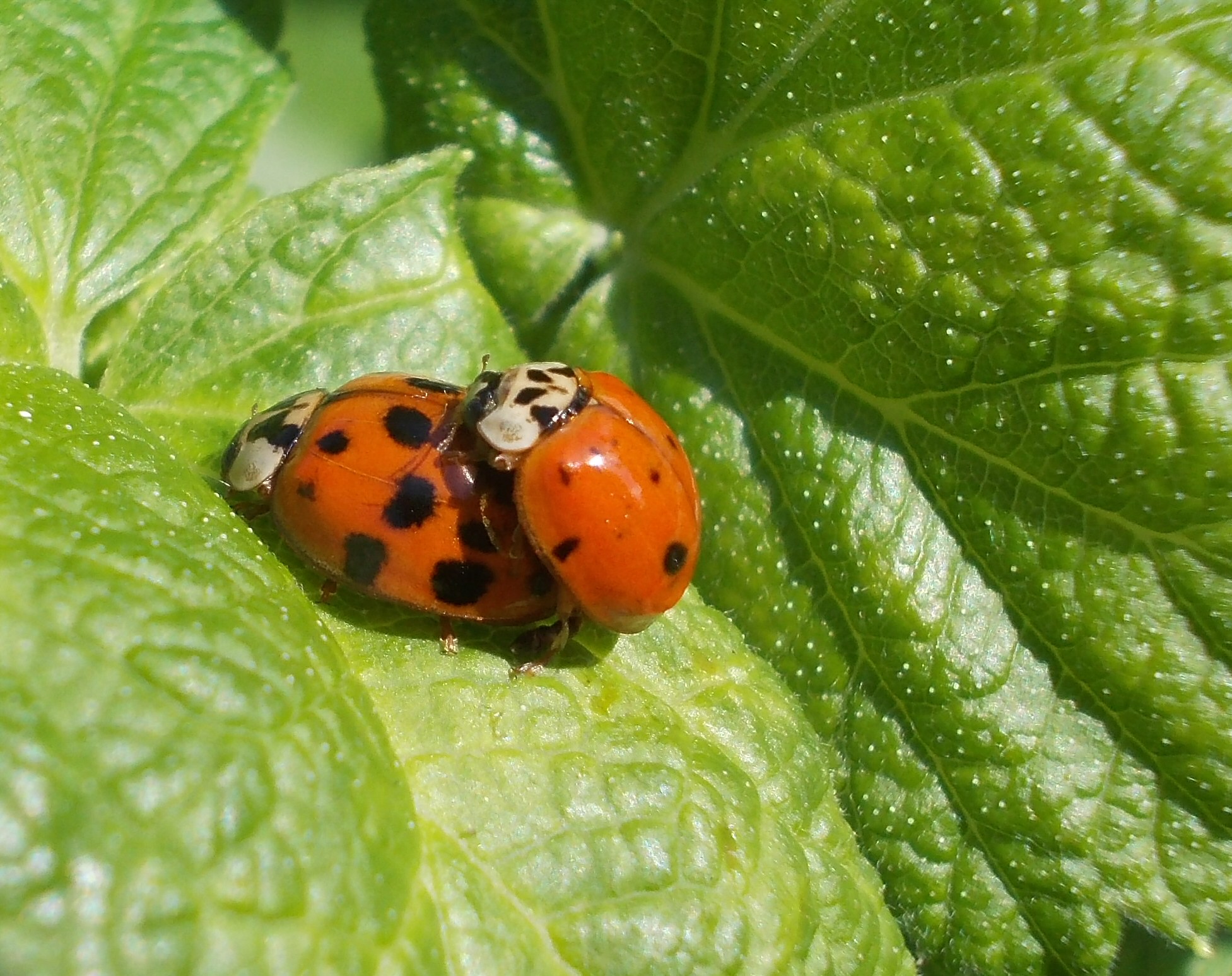
Harlequin Ladybirds mating
Other insects are clearly more like residents. Half-a-dozen leaves have a boldly coloured Harlequin Ladybird (or two: mating) in full view. It has been well said that insects fall into two camps: those that take good care not to be seen, and those that make sure they can be seen. Ladybirds, with their bold warning colours – red+black, yellow+black, red+black+white – are certainly in the conspicuous camp. This means they are signalling their unsuitability as food; the great pioneering zoologist E. B. Poulton coined the term ‘Aposematism’ (Greek ‘apo’ = from, ‘sema’ = sign, i.e. ‘warning off’) for this kind of warning coloration. In the case of the ladybird, they have bitter, foul-tasting or toxic chemicals in their bodies sufficient to make any predator gag, spit them out, and remember not to eat them again. This doesn’t necessarily save the life of the one they learn on, but it’s good for all the others. Each foul-tasting animal gets a better chance of not being tried out as a meal if it looks as much like other foul-tasting animals that predators may have had a bad experience with already. The result is Müllerian Mimicry (yeah, another famous Victorian zoologist) in which the vile imitate the vile as closely as possible. This is why bees look like wasps which look like bees: they all do better if they have the same obvious ‘don’t mess with me’ look.
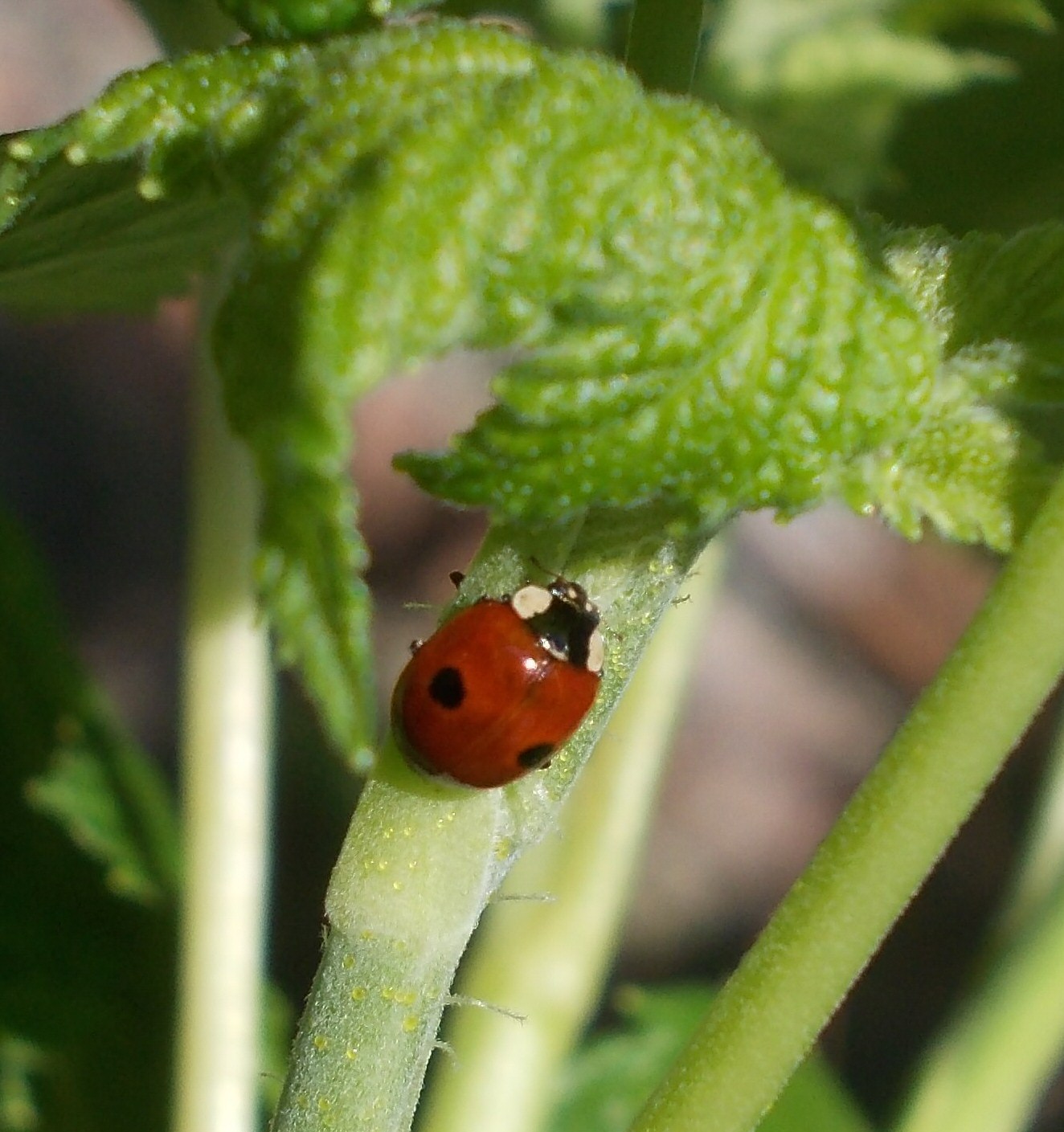
A native 2-Spot Ladybird, on the same bush
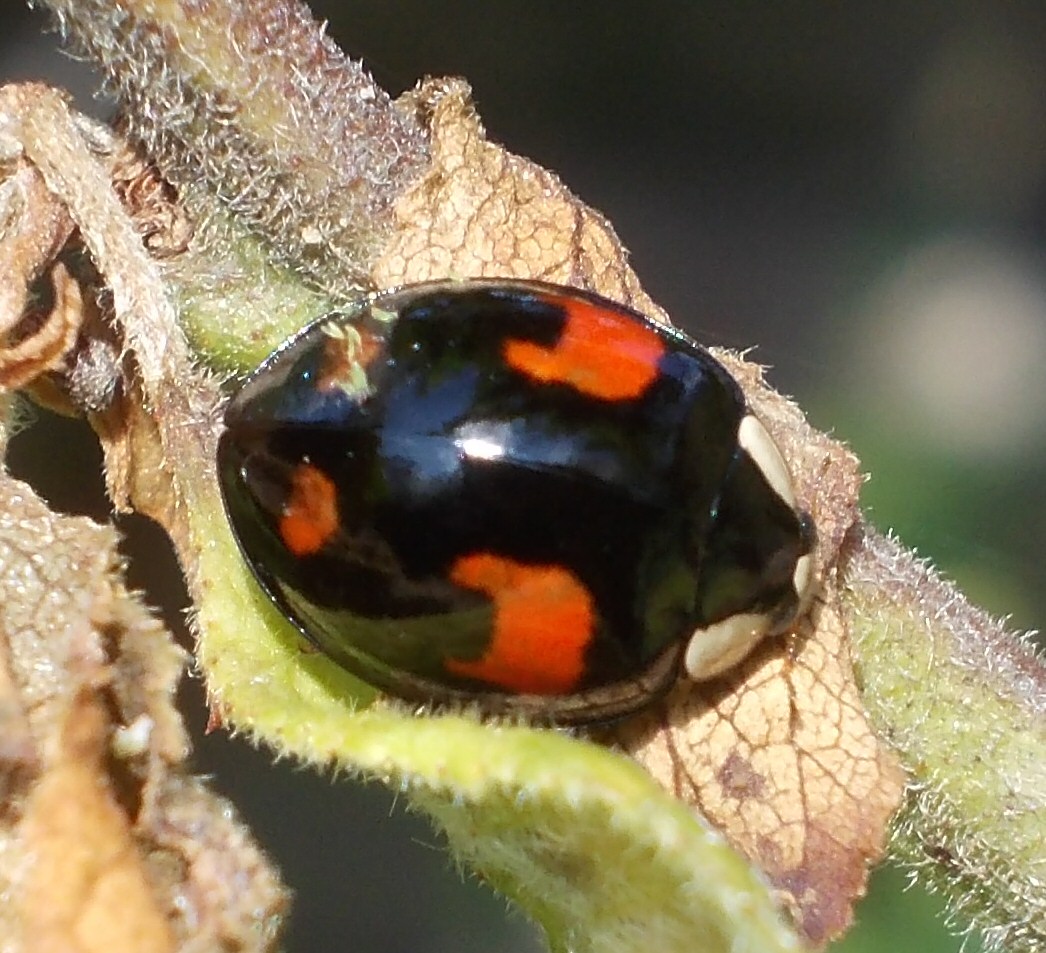
The Harlequin Ladybird is big and bold, advertising itself fearlessly. It is spreading rapidly through Britain, having been unknown here not many years ago. It hasn’t totally displaced our native ladybirds: in fact, my Blackcurrant bush is also home to several 2-spot Ladybirds, much smaller and red all over but for one big black spot on each wingcase. The Harlequins are so called because they have many possible patterns, from much like a 12-spot Ladybird to almost entirely black (the odd red patch remaining), but they always have quite a lot of white on the head, which the natives generally don’t.
A nearly-black Harlequin ladybird… one species, whatever the pattern
As if that wasn’t enough, several small rather triangular true flies (Diptera) are displaying on the same bush; these are probably males waiting for a mate. They lack the ‘pictured’ wings of the Celery Fly – I’ve got those too, worse luck, though they are pretty little insects, and it’s curious to see them in a mating pile-up, as rival males fight to get the female. What she thinks of it, nature does not relate.
All you have to do to enjoy diverse insect life in your garden is … not to spray. In fact, the insects I’ve seen today are a good reason why spraying is a bad idea. The ladybird larvae are powerful predators of aphids, while the Ichneumon ‘flies’ (parasitic wasps) are valuable biological controls of many damaging species of moth, killing their caterpillar larvae. In short, they are the gardener’s friends.
That’s a lot of the world on a leaf. Or at least, a lot of evolutionary ecology for a May Bank Holiday weekend.
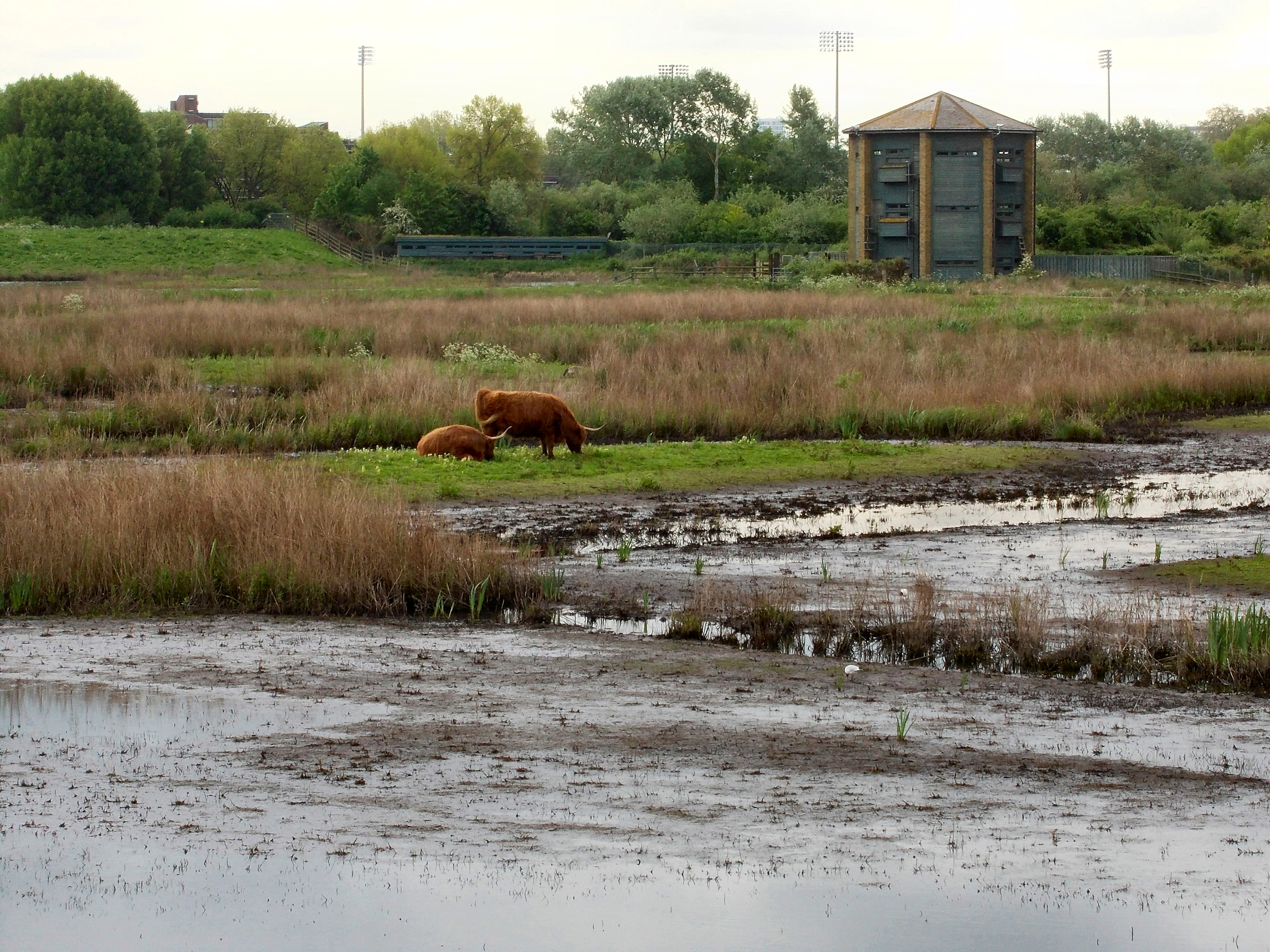
Highland Cattle on the Wetland Centre Grazing Marsh
In the hope of catching a glimpse of a little more of the spring migration, and happy to take an hour off from writing, I popped in to the Wetland Centre. There was no sign of the assorted rarities that the warden had put on the board for the day – likely, they flew overhead while he was doing his morning scan of the skies – but the Sand Martins were joined by five House Martins, hawking for flies over the wildside lake.
The view from the wildside hide was pretty desolate, with the water level now low in the grazing marsh; a few Black-Headed Gulls squealed querulously at each other, their chocolate-brown heads and napes (quite a misnamed bird, really) handsome with their red legs. Two rufous Highland Cattle grazed peacefully, their close nibbling and heavy feet doing a job of mowing, disturbing the ground gently, and adding manure to attract flies, that could hardly be achieved any other way: hence the tabloid headline.
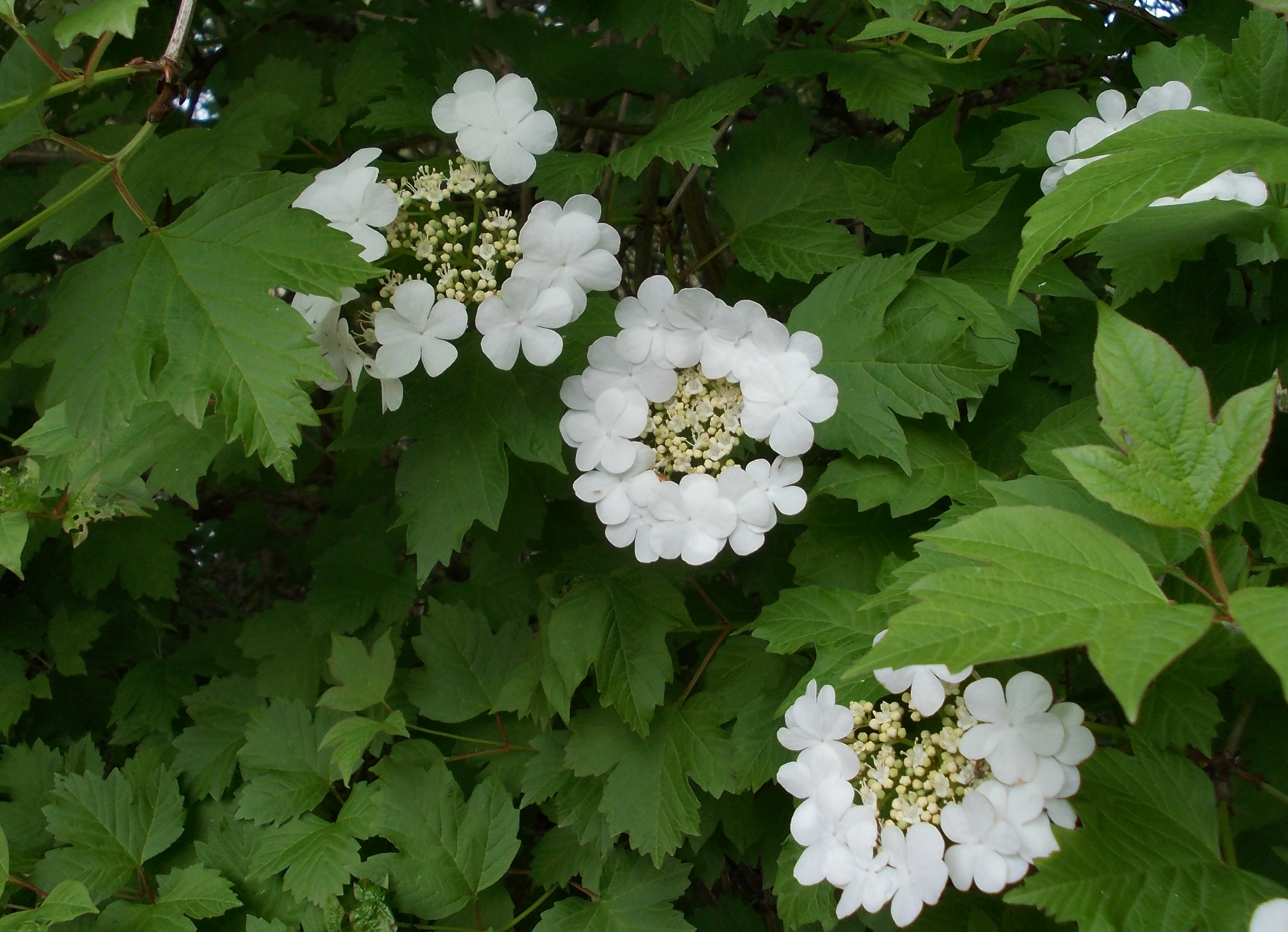
Guelder Rose in Bloom
On the wildside summer route, now open, Guelder Rose bushes are elegant with their white rosettes of large florets around a disc of small ones, making a flower-like bunch all together. Their deeply divided leaves provide an easy distinction from the Wayfaring Tree.
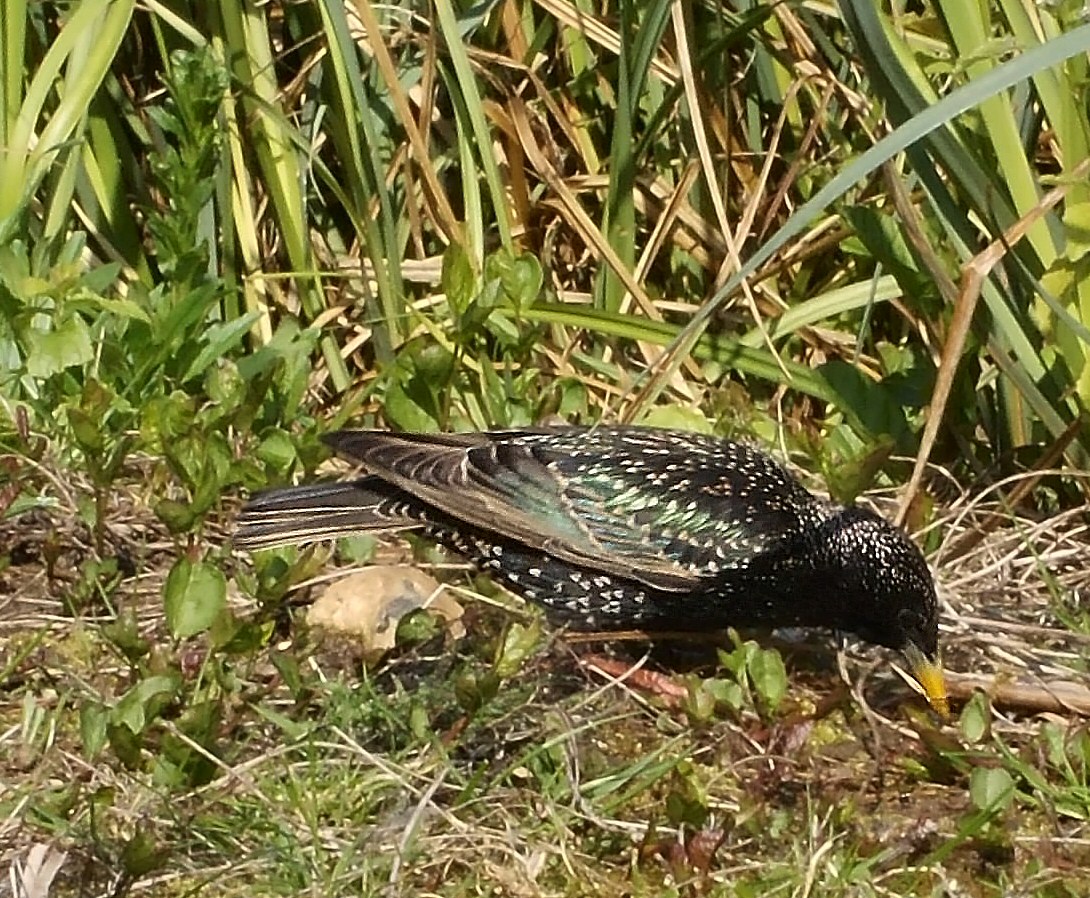
Starling foraging by reedbed … why do they think they’re waders?
One of the abiding mysteries of London’s natural history is why Starlings act as if they believe they are wading birds. At the Wetland Centre, the flock of Lapwings is constantly accompanied by Starlings, whether in the air or on small muddy islands.
Today, a few starlings were rootling about in front of a reedbed, their handsomely starry plumage giving back the warm sunshiine with green iridescence that for once the camera has managed to catch. They really are beautiful birds in fresh plumage; quite unlike their ‘worn’ plumage, where they just look dark grey-brown and scruffy.
Six warblers today – an early Sedge Warbler squeaking and rasping out its complex rhythms with funky discordant notes a few feet away from the path; some invisible Cetti’s as usual; Blackcaps and surprisingly Whitethroats all about, singing away; a Chiffchaff or two; and a Garden Warbler too.
Out in the pools and on the grazing marsh, a good number of Redshank with their graceful calls, and plenty of activity from Lapwings and Common Terns – these being harassed by Black-Headed Gulls; and overhead an early Hobby, circling like a small dark Peregrine with long wings, high in the sky.
Not many butterflies about – Orange Tip, a very worn Peacock, Brimstone, Small White; and several Bee Flies, like a miniature hummingbird moth with a furry body and a long straight proboscis; but while they keep up the wing action in front of a flower, actually 4 out of 6 legs perch on it! One of the bee flies was hovering over some low vegetation with no flowers, darting down rapidly and repeatedly, at once coming back up, like a damselfly laying eggs: that might be what it was doing.
A reader of the RSPB’s members’ magazine, Nature’s Home, wrote in a letter to the editor that “If I had my time again I would try and be an all-round naturalist, instead of just a birdwatcher.” [Mike Strickland, Summer 2014 issue, ‘Your view’ page 13.] Well, good on you, Mr Strickland. He went on to praise “such ‘all-round giants’ as Gilbert White and Charles Darwin.” White wrote the Natural History of Selborne, covering topics such as the swallows that flew round his nice house, how to get a garden growing (buy several cartloads of manure – literally – and use it to build a raised veggie bed), the doings of a hibernating tortoise, and whether swallows spend the winter underwater or in holes somewhere. Darwin wrote about everything from Galapagos Finches to earthworms and human emotions, with a lot of time on dogs, pigeons, barnacles and natural selection.
Clearly Mr Strickland had a point. If we’re going to be rounded naturalists, we need to observe whatever is around us – slime moulds and lichens, aphids and fireblight, hoglice and cuckoospit, not just the elegant courtship dances of Great Crested Grebes.
The editor assured Mr Strickland that “The study of other forms of wildlife has definitely become more mainstream with more and more birdwatchers also taking a keen interest in dragonflies, butterflies and moths. While other wildlife has been a feature of the RSPB magazine for quite some time, birds will definitely remain at its heart.”
The other forms of wildlife that, we learn, birdwatchers bother to look at are apparently dragonflies, butterflies and moths. That’s just two groups really – Odonata and Lepidoptera; both are large, day-flying, colourful, and conspicuous – just like birds, but without the feathers – differing only in being insects. Forgivable, I guess. They are, basically, the next best thing: easy to notice, out there when you want ’em (shame they don’t fly all year), and best of all, not too numerous.
I mean, suppose the average birder wanted to get into the beetles, the Coleoptera. They can be found all over the world, are quite often big and spectacular, don’t fly much, are generally black or brown, and are mostly so small you need a hand-lens or microscope, and are so numerous in species that you need to take them to the museum expert to get identified for you. Not terribly convenient, but definitely important.
The biologist J.B.S. Haldane is supposed once to have said, in response to a natural theologian who wondered what one could conclude about God from the study of nature: “An inordinate fondness for beetles.” Since there are about 400,000 species of beetle, one species in every four is a beetle, and a rational Martian visiting Earth would conclude that the planet’s ecosystem designer must have had six legs and a hard waterproof exoskeleton, presumably the joke that Haldane had in mind.
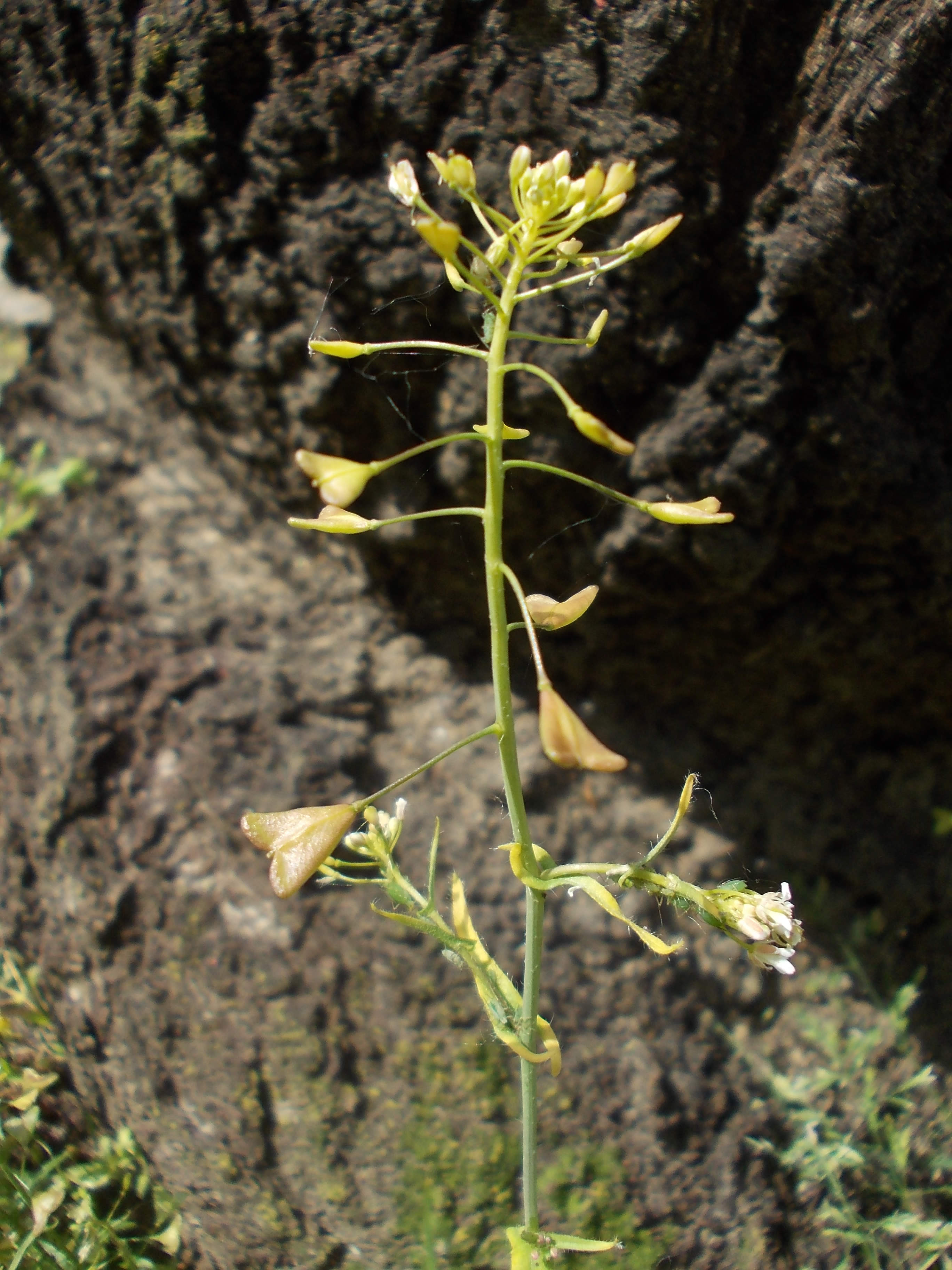
Shepherd’s Purse in my street … almost finished reproducing for the year
If we are going to be less species-ist than Haldane’s Coleopteran Creator, we need to cast our net wider than Aves, Odonata and Lepidoptera. The streets round here are planted with cherries, mainly; there are a few whitebeams, a rowan or two, a line of ash trees, and a few foreign hazels, they could be the American hazel, must check when they fruit. Under the cherries, the observant naturalist can note that Shepherd’s purse, the delightfully named Capsella bursa-pastoris (guess the poor man had so little money, it could fit in those tiny capsules) is already in fruit, soon to scatter its miniature seeds, and April isn’t even over: weeds have to be quick to survive on dry ground, perhaps. The ash trees support a lichen flora which is far more diverse than the basic Lecanora conizaeoides (low grey scaly lichen, no English name) that survived the pollution of the twentieth century; the trees have circles of Common Orange Lichen (Xanthoria parietina) and little patches of a grey leafy Parmelia lichen. And it doesn’t just consist of birds and other conspicuous day-flying objects, either. If that’s all we know to look at, we’re definitely amateur dilettante nature-lovers. Amateur is the French for lover, by the way, and dilettante is the Italian for someone that takes (idle) pleasure in something, the word is related to ‘delight’. Curious that both words should mean “ignorant dabbler” in English. But curiously appropriate, perhaps.
Down at Wraysbury, I wondered what I might see now the spring migration is well and truly under way. Last year there was a single Cuckoo, a rare treat. And perhaps there would be a good number of warblers already.
The winter ducks had all vanished from the lakes, all bar a pair of shy Gadwall right at the back. There were indeed quite a few warblers about – Chiffchaffs, Blackcaps, Cetti’s, Whitethroats, Garden Warblers and one or two Willow Warblers, all singing lustily. I listened out for a Sedge Warbler to make it Seven but couldn’t find one. Still, not bad going.
But over the lake there was a high call: Pik! Cheer! Cheeri-Cheeri-Cheeri-Cheer! A pair of Common Terns, the first of the year: graceful white ‘sea swallows’, marvellously buoyant in flight. But no – there were two pairs .. no, five birds … no, seven in all. They wheeled and shrieked high above, swooped and delicately took insects from the water surface. Comically, one or two of the Black-Headed Gulls tried to do the same: they looked like tubby Sunday footballers trying gamely to keep up with their mates, flapping heavily, looking rotund and clumsy – yet, these are the same birds that gracefully wheel about the tourists at the Round Pond in Kensington Gardens, skilfully catching pieces of bread tossed into the air at any speed, any angle, any distance. It’s just that the terns are seven times more agile. Their forked tails divide into streamers as long as the rest of the tail; their wings almost pure white below, smooth ash-grey above. Do they make a summer? Almost.
Also swooping over the water was one Swallow, the first of the year for me; and about eight House Martins were hunting above the treetops. Some Alder Flies flew past; perhaps they are emerging from the water, providing a feast for the terns.
One green female Banded Demoiselle perched on some nettles; she too is the first of her kind – indeed, the first dragonfly of any kind – for me this year. And a solitary Greylag goose stood in the shallows, an unusual sight here.
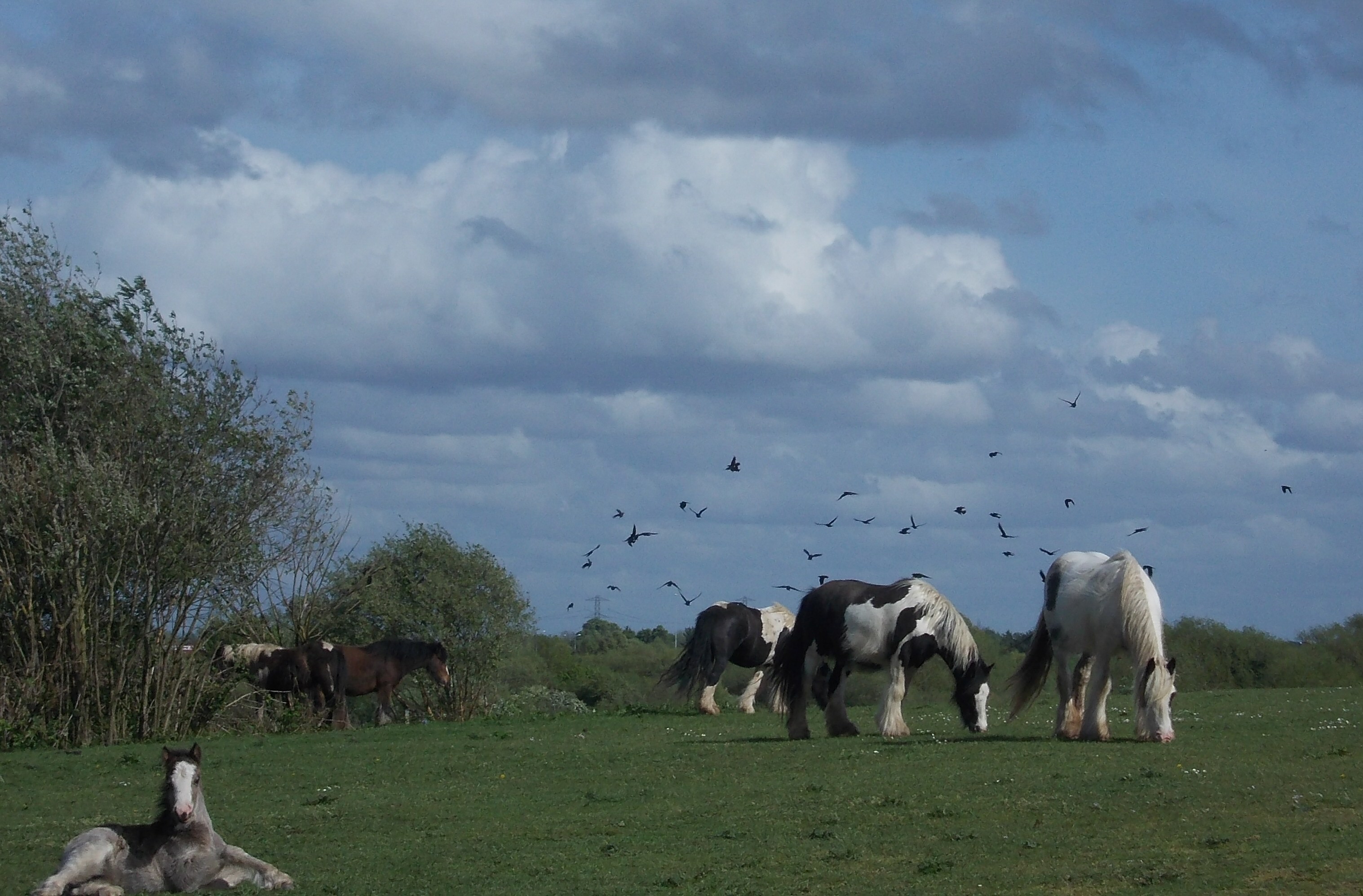
Horses and Jackdaws at Wraysbury
Around the horses on the green grassy hill that used to be the dump, a flock of Jackdaws with some Carrion Crows, benefiting from the insects around the horses; and a second flock, more of a surprise, of Stock Doves. They are notoriously under-reported, people just assuming they are Feral Pigeons or Wood Pigeons without looking to check. They all had the same pattern, and none of them had white wing flashes.
Walking down to the road, the narrow path was carpeted with small teardrop-shaped white petals: Hawthorn flowers, May blossom.
Free Talk: Gunnersbury Triangle, Sunday 8 June 2014 at 2pm
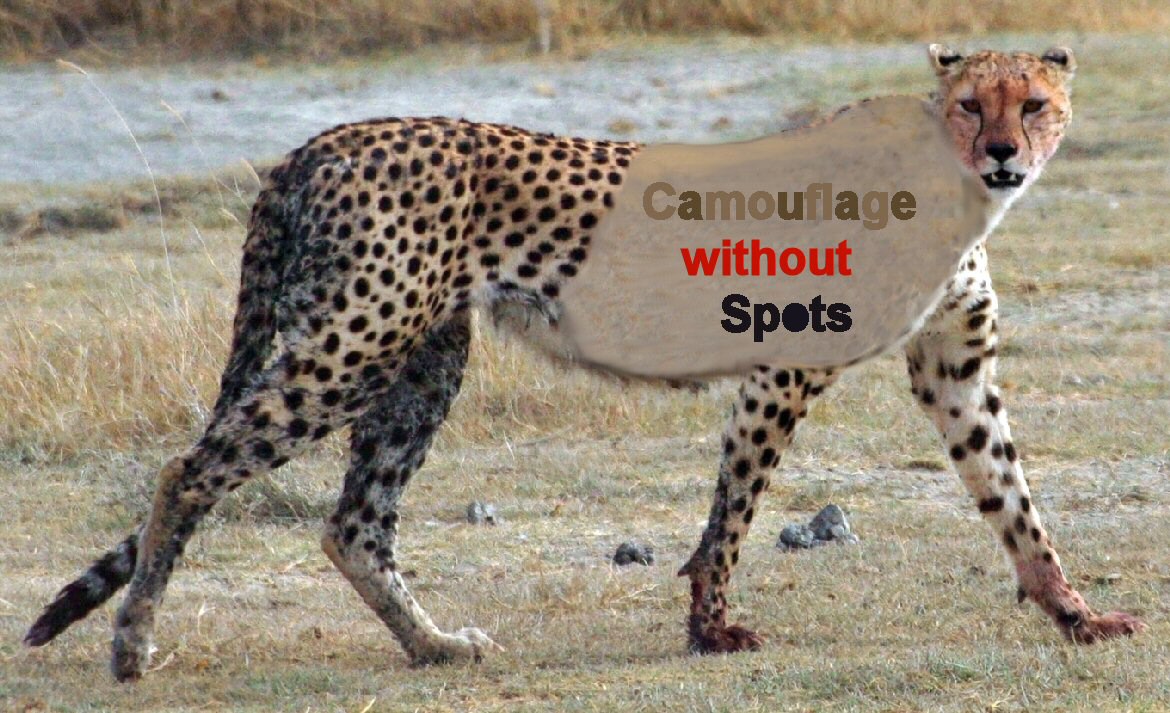
In this short and I hope lively talk, illustrated with models and photographs, I will try to show that camouflage is a lot more than spotty coats.
Animals use many different tricks to hide themselves. Even when there is no cover to hide behind, animals find ingenious ways to make themselves invisible. And if they don’t need to hide, they use the same tricks in reverse to make themselves as obvious as possible.
“Suitable for ages 8 – 80”. Roughly.
OK, you want more technical detail. Hmm. Well, I shall not be talking about military camouflage, though it is (or should be) based on the same principles as in zoology. The title already promises no spots, more or less, so I shall obviously mostly be avoiding what my hero Hugh Cott called disruptive patterns. Yes, you can see that I’ve spent far too much time trying to improve Wikipedia’s coverage of camouflage. If you nose about in there you’ll discover that I’ll have plenty of spotless methods to talk about. To whet your appetite, here’s Hugh Cott’s beautiful drawing of a Potoo, which makes itself as good as invisible by perching, stone-still, atop a broken branch. I’ll leave it up to you to work out how the trick works. Even better, come along to my talk.
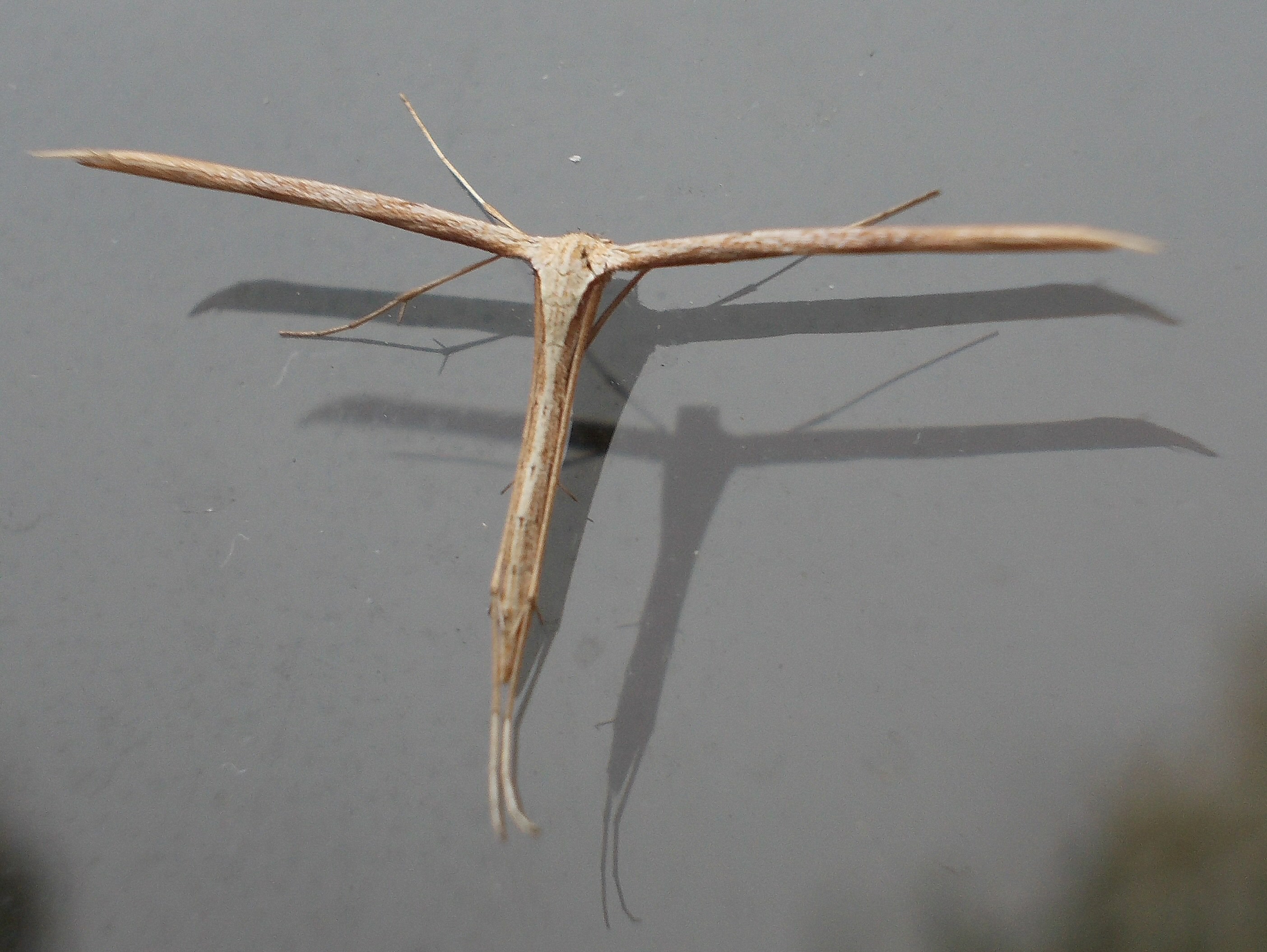
An extremely slim-winged Plume Moth landed on the kitchen window and has rested there for some hours, in broad daylight. I was familiar with the distinctive White Plume Moth, Pterophorus pentadactyla, a ghostly little moth with thin, branched, feathery wings – never understood the ‘penta-dactyla’, (‘five-fingered’) as I’d make it many, or perhaps two, but certainly the wings are oddly subdivided. This moth was obviously something in the same family (Pterophoridae) but another species, and given its brownish colour, it must be very inconspicuous among vegetation or on bark.
Plume Moth cf Stenoptilia bipunctidactyla
The excellent British Moths and Butterflies: A Photographic Guide by Chris Manley 2008, reprinted 2011 by Bloomsbury ( Amazon.com, Amazon.co.uk), quickly pointed to a species of Stenoptilia: there are several similar and hard-to-tell species, so I wouldn’t presume to say which one it is, but it is most like Stenoptilia bipunctidactyla. The photo shows the family’s distinctive T-shape, and the long thin whitish legs with spines. The back is dotted, and the wingtips lack white, which is why I’m guessing it’s something like this species. It’s said to be common throughout Britain, eating Scabious.
The recent East winds and warmer weather have brought plenty of spring migrants to southern Britain. Today at the London Wetland Centre a twitch was in full swing at the Peacock Tower, the object of the lovers’ attention being a Common Sandpiper peacefully browsing along the muddy shore, happily unaware of the excitement it was causing. The breeding Redshanks, too, stalked about the shallows probing for food; the Lapwings as always alert, chasing off Carrion Crows and anything else that might have been interpreted as threatening. Around the paths, three or four early Sand Martin arrivals wheel and swoop like the small brown swallows that they are; their nest-cliff is still empty.
Around the reserve, quite a few Brimstone and Small White butterflies, and an Orange Tip gave movement and colour. I heard the first Sedge Warbler of the year, and despite being right next to the willow bush from which a Cetti’s Warbler was giving out its explosively phrased song, I couldn’t see the songster. A Blackcap however could be glimpsed behind the Sheltered Lagoon, chattering its alarm call. A Song Thrush sang at intervals, and a Dabchick gave its beautiful trill and some small squeaks from the Lagoon, in between spending a lot of time under water.
Back at home, a queen Wasp was nosing about some Ivy-Leaved Toadflax, and a red Mason Bee dug for earth in a seedbed, flying off with a little load for her nest.
Down to Aston Rowant on a fine clear sunny day with a cold East wind that brought spring migrants like the Ring Ousel, a rare blackbird of mountain and moorland. I saw a probable one diving into a juniper bush; they like to stop off on the scarp of the Chiltern Hills as the next best thing to their favoured moors, before flying on to Wales or wherever.
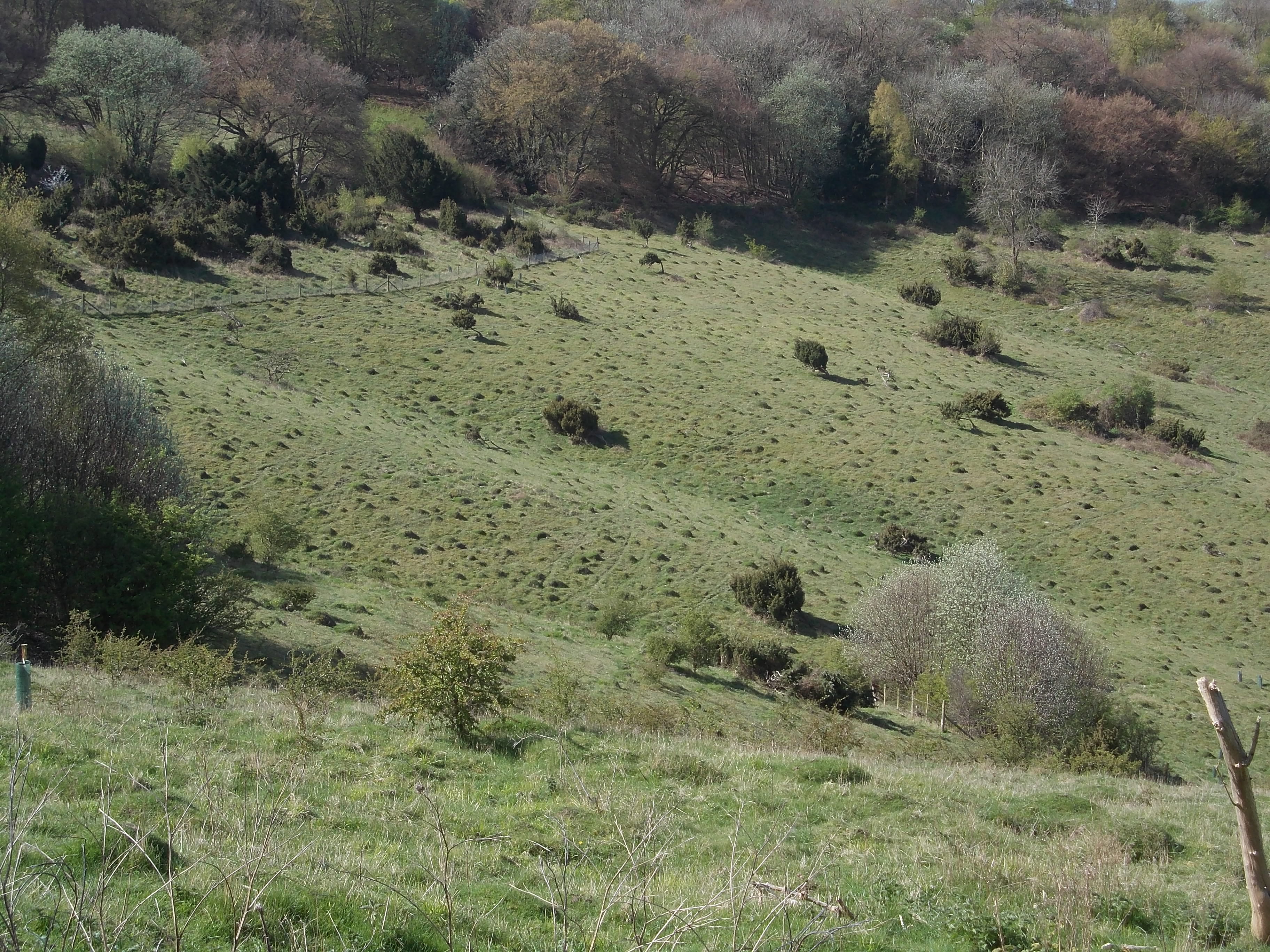
Anthills dotting Aston Rowant chalk grassland
The scarp slope of the relatively hard Chalk falls steeply to the broad plain of the soft Oxford Clay below, to the West. Much of the grassland has been destroyed for agriculture, either falling under the plough or simply being ‘improved’ as pasture with fertiliser, encouraging long grasses at the expense of the wealth of flowers that once covered the English countryside. Happily, here in the reserve and in quite a few places on the Chilterns, the steepness of the land has discouraged improvement. The chalk grassland is dotted with hundreds of anthills, the tiny yellow ants living all their lives below ground, tempting green woodpeckers to come out and hunt for them.
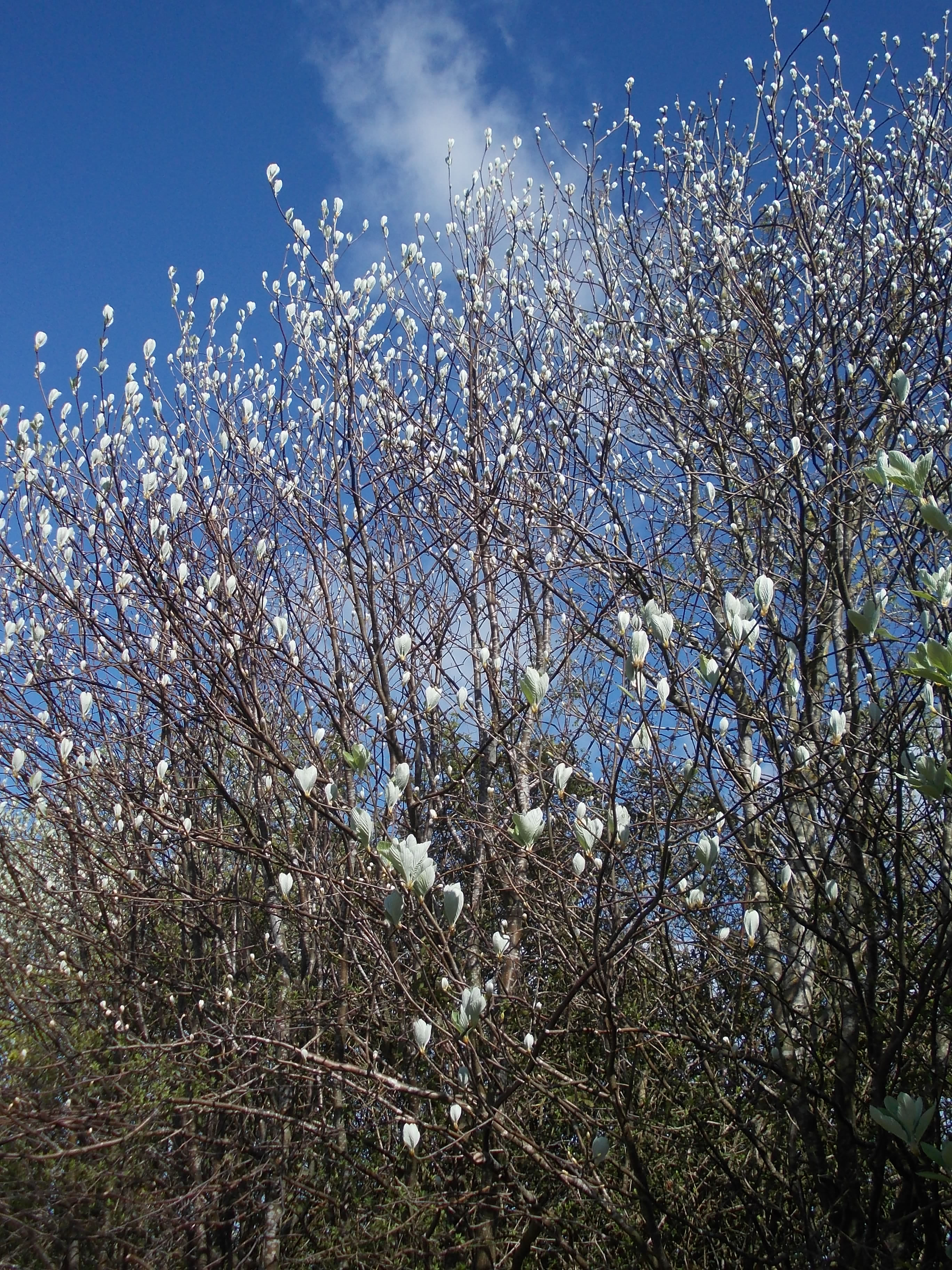
Whitebeam coming into leaf
The trees and flowers are visibly weeks behind those of London. The Whitebeam is just coming into its fair white leaves, which look almost like Magnolia flowers in their little clusters newly burst from the bud. But the tree’s name comes from its white wood, not its leaves.
Witch’s Brooms
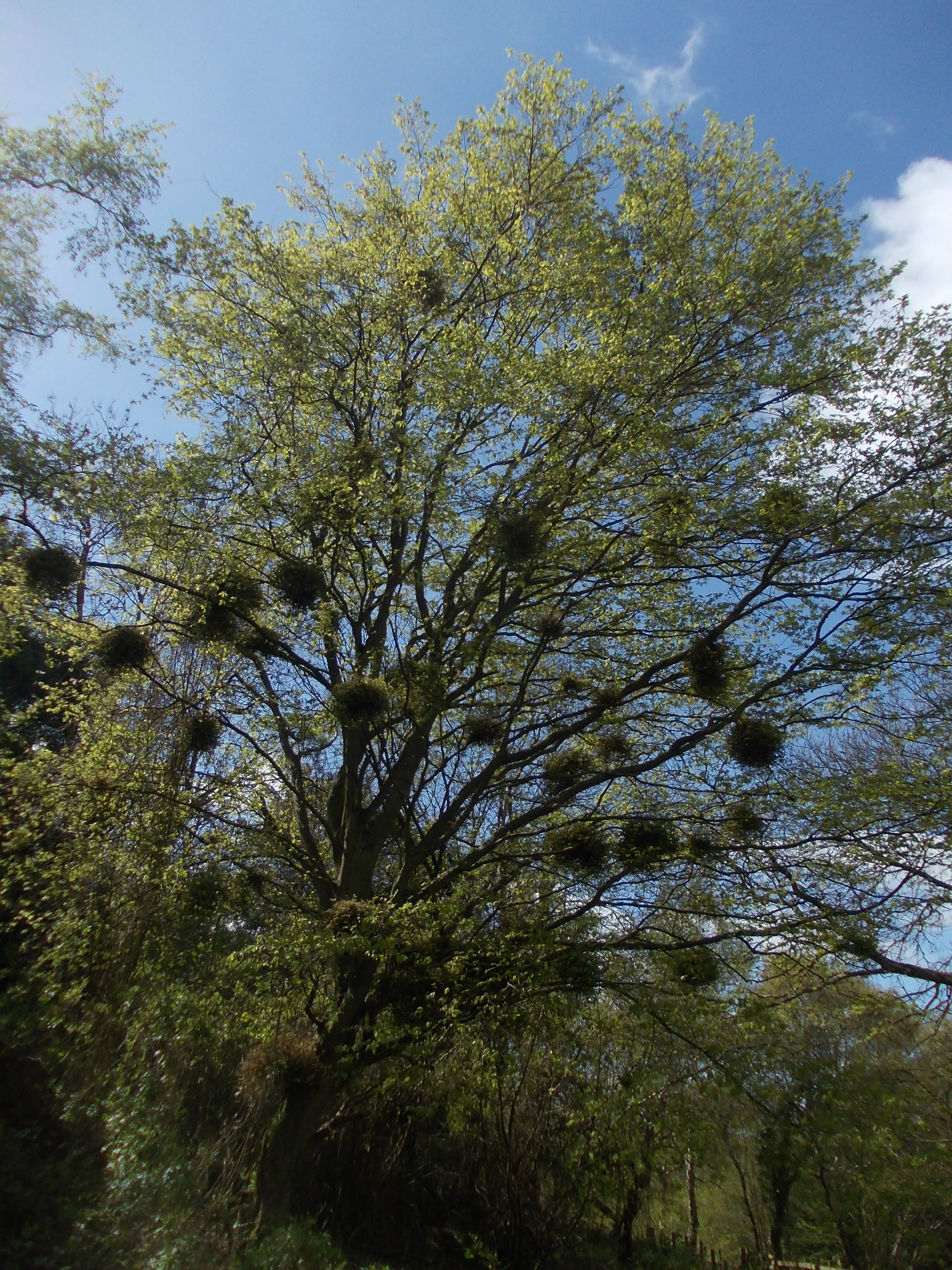
At the bottom of the scarp, a field away from the Ridgeway which follows the line of hills for many miles, Hornbeams and Birches marked a change in the soil, which must be neutral or acid down here, compared to the strictly alkaline rendzinas and brown earths of the chalk. One of the Hornbeams looked as if it was oddly full of Mistletoe, but up close it proved to be a mass of Witch’s Brooms, growths of the tree itself caused by an infection.
The English seem unemotional … except for their passion for nature