Category Archives: Wildlife

Ian Alexander’s Amazing Audio Guide to British Warblers

Today I noted down in my nature diary “Sedge – Cetti’s – Blackcap – Chiffchaff – Whitethroat.” I didn’t see any of them: but I’m sure all of them were there, because I heard them unambiguously.

If you think that would be a nice thing to do, but utterly impossible for you, being a city-dweller with cloth ears, let me reassure you: it’s really not difficult. Have you ever been in a noisy party where someone suddenly said your name? You picked out the sound right away, and looked straight at where it came from, didn’t you. In other words, your hearing, and the auditory processing part of your brain, is perfectly adapted to picking out sound signatures from a jumble of other stuff  – engineers call it noise, and who are we to disagree  – without even thinking about it. It’s a wonderful ability, and it has obvious survival value.

So, to warblers. A lot of small, inconspicuous LBBs (yeah, little brown birds) that mainly lurk about deep inside bushes: but with one sharply distinguishing feature – you guessed it, their song. Each species takes good care to avoid hybridising with other species, probably producing uselessly infertile offspring, by announcing its identity to all and sundry. Males tell other males to push off; and they tell females where they are, what species they are, and (so I’m told) how wonderfully fit they are, just by singing in what the females judge is the right way.

So what is the right way? How, in other words, do these warblers sound? Ok, I lied about the audio, there’s no tape or what have you here. But, in simple words, here’s how to tell them apart.

Let’s start with the easiest one. The Chiffchaff just says his name, over and over and over again. Chiff-chaff-chiff-chaff-chiff-chaff… It’s a fairly high, lisping sort of song on, yes, exactly two notes. If you’re a registered European you may prefer to call it Zilp-zalp-zilp-zalp-zilp-zalp…. — it’s the same thing. The call is pretty loud and clear; if you know the Great Tit’s insistent Teacher-Teacher-Teacher call from park or garden, well, it’s not as harsh as that. The Chiffchaff can be heard almost anywhere there are a good number of trees and bushes; there are plenty in parks and by the river.

The warbler that looks almost exactly like the Chiffchaff is the Willow Warbler. It doesn’t frequent willows. It seems to be getting scarcer, and it likes more secluded bushy areas than the Chiffchaff. The song is a unique series of descending phrases, lisping from high to low like a pianist carefully practising his scales every morning: swieeuo(high)-swieeuo-swieeuo-swieeuo-swieeuo-swieeuo(low). It never varies.

The Blackcap is one of the commonest of our warblers. It sings from any reasonably thick patch of bushes: you need a pretty large garden to get Blackcaps, but they’re in every park and reserve. It’s a bit tricky to describe the Blackcap’s song, because he always improvises, like a jazz musician doing a gig. However, he is a bit of an opera meister, a tenor constantly worrying about his voice. So he goes like this:  Ahem. La, la. Do re mi fa. Ahem. Hrrm. La la la. Ah, let me see. Yes. Aaaaaa–La Dolce Vita — Voce di Tenore – si – Aaaaaa!  In short, the Blackcap starts rather hesitantly, stumbles a bit, warms up, sings a few fine fluty notes — and stops abruptly.  Another way of putting it is the traditional “Blackcap’s brief”, but he’s not always quite that short.

The singer you might confuse with the Blackcap is the Garden Warbler. He’s distinctly less common, and requires more green space, but you have a good chance of hearing him in May. The Garden Warbler’s song is immediately recognisable as rather good. Even if you don’t bother with classical music much, you can at once hear that this is someone with a well-trained voice, perfectly modulated, even, rich, rapid, full of notes, expressive. I don’t want to spoil this by saying that the voice doesn’t do terribly much, but it’s true: the Garden Warbler’s song is always somewhat of a piece. It can go on for quite a while, sometimes tens of seconds without a break (excellent breath control), but there are no sudden leaps, no sharp highs or lows, no discordant notes. It’s Radio 3 not trying too hard in between major concerts.

Quite the opposite is the Sedge Warbler. I can give you a pretty sharp clue as to where you’ll find him singing: in a patch of reeds, certainly near water. He doesn’t need much room: at the Wetland Centre, one sings from a tiny reedbed right in front of a hide, and it’s amusing to watch people trying to locate him even as he sings his heart out. The Sedge Warbler’s song is REALLY discordant. Think modern classical and then some. Schoenberg and Cage rolled into one. Charr-charr-charr (so far so good) SQUEAK Chirp Weeaaiourgh – SQUEAK SQUEAK SQUEAK chirp chirp charr-charr-charr- getting used to this – charr-charr-charr SQUEAK hic! SQUAWK SQUNK got you there charr-charr-charr… and so on for ages. I promise you’ll recognise him straight away.

If we’re into scratchy, the Whitethroat is the start. He’s a beautiful bird and if you’re quiet and come out early before the hordes you’re quite likely to see him atop a tall thorn bush, singing at the top of his voice. He prefers rather isolated bushes in patches of scruffy scrubland. He is reddish brown with a conspicuous fluffy white throat, like an elegant eighteenth-century Mr Darcy with a tailcoat and a white silk neckerchief. Unfortunately for the romantic appearance, Mr D really can’t sing too well, nor for very long. Squeaky-squawky-scritch-scratch. Scrape. Scritchy-scratchy.  Honestly, that’s about it. Occasionally if you’re very lucky you get a little bit of tune, but mostly there aren’t many musical notes in it at all.

OK, the Cetti’s. He isn’t nearly as Italian as his name; in fact, you can find him in reedbeds and beside lakes pretty much all year. He is a real skulker, so I hardly need to describe him, other than to say he sings from quite low down in thick waterside bushes. If you see him at all, it will be a quick glimpse of a medium-dark brown bird with a rounded tail, vanishing into a bush. To compensate, he has a REALLY LOUD song with the pattern Witchipitipit, Witchipitipit. Well, that’s the polite phonetic version. If I remember rightly, it was Simon Barnes in his magnificently naughty How to be a bad birdwatcher (Short Books, 2004; Amazon.com Amazon.co.uk) who voiced the Cetti’s as Me! Cetti’s! If you don’t like it, you can Fuck Off! You’ll definitely recognise him when you hear him, or he’ll nut you one. And once you know his song, you’ll be surprised how widespread he is.

I could do the Lesser Whitethroat for you too, and the Reed Warbler, but I expect you’ve had quite enough for one go. But feel free to ask me if you’re curious.
Glorious Spring Morning at the Wetland Centre

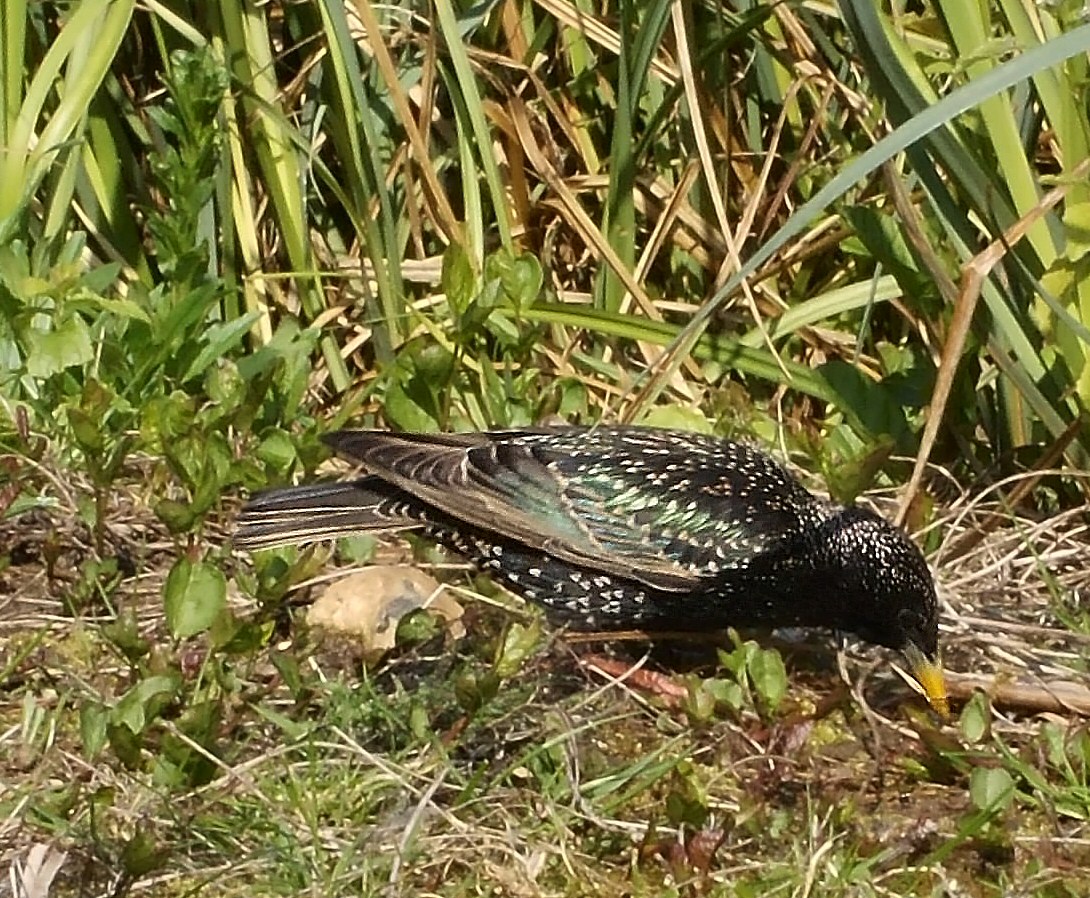
Starling foraging by reedbed ... why do they think they're waders?
Starling foraging by reedbed … why do they think they’re waders?

One of the abiding mysteries of London’s natural history is why Starlings act as if they believe they are wading birds. At the Wetland Centre, the flock of Lapwings is constantly accompanied by Starlings, whether in the air or on small muddy islands.

Today, a few starlings were rootling about in front of a reedbed, their handsomely starry plumage giving back the warm sunshiine with green iridescence that for once the camera has managed to catch. They really are beautiful birds in fresh plumage; quite unlike their ‘worn’ plumage, where they just look dark grey-brown and scruffy.

Six warblers today – an early Sedge Warbler squeaking and rasping out its complex rhythms with funky discordant notes a few feet away from the path; some invisible Cetti’s as usual; Blackcaps and surprisingly Whitethroats all about, singing away; a Chiffchaff or two; and a Garden Warbler too.

Out in the pools and on the grazing marsh, a good number of Redshank with their graceful calls, and plenty of activity from Lapwings and Common Terns – these being harassed by Black-Headed Gulls; and overhead an early Hobby, circling like a small dark Peregrine with long wings, high in the sky.

Not many butterflies about – Orange Tip, a very worn Peacock, Brimstone, Small White; and several Bee Flies, like a miniature hummingbird moth with a furry body and a long straight proboscis; but while they keep up the wing action in front of a flower, actually 4 out of 6 legs perch on it! One of the bee flies was hovering over some low vegetation with no flowers, darting down rapidly and repeatedly, at once coming back up, like a damselfly laying eggs: that might be what it was doing.

Star Species of a Seven-Warbler Walk was … Skylark

I did wonder, before I began writing a nature journal here, whether half the entries wouldn’t be ‘nothing much to report today’. Well, so far I haven’t been there.

I went down to Wraysbury again in the hope of finding the Lesser Whitethroat. I arrived rather early, driving out of town only to see a gigantic queue of cars crawling in the other way, trying vainly to beat the Tube strike. No-one was about as I wrapped up in an extra pullover and listened intently to the morning chorus.

My day was already made when I actually SAW a Cetti’s Warbler – for about a second, before the rich brown bird with the rounded tail dived for cover. A Cormorant flapped heavily, taking off from the lake like a lumbering military transport, showing glossy blue-black plumage like a giant crow, circling three times to gain height. Two pairs of Gadwall (only one pair last time) swam shyly near the far side of the lake; Green Woodpeckers laughed their loud ringing call.

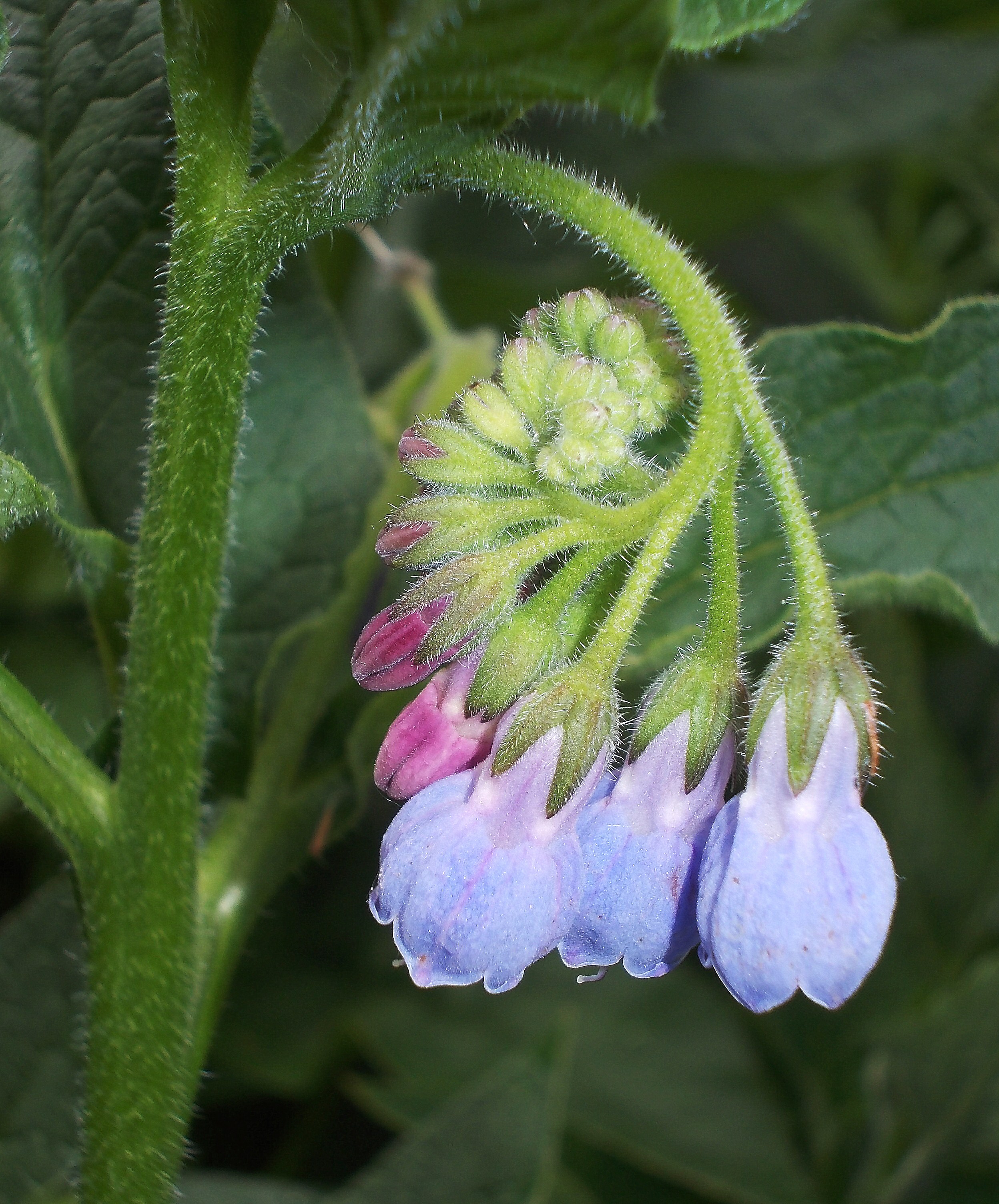
Comfrey flowerhead just starting

Blackcaps were singing all over; Song Thrushes too, at least three of them; a considerable flock of Long-Tailed Tits made their extraordinary “Tsrrrrrp” noise (try it); Chiffchaffs spoke their name, and (Common) Whitethroats sang their rasping songs or chattered from inside their thornbushes. Great clumps of Comfrey, the medicinal herb used in mediaeval times to knit bones, have suddenly sprung up with their dark, foxglove-like leaves and clusters of flowers in a range of anthocyanin colours – reds and violets.

There were more Willow Warblers and Garden Warblers, too, making them easier to find; more must be arriving each day now.

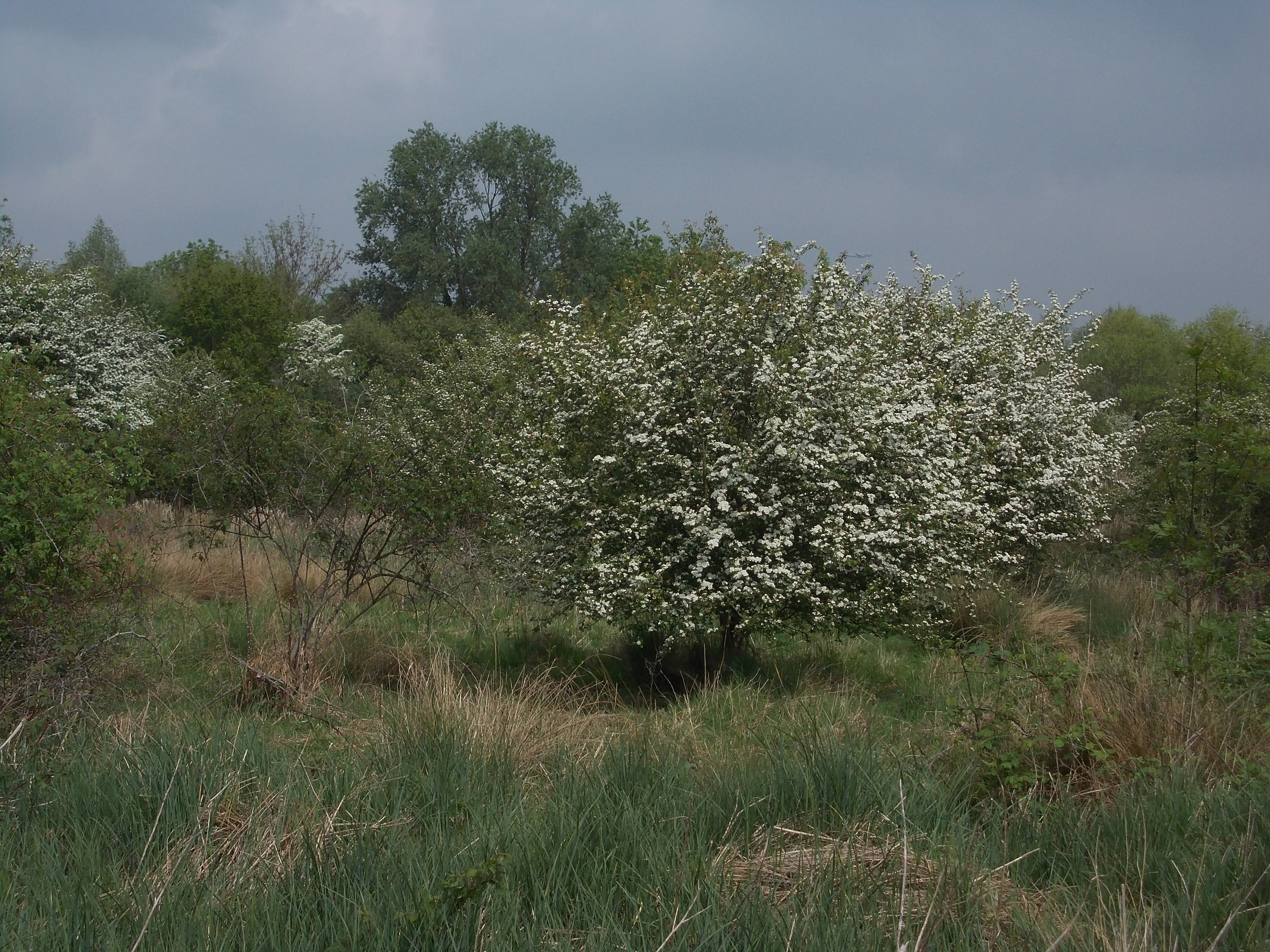
Whitethroat habitat
Whitethroat habitat: Hawthorn bushes in damp open scrubland

I made my way over the bridge and out into the dry scrubland. Whitethroats were all around now, singing competitively; a few Blackcaps joined in. Then, yes, I heard the simple, flat trill of a Lesser Whitethroat. I sat down and listened, heard it a few more times to make sure: it was a Seven Warbler Walk, I think actually my first, at least when I’ve taken the trouble to count them and write them down. I took a swig of water; an Orange Tip and a Brimstone butterfly flickered past.

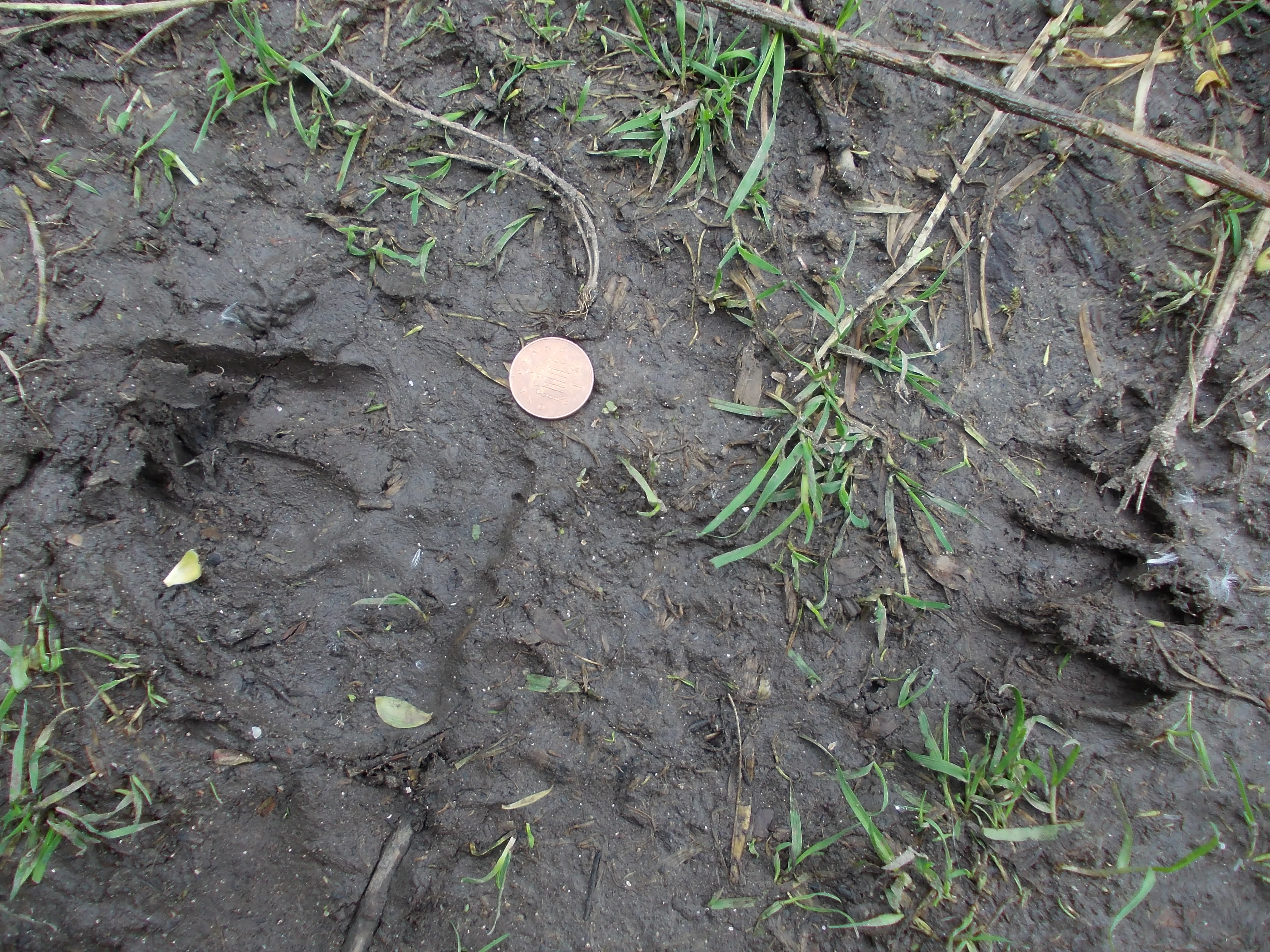
DSCN0214 Roe Deer slots (with penny for scale)
Roe Deer slots (with penny for scale)

Looking about the bushes carefully, I noticed a trail of Roe Deer prints, medium and small. Their numbers have been increasing steadily, certainly since 2007, and they are close to becoming a nuisance. About 350,000 are culled each year; another 74,000 or so are killed on the roads, without limiting their growth. Clearly we need some predators, though what our farmers would say to having Lynx back, let alone Wolverines, is easy to imagine.  Where they are most numerous, woodland shrub vegetation and bird numbers are suffering.

On the way out, some Goldfinches sang near the road, and a Swallow flew overhead by the river Colne. I felt I’d had a good day, and braced myself for a tricky drive home. On a whim, I went via the airport road. It’s a bit slow but not uninteresting, and there’s a nice tunnel. Waiting at one of the sets of lights, I opened the window, and at once heard a Skylark singing its rippling song. I looked up, and there it was for a moment, a little flickering dark shape against the bright sky, pouring out its aerial music. The lights changed, and a jet growled in to land, the air whistling over its fully-extended flaps.

Fancy, a Skylark at Heathrow, seen and heard from a car, the highlight of a seven-warbler walk, Lesser Whitethroat and all.


All-round Amateur Dilettante Nature-lovers…

A reader of the RSPB’s members’ magazine, Nature’s Home, wrote in a letter to the editor that “If I had my time again I would try and be an all-round naturalist, instead of just a birdwatcher.” [Mike Strickland, Summer 2014 issue, ‘Your view’ page 13.]  Well, good on you, Mr Strickland. He went on to praise “such ‘all-round giants’ as Gilbert White and Charles Darwin.” White wrote the Natural History of Selborne, covering topics such as the swallows that flew round his nice house, how to get a garden growing (buy several cartloads of manure – literally – and use it to build a raised veggie bed), the doings of a hibernating tortoise, and whether swallows spend the winter underwater or in holes somewhere. Darwin wrote about everything from Galapagos Finches to earthworms and human emotions, with a lot of time on dogs, pigeons, barnacles and natural selection.

Clearly Mr Strickland had a point. If we’re going to be rounded naturalists, we need to observe whatever is around us – slime moulds and lichens, aphids and fireblight, hoglice and cuckoospit, not just the elegant courtship dances of Great Crested Grebes.

The editor assured Mr Strickland that “The study of other forms of wildlife has definitely become more mainstream with more and more birdwatchers also taking a keen interest in dragonflies, butterflies and moths. While other wildlife has been a feature of the RSPB magazine for quite some time, birds will definitely remain at its heart.”

The other forms of wildlife that, we learn, birdwatchers bother to look at are apparently dragonflies, butterflies and moths. That’s just two groups really – Odonata and Lepidoptera; both are large, day-flying, colourful, and conspicuous – just like birds, but without the feathers – differing only in being insects. Forgivable, I guess. They are, basically, the next best thing: easy to notice, out there when you want ’em (shame they don’t fly all year), and best of all, not too numerous.

I mean, suppose the average birder wanted to get into the beetles, the Coleoptera. They can be found all over the world, are quite often big and spectacular, don’t fly much, are generally black or brown, and are mostly so small you need a hand-lens or microscope, and are so numerous in species that you need to take them to the museum expert to get identified for you. Not terribly convenient, but definitely important.

The biologist J.B.S. Haldane is supposed once to have said, in response to a natural theologian who wondered what one could conclude about God from the study of nature: “An inordinate fondness for beetles.” Since there are about 400,000 species of beetle, one species in every four is a beetle, and a rational Martian visiting Earth would conclude that the planet’s ecosystem designer must have had six legs and a hard waterproof exoskeleton, presumably the joke that Haldane had in mind.

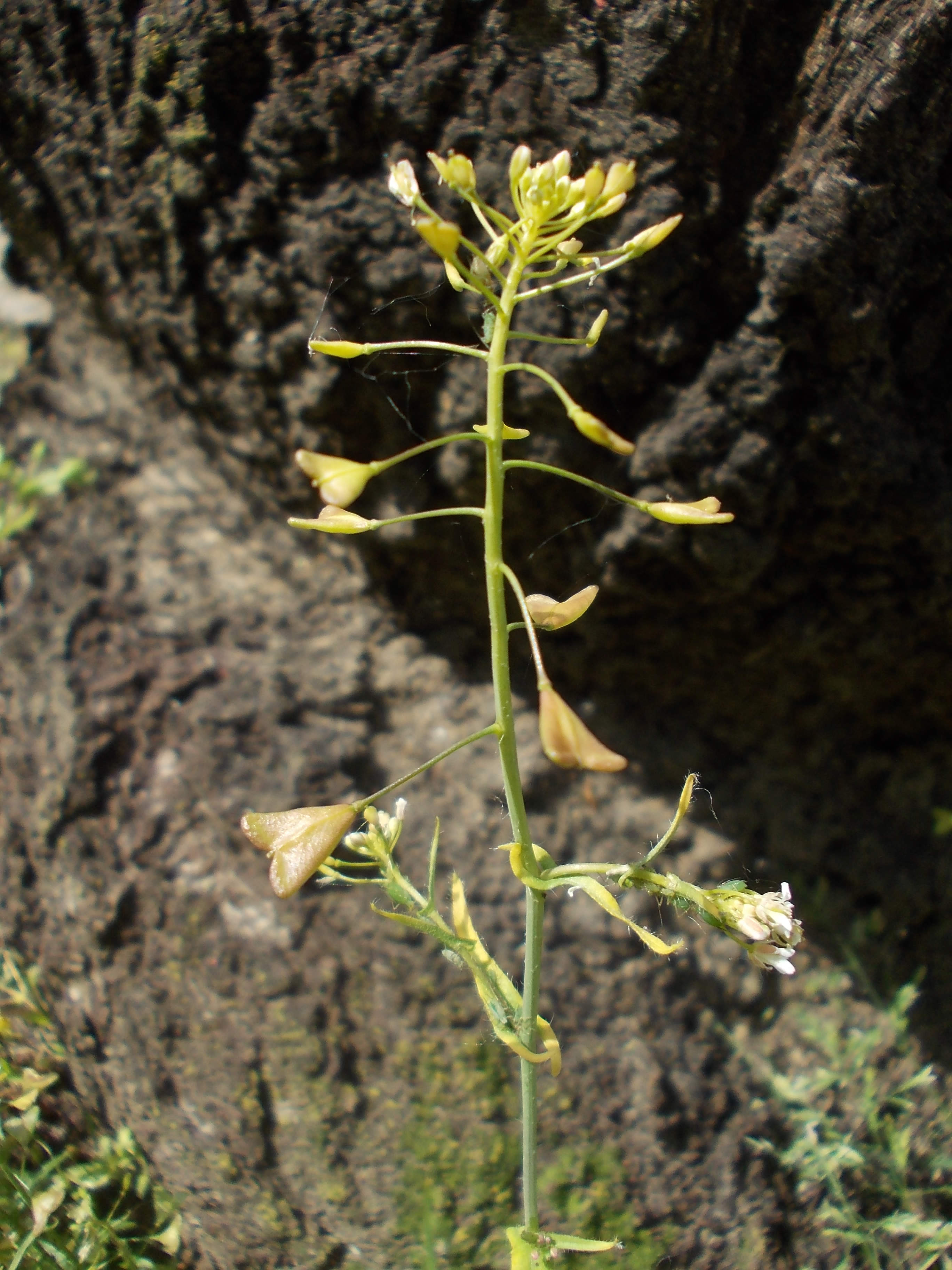
Shepherd's Purse in my street ... almost finished reproducing for the year
Shepherd’s Purse in my street … almost finished reproducing for the year

If we are going to be less species-ist than Haldane’s Coleopteran Creator, we need to cast our net wider than Aves, Odonata and Lepidoptera. The streets round here are planted with cherries, mainly; there are a few whitebeams, a rowan or two, a line of ash trees, and a few foreign hazels, they could be the American hazel, must check when they fruit.  Under the cherries, the observant naturalist can note that Shepherd’s purse, the delightfully named Capsella bursa-pastoris (guess the poor man had so little money, it could fit in those tiny capsules) is already in fruit, soon to scatter its miniature seeds, and April isn’t even over: weeds have to be quick to survive on dry ground, perhaps. The ash trees support a lichen flora which is far more diverse than the basic Lecanora conizaeoides (low grey scaly lichen, no English name) that survived the pollution of the twentieth century; the trees have circles of Common Orange Lichen (Xanthoria parietina) and little patches of a grey leafy Parmelia lichen. And it doesn’t just consist of birds and other conspicuous day-flying objects, either. If that’s all we know to look at, we’re definitely amateur dilettante nature-lovers. Amateur is the French for lover, by the way, and dilettante is the Italian for someone that takes (idle) pleasure in something, the word is related to ‘delight’. Curious that both words should mean “ignorant dabbler” in English. But curiously appropriate, perhaps.

Seven Sea Swallows Don’t Make a Summer …

Down at Wraysbury, I wondered what I might see now the spring migration is well and truly under way. Last year there was a single Cuckoo, a rare treat. And perhaps there would be a good number of warblers already.

The winter ducks had all vanished from the lakes, all bar a pair of shy Gadwall right at the back. There were indeed quite a few warblers about – Chiffchaffs, Blackcaps, Cetti’s, Whitethroats, Garden Warblers and one or two Willow Warblers, all singing lustily. I listened out for a Sedge Warbler to make it Seven but couldn’t find one. Still, not bad going.

But over the lake there was a high call: Pik! Cheer! Cheeri-Cheeri-Cheeri-Cheer! A pair of Common Terns, the first of the year: graceful white ‘sea swallows’, marvellously buoyant in flight. But no – there were two pairs .. no, five birds … no, seven in all. They wheeled and shrieked high above, swooped and delicately took insects from the water surface. Comically, one or two of the Black-Headed Gulls tried to do the same: they looked like tubby Sunday footballers trying gamely to keep up with their mates, flapping heavily, looking rotund and clumsy – yet, these are the same birds that gracefully wheel about the tourists at the Round Pond in Kensington Gardens, skilfully catching pieces of bread tossed into the air at any speed, any angle, any distance. It’s just that the terns are seven times more agile. Their forked tails divide into streamers as long as the rest of the tail; their wings almost pure white below, smooth ash-grey above. Do they make a summer? Almost.

Also swooping over the water was one Swallow, the first of the year for me; and about eight House Martins were hunting above the treetops. Some Alder Flies flew past; perhaps they are emerging from the water, providing a feast for the terns.

One green female Banded Demoiselle perched on some nettles; she too is the first of her kind – indeed, the first dragonfly of any kind – for me this year. And a solitary Greylag goose stood in the shallows, an unusual sight here.

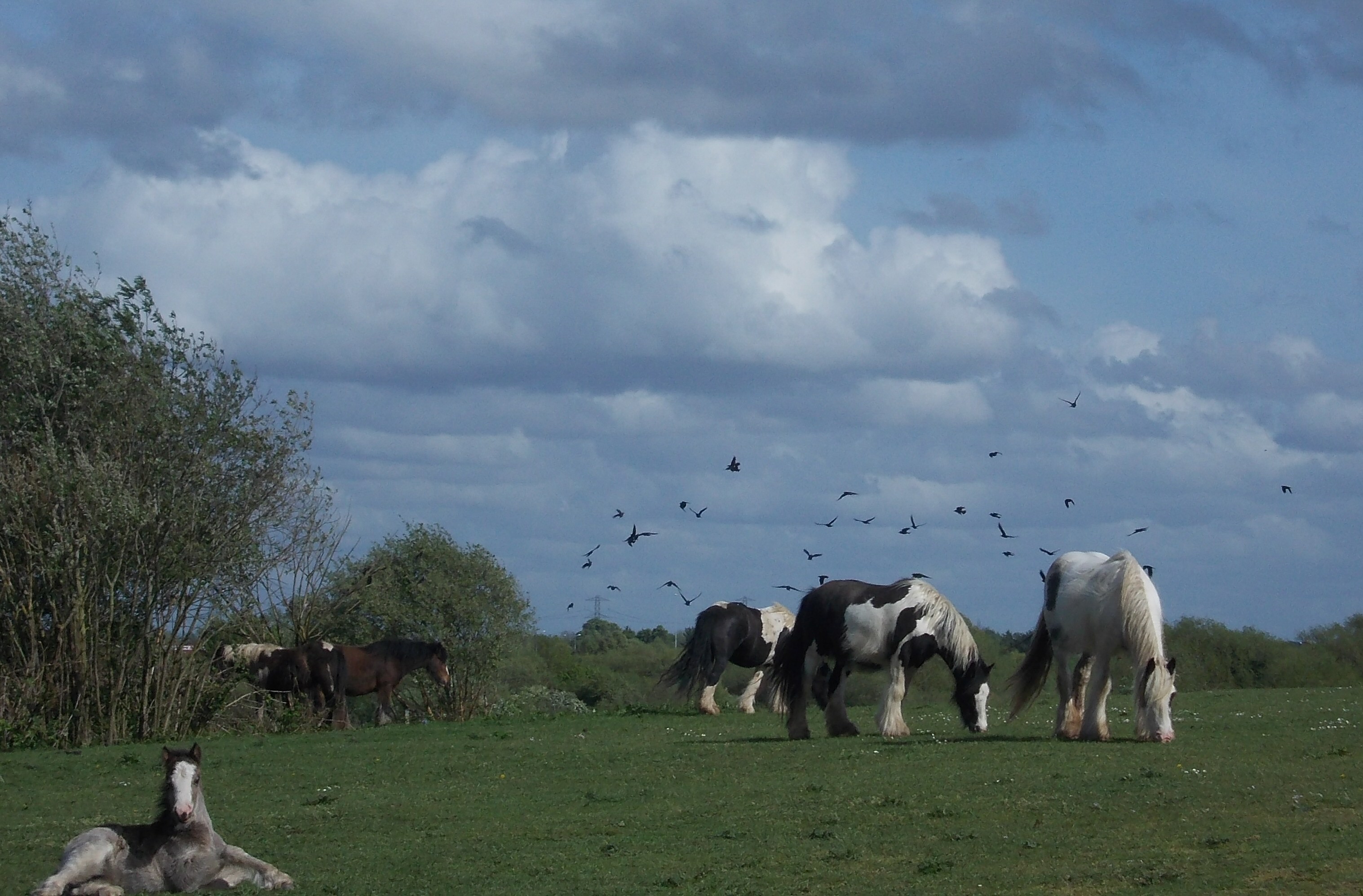
Horses and Jackdaws at Wraysbury

Around the horses on the green grassy hill that used to be the dump, a flock of Jackdaws with some Carrion Crows, benefiting from the insects around the horses; and a second flock, more of a surprise, of Stock Doves. They are notoriously under-reported, people just assuming they are Feral Pigeons or Wood Pigeons without looking to check. They all had the same pattern, and none of them had white wing flashes.

Walking down to the road, the narrow path was carpeted with small teardrop-shaped white petals: Hawthorn flowers, May blossom.

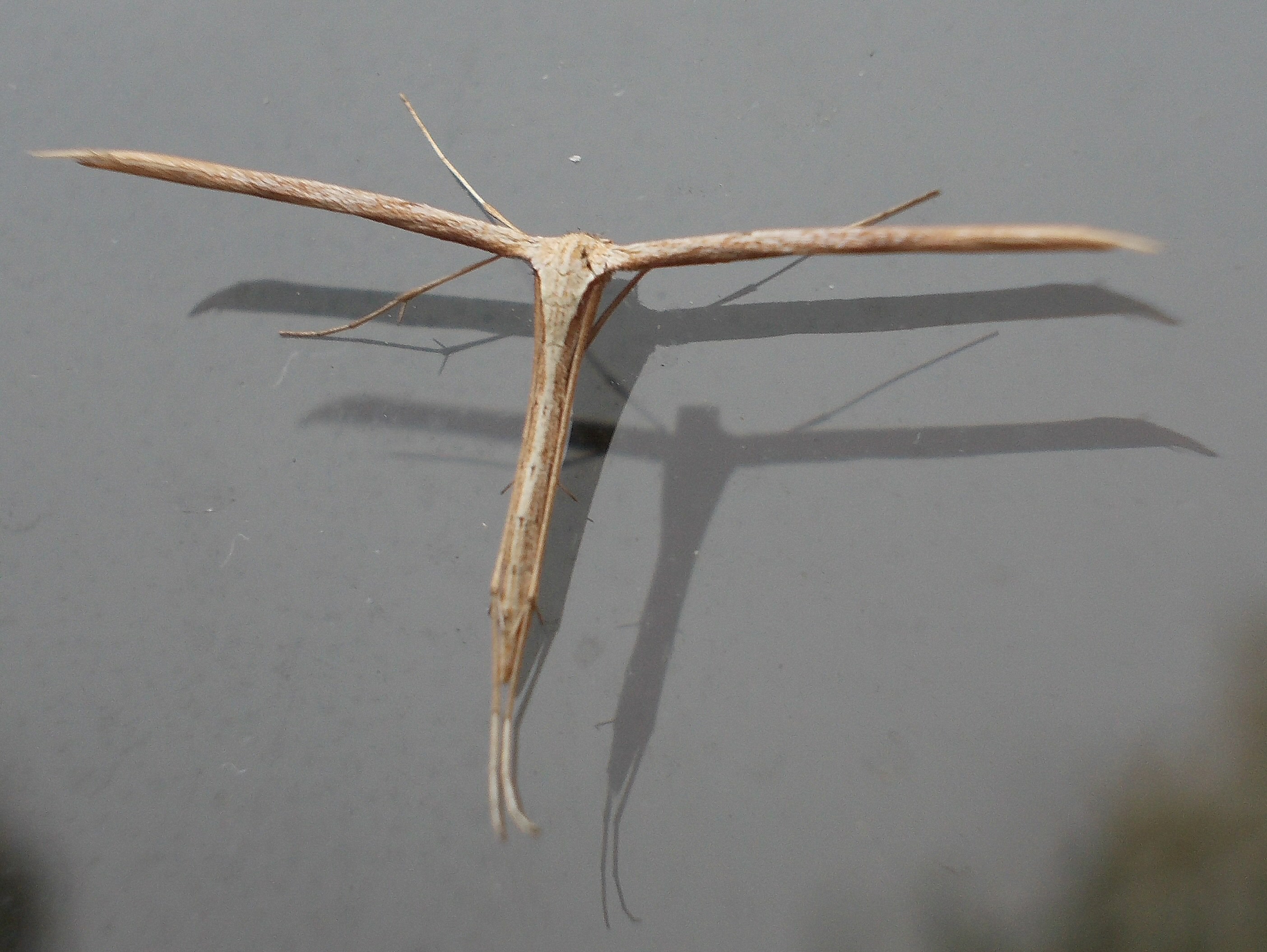
Plume Moth cf Stenoptilia bipunctidactyla

An extremely slim-winged Plume Moth landed on the kitchen window and has rested there for some hours, in broad daylight. I was familiar with the distinctive White Plume Moth, Pterophorus pentadactyla, a ghostly little moth with thin, branched, feathery wings – never understood the ‘penta-dactyla’, (‘five-fingered’) as I’d make it many, or perhaps two, but certainly the wings are oddly subdivided. This moth was obviously something in the same family (Pterophoridae) but another species, and given its brownish colour, it must be very inconspicuous among vegetation or on bark.

Plume Moth cf Stenoptilia bipunctidactyla

The excellent British Moths and Butterflies: A Photographic Guide by Chris Manley 2008, reprinted 2011 by Bloomsbury ( Amazon.com,  Amazon.co.uk), quickly pointed to a species of Stenoptilia: there are several similar and hard-to-tell species, so I wouldn’t presume to say which one it is, but it is most like Stenoptilia bipunctidactyla. The photo shows the family’s distinctive T-shape, and the long thin whitish legs with spines. The back is dotted, and the wingtips lack white, which is why I’m guessing it’s something like this species. It’s said to be common throughout Britain, eating Scabious.

Of Witch’s Brooms and Anthills

Down to Aston Rowant on a fine clear sunny day with a cold East wind that brought spring migrants like the Ring Ousel, a rare blackbird of mountain and moorland. I saw a probable one diving into a juniper bush; they like to stop off on the scarp of the Chiltern Hills as the next best thing to their favoured moors, before flying on to Wales or wherever.

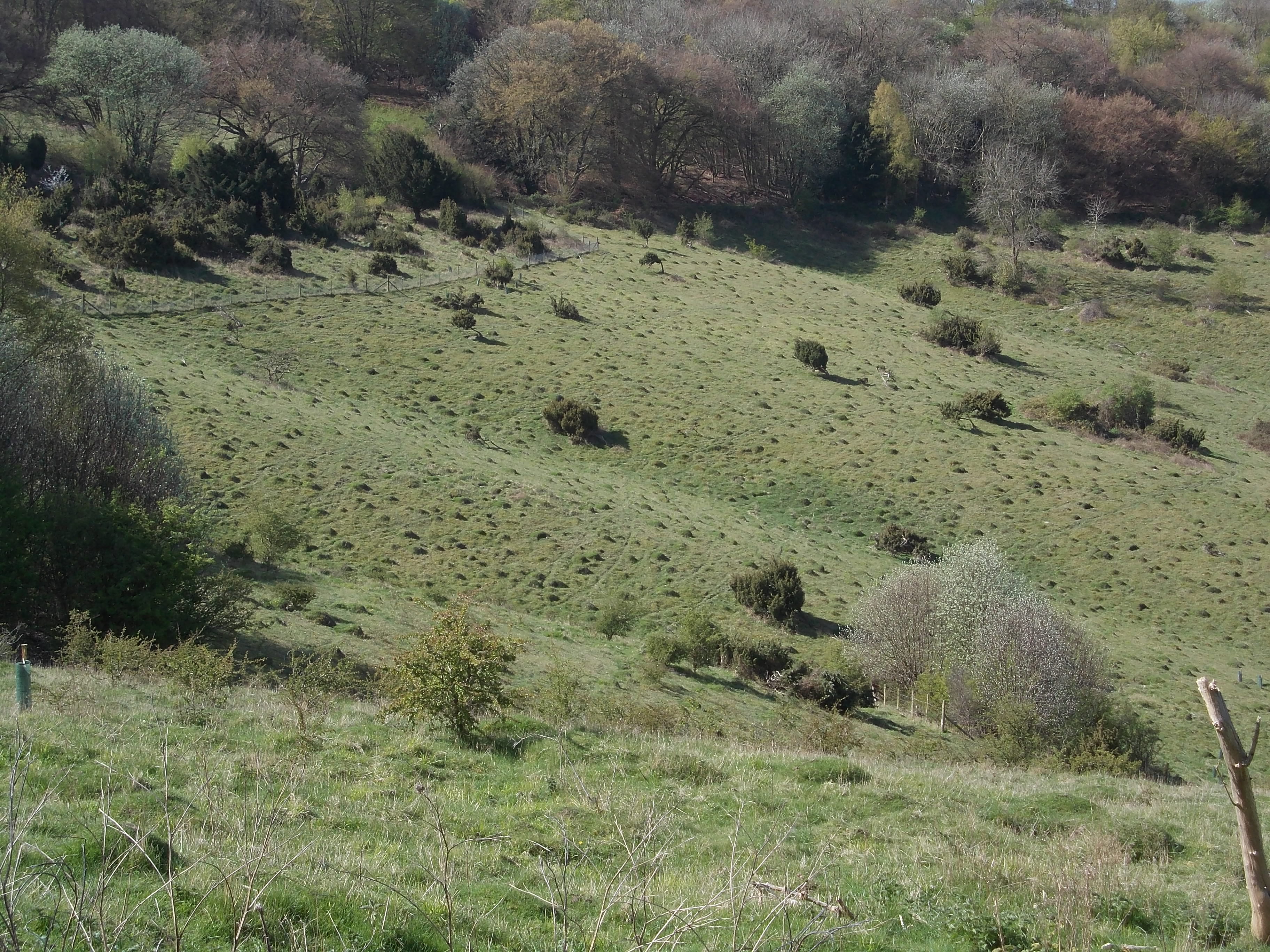
Anthills dotting Aston Rowant chalk grassland

The scarp slope of the relatively hard Chalk falls steeply to the broad plain of the soft Oxford Clay below, to the West. Much of the grassland has been destroyed for agriculture, either falling under the plough or simply being ‘improved’ as pasture with fertiliser, encouraging long grasses at the expense of the wealth of flowers that once covered the English countryside. Happily, here in the reserve and in quite a few places on the Chilterns, the steepness of the land has discouraged improvement. The chalk grassland is dotted with hundreds of anthills, the tiny yellow ants living all their lives below ground, tempting green woodpeckers to come out and hunt for them.

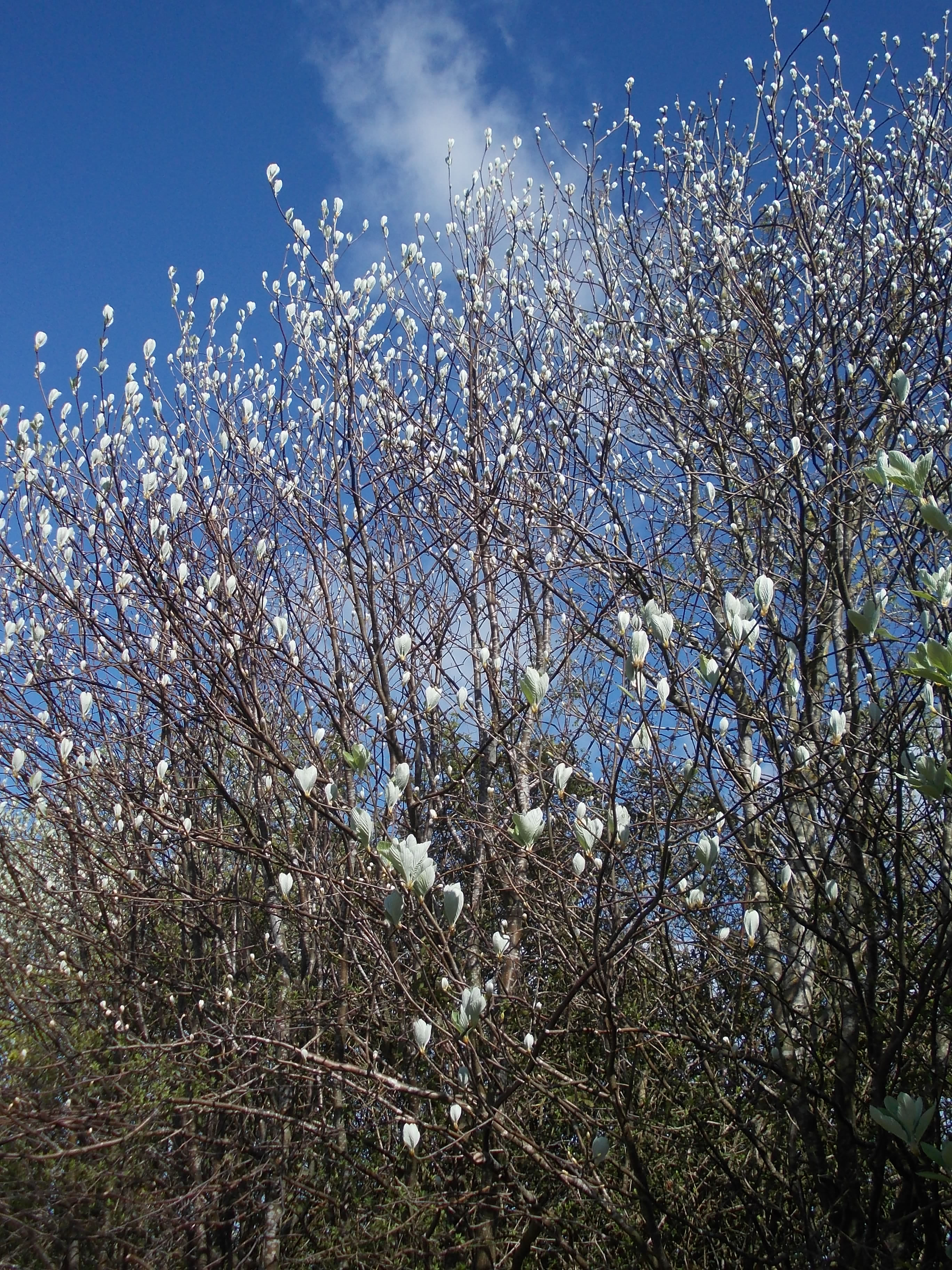
Whitebeam coming into leaf

The trees and flowers are visibly weeks behind those of London. The Whitebeam is just coming into its fair white leaves, which look almost like Magnolia flowers in their little clusters newly burst from the bud. But the tree’s name comes from its white wood, not its leaves.

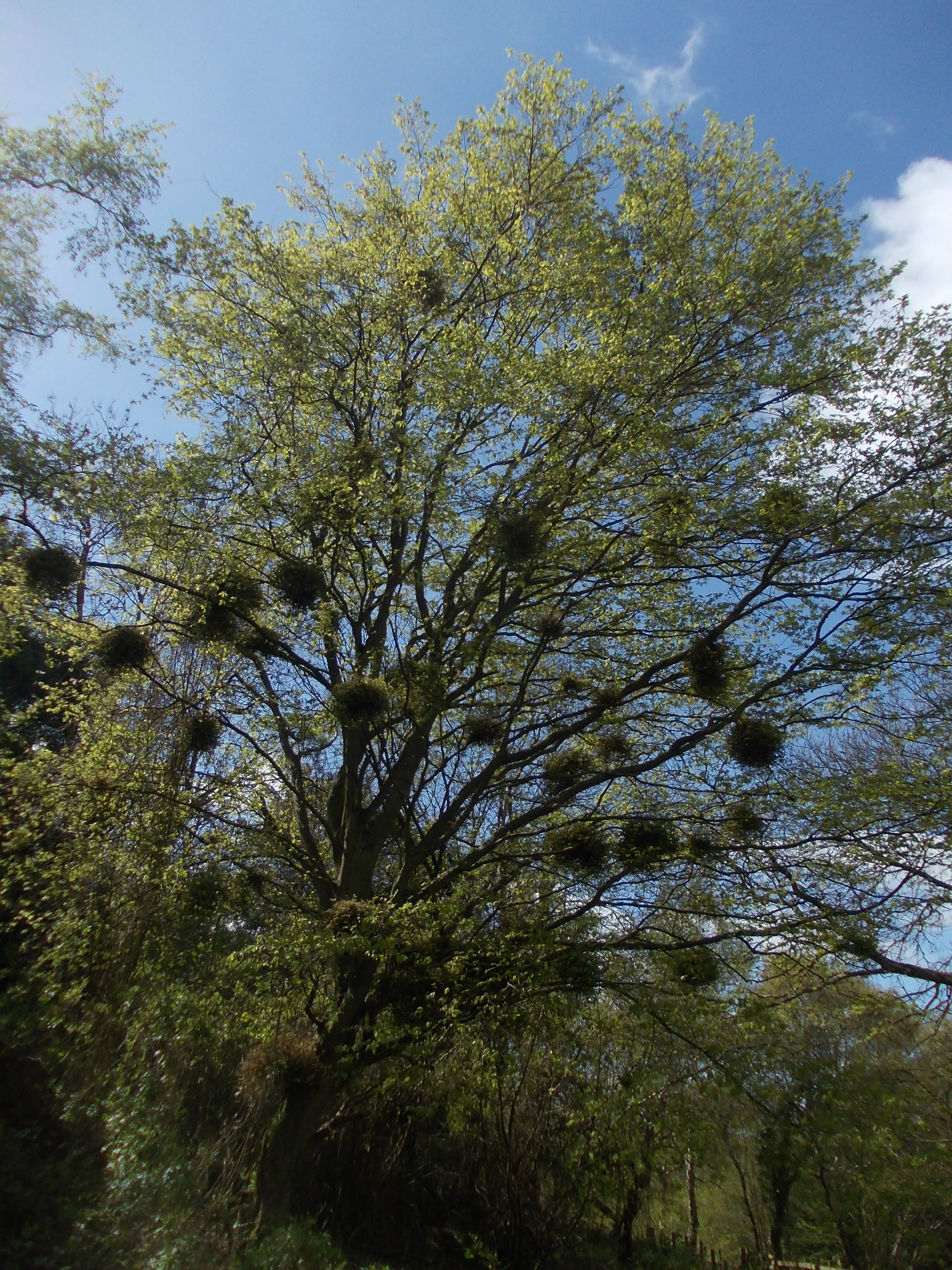
Witch's Brooms
Witch’s Brooms

At the bottom of the scarp, a field away from the Ridgeway which follows the line of hills for many miles, Hornbeams and Birches marked a change in the soil, which must be neutral or acid down here, compared to the strictly alkaline rendzinas and brown earths of the chalk. One of the Hornbeams looked as if it was oddly full of Mistletoe, but up close it proved to be a mass of Witch’s Brooms, growths of the tree itself caused by an infection.


Fashionable Urban Foxy Lady

At 3 am these last few nights, the streets round here have echoed to a series of brief, hoarse barks. You might think it some kind of dog, and you’d be right: it is a fox, or rather a vixen*, barking, either to advertise her presence to males, or it seems to hurry her cubs along.

What the urban foxes live on is easy enough to discover: anyone who incautiously leaves out a bin bag for collection overnight, finds it ripped to shreds in the morning, the inedible wrappers scattered about the street, any juicy bits of meaty leftovers or chicken carcases devoured.

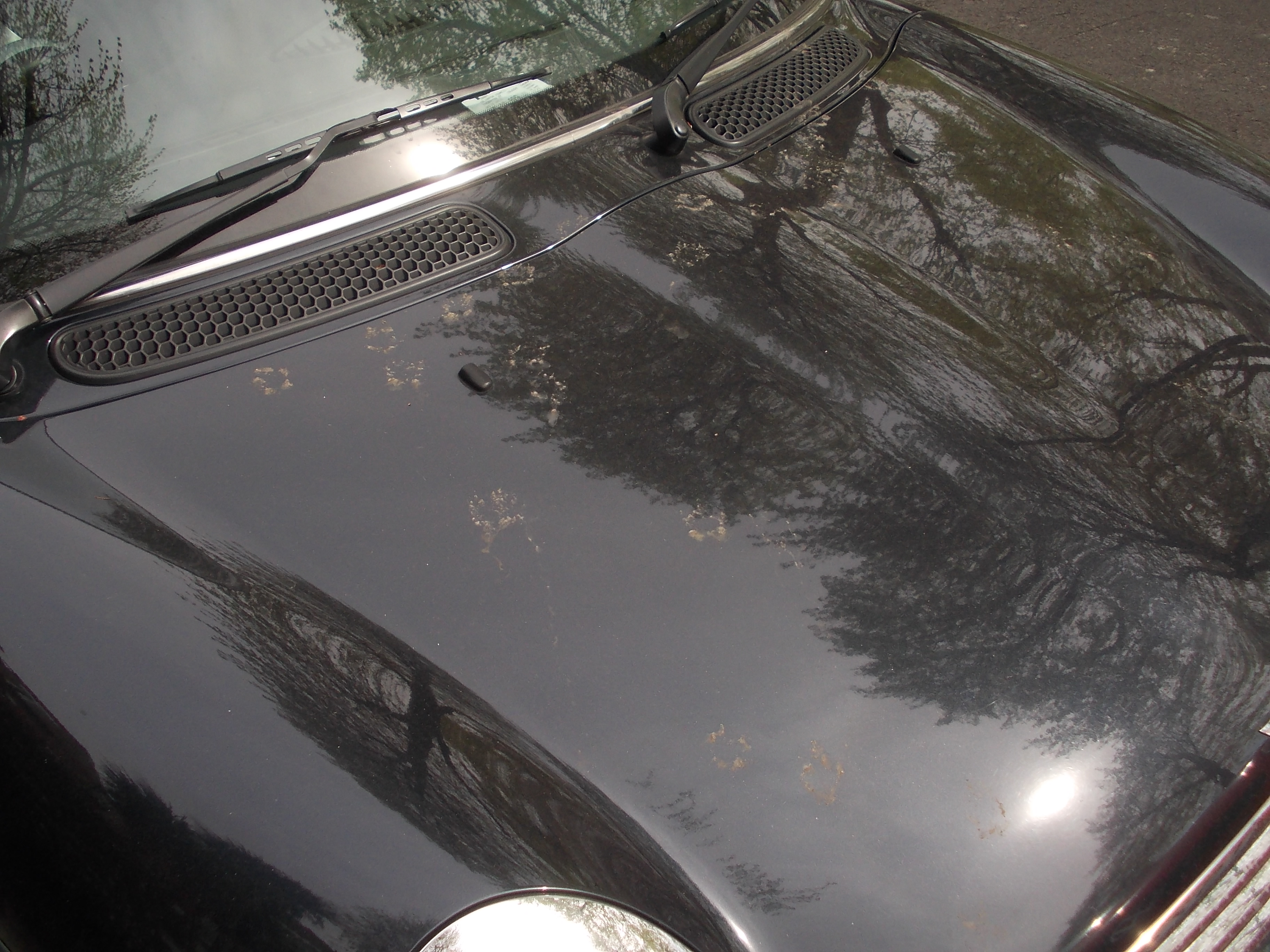
Fox footprints on a car bonnet

The foxy ladies aren’t averse to a bit of motoring, either, or at least to clambering all over cars to have a good look at something. As to whether the vixens are fashionable or chic, I’ll leave that to the dog foxes to decide.

* I suppose this odd-seeming word for a female fox has some connection to German Füchse(n), vixen, via Old English.

Spring has sprung

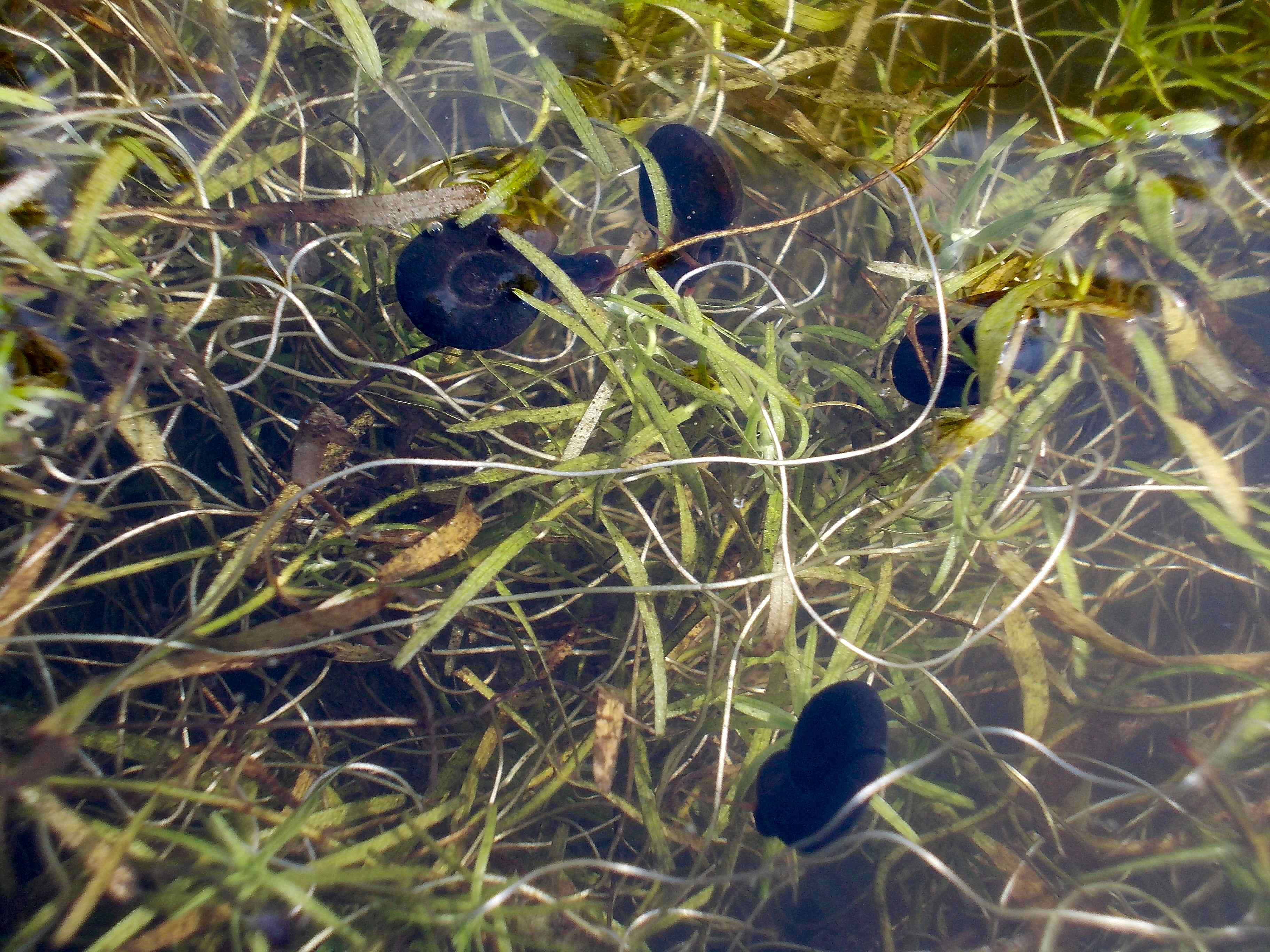
Ramshorn pond snails

Today dawned foggy and cool, but the sun soon burnt its way through and it became a hot spring day. I spent most of it reroofing the tool shed at the Gunnersbury Triangle nature reserve. It was in tatters after at least one hard winter, and it was an interesting exercise peeling off the layers hopefully tacked one on top of the leaky other. I then removed three full boards from the roof, complete with what I’m sure any mycologist would have found a fascinating colony of wet rot fungus, together with several wriggly centipedes and a lot of woodlice.

As it grew hotter on the roof, I was joined by at least two species of hoverfly, one large, dark, and almost unstriped. A brimstone butterfly chased around with a smaller white, perhaps a green-veined or an orange tip. A comma butterfly wandered about. Down below, the stinging nettles, hops, and garlic mustard (ideal for orange tips) are coming up nicely, but there’s too much cow parsley and some volunteers are pulling a lot of it out.

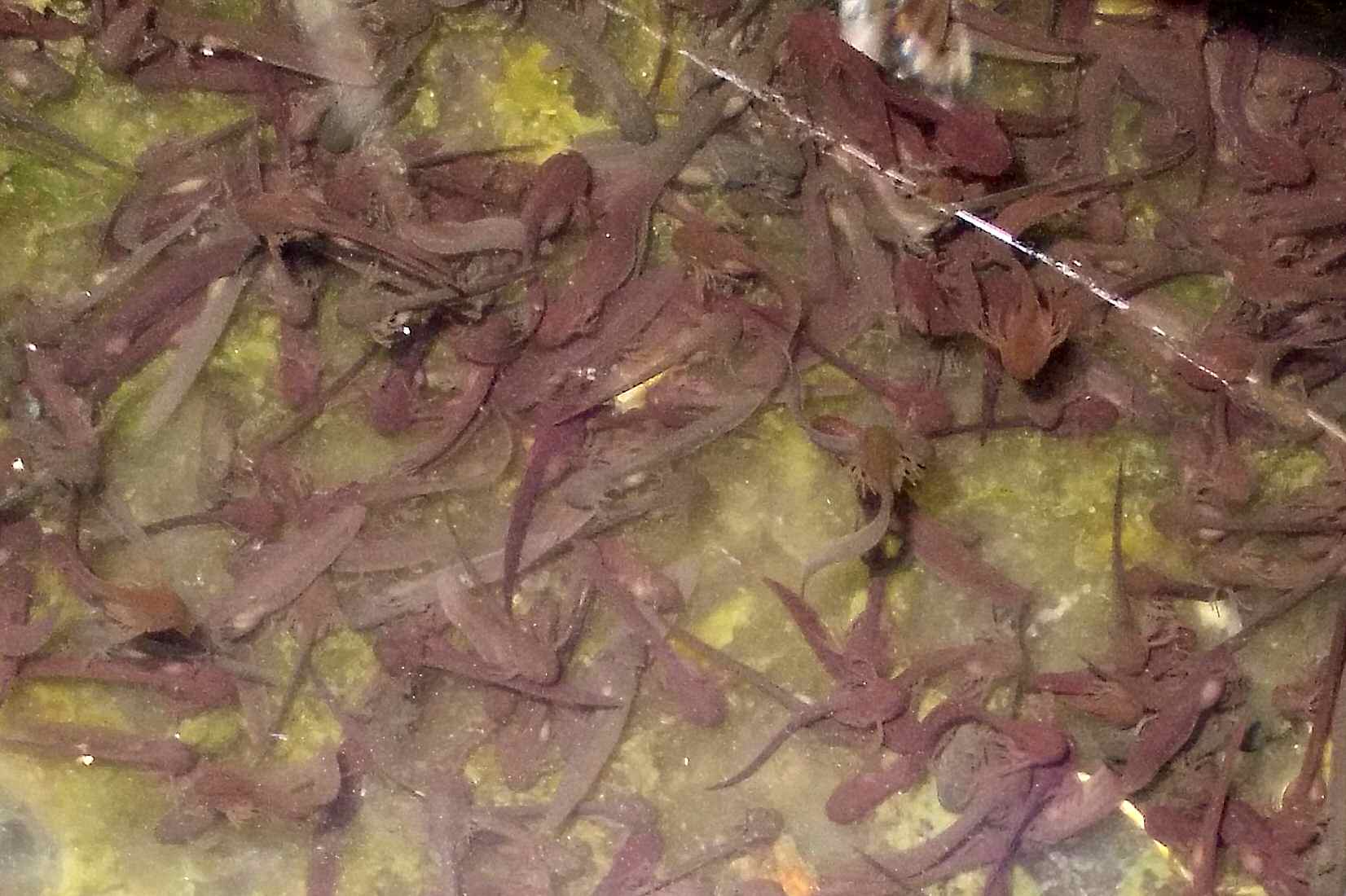
Newly-Hatched Tadpoles

At lunchtime I walked down to the pond. Chiffchaffs were singing all over; the pond was suddenly covered in pond skaters (Gerris) with one or two whirligig beetles. The tadpoles have hatched out into a wriggling mass.
Spring has sprung.

On the boardwalk, we’re havin’ some fun

Since rain was forecast, we drank up our morning tea quickly, took the tools we needed and wheeled our wheelbarrows off into the reserve. I was given the job of making the boardwalk over the pond safe. It looked all right, but quite a few boards were springy, one or two wobbled, and there were some alarmingly wide gaps where the boards fanned out to get around an angle, so they were tight one side, gappy the other.  A mallard duck and drake were snoozing on the other end of the boardwalk. She had laid an egg in the swamp, then moved it behind a tree, but didn’t seem to be sitting on it.

I’m not particularly keen on power tools, but the volunteer officer gave me some flattery about my always doing work aesthetically, so I took a look at the boards. Sure enough, at the angle the boards were all over the place, uneven, and fixed any which way. A chiffchaff sang its endless, two-note ditty: not all warblers have thrilling, nightingale-like songs.

I took the drill and set about pulling out the worst of the boards. Three screws came out; the fourth one was inaccessibly deep and the drill bit just rattled over it. I jemmied up the board, hammered out the offending screw from the back, and levered it off. This was not at all the quiet and restful day in nature I’d had in mind. I lined the board up where I felt it should have gone and screwed it down. The next gap was now wider than before, so it was the next board’s turn. You can guess where this was going. On the fourth board I pulled out six screws, but it still didn’t budge. Scraping around carefully, I spotted another screw, deeply buried in a dirty crevice. I cleaned it off as best I could and luckily it came out. The board was still remarkably solid at both ends: clearly there were still at least two screws holding it down. But where? I took a spare screw and scratched about suspiciously: sure enough, there were two more subtly buried heads. I picked the mud out of the heads, and remarkably they both came up with the drill. Nine screws where three or so should have sufficed, on a misplaced, unchecked board.
Just as I was fixing it down with these dark thoughts, a blackcap burst into song: the first of the year for me.

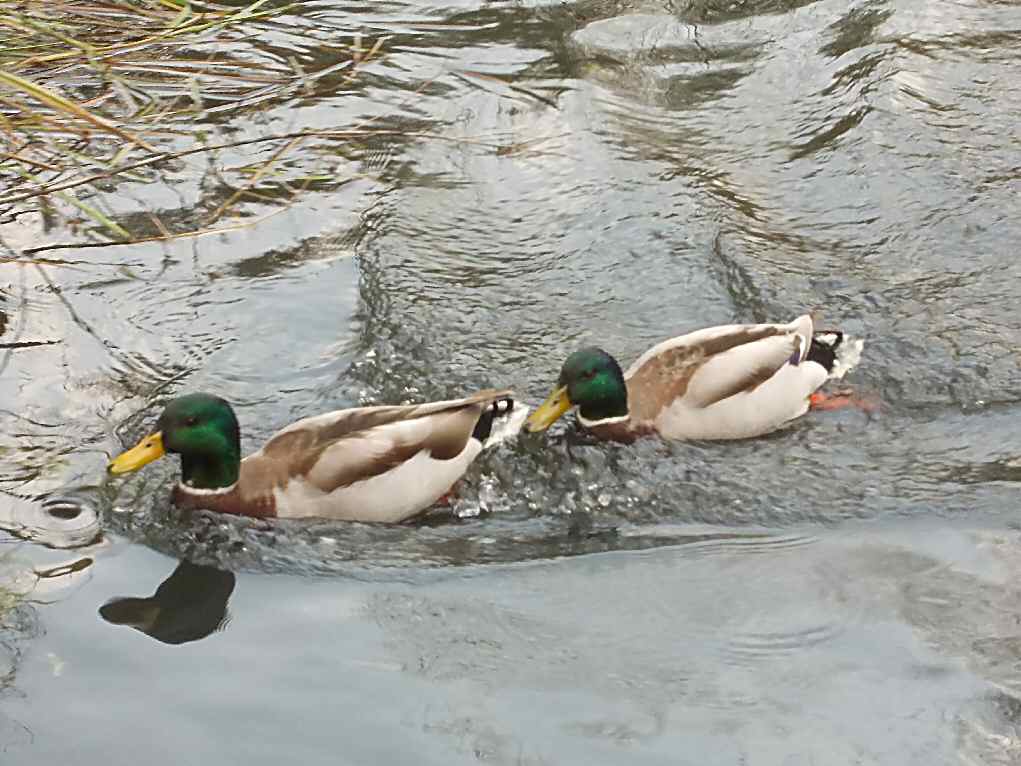
Mallard dispute
Mallard dispute

The remaining planks were not too gappy, but were a bit higgledy-piggledy at either end. I pulled up a few more and lined them up to step round the angle as evenly as possible. Then I walked about and put in a line of screws where the boards were springing up and hadn’t been fixed down to the stringer below.  The sun was shining and it was really quite warm on the boards. Suddenly there was a splash, and a lot of quacking. A rival drake had landed on the pond! The sleeping pair stood up and quacked for all they were worth. In a moment he had come over, and the pair jumped into the pond. He gave chase. Round and round they went, taking shelter under my feet, their position given away by a steady line of ripples. Then out they burst, flying, splashing down, sometimes with both males grabbing the female. They all flew off, but came back to fight some more a few minutes later.  Being a drake in the breeding season is clearly hard work, even when you’re the only resident on a pond.